
Virtual Notary UK: Legal Requirements for London Clients
- PPC Guyz Google & Semrush Certified
- Aug 12
- 12 min read

A digital signature is no longer a mere convenience; it is a sophisticated legal instrument that, when executed under the correct regulatory framework, carries the full weight of a traditional wet-ink seal. For London professionals managing international property deals or complex corporate restructures, the shift toward a Virtual Notary UK offers a vital solution to the constraints of physical presence and pressing deadlines. You likely recognise the frustration of navigating intricate cross-border requirements whilst fearing that a minor technical oversight might lead to document rejection by a foreign consulate or government body.
We understand that the transition from physical to digital certification requires absolute precision to maintain international validity. This expert guide provides the clarity you need to master the complexities of remote legal services, specifically addressing the critical distinctions between Qualified Electronic Signatures and simpler digital variants. By following our structured approach, you will secure a legally valid, notarised document delivered digitally, effectively removing the need for a trip to Central London. We will detail the current FCDO stance on e-Apostilles and the specific procedural steps necessary to ensure your documents remain compliant across various global jurisdictions.
Table of Contents
Understanding Virtual Notary Services in the UK
Remote online notarisation, frequently referred to as RON, represents a significant departure from the centuries-old tradition of physical "wet-ink" signatures. While traditional notarisation requires the physical presence of the signatory before a Notary Public, a Virtual Notary UK session enables this interaction to occur via encrypted video link. This evolution is underpinned by UK electronic signature laws, which provide the statutory basis for digital authentication and ensure that electronically signed documents carry the same legal weight as their physical counterparts. As an officer of the law, the Notary Public remains the primary gatekeeper of document integrity, ensuring that the transition from paper to pixel does not compromise the validity of the certification or the security of the transaction.
The primary drivers for this shift are global mobility and corporate efficiency. Modern business demands rapid execution, and the ability to certify documents remotely allows international property deals and high-stakes corporate restructures to proceed without the logistical delays inherent in physical document courier services. Our role is to act as the "Expert Fixer" for these complex cases, providing a technical bridge between London and the global market.
The Evolution of Remote Certification
The 2020s acted as a catalyst for the legal sector, accelerating the shift from physical to video-based presence. Whilst the core duties of the Notary Public, such as verifying identity and ensuring capacity, remain unchanged, the medium of delivery has adapted to meet the demands of a digital economy. A virtual notary is a legally authorised remote certification process using secure video and digital signatures. This transition ensures that cross-border transactions proceed without the delays inherent in traditional mail or physical travel. It's a modern solution that respects the gravity of legal certification whilst embracing the speed of contemporary commerce.
Key Benefits for Corporate and Private Clients
For busy executives and private individuals alike, the advantages of virtual services are immediate and measurable. We focus on delivering a seamless experience that prioritises both speed and security. Consider the following benefits:
Eliminating Travel: Avoid the time-consuming trip to Central London by completing your notarisation from your home or office.
Rapid Turnaround: Meet urgent international deadlines for property transactions or business deals through immediate digital delivery.
Enhanced Security: Digital audit trails and robust identity verification (IDV) standards provide a higher level of fraud prevention than traditional methods.
Regulatory Compliance: Every session is conducted in strict accordance with the Faculty Office regulations to ensure international validity.
Act now to secure your remote appointment. Our team is ready to facilitate your urgent legal requirements with precision and speed.
The Legal Framework: Digital Signatures and Video Witnessing
The legal validity of remote notarisation rests on a rigorous technical framework that ensures digital authenticity is beyond reproach. The Law Commission report on electronic signatures confirmed that digital signatures are legally equivalent to their physical counterparts, provided there's a clear intention to authenticate the document. For a Virtual Notary UK service to be compliant, the Notary must strictly adhere to the Practice Rules set by the Faculty Office of the Archbishop of Canterbury. These regulations ensure that the core principles of notarisation, specifically the certainty of identity and clarity of intent, are maintained in a digital environment. We act as the "Expert Fixer" in this space, navigating these technical requirements to ensure your documents are prepared for international use without the risk of rejection.
Qualified Electronic Signatures (QES) Explained
Not all digital signatures are created equal. Whilst Simple Electronic Signatures (SES) or Advanced Electronic Signatures (AES) might suffice for internal company memos, they frequently fall short of the standards required for international legalisation. A Qualified Electronic Signature (QES) is the gold standard for cross-border transactions. It requires the signer's identity to be verified by a Trust Service Provider (TSP) and utilises a digital certificate uniquely linked to the signatory. Unlike traditional embossed seals, a digital seal is cryptographically bound to the document. This ensures that any subsequent alteration is immediately detectable. If you require immediate assistance with high-stakes documentation, our notary London services provide the necessary technical expertise to ensure your digital certification is beyond reproach.
Regulatory Compliance and Data Security
Compliance extends beyond the signature itself. The Notary must remain physically located in England or Wales during the video session to satisfy jurisdictional requirements. The entire session is recorded and stored in accordance with GDPR and the UK Data Protection Act 2018. These video recordings and digital audit logs provide superior evidence of "due execution" compared to traditional methods. They capture the precise moment of signing and the interaction between the parties. Robust Identity Verification (IDV) standards are mandatory before any session begins. These include:
Biometric Scanning: High-resolution scanning of passports or national ID cards to verify security features.
Liveness Checks: Real-time video verification to ensure the signatory is physically present and not a static image or deepfake.
Credential Analysis: Automated checks against global databases to confirm the validity of the identification documents provided.
This meticulous approach to data security and regulatory adherence is what distinguishes a professional virtual service from a mere video call. It provides the legal certainty required for international property transactions and corporate resolutions.
Global Acceptability: Will Your Document Be Valid Abroad?
The most pressing concern for any client considering a Virtual Notary UK service is whether the destination country will recognise the digital seal. Unlike oversimplified claims of universal acceptance, the reality of international law is nuanced and requires a strategic approach. Acceptance is not a binary state; it is contingent upon the domestic laws of the receiving jurisdiction and their specific interpretation of digital evidence. We operate as your "Expert Fixer" in this regard, assessing the likelihood of successful legalisation before the process begins to prevent costly delays or rejection at the consulate level.
Jurisdictional Nuances: Who Accepts Virtual Notarisation?
Global receptivity to remote certification generally follows the divide between Common Law and Civil Law systems. Countries like the USA, Australia, and Canada have long-established frameworks for remote online notarisation, making them highly compatible with British digital certifications. Similarly, many EU member states recognise digital signatures under the eIDAS Regulation, though local land registries may still insist on traditional formalities for property deeds. Conversely, jurisdictions in the Middle East and parts of Asia frequently maintain a strict "wet-ink" requirement. These regions often necessitate a physical presence because their local legalisation chain involves manual embassy stamps that are not yet digitised. The Hague Apostille Convention facilitates a smoother digital document flow amongst member states, but the final recipient's internal policies always take precedence.
Mitigating the Risk of Rejection
Securing "pre-approval" from the foreign lawyer, bank, or government body receiving the document is a critical, non-negotiable step. We advise all clients to present a draft of the proposed digital certificate to their overseas counsel before the formal session occurs. This proactive measure ensures that the specific digital format, such as a Qualified Electronic Signature, meets their local evidentiary standards. The Virtual Notary UK process is governed by the official guidance on remote notarisation, which provides the framework for ensuring these documents meet the highest technical standards. To further bridge the gap, we often include a specific Notarial Certificate that explains the remote process, citing the relevant UK statutes that grant the document its legal authority. If a jurisdiction is known to be resistant to digital-only files, we can provide a hybrid solution. This involves witnessing the signature via video link and subsequently applying a physical seal to the hard-copy document, ensuring you satisfy both modern efficiency and traditional requirements.
Don't leave your international transactions to chance. Confirm the requirements of your receiving authority today to ensure a seamless certification process.
The Step-by-Step Process for Remote Notarisation
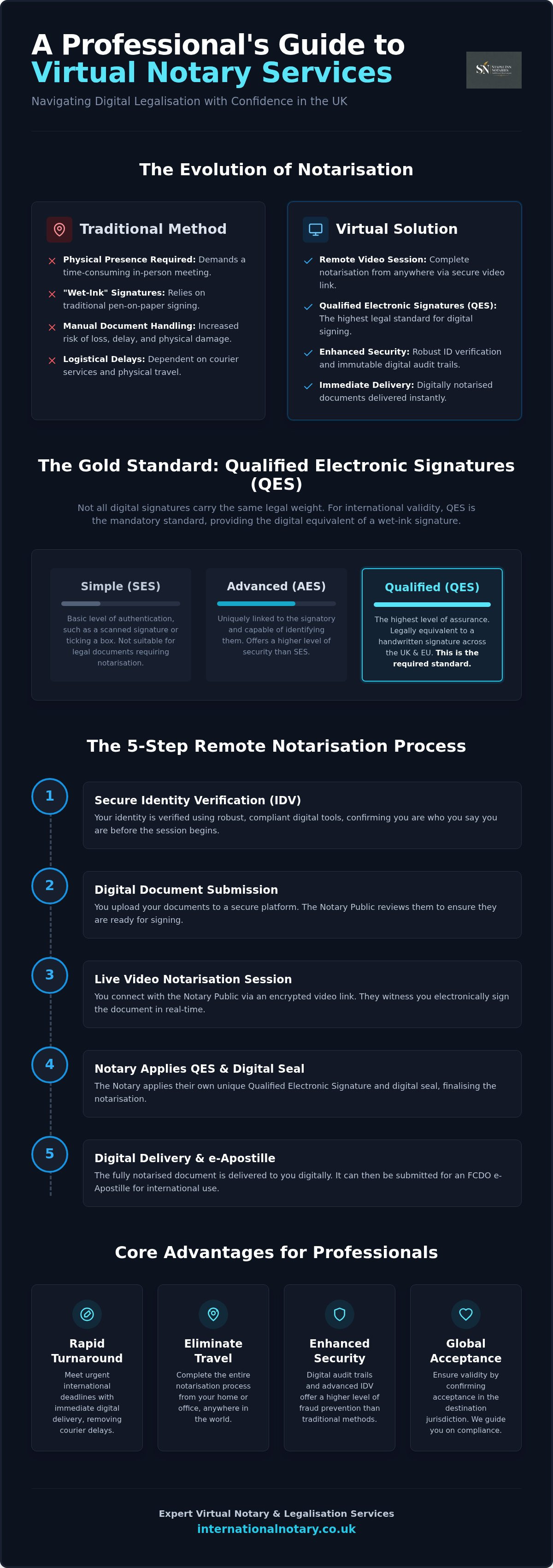
Executing a document through a Virtual Notary UK service involves a methodical sequence designed to satisfy both English law and the technical requirements of the receiving jurisdiction. This is not merely a video call; it is a structured legal procedure where the Notary Public remains responsible for ensuring the document's integrity. The process begins with an initial consultation to assess the document type and confirm whether the destination country accepts digital certification. Once confirmed, you will proceed through a secure digital onboarding phase where documents are uploaded and your identity is verified using biometric standards. This rigorous preparation ensures that the live session is efficient and the resulting certification is legally robust.
The workflow follows a logical progression to ensure no procedural step is overlooked:
Initial Assessment: We review the specific requirements of your transaction and the receiving authority.
Secure Upload: Documents are submitted via an encrypted platform to maintain data confidentiality.
Identity Verification: You will complete a biometric ID check using a smartphone or webcam before the appointment.
The Live Session: A recorded video appointment where the signing is witnessed in real-time.
Final Certification: The Notary applies a Qualified Electronic Signature and delivers the digitally sealed file.
Preparing Your Documents for Video Notarisation
Technical readiness is the foundation of a successful remote session. You must ensure all documents are in a high-resolution, compatible PDF format to facilitate the application of digital signatures. Physical originals of your identification, such as a valid passport or driving licence, must be available for visual inspection during the camera session. For corporate clients, organising the necessary supporting evidence is vital. This typically includes Board Minutes or Company Resolutions that confirm your authority to sign on behalf of the entity. Having these elements prepared in advance prevents delays and ensures the "Expert Fixer" can move your transaction forward without friction.
What to Expect During the Video Session
The session itself is a formal legal interaction. You will be asked to make a verbal declaration, confirming your identity and your understanding of the document you are signing. Whilst on screen, you will apply your digital signature through the secure platform, allowing the Notary to witness the act of execution directly. Most sessions are completed within 15 to 30 minutes, reflecting our commitment to professional efficiency. Once the session concludes, the Notary applies the digital seal and the completed document is delivered to you electronically. If you have an urgent deadline for an international deal, contact our notary public London team immediately to begin the onboarding process.
Integrating Virtual Notarisation with Apostille Services
The final stage of ensuring your document is fit for purpose abroad involves the legalisation process, usually through the issuance of an Apostille. Whilst the Virtual Notary UK session confirms the identity and intent of the signatory, the Apostille provides the necessary government-level verification of the Notary’s standing. The Foreign, Commonwealth & Development Office (FCDO) has modernised this requirement through the e-Apostille service, allowing for a fully digital chain of authority. This end-to-end electronic flow is the most efficient method for London clients to secure international recognition for their documents without the delays associated with physical post.
A critical distinction must be made for jurisdictions that haven't yet fully digitised their legalisation intake. In these instances, a "hybrid" model is required. You may sign your document via a remote video session, but the resulting digital file must then be converted into a physical format for a traditional paper Apostille. This requires a specific notarial certificate that bridges the gap between the digital act of witnessing and the physical requirement of the receiving state. We act as the authoritative gatekeeper in this complex flow, ensuring that the transition from digital to paper doesn't invalidate the certification or lead to rejection by foreign authorities.
The Rise of the e-Apostille in 2026
As of 2026, the FCDO’s digital portal has become the primary conduit for certifying electronic documents. This system processes Qualified Electronic Signatures with remarkable speed, often reducing legalisation timeframes from several business days to just a few hours. It's essential to verify if your destination country is registered to accept e-Apostilles, as some Hague Convention members still strictly require the physical embossed sticker. We provide the technical oversight to confirm these requirements before you commit to a digital-only path, ensuring your documents meet the specific criteria of the receiving consulate or bank.
Why Choose Staple Inn for Your Virtual Requirements?
Our "Expert Fixer" approach is specifically designed for high-stakes corporate power of attorney notarisation London. We understand that business requirements can shift rapidly, which is why we offer a seamless transition between virtual and Mobile Notary London services. If your document requires a physical presence due to specific jurisdictional constraints, we adapt our service to meet that need immediately. Our firm remains deeply rooted in tradition whilst operating with a modern, fast-paced mindset. Contact Staple Inn Notaries to organise your remote appointment today and ensure your documentation is handled with the highest level of professional authority and procedural compliance.
Securing Your International Documentation with Precision
The evolution of remote certification has fundamentally changed how London clients manage international legal requirements. By utilising a Virtual Notary UK service, you gain the advantage of rapid execution without sacrificing the procedural rigour required for global validity. Success in this digital space depends entirely on technical compliance, specifically the use of Qualified Electronic Signatures and robust identity verification. Whilst acceptance varies between jurisdictions, our specialised expertise ensures that your documents meet the exacting standards of foreign consulates and banks.
Staple Inn Notaries remains your authoritative partner in this transition. Regulated by the Faculty Office, we specialise in complex corporate certifications and high-stakes international transactions. We provide the technical bridge between Central London and the global market, managing the full end-to-end legalisation flow including e-Apostilles. Don't let logistical barriers delay your business objectives. We are ready to facilitate your requirements with the speed and precision your professional schedule demands.
Book your expert virtual notary appointment with Staple Inn today to ensure your documents are certified with absolute precision. We look forward to facilitating your next international transaction with calm competence.
Frequently Asked Questions
Can I use a virtual notary for a UK property sale?
You can use virtual services for certain property documents, but you must confirm acceptance with HM Land Registry and your mortgage lender first. Whilst digital signatures are legally valid, specific conveyancing protocols often require a witnessed electronic signature where the witness is physically present. We advise checking the specific requirements of your transaction to ensure the digital certification meets the necessary evidentiary standards.
Is a remote notarisation valid for use in the United Arab Emirates?
Remote notarisation is typically not accepted in the UAE because their legalisation process requires physical embassy stamps and manual verification. The UAE is not currently a participant in the Hague e-Apostille pilot, which means documents usually require a wet-ink signature and a physical seal. We recommend our mobile notary service for UAE-bound documents to ensure they satisfy these traditional requirements.
How much does a virtual notary service cost in the UK?
The cost of a Virtual Notary UK session depends on the complexity of the document and the number of signatories involved. Professional fees are structured to reflect the technical requirements of secure identity verification and the issuance of Qualified Electronic Signatures. We provide a tailored quote after reviewing your specific documentation and the requirements of the destination jurisdiction.
What technology do I need for a remote notary appointment?
You require a stable internet connection and a device equipped with a high-definition camera, such as a smartphone, tablet, or laptop. The platform used for the appointment is secure and encrypted to protect your data. You will also need your original identification documents ready for biometric scanning during the identity verification phase of the session.
Can I notarise a Lasting Power of Attorney (LPA) virtually?
You cannot notarise or witness a UK Lasting Power of Attorney virtually under current Office of the Public Guardian regulations. These documents require the physical presence of the donor and the certificate provider to ensure no undue influence is present. Whilst other types of powers of attorney can be handled remotely, the LPA remains a strictly physical procedure to protect vulnerable individuals.
What happens if the foreign consulate rejects my digitally notarised document?
If a document is rejected, we act as the Expert Fixer to resolve the technical discrepancy with the receiving authority. Rejections usually occur because the destination country requires a physical Apostille rather than an electronic one. In such cases, we can quickly transition to a hybrid or physical service to ensure your transaction proceeds without significant delays.
Is the video call recorded for legal purposes?
Yes, the entire video session is recorded and securely stored as part of the notarial act's audit trail. This recording serves as definitive evidence of the signatory's identity, capacity, and willingness to sign the document. All data is handled in strict accordance with the UK Data Protection Act and GDPR requirements to ensure client confidentiality.
Can a virtual notary certify my passport copy?
A Virtual Notary UK can certify a copy of your passport by verifying the original document during the live video session. We use advanced identity verification tools to confirm the security features of the passport before issuing the digital certification. This process results in a legally valid, digitally sealed copy that is suitable for many international business and administrative applications.


Comments