
Apostille Services London: The Professional Guide to Document Legalisation in 2026

Updated: Sep 3
An apostille is not a mere administrative formality; it is the definitive gatekeeper that determines whether your high-stakes international transaction proceeds or collapses under the weight of procedural error. You likely understand the pressure of managing tight deadlines for overseas property acquisitions while facing the opaque requirements of the Foreign, Commonwealth & Development Office. It's common to feel concerned that a minor clerical oversight might lead to a document rejection by foreign registries or judicial bodies. This guide provides the technical clarity required to secure an apostille for power of attorney london on your first attempt, ensuring your documentation meets the rigorous standards of 2026. We will examine the essential role of professional notarisation as a foundation for validity, the current FCDO processing timelines for paper and electronic certificates, and the specific protocols for legalising corporate records. Secure your documents. Eliminate procedural delays. By following this expert framework, you can mitigate the risk of rejection and maintain the momentum of your international business interests.
Table of Contents
Understanding Apostille Services in London: A Comprehensive Overview
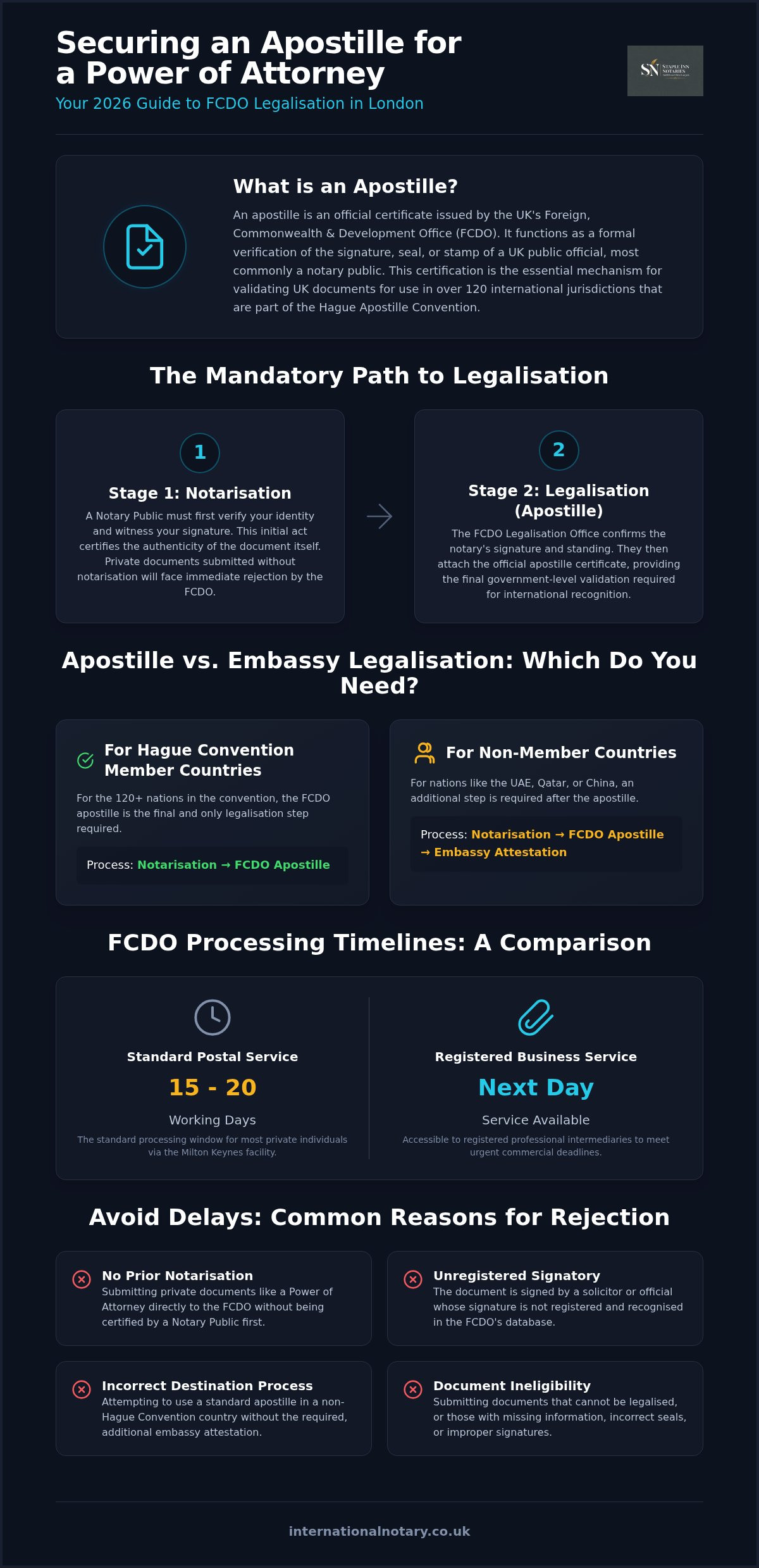
An apostille is an official certificate issued by the Foreign, Commonwealth & Development Office (FCDO). It functions as a formal verification of the signature, seal, or stamp of a UK public official, most commonly a notary public. In 2026, this certification remains the essential mechanism for validating UK documents for use in international jurisdictions. London’s status as a global financial and legal hub is reinforced by the proximity of the FCDO Legalisation Office and over 160 foreign embassies. This concentration of authority makes the city the primary centre for rapid document legalisation. Whether you're executing a cross-border property sale or managing a multi-jurisdictional corporate restructuring, the apostille provides the necessary legal bridge to foreign recognition.
Distinguishing between notarisation and legalisation is critical for a successful application. Notarisation is the initial act of a notary public certifying the authenticity of a signature or document. Legalisation is the subsequent step where the government confirms the notary's own standing. Securing an apostille for power of attorney london requires this precise two-stage sequence. Private documents submitted directly to the FCDO without prior notarisation will face immediate rejection. Follow the correct order to ensure your documentation carries the weight of law abroad. Secure your documents. Avoid rejection.
The role of the Hague Apostille Convention
The Apostille Convention of 1961 serves as the foundational treaty for modern international document exchange. Before its implementation, legalising a document was an arduous process involving multiple layers of bureaucratic attestation. For the 120+ nations that are currently members, this treaty replaced the traditional "chain" of legalisation with a single, universally recognised certificate. This shift has significantly reduced the administrative burden on international business. In 2026, the expanding list of member states continues to simplify global mobility and trade, allowing for the swift verification of public records across borders.
Apostille vs Embassy Legalisation: Which do you need?
The specific requirements of your destination country determine your legalisation path. If the recipient nation is a member of the Hague Convention, the FCDO apostille is the final requirement. In contrast, non-member states like the UAE, Qatar, or China require a more complex two-step attestation. You must first obtain the FCDO apostille before the document is presented to the relevant embassy or consulate for final approval. A specialist London notary acts as a vital intermediary in these cases, managing the nuances of embassy-specific protocols to prevent procedural delays. Verify your recipient's requirements early to avoid the risk of document rejection by foreign authorities. Use a professional to ensure your apostille for power of attorney london meets all international standards.
How to Obtain an Apostille: A Step-by-Step London Guide
Securing an apostille for power of attorney london requires a methodical approach to satisfy both domestic regulations and foreign requirements. In 2026, the London market offers two primary routes: the standard postal service and the expedited business-to-business channel. Most private individuals face a standard processing window of 15 to 20 working days via the Milton Keynes facility. Conversely, registered professional intermediaries can access next-day services to meet urgent commercial deadlines. You must confirm document eligibility before submission to prevent the loss of government fees and critical time. Expert review ensures that every seal and signature meets the exact specifications of the UK government's Legalisation Office.
Step 1: Document Verification and Notarisation
Private documents, including an apostille for power of attorney london and Passport and ID Certification, cannot be legalised without prior authentication. A notary public must first verify your identity and witness the signature to ensure the document is legally binding. The FCDO only recognises signatures from officials whose details are already stored in their database. If your chosen solicitor is not registered, the application will be summarily rejected. This initial verification is the most common point of failure for unassisted applications. Don't risk your timeline on unregistered signatures.
Step 2: Submission to the Legalisation Office
Once notarised, you must choose between a physical paper apostille and the e-Apostille service. While the e-Apostille offers a rapid turnaround of up to two working days, it's only viable if the receiving authority accepts digital certification. For physical documents, we recommend using secure, trackable couriers to transport originals to the Legalisation Office. Avoid standard post for sensitive instruments. If you're managing a time-sensitive property deal, engaging professional notary services to manage this logistics chain is the most efficient way to guarantee delivery.
Step 3: Embassy Attestation (If Required)
Countries outside the Hague Convention require an additional layer of verification. After the FCDO has issued the apostille, the document must be presented to the relevant embassy, often located in districts such as Kensington, Belgravia, or Marylebone. Each consulate maintains unique processing times and fee structures. Some require formal translations by certified linguists before they will provide their final seal. Managing these disparate requirements requires constant communication with consular staff to avoid unexpected delays. The process is demanding; precise execution is the only way to ensure international compliance.
Essential Documents Requiring Legalisation: From Power of Attorney to Corporate Records
The legalisation process in London encompasses a broad spectrum of instruments, each requiring specific modes of certification to satisfy the standards of the Hague Conference on Private International Law (HCCH). Original wet ink signatures remain the gold standard for high-value property deals and international litigation. While digital signatures are gaining traction, many foreign jurisdictions still demand physical seals to mitigate the risk of fraud. Identifying the correct classification of your document is the first step toward a successful apostille for power of attorney london. Failure to provide the correct format often leads to summary rejection by the FCDO. Precision is non-negotiable.
Corporate and Business Documentation
International expansion necessitates the legalisation of core business records. Opening an overseas branch requires apostilled Certificates of Incorporation and Articles of Association. Board Minutes and Company Resolutions must also be authenticated to satisfy international banking compliance and anti-money laundering protocols. For these complex instruments, corporate power of attorney notarisation London provides the necessary legal foundation. Companies House plays a pivotal role here; they provide the certified copies of business records that the FCDO requires for legalisation. A Certificate of Good Standing is frequently requested to prove a company's active status during 2026 transactions.
Private Client and Personal Records
Personal records require equal precision to ensure global validity. Residency applications and global mobility often hinge on the successful legalisation of birth, marriage, or death certificates. If you're managing overseas assets, an apostille for power of attorney london is indispensable for your international probate lawyer. This ensures your authority is recognised by foreign courts and financial institutions without delay. Educational diplomas and transcripts also fall under this category. Professional accreditation in 2026 demands that these academic records are certified by a notary public before the apostille is applied. Don't leave your personal status to chance. Secure your documentation through a verified professional channel.
Avoiding Delays: Common Reasons for Legalisation Rejection at the FCDO
Rejection by the Foreign, Commonwealth & Development Office (FCDO) is rarely the result of a single substantive error; it's usually the consequence of multiple technical oversights. In 2026, the primary cause of document return is the use of a signatory whose details aren't registered in the FCDO database. Every solicitor or notary must maintain an active registration with the Legalisation Office. If you submit an apostille for power of attorney london signed by an unregistered official, the process stops immediately. This causes catastrophic delays for time-sensitive international deals that rely on precise execution.
Beyond registration, "stale dates" present a significant hurdle for London businesses. While a UK document may remain valid domestically, foreign registries in regions like the Middle East often reject certificates issued more than 90 days prior. Digital submissions face their own challenges. Non-compliant digital signatures or low-resolution scans will trigger an automatic rejection in the e-Apostille system. Although the turnaround for an e-Apostille is up to two working days, your digital documentation must meet the rigorous technical standards defined by the FCDO to benefit from this speed. Don't risk your timeline on poor scan quality.
Improper Notarial Certification
A simple "witnessing" of a signature is insufficient for most international jurisdictions. A full notarial act is required. This involves specific certification wording that confirms the identity, capacity, and authority of the person signing the document. If this wording doesn't mirror the legal expectations of the recipient country, the apostille may be granted by the FCDO but ultimately rejected by the foreign authority. The physical notary seal must also be clear, identifiable, and positioned away from other text to ensure it remains legible for FCDO examiners.
Photocopies vs Original Documents
The FCDO maintains strict rules regarding the use of photocopies. While some corporate records can be legalised as certified copies, an apostille for power of attorney london almost always requires the original instrument with a wet-ink signature. Academic certificates require an even more rigorous path; they often need direct verification from the issuing university before the FCDO will accept them for legalisation. For precious, irreplaceable documents, the risk of loss in the standard post is too high. Secure your transaction. For professional oversight that eliminates the risk of rejection, engage Staple Inn Notaries for your urgent legalisation needs.
Streamlining Your Application with a Professional Central London Notary
Managing the legalisation lifecycle requires more than just submitting a form; it demands a project management approach that accounts for every potential point of failure. A specialist notary public acts as your authoritative guide through this complex landscape, ensuring that your documentation meets the exact specifications of foreign registries. When you require an apostille for power of attorney london for a time-sensitive transaction, professional intervention eliminates the guesswork that often leads to rejection. We leverage established relationships with the FCDO and various London consulates to navigate the bureaucracy on your behalf. This reduces the administrative burden on your internal teams, allowing you to focus on the commercial aspects of your deal whilst we secure the legal validity of your instruments.
For corporate entities operating at pace, on-site certification is often a necessity rather than a luxury. Our Mobile Notary London service provides immediate access to certification at your offices, which is particularly beneficial for high-stakes business deals in the City or Canary Wharf. This on-site presence allows for the immediate correction of any document discrepancies before they reach the FCDO, further safeguarding your timeline. Secure your transaction. Eliminate procedural delays.
The Value of a Regulated Notary Public
Trust is the currency of international law. As a firm regulated by the Faculty Office of the Archbishop of Canterbury, we provide a level of certification that is recognised and respected by judicial authorities worldwide. Our Expert Fixer methodology involves a rigorous pre-submission audit of every document. We don't just witness signatures; we verify the entire context of the transaction to anticipate and neutralise potential rejection points. By bundling notarisation, the apostille for power of attorney london, and professional translation into a single managed service, we provide a seamless solution for complex cross-border matters.
Urgent and Bespoke Legalisation Solutions
High-value transactions in 2026 often demand same-day or next-day turnarounds that standard postal routes can't accommodate. We provide bespoke legalisation strategies for high-net-worth individuals and family offices managing global estates, ensuring that UK-executed documents comply with the specific civil law requirements of foreign jurisdictions. This specialist knowledge closes the gap between domestic legal standards and international expectations, providing the certainty required for successful global mobility and asset management. Secure your interests. Ensure your documents are valid upon arrival.
Secure Your International Validity with Expert Legalisation
Navigating the procedural requirements of the Foreign, Commonwealth & Development Office in 2026 demands technical precision and a thorough understanding of evolving digital standards. Successful document acceptance hinges on the foundational step of professional notarisation, particularly when securing an apostille for power of attorney london for high-value property or corporate deals. By selecting the appropriate legalisation route and ensuring all signatories are registered with the Legalisation Office, you eliminate the risk of costly procedural delays. We act as your authoritative gatekeeper, managing the entire lifecycle from initial certification to final embassy attestation.
As specialists in Central London corporate and private client law, regulated by the Faculty Office of the Archbishop of Canterbury, we provide the expertise required to navigate international bureaucracy. Whether you require mobile notary services for an urgent boardroom resolution or bespoke legalisation for a global estate, our team ensures your documents carry the necessary weight abroad. Contact Staple Inn Notaries for Expert Apostille Services in London to secure your transaction today. Your international objectives are within reach when supported by professional certification.
Frequently Asked Questions
How long does it take to get an apostille in London in 2026?
Standard postal applications via the FCDO typically require 15 to 20 working days in 2026. Electronic e-Apostilles offer a significantly faster turnaround of up to two working days. For urgent commercial deadlines, registered professional intermediaries can access a next-day service that isn't available to the general public. These timelines exclude delivery durations. We recommend selecting a service level that aligns with your specific international transaction deadlines to avoid procedural failure.
Can I get an apostille for a document issued outside the UK?
No, the UK Foreign, Commonwealth & Development Office only legalises documents issued in the United Kingdom. If your document originated abroad, you must secure an apostille from the relevant authority in the issuing country. However, we can often notarise a copy of a foreign document or a new instrument that references foreign assets. This new UK-notarised document can then receive an apostille for power of attorney london for use overseas.
What is the difference between a notary and an apostille?
Notarisation is the primary act of a Notary Public certifying the authenticity of a signature or the validity of a document. An apostille is a secondary verification issued by the government to confirm the notary's own authority. You cannot obtain an apostille for private instruments without first securing a notarial seal. Think of the notary as the witness to your transaction and the FCDO as the witness to the notary's status.
Is an e-Apostille as valid as a physical paper apostille?
An e-Apostille carries the same legal weight as a physical certificate under the Hague Convention, provided the recipient accepts digital formats. In 2026, nations such as Italy, the Netherlands, and the Philippines increasingly prefer electronic verification. You must verify the requirements of the receiving authority before choosing this route. Physical paper remains the safer option for jurisdictions that haven't yet modernised their registry systems or for high-value property deeds.
How much does the FCDO charge for legalisation services?
The official FCDO fee for a standard paper-based apostille is £45 per document. Electronic certificates are processed at a reduced rate of £35 per e-Apostille. Registered business providers can access a next-day service for an FCDO fee of £40, though this excludes the provider's own administrative and courier costs. These government charges are non-refundable. Ensure your apostille for power of attorney london application is technically perfect before payment to avoid financial loss.
Do I need to attend the Legalisation Office in person?
You cannot attend the Legalisation Office in person as a member of the public. The FCDO operates exclusively through postal submissions or via registered professional agents. While the physical office is located in Milton Keynes, Central London businesses typically utilise secure courier networks to manage the logistics. This ensures that sensitive original documents are tracked throughout the process. Professional intermediaries provide the only viable route for expedited, hand-delivered submissions to the FCDO.
What happens if my document is rejected by the Legalisation Office?
If the FCDO rejects your application, they will return the document with a memorandum explaining the refusal. Common reasons include unregistered signatures or improper notarial wording. You will usually lose the government fee and face significant delays to your international timeline. In these instances, you must rectify the specific technical error, such as securing a fresh notarial act, before resubmitting the entire application. Professional pre-checks are designed to eliminate this risk entirely.
Does an apostille expire after a certain amount of time?
An apostille certificate does not have a formal expiry date under the Hague Convention. However, many foreign jurisdictions and financial institutions apply "stale date" rules, often requiring documents to be less than six months old. In regions such as the Middle East, this window can be as short as 90 days. You should always check the specific validity period required by the recipient authority in 2026 to ensure your documentation remains acceptable.



Comments