
Cost of apostille UK 2026: How much you’ll pay in total

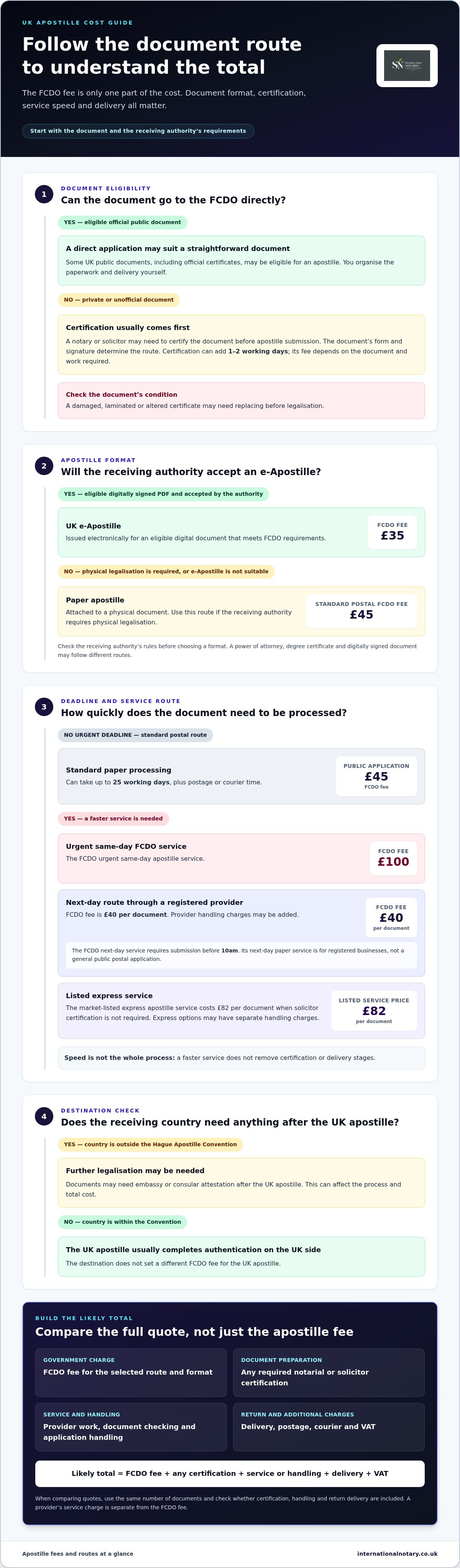
The FCDO fee is only the starting point for the cost of an apostille in the UK in 2026. According to the Foreign, Commonwealth & Development Office, a standard postal apostille costs £45, while a UK e-Apostille costs £35. Your total depends on the application route and any additional costs for document certification, handling, delivery and VAT.
If you’re comparing quotes, it’s sensible to look beyond the headline fee: two options can include different services and charges. This article explains how the FCDO fees, paper and electronic routes, service speed and VAT affect the amount you pay, so you can assess the likely total before choosing how to proceed.
You’ll also learn when a document may need certification before legalisation and why the receiving country’s requirements matter. The sections below break down the main cost components and explain when professional assistance with apostille and legalisation may be useful.
Table of Contents
Express or Premium apostille service?
Your total depends on the application route, speed and any work needed before legalisation. Compare what each service includes, not just the apostille fee.
Choosing an application route
A direct application means submitting an eligible document to the Foreign, Commonwealth & Development Office (FCDO) yourself. A professional service can manage submission and related handling. A direct application may suit a straightforward document if you have time to organise the paperwork and delivery. A notary can help when a document needs certification or when you need the apostille process managed.
Some UK public documents, including official certificates, may be eligible for an apostille. Private or unofficial documents usually need certification first. The document’s form and signature determine the route, and the receiving authority’s requirements matter too. A damaged, laminated or altered certificate may need replacing before legalisation.
Service fees and inclusions
A service fee covers the provider’s work, which may include document checking, application handling and arranging return delivery. The FCDO standard postal apostille fee is £45, according to the Foreign, Commonwealth & Development Office. The market-listed express apostille service costs £82 per document when solicitor certification isn’t required. A same-day apostille service costs £100, while express options may carry separate handling charges.
Ask what the quote includes: the FCDO fee, certification, handling, courier or delivery, and VAT can affect the amount payable. “Express” describes speed, not necessarily a complete package. Compare quotes for the same number of documents and the same service scope, including whether return delivery is included.
Reliability and deadline considerations
Choose a route around your actual deadline and the document’s readiness. The FCDO next-day service requires submission before 10am, while a registered-business next-day route is distinct from a public postal application. Standard paper processing can take up to 25 working days, plus postage or courier time. A faster service may reduce processing time, but it doesn’t remove certification or delivery stages.
When comparing a low-cost quote with a managed service, check what each includes and how the application will be processed. Confirm the deadline, document requirements and return method. Staple Inn Notaries provides apostille and legalisation services for clients in Central London.
Certification and delivery costs
Documents requiring prior notarial certification need that step before apostille submission, which may add 1-2 working days. The certification fee depends on the document and work required; its price is provided after a quote request. Solicitor certification may also be needed for some documents, so include it when comparing a total rather than treating the apostille fee as the full cost.
Postage choices, document weight and destination affect delivery charges. Include them when calculating the total.
FCDO apostille fees
The Foreign, Commonwealth & Development Office (FCDO) charges fees according to the application route and apostille format. The fee for a UK application is not a separate rate for each destination country. The receiving country may, however, require further legalisation.
Official apostille fees
The official apostille fee is the amount charged for FCDO legalisation, before any separate service or delivery costs. According to the Foreign, Commonwealth & Development Office, a standard postal apostille application from the public costs £45. The fee for a UK e-Apostille is £35, according to the Foreign, Commonwealth & Development Office.
The FCDO fee is a government charge, not the total cost of using a notary or apostille service. Document preparation, certification and return delivery can incur separate charges. For example, a degree certificate requiring certification first follows a different route from an eligible document submitted directly.
Fees by apostille format
A paper apostille is attached to a physical document, whilst an e-Apostille is issued electronically for an eligible digital document. The FCDO fee is £45 for a standard postal application and £35 for a UK e-Apostille.
Check the receiving authority’s requirements before choosing a format. A power of attorney, degree certificate and digitally signed document may follow different routes. An e-Apostille is available only for certain digitally signed PDF documents that meet FCDO requirements. A paper apostille is needed if the receiving authority requires physical legalisation.
The FCDO urgent same-day apostille service costs £100. Its next-day paper-based service is for registered businesses, rather than a general public postal application. A separate listed next-day service through a registered provider carries a £40 FCDO fee per document, according to the Foreign, Commonwealth & Development Office. Provider handling charges may sit on top of that government fee.
The destination country affects what may be required after the UK apostille, not the FCDO fee for each destination. Documents for countries outside the Hague Apostille Convention may need embassy or consular attestation after apostille. For a country within the Convention, the UK apostille usually completes authentication on the UK side.
Separate the official fee from any notary, solicitor, agent or courier charge when comparing totals. A professional service may handle document checks and submission, but its charge isn’t the FCDO fee. If your document needs notarial certification or you’re unsure which route applies, you can make an enquiry about apostille requirements.
Paper-based apostilles and e-Apostilles
A paper apostille is attached to a physical document, while an e-Apostille is issued electronically. The right format depends on the document and the receiving authority’s requirements. Choosing the wrong format may mean arranging legalisation again, so confirm what the overseas organisation accepts before submitting UK documents.
The FCDO e-Apostille fee is £35, while a standard postal paper apostille costs £45. Eligible e-Apostilles can take up to 2 working days to process. Paper applications follow a postal process and can take several weeks, with courier or postage time added to processing. The lower electronic fee does not make the format suitable for every document or destination.
An e-Apostille is available only for certain digitally signed PDF documents that meet FCDO requirements. A scan of a paper certificate is not the same as an eligible digitally signed document. Before choosing electronic legalisation, confirm that the receiving authority accepts it and that the document meets FCDO requirements.
Some overseas authorities require an apostille attached to a physical original or official certified copy. This can apply to documents for immigration, marriage abroad, property, employment, court or family matters. If the authority requires a paper certificate, choosing an e-Apostille because it costs less will not meet that requirement.
UK birth, marriage and death certificates can often be submitted as an original or official certified copy without solicitor certification first. A damaged, laminated or altered certificate may need replacing before legalisation. Check its condition and format before choosing a route. The apostille process cannot correct an invalid or unacceptable document.
Private or unofficial documents usually need certification before the FCDO can legalise them. For example, a signature or the execution of a document may need authentication by a notary. This preliminary work can add cost and time beyond the apostille fee. A public certificate and a privately signed document do not necessarily follow the same application route.
The destination country also affects what follows the apostille. Documents for countries outside the Hague Apostille Convention may need embassy or consular attestation afterwards. For countries within the Convention, the apostille usually completes authentication on the UK side, but the receiving authority still determines which format it accepts.
Match the document, format and destination before applying. A digitally signed PDF may qualify for an e-Apostille, while a physical certificate may need a paper apostille. This distinction affects the fee, processing route and delivery arrangements. First confirm the receiving authority’s requirements, then choose the corresponding FCDO application route.
Registered provider and postal application routes
A postal application and a registered provider’s next-day route differ in submission method, processing time and charges. The route can affect how quickly documents are legalised, but it does not remove requirements for valid documents or prior certification.
The Foreign, Commonwealth & Development Office fee for a UK apostille submitted through a registered provider’s next-day service is £40 per document. The next-day paper-based service is available to registered businesses, not as a general public route. Its stated processing time is one working day, while the provider may charge separately for handling, document checks and delivery.
For public applications, the FCDO estimates standard postal processing at approximately 10 working days, with no guaranteed turnaround. Postal applications can take several weeks overall, particularly once sending and return delivery are included. Treat processing estimates as distinct from total elapsed time: postal transit, document preparation and any solicitor certification can extend the period before the legalised document reaches you.
Registered providers can manage submission and related handling, which may suit applicants coordinating several documents or working to a deadline. A direct postal application avoids a provider’s service fee, but the applicant must organise the application and return arrangements. Compare the government fee with the complete provider quote, rather than assuming the £40 next-day fee represents the total service cost.
An urgent route is not suitable for every document. UK private or unofficial documents usually need certification before apostille submission, and that step must fit the timetable. For example, a power of attorney requiring notarial certification needs that step before FCDO processing. A document submitted without required certification may be rejected or cannot be legalised, and the FCDO does not refund the fee if legalisation cannot be completed.
The destination also shapes the route. A marriage certificate for a country in the Hague Apostille Convention may need a UK apostille, while a country outside the Convention may require embassy or consular attestation afterwards. The receiving authority sets the requirements, so confirm whether it needs a paper apostille or further authentication before paying for urgent processing.
For a useful comparison, note the document type, certification status, deadline and destination. Separate the FCDO charge from provider handling, certification and courier costs. Courier and postage charges are additional to FCDO legalisation charges. This makes it easier to see whether a faster route meets your deadline or simply adds expense without resolving a delay in document preparation.
Total apostille cost including VAT
The total may include the government fee, certification, service, delivery and applicable VAT. The final amount depends on the document, application route and destination, so the headline apostille fee alone does not show the full cost.
Separate each cost before comparing quotes. The FCDO fee covers legalisation; a provider’s charge may cover document checks, handling and administration. Certification may be needed to authenticate a document’s signature or status first. Courier or postage can add another charge, and VAT may affect service costs. Ask for a breakdown that identifies what the total includes.
For a public postal application, the FCDO fee is £45. An e-Apostille costs £35, whilst a registered provider’s next-day route has a £40 FCDO fee per document. These are government charges, not necessarily the complete amount due. A managed service can add handling, certification and delivery; the route and document requirements determine which additions apply.
Government fee: identify the FCDO charge for the chosen route.
Certification: include notarial or solicitor work if required.
Service handling: account for administration or document checking.
Delivery: include return postage or courier charges.
VAT: establish whether it applies to quoted service charges.
Check how VAT is treated on each component of the quote rather than assuming it applies equally to every line. Notarial certification, handling and courier charges are distinct items. Ask for a clear breakdown showing any VAT alongside the relevant charge. This makes totals easier to compare and helps avoid mistaking an initial fee for an all-in price.
The destination country can affect what is required after the UK apostille. Documents for countries outside the Hague Apostille Convention may need embassy or consular attestation afterwards. This additional stage can affect the overall cost and timetable. Check the receiving authority’s requirements before choosing a route or calculating your legalisation budget.
For a power of attorney, for example, the total may involve certification before FCDO legalisation, followed by return delivery. A straightforward public document may not require the same preparation. The document type, signature, destination and chosen processing route determine the cost factors. The price of a notarial service depends on the case and is given after a quote request.
To establish the likely cost components for your document, request a quote for apostille assistance.
If a document’s signature or status needs authentication first, notarial certification is an additional cost. It is separate from the FCDO fee and any service or delivery charges. Whether certification is needed depends on the document and application route.
Staple Inn Notaries: Notary Central London
Staple Inn Notaries can notarise documents before apostille and manage apostille and legalisation. The Central London notary service can help with documents that need a notary’s certification, including powers of attorney and statutory declarations. Mobile notary appointments are available across Central London.
Bring the document type, intended destination and receiving authority’s instructions into the discussion. These details help identify whether certification is needed before legalisation and which requirements may affect the application route. The service price depends on the case and is provided after a quote request.
For assistance with your document, contact Staple Inn Notaries.
Prepare your documents for the next step
Before submitting documents, organise the receiving authority’s instructions, the original or required certified copy, and any existing signature or certification details. This gives you a clear basis for deciding the legalisation route and estimating the cost of an apostille in the UK in 2026. If requirements are unclear, resolving them before application can help prevent avoidable processing delays.
Staple Inn Notaries offers Notary Central London, Notary Public Central London and Notary London services for documents requiring notarial attention before apostille. The price depends on the case and is provided after a quote request, with the document, certification required and handling needs informing the assessment.
Share the document type and intended destination to discuss the appropriate next step. Contact Staple Inn Notaries about your document and move forward with greater clarity.
Frequently Asked Questions
How Much Does an Apostille Cost in Total?
A straightforward apostille starts with the applicable FCDO fee, but the total depends on document preparation, service handling and delivery. If the document needs certification, include that work and any applicable VAT in your budget. Compare itemised totals, not headline charges, for the cost of an apostille in the UK in 2026.
What Is the FCDO Apostille Fee?
The FCDO fee for a standard postal apostille application from the public is £45, according to the Foreign, Commonwealth & Development Office. The UK e-Apostille fee is £35, according to the Foreign, Commonwealth & Development Office. These are official legalisation charges, not necessarily the complete amount payable when an application includes certification, professional handling or delivery. The document’s format and application route determine which government fee applies.
Are apostille fees refundable if my document is rejected?
No. The UK Legalisation Office does not refund its fee if a document cannot be legalised. For example, a private document may need certification before submission, or a damaged certificate may need replacing. Identify the document type, signature and certification requirements before applying. Paying the fee does not mean an apostille will be issued if the document cannot be legalised, so make sure the paperwork meets the relevant requirements.
Is an e-Apostille Cheaper Than a Paper Apostille?
Yes. The UK e-Apostille fee is £35, compared with £45 for a standard postal paper apostille. Price alone doesn’t determine the right format: the document must meet electronic requirements, and the receiving authority must accept an e-Apostille. For example, a digitally signed PDF may qualify, while a physical certificate may require paper legalisation.
Can I walk in for a UK Apostille?
For a public application, plan around the FCDO’s standard postal route, not a walk-in counter visit. Allow time to send the documents, for processing and for their return. A registered provider may submit documents through a different service route, separate from a public walk-in application. Choose based on whether the documents are ready, your deadline and the return arrangements.
Do you need embassy attestation as well?
It depends on the destination country. UK documents for countries within the Hague Apostille Convention usually need no further authentication on the UK side after apostille. For countries outside the Convention, embassy or consular attestation may be required afterwards. For example, a document for overseas use may need both stages. Check the receiving authority’s instructions before arranging legalisation.
How Does the Apostille Process Work?
An apostille authenticates a UK document or signature for international use. First, the document must be in a form the FCDO can legalise; private or unofficial documents usually need certification before submission. The FCDO checks the relevant signature or official status and issues an apostille if the document can be legalised. The receiving authority’s requirements determine whether you need a paper document or an eligible electronic format.
What is the UK FCDO apostille fee in 2026?
For public applicants, the standard postal apostille fee is £45, according to the Foreign, Commonwealth & Development Office. The UK e-Apostille fee is £35, according to the Foreign, Commonwealth & Development Office. The FCDO fee for a UK apostille submitted through a registered provider’s next-day service is £40 per document, according to the Foreign, Commonwealth & Development Office. Certification, provider charges and delivery may increase the total.



Comments