
Probate Administration London: The 2026 Professional Guide to Estate Settlement

Updated: Sep 6
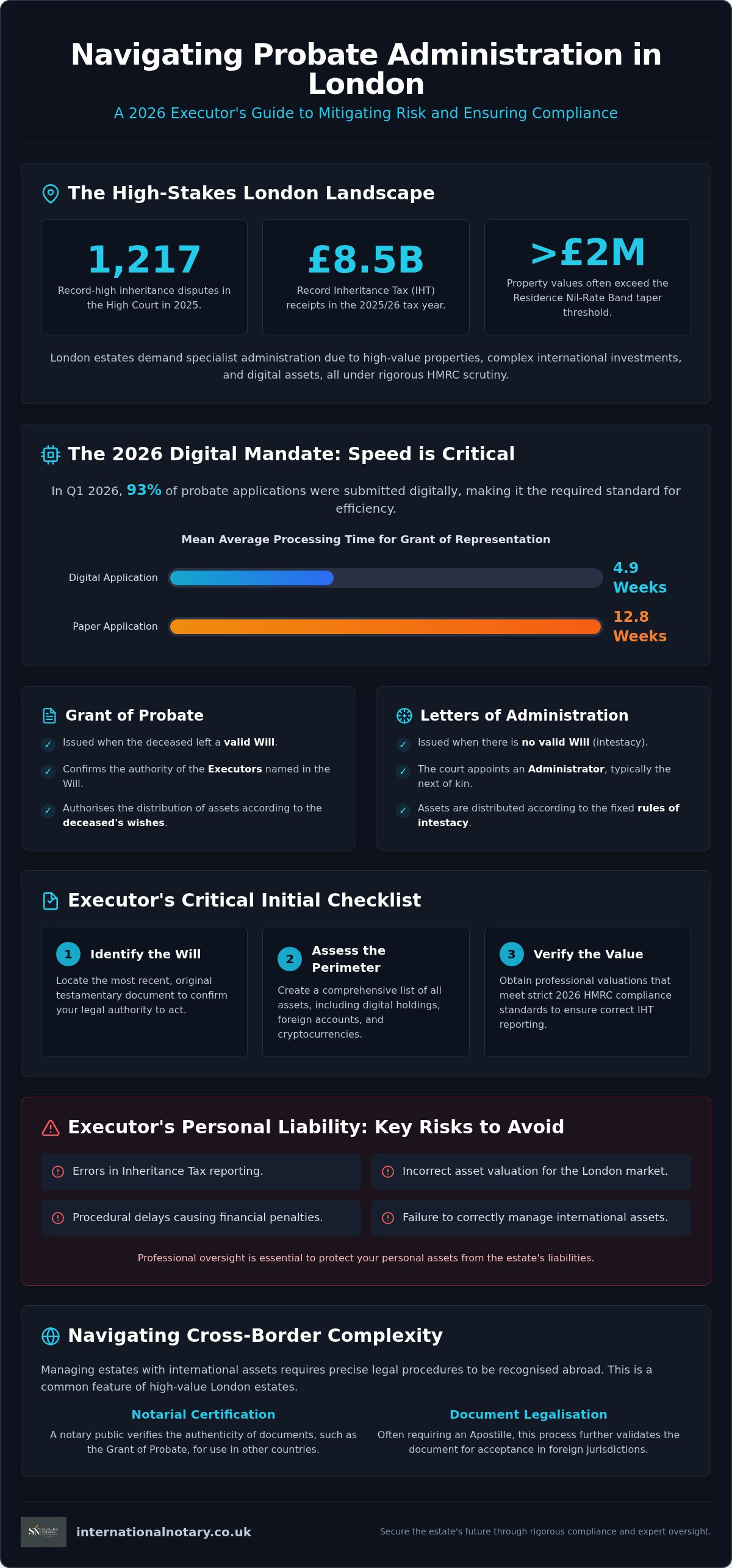
In 2025, inheritance disputes in the High Court reached a record high of 1,217 cases, a figure that underscores the increasing volatility of estate settlement in a high-value market. Navigating Probate Administration London is no longer a simple administrative exercise; it's a high-stakes legal process where the threat of personal liability for executors is very real. You likely feel the weight of this responsibility, especially when managing complex cross-border assets or navigating the July 2026 fee increases at the probate registry. Errors in inheritance tax reporting or delays in document legalisation can lead to significant financial penalties and fractured family relationships.
This guide provides the definitive procedural framework you need to mitigate these risks and ensure the efficient distribution of assets. We'll examine the technical requirements for international document certification, the latest HMRC compliance standards for the frozen nil-rate bands, and the streamlined digital pathways now required for 2026 applications. Gain the clarity needed to discharge your duties with absolute precision. Secure the estate's future through rigorous compliance and expert oversight. Eliminate procedural delays and protect your professional reputation.
Table of Contents
The Landscape of Probate Administration in London
Probate administration is the methodical legal and financial management of a deceased person's estate, encompassing everything from asset valuation to the final distribution to beneficiaries. In the capital, this process carries heightened significance. Probate Administration London involves navigating a jurisdiction defined by multi-million pound property values and intricate investment structures that often span several borders. Whether you're acting as an Executor named in a valid Will or an Administrator appointed by the court under the rules of intestacy, your legal obligations are absolute. Failure to adhere to the Probate process in England and Wales can result in personal financial liability for errors in tax reporting or asset distribution.
Personal representatives often underestimate the gravity of their role. You are legally responsible for settling all debts and taxes before any inheritance is released. In a market where property values frequently exceed the £2 million taper threshold for the Residence Nil-Rate Band, a single miscalculation can lead to a significant shortfall. Professional oversight provides the necessary buffer between your personal assets and the estate's liabilities, ensuring that the settlement is both legally sound and tax-efficient.
Why London Estates Require Specialist Administration
London estates aren't typical. The sheer concentration of high-value residential assets in Central London, combined with complex commercial holdings, requires a granular level of valuation that standard services often miss. We frequently see estates comprising not just physical property, but significant portfolios of digital assets, crypto-currencies, and diverse shareholdings amongst the city's professional classes. HMRC maintains rigorous scrutiny over these valuations. Precision is mandatory to ensure the correct Inheritance Tax (IHT) is paid, especially as IHT receipts reached a record £8.5 billion in the 2025/26 tax year. Don't rely on generic estimates; the London market demands expert appraisal to avoid investigation.
The Role of the Executor in 2026
By 2026, the mandate for executors has evolved into a digital-first responsibility. Statistics from the first quarter of 2026 show that 93% of probate grant applications were made digitally, reflecting a system that rewards speed and technical accuracy. Your fiduciary duty requires you to act in the best interests of the beneficiaries at all times. The initial phase is critical. You must secure the original Will and identify the immediate asset perimeter before the five-week average processing time for digital grants begins. Efficiency here isn't just a preference; it's a requirement to prevent the accumulation of interest on unpaid tax or the depreciation of volatile assets.
Act now to secure the estate's foundations:
Identify the Will: Locate the most recent original document to confirm your authority.
Assess the Perimeter: Create a comprehensive list of all assets, including digital holdings and foreign accounts.
Verify the Value: Obtain professional valuations that meet the strict 2026 HMRC compliance standards.
Legal Mechanisms: Grant of Probate vs Letters of Administration
Securing the foundational authority to manage an estate requires a specific legal instrument issued by the court. This document validates your standing to third parties, such as banks and the Land Registry, who cannot legally release assets without it. In the context of Probate Administration London, the choice between a Grant of Probate and Letters of Administration depends entirely on the existence of a valid Will. While the former confirms the appointment of executors chosen by the deceased, the latter is a court-mandated appointment for an administrator when no testamentary instructions exist. Both documents serve to formalise the settlement process, yet the path to obtaining them involves distinct procedural hurdles.
The Application Process for London Executors
Executors must begin by collating the original Will and the death certificate to establish the legal basis for the claim. A Grant of Representation is the umbrella term for both Probate and Letters of Administration. You are then required to calculate the gross and net value of the estate for legalisation and tax reporting purposes. Accuracy is vital. In early 2026, digital applications were processed in a mean average of 4.9 weeks, while paper applications suffered significant delays, averaging 12.8 weeks. Professional filing ensures your submission adheres to the official government probate guidance, reducing the risk of your case being amongst the 42,490 open applications currently stalled in the registry system.
Dealing with Intestacy in the Capital
Intestacy presents unique challenges for modern family structures and cohabiting partners in London. If an individual dies without a Will, the Rules of Intestacy dictate the distribution of assets, often with results that conflict with the deceased's likely wishes. For deaths occurring after the 2023 update, a surviving spouse inherits all personal property, the first £322,000 of the estate, and half of the remaining balance; the other half is divided amongst the children. Cohabiting partners who aren't married or in a civil partnership have no automatic inheritance rights under these rules. Identifying and verifying the identity of rightful heirs in these cases is a meticulous task. You may require assistance finding a notary in London to certify the necessary identification documents for beneficiaries residing outside the UK. For complex estates, professional Probate Administration London provides the necessary oversight to resolve these claims efficiently.
Cross-Border Complexity: International Assets and Notarial Oversight
London’s status as a global financial hub ensures that many high-value estates possess a significant international footprint. Administering an estate that includes residential property in the EU or bank accounts in North America introduces layers of procedural complexity that extend far beyond standard domestic requirements. Whilst a UK Grant of Probate provides local authority, foreign jurisdictions rarely recognise this document in its native form. You must navigate the specific legalisation requirements of each territory to release overseas funds. Professional Probate Administration London requires a deep understanding of these cross-border mechanics to prevent assets from becoming indefinitely frozen in foreign probate courts.
A Notary Public acts as the essential conduit between the UK court system and international registries. When Dealing with a deceased's financial affairs, executors often discover that foreign institutions demand notarised and legalised evidence of their authority. We bridge this gap by certifying the Grant of Probate, ensuring it meets the rigorous standards of validity required by overseas banks and land registries. Our intervention reduces the administrative friction that often stalls international Probate Administration London.
Legalising Documents for Foreign Jurisdictions
Foreign authorities typically require an apostille to verify the authenticity of the signature and seal on a UK public document. This process, managed through the Foreign, Commonwealth & Development Office (FCDO), confirms the document's legitimacy for use in countries that are party to the Hague Convention. For nations outside this treaty, further consular legalisation is mandatory. Utilising specialist Apostille Services London ensures that your documentation is processed with the necessary speed and precision. Don't risk rejection by submitting unverified copies; secure the correct certification from the outset.
Foreign Beneficiaries and Identity Verification
Verifying the identity of beneficiaries residing outside the United Kingdom is a critical component of anti-money laundering (AML) compliance. Executors bear the burden of proof to ensure that funds are distributed to the correct individuals without breaching international financial regulations. Notarised ID certification provides the high-level assurance required for these transactions. We coordinate directly with international lawyers, such as Aquarius Lawyers in Australia, to synchronise document requirements, ensuring that beneficiary identities are certified in a format that satisfies both UK and foreign regulatory bodies. This proactive approach eliminates the risk of distribution delays and protects the executor from potential compliance failures.
Executing a London estate requires a methodical, phase-based approach to ensure no fiduciary duty is overlooked. Probate Administration London moves from the theoretical authority of the grant into the practical liquidation of assets. This sequence is strictly regulated; you cannot bypass the tax reporting phase to reach distribution. Each step requires meticulous documentation to satisfy both HMRC and the probate registry. Follow this procedural checklist to maintain compliance:
Phase 1: Valuation and HMRC Reporting. Collate all asset values and complete the IHT400 forms for estates subject to Inheritance Tax.
Phase 2: Applying for the Grant. Submit your application via the probate registry portal, accompanied by the required legal statements and original Will.
Phase 3: Asset Collection. Once the grant is issued, close bank accounts, sell London property, and liquidate investment portfolios.
Phase 4: Debt Settlement. Identify all creditors and settle outstanding liabilities, including utility bills and final tax returns.
Phase 5: Distribution. Prepare the final estate accounts and transfer the remaining assets to the beneficiaries.
Valuation and Inheritance Tax (IHT) Strategies
Accurate property valuations are the cornerstone of a successful application. In the London market, where valuations are volatile and often exceed the £2 million taper threshold, HMRC frequently scrutinises self-assessments. Employing RICS-qualified surveyors is essential to provide a robust valuation that withstands investigation. You must also manage the IHT payment timelines effectively. Inheritance Tax must usually be paid before the Grant of Probate is issued. This often necessitates applying for a bank loan or utilising the Direct Payment Scheme to release funds from the deceased's accounts specifically for tax settlement.
Asset Liquidation and Distribution
Liquidating a London estate often involves the transfer of complex leasehold and freehold titles. This requires precise coordination with managing agents and the Land Registry to ensure a clean break and valid transfer. For estates with significant share portfolios, you must deal with share registrars and provide certified documentation to facilitate the liquidation of financial instruments. If your administration involves international assets, you will need to understand the associated Notary Public London Fees for document certification. Secure professional oversight to manage these complexities without delay. Contact us today for expert assistance with Probate Administration London.
Professional Estate Settlement: Why Specialist London Expertise is Essential
London’s high-value estate landscape demands a level of technical precision that exceeds standard legal offerings. For executors managing significant portfolios, Staple Inn Notaries operates as the "Expert Fixer", providing the rapid, meticulous service required to navigate complex settlement hurdles. We combine the granular rigour of private client law with international notarial authority to deliver a unified solution. This integrated approach is particularly vital when managing Probate Administration London, where time-sensitive corporate interests and private legacies often intersect. By centralising these functions, we eliminate the friction typically caused by coordinating between multiple disparate legal entities.
The Advantage of Central London Notarial Integration
Executing a London estate often requires the simultaneous management of domestic probate and international legalisation requirements. We provide a seamless transition between these two distinct legal spheres, ensuring that every document is fit for purpose both in the UK and abroad. Our specialists understand the urgency inherent in corporate estate matters where share transfers or property sales may be contingent on immediate certification. We offer on-site and mobile notary services to accommodate the demanding schedules of busy London executors. This accessibility ensures that document certification never becomes a bottleneck in the overall administration process. Secure your documentation through our authoritative, fast-paced service model.
Mitigating Risk and Ensuring Compliance
Attempting DIY probate in the capital carries significant financial risks that frequently lead to severe HMRC penalties or personal beneficiary claims against the executor. Professional oversight mitigates these liabilities through robust professional indemnity and strict regulatory compliance. As a firm regulated by the Faculty Office of the Archbishop of Canterbury, we ensure all statutory declarations and affidavits are executed to the highest professional standard. This regulatory standing provides executors with the reassurance that their actions are legally sound and defensible. Our bespoke approach also extends to contentious probate and will disputes, where we provide a calm, authoritative framework for resolving conflicts without unnecessary narrative detours. Secure the estate’s integrity and your personal reputation by avoiding the common pitfalls of unverified Probate Administration London. Review our Notary Central London overview for a full summary of our professional certification and legalisation capabilities.
Securing the Future of High-Value London Estates
Managing a deceased person's affairs in the capital requires more than just administrative diligence; it demands a sophisticated understanding of both domestic law and international treaty requirements. We've explored the necessity of precise asset valuation to satisfy HMRC's rigorous 2026 standards and the essential role of notarial certification in unlocking overseas accounts. Attempting to navigate these complexities without specialist oversight risks significant personal liability and prolonged registry delays. Professional Probate Administration London provides the technical framework needed to protect the estate's value and ensure a seamless distribution to beneficiaries.
Staple Inn Notaries operates as your "Expert Fixer", delivering the rapid and meticulous service essential for urgent or complex settlements. As a firm regulated by the Faculty Office of the Archbishop of Canterbury, we specialise in Central London and international estate law, bridging the gap between UK probate and foreign legalisation. Don't let administrative bureaucracy stall your progress. Secure professional probate administration with Staple Inn Notaries to discharge your duties with absolute confidence. You can successfully resolve even the most intricate estate matters with the right expert support.
Frequently Asked Questions
How long does probate administration usually take in London in 2026?
In early 2026, the mean average time to issue a probate grant was approximately 5 weeks for all application types. Digital applications are significantly more efficient, averaging 4.9 weeks, whilst paper applications can take up to 12.8 weeks. These timelines reflect the processing at the probate registry and do not include the initial valuation phase. Professional Probate Administration London ensures that applications are submitted without errors, preventing further delays in this time-sensitive process.
Do I need probate if the deceased only had assets in a joint account?
Probate is generally not required for assets held in joint names, as these pass automatically to the surviving owner under the principle of survivorship. You will simply need to present a death certificate to the bank or building society to update the account records. However, if the deceased also owned property as tenants in common or held sole assets exceeding the £5,000 threshold, a Grant of Probate will be necessary to manage the wider estate settlement.
Can a London notary help with probate for assets located in Europe or the US?
A London notary provide essential assistance by certifying the Grant of Probate and other legal instruments for use in foreign jurisdictions. Overseas registries and banks in Europe or the US typically require notarised copies and apostilles before they will release assets to UK executors. We act as the technical bridge, ensuring your documentation meets international validity standards. This specialist oversight prevents the frustration of rejected documents and accelerates the distribution of cross-border holdings.
What are the risks of administering an estate without professional legal help?
Administering an estate without professional guidance exposes the executor to significant personal financial liability for errors in tax reporting or asset distribution. HMRC maintains strict scrutiny over valuations, and record-high IHT receipts in the 2025/26 tax year highlight the consequences of non-compliance. Without expert oversight, you may face penalties for late payments or claims from disgruntled beneficiaries. Professional Probate Administration London mitigates these risks by ensuring all statutory duties are discharged with absolute precision.
How is Inheritance Tax calculated for high-value London properties?
Inheritance Tax is calculated at 40% on the portion of the estate exceeding the nil-rate bands. For the 2026/27 tax year, the standard threshold is £325,000, plus an additional £175,000 Residence Nil-Rate Band if the property passes to direct descendants. In London, the £2 million taper threshold is a critical consideration; the RNRB is reduced by £1 for every £2 the estate exceeds this value. Accurate, RICS-qualified valuations are mandatory to ensure compliance with these frozen thresholds.
What happens if a Will is contested during the probate process?
If a Will is contested, the probate process typically stalls while the dispute is resolved. A caveat may be lodged at the probate registry to prevent the grant from being issued, a trend that rose by 56% between 2019 and 2024. In 2025, a record 1,217 disputed cases reached the High Court. Resolution requires formal legal mediation or court intervention to determine the Will's validity, often focusing on testamentary capacity or undue influence amongst beneficiaries.
Is a Grant of Probate always required to sell a property in London?
A Grant of Probate is mandatory to sell or transfer a property held in the deceased's sole name or as a tenant in common. The Land Registry will not register a transfer of title without this formal authority. Whilst you can market the property and accept an offer before the grant is issued, the sale cannot complete until the legal instrument is presented. Securing the grant efficiently is therefore vital to avoid losing buyers in a competitive market.
Can I apply for probate myself, or must I use a solicitor or notary?
You are legally permitted to apply for probate yourself, but for high-value or international estates, this is rarely advisable. The complexity of HMRC reporting and the risk of personal liability for errors make professional assistance a practical necessity. Most executors in 2026 utilise digital portals, but the technical requirements for certifying documents for foreign assets require the specific authority of a notary. Expert intervention ensures the process remains efficient, legally compliant, and insulated from procedural delays.



Comments