
Apostille Birth Certificate: Professional London Legalisation Guide 2026

Updated: Sep 3
A single administrative error on your application can delay a critical visa or property purchase by weeks, potentially jeopardising your entire international transition. We recognise that securing an apostille birth certificate often feels like a high-stakes race against a rigid deadline, especially when you're faced with the confusing choice between original certificates and certified copies. It's natural to feel anxious about whether foreign authorities will accept your paperwork or if a minor oversight will result in a costly rejection.
Staple Inn Notaries provides the professional assurance required to navigate these procedural complexities, offering rapid legalisation services from our Central London base to ensure your UK documents achieve immediate international validity. Our expert-led approach bypasses the standard 15 to 20 working day delays often seen in public postal applications; we provide a streamlined path for both Hague Convention nations and more complex embassy requirements. This guide details the 2026 legalisation landscape, explaining how we secure your documents with the precision and urgency your timeline demands. You will gain clarity on the current FCDO standards and the specific steps necessary to guarantee your document is legally recognised abroad.
Table of Contents
What is an Apostille for a Birth Certificate?
An apostille is an official certificate issued by the Foreign, Commonwealth & Development Office (FCDO) that confirms the authenticity of a public document. For individuals moving abroad, securing an apostille birth certificate is a mandatory procedural step to ensure their identity is legally recognised by foreign jurisdictions. This certification does not validate the content of the document itself; rather, it verifies the legitimacy of the signature, seal, or stamp placed upon it by the issuing registrar. While the birth certificate itself is a public record, its validity beyond British borders is not automatic.
The legal framework for this process was established under the Apostille Convention, which simplified the previously cumbersome chain of legalisation for member nations. Without this official verification, your UK birth certificate remains a domestic record with no standing in international law. Foreign authorities frequently reject unlegalised documents during critical applications for marriage, residency, or professional employment. This causes significant delays. It can even lead to the total collapse of time-sensitive international transactions.
The Role of the Foreign, Commonwealth & Development Office
The FCDO acts as the sole competent authority in the UK for the issuance of apostilles. They maintain an extensive, secure registry of authorised signatures from the General Register Office (GRO), allowing them to cross-reference the official who signed your specific certificate. This registry is meticulously updated to include registrars and assistant registrars from across the United Kingdom. The FCDO serves as the United Kingdom’s definitive gatekeeper for international document validity, ensuring that domestic records meet the rigorous standards required for cross-border recognition. This centralised oversight provides foreign governments with the necessary assurance that a document is genuine and legally issued.
When is a Birth Certificate Apostille Required?
Legalisation is rarely a voluntary choice; it's a prerequisite for most formal interactions with foreign states. You will typically require an apostille birth certificate in the following scenarios:
Visa and Residency Applications: Most nations require legalised proof of identity and lineage before granting long-term visas or permanent residency permits.
International Marriage: If you're marrying outside the United Kingdom, local authorities need verified proof of your birth details to process the civil registry.
Inheritance and Probate: Managing the estate of a deceased relative abroad often necessitates the legalisation of family records to prove legal entitlement.
Employment Overseas: Certain jurisdictions require a legalised birth certificate to issue work permits or verify professional credentials for highly regulated industries.
Failing to provide a correctly legalised document often results in immediate application rejection. We act with controlled urgency to ensure your documentation adheres to these strict global standards before you submit it to foreign authorities.
How to Organise an Apostille for Your UK Birth Certificate
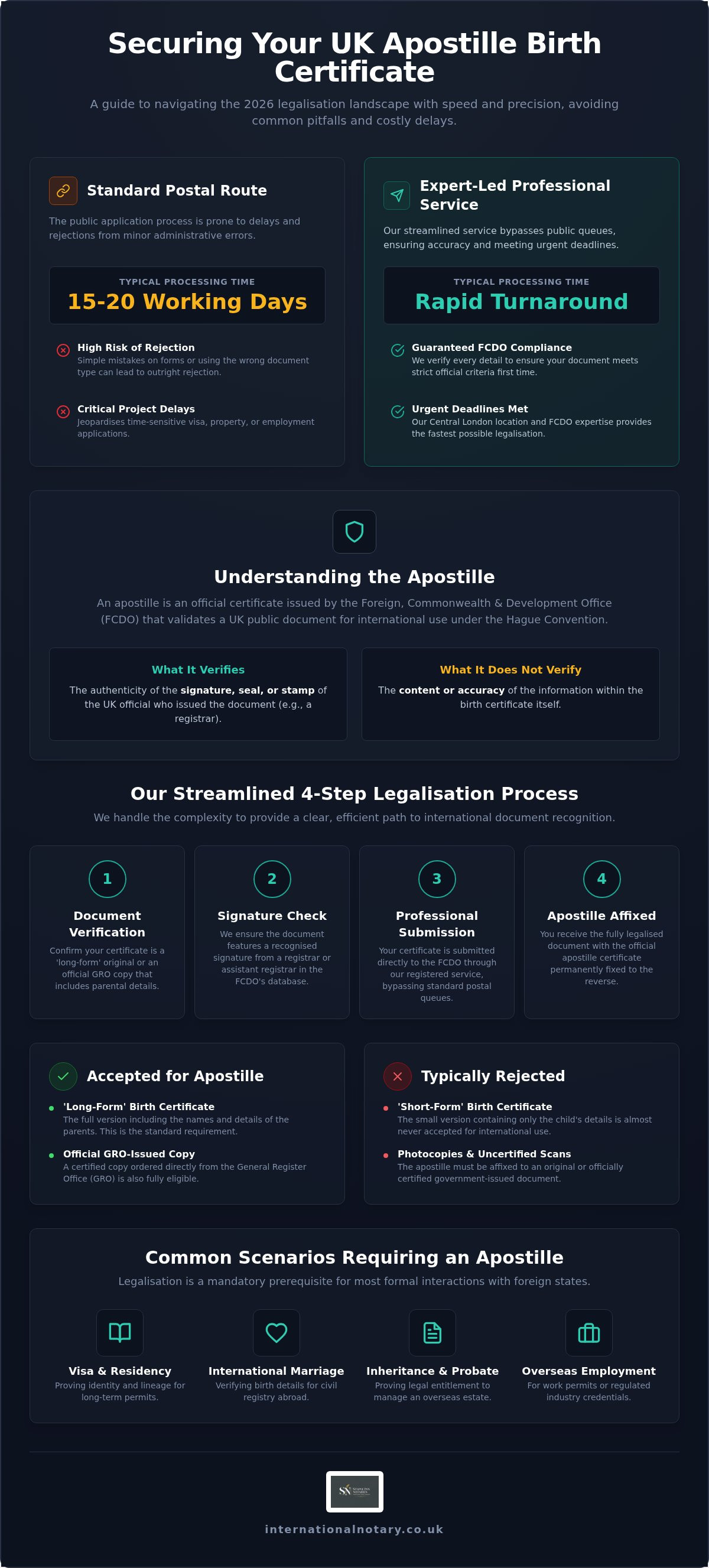
Securing an apostille birth certificate involves a rigid sequence of verification steps that must be executed with precision. Errors lead to rejection. To ensure your documentation is accepted by foreign authorities without delay, follow this professional protocol:
Step 1: Confirm your document is a "long-form" original or an official GRO copy.
Step 2: Verify the document features a recognised signature from a registrar or assistant registrar.
Step 3: Submit the certificate to a professional legalisation service to bypass standard public postal delays.
Step 4: Receive your legalised document with the apostille permanently affixed to the reverse side.
Originals vs. Certified Copies: Which do you need?
Most foreign governments demand that the apostille be placed on an original government-issued certificate. A "short" birth certificate, whilst valid for some domestic UK purposes, only lists the child's name and is almost never accepted for international legalisation. You must provide the "long-form" version that includes parental details. This is essential for verifying lineage in residency or inheritance cases. Avoid using photocopies. Even if a solicitor certifies a copy as a true likeness, the FCDO usually requires the apostille to be attached to the original government-issued paper. The Hague Conference on Private International Law sets the global standard for these requirements, ensuring that only authentic government signatures are legalised for cross-border use.
Checking Registrar Signatures and Seals
The FCDO operates a sophisticated verification system. They will only legalise documents signed by officials whose signatures are already recorded on their official database. Older certificates occasionally present a challenge; if the original registrar's signature cannot be verified against current records, the application will be returned. In these instances, you must obtain a fresh, official duplicate from the General Register Office (GRO) to proceed. Our role is to act as your expert intermediary, identifying these potential hurdles before they cause a bottleneck. If you require professional guidance on document eligibility, our Apostille and Legalisation Services offer a comprehensive review to ensure every seal and signature meets the FCDO's exacting 2026 standards. This meticulous oversight provides the certainty required for high-stakes international applications.
Processing Times and Costs for Document Legalisation
Timing remains the most frequent point of failure in international document submissions. While the Foreign, Commonwealth & Development Office (FCDO) provides a standard postal route for the general public, this method often proves insufficient for urgent visa or property applications. Standard postal applications typically face a turnaround of 15 to 20 working days. During peak periods, such as the summer relocation window or the end of the financial year, these timelines often extend further due to fluctuating UK Legalisation Office volumes. For those managing time-sensitive transitions, the risk of a three-week delay is often unacceptable.
Securing an apostille birth certificate through a professional London intermediary provides a strategic advantage. We utilise registered status to access expedited processing channels that are not available to the public. This professional scrutiny ensures that your certificate is verified for eligibility before submission, effectively eliminating the risk of a time-consuming rejection due to an unrecognised registrar signature or document damage.
Standard vs. Urgent Apostille Services
The choice between service levels depends entirely on your specific deadline. The standard postal service is appropriate for individuals with no immediate travel or legal requirements. In contrast, urgent matters require a more robust approach. In 2026, professional intermediaries in Central London continue to provide a next-day service, where documents are hand-delivered to the FCDO and processed with priority. This creates a significant contrast between the 20-day public wait and a 24-hour professional turnaround. We manage these logistics with a mindset of controlled urgency, ensuring your paperwork remains on track even when government departments face seasonal backlogs.
Understanding Total Legalisation Costs
Total expenditure for document legalisation is comprised of several distinct components. These include the mandatory FCDO statutory fee, professional administration charges, and secure courier costs. For documents destined for countries outside the Hague Convention, additional fees for embassy attestation will apply. These requirements vary significantly between jurisdictions; for instance, the California Secretary of State's guide on apostilles provides a useful reference for how these standards are applied internationally, reflecting the universal necessity for official verification.
Within Central London, secure document transport has moved toward dedicated point-to-point couriers rather than standard mail. This trend ensures that original birth records, which are difficult and slow to replace, are never lost in transit. By combining local courier efficiency with our proximity to the FCDO, we provide a seamless solution that balances procedural compliance with the practical need for speed. This managed approach offers the professional assurance that your legalisation process is handled correctly the first time.
Navigating International Requirements: Hague Convention and Beyond
The destination of your document dictates the procedural route we must follow. Since the 1961 Hague Apostille Convention revolutionised the movement of international documentation, the process has bifurcated into two distinct paths. For jurisdictions that are signatories to this treaty, an apostille birth certificate remains the final and absolute requirement for legal recognition. However, for nations outside this agreement, the apostille is merely the first stage in a more complex chain of legalisation. Understanding which path your document must take is vital to avoiding the risk of it being deemed legally void upon arrival.
Member Countries of the Hague Convention
The Hague Convention currently includes 130 member nations, encompassing many of the most common destinations for UK citizens moving abroad. In states such as Spain, France, Italy, the USA, and Australia, the apostille certificate serves as a universal proof of authenticity. This single stamp replaces the old, cumbersome system of multiple embassy visits; it provides foreign officials with the immediate assurance that the registrar's signature on your birth record is genuine. Securing an apostille birth certificate for these nations is a streamlined process. The treaty was designed to abolish the requirement of diplomatic or consular legalisation for foreign public documents, creating a more efficient environment for international travel and commerce. Amongst member states, this mutual recognition significantly reduces administrative friction.
Embassy Attestation for Non-Hague Jurisdictions
Nations that haven't joined the Hague Convention, such as the UAE, Qatar, or China, require a multi-stage process known as embassy attestation. This requires us to first obtain the FCDO apostille before hand-delivering the document to the destination country’s London embassy for a final consular stamp. Each embassy maintains its own specific, and often shifting, requirements for birth records. Some may require certified translations whilst others demand specific covering letters or proof of residency. Managing this chain of legalisation requires precision and controlled urgency to meet tight visa deadlines. If you're managing a move to a non-Hague jurisdiction, our Apostille and Legalisation Services provide the expert oversight necessary to navigate these complex embassy protocols without delay.
Why Professional Notarial Oversight is Essential for Legalisation
A Notary Public provides a level of professional certification that is globally recognised and frequently requested by foreign legal systems. Whilst a UK birth certificate is a public document that can be apostilled directly, the broader context of your application often requires additional notarial intervention. For example, if your apostille birth certificate is being submitted alongside a translated document or a sworn affidavit of identity, these supplementary papers must be notarised to satisfy international compliance standards. We provide this expert legal oversight to ensure your entire documentation bundle is robust and immune to rejection by foreign registries. This meticulous approach prevents the procedural failures that often plague unassisted applications.
Our firm offers comprehensive Apostille Services in London, combining technical legal knowledge with a modern, responsive mindset. This dual approach allows us to act as the "Expert Fixer" for complex international requirements.
The Advantage of Using a Notary Public in Central London
Proximity to the Foreign, Commonwealth & Development Office and major diplomatic missions in the capital is a decisive factor in processing speed. Our Central London location facilitates rapid, hand-couriered access to these institutions, allowing us to manage your legalisation with a sense of controlled urgency. Our specialists advise on whether your specific destination requires a simple apostille or full notarial certification, preventing the common mistake of over-legalising or under-certifying documents. You gain the peace of mind that comes from knowing your sensitive records are handled by professionals regulated by the Faculty Office of the Archbishop of Canterbury. This regulatory standing is essential for documents destined for jurisdictions with strict formal requirements.
Mobile Notary Services for Urgent Private Matters
For clients with restrictive schedules or those managing high-value transactions, we offer a dedicated Mobile Notary London service. We can visit your home or office to collect, verify, and notarise documents in person. This service is particularly beneficial for high-net-worth individuals and corporate executives who cannot afford the time to visit a physical office. Efficiency is our priority. By integrating mobile verification with our rapid apostille processing, we create a seamless experience that eliminates procedural bottlenecks. We understand the time-sensitive nature of your requirements. Our mobile team ensures that even the most complex apostille birth certificate applications are initiated immediately, maintaining the momentum of your international applications without requiring you to leave your desk. This "Expert Fixer" approach is designed to reduce client anxiety through direct, professional accessibility.
Securing Your International Documentation with Professional Certainty
Navigating the 2026 legalisation landscape requires more than a basic understanding of government forms; it demands a strategic approach to document verification and international compliance. Ensuring you have the correct long-form certificate with a recognised registrar signature is the first step in avoiding procedural rejection. Whether your destination follows the streamlined Hague Convention route or requires multi-stage embassy attestation, the precision of your initial submission determines the speed of your success. Bypassing the standard 20-day public postal delays is essential for maintaining the momentum of your visa or property applications.
Staple Inn Notaries acts as your "Expert Fixer" from our Central London base, providing direct access to the FCDO and foreign consulates. We're regulated by the Faculty Office of the Archbishop of Canterbury, ensuring that every apostille birth certificate we handle meets the highest standards of legal scrutiny. Don't let administrative backlogs jeopardise your international residency or professional move. Contact Staple Inn Notaries for Urgent Apostille Services to secure your documentation with controlled urgency and professional assurance. Your global transition deserves the certainty of expert oversight.
Frequently Asked Questions
How long does it take to apostille a birth certificate in London?
Standard postal applications processed directly through the FCDO typically require 15 to 20 working days for completion. However, utilising a professional intermediary in Central London allows for significantly faster results. We provide a next-day service by hand-delivering documents to the Legalisation Office, bypassing the standard public wait. This expedited route is essential for clients facing tight deadlines for international property transactions or urgent visa applications where every day is critical.
Can I get an e-Apostille for a UK birth certificate?
The FCDO does offer an e-Apostille service, yet birth certificates are currently excluded from this digital route because they require a physical signature or seal from the General Register Office. Furthermore, the traditional paper format remains the global standard. In 2024, approximately 99% of legalisation certificates were issued in paper format. Foreign authorities, particularly for residency or marriage, still demand a physical apostille birth certificate to ensure the document's long-term durability and cross-border verification.
Do I need to provide the original birth certificate for an apostille?
You must provide either the original long-form birth certificate issued at the time of registration or an official duplicate from the General Register Office (GRO). The FCDO will not legalise photocopies or documents certified by a solicitor as "true copies" for birth records. If your original is damaged or features an unrecognised signature, you'll need to order a fresh GRO copy before the legalisation process can proceed to avoid immediate rejection.
What is the difference between notarisation and an apostille?
Notarisation is a professional certification performed by a Notary Public to verify the authenticity of a private document or signature. In contrast, an apostille is a government certificate issued by the FCDO to verify the signature of a public official, such as a registrar. Whilst birth certificates are public documents and don't usually require notarisation, accompanying private documents, such as powers of attorney, must be notarised before they can receive an apostille for international use.
Will my apostilled birth certificate expire?
An apostille does not have a technical expiry date under the Hague Convention. However, many foreign authorities, especially in jurisdictions like Spain or the UAE, often require documents to be legalised within the last six months. It is vital to check the specific requirements of the destination country before submission. If your apostille birth certificate was issued several years ago, you might need to obtain a fresh one to ensure acceptance by foreign registries and government departments.
Can a solicitor apostille a birth certificate instead of a notary?
Neither a solicitor nor a notary issues the apostille itself; this is exclusively the role of the FCDO. However, for documents requiring prior certification, a Notary Public is generally preferred because their seal is globally recognised by embassies and foreign courts. Solicitors' certifications are frequently rejected by non-Hague nations. Using a notary ensures that your entire document package adheres to the highest international standards of professional verification and procedural compliance required for cross-border recognition.
What happens if my document is rejected by the FCDO?
If the FCDO rejects your application, it is usually because the registrar's signature is not on their database or the document is a photocopy. You will be required to rectify the error, which often involves ordering a new certificate from the GRO and paying the submission fees again. We eliminate this risk by performing a pre-submission audit of your documents, ensuring all signatures and seals meet the necessary criteria before they reach the Legalisation Office.
Do I need a translation of my birth certificate for the apostille?
You don't need a translation to obtain the apostille from the FCDO, as they are legalising a British document. However, the destination country almost certainly requires a certified translation of both the birth certificate and the apostille into their official language. These translations often require their own separate notarisation to be accepted by foreign registries. We can coordinate this multi-stage process to ensure your documentation is fully compliant for use amongst foreign authorities without delay.



Comments