
How to Prepare Notarised Documents in the UK: A Professional Guide (2026)

Updated: Sep 3
A single missing seal can collapse a multi-million pound international merger or derail a life-changing property acquisition in seconds. In the high-stakes environment of global commerce, the validity of your paperwork is the only currency that matters. You likely recognise that securing notarised documents uk for use abroad is a task fraught with technical complexity and unforgiving deadlines. It's a legitimate concern that foreign authorities might reject your submission if it lacks precise procedural compliance.
We understand the frustration of deciphering legal jargon whilst facing the pressure of a time-sensitive transaction. This expert-led guide provides the clarity you require, offering a methodical breakdown of the authentication process under the current 2026 regulatory framework. You'll master the essential steps to ensure your documents achieve global legal standing, from understanding the New Notaries (Conduct and Discipline) Rules 2026 to managing Foreign, Commonwealth & Development Office requirements. We'll examine the specific procedures for powers of attorney and corporate resolutions, ensuring you possess a valid document accepted overseas without unnecessary procedural delays.
Table of Contents
Understanding Notarised Documents in the UK: Why and When You Need Them
Notarised documents uk are records that have been formally authenticated by a Notary Public to verify their legitimacy for use outside the United Kingdom. Unlike domestic certification, this process involves the application of a unique public seal; this is a symbol recognised globally under international law and various Hague Convention treaties. This seal acts as a guarantee to foreign jurisdictions that the document is genuine, the signatory has been properly identified, and the act was performed with full legal capacity. It's the essential bridge between the UK legal system and the requirements of a foreign authority.
There are approximately 800 certified notaries in England and Wales. This small, highly regulated group facilitates the movement of legal instruments across borders. Primary triggers for this requirement include:
The sale or purchase of overseas property.
International corporate expansion or the establishment of foreign branches.
Permanent migration or applications for dual citizenship.
The execution of international commercial contracts.
The Role of the Notary Public in the UK
A Notary Public is a specialist lawyer appointed by the Court of Faculties of the Archbishop of Canterbury. This ancient office carries significant historical weight. Its primary function is to serve as a neutral witness to the truth. Unlike a solicitor, whose primary duty is to their client, a notary's overarching duty is to the document itself and the foreign officials who will eventually rely upon it. This distinction is vital for international validity. As an "Expert Fixer", the notary ensures that the document is not merely signed but is legally fit for its specific purpose in a foreign jurisdiction, pre-empting potential rejections before they occur.
When a Standard Solicitor Certification is Insufficient
Many clients discover too late that a standard solicitor’s signature is insufficient for international use. It rarely satisfies foreign officials. Authorities abroad, particularly those in civil law systems, require the specific "probative value" that only a notary can provide. This refers to the document’s ability to serve as self-authenticating evidence in a court of law. To understand the broader context of this office, one might ask What is a Notary Public? and find that it is a globally recognised authority that transcends local legal boundaries. Whilst a solicitor certifies documents for domestic UK use, a notary holds the unique legal power to ensure notarised documents uk are granted full international validity through the application of their official seal and signature.
Common Types of UK Documents Requiring Notarisation
The variety of records requiring authentication is extensive, but they generally fall into two distinct categories: private individual requirements and corporate business transactions. A significant portion of our work involves the notarisation of Powers of Attorney for overseas use. This legal instrument is vital for clients who need to appoint a representative to manage property sales, inheritance matters, or litigation in a foreign jurisdiction. Without a notary's seal, these documents are frequently rejected by foreign land registries and financial institutions.
Educational certificates, including degrees, diplomas, and professional transcripts, represent another high-volume category for notarised documents uk. Foreign employers and visa authorities require these to be authenticated to mitigate the risk of qualification fraud. We also provide meticulous certification for identity documents like passports and driving licences. This process isn't a simple photocopy; it involves verifying the original document's security features and confirming the holder's identity against the latest 2026 anti-fraud standards.
Corporate Notarial Requirements
UK companies operating in the EU, US, or Dubai often face complex regulatory hurdles. We frequently certify company resolutions, board minutes, and certificates of incorporation to facilitate international trade. A critical component for many businesses is the "Certificate of Good Standing". This document confirms the company is active and compliant with UK filing requirements. As members of The Notaries Society, we adhere to strict protocols when verifying the authority of company signatories. This ensures that the person executing the document has the legal capacity to bind the corporation, a requirement that's non-negotiable for international commercial contracts. If you're managing a high-stakes transaction, engaging a notary in Central London can pre-empt these technical challenges.
Private and Individual Legal Documents
Individual legal needs often involve statutory declarations or affidavits intended for foreign court proceedings. These documents allow UK residents to provide sworn evidence without appearing in person abroad. For those planning an overseas wedding, a "No Impediment" certificate is often required to prove they're legally free to marry. Additionally, we handle consent forms for minors travelling abroad. Many countries now require these forms to be notarised to prevent international parental child abduction. We ensure these documents are drafted and executed with the precision required to satisfy border authorities and foreign registrars alike.
Notarisation vs Apostille: Navigating the Legalisation Chain
Notarisation is the foundational act of verification, but it is rarely the final step in the authentication chain. For a document to be legally recognised by a foreign government, it often requires a second tier of validation known as an Apostille. This is an official certificate issued by the UK government's legalisation office. It is attached to the notary's certificate to confirm the authenticity of the notary’s signature and seal. For notarised documents uk, this certificate acts as a universal bridge, ensuring your paperwork is accepted without further questioning by foreign officials.
The Hague Convention of 1961 established a streamlined framework for international document acceptance. It effectively abolished the cumbersome requirement of full diplomatic legalisation for foreign public documents amongst signatory nations, replacing it with the standardised Apostille. However, destination matters. If the receiving country is not a party to this convention, you must navigate the final tier: Consular Legalisation. This involves submitting the document to the specific embassy or high commission of the destination country for final attestation.
The FCDO Legalisation Office Process
The Foreign, Commonwealth & Development Office (FCDO) in London serves as the ultimate authority for UK legalisation. Their officials perform a meticulous comparison of the "wet ink" signature on your document against their extensive database of registered notaries. This verification is precise. If the signature deviates even slightly from the registered version, the document is rejected. Standard services are suitable for general applications, whilst "Premium" same-day legalisation is available for urgent corporate transactions that cannot afford procedural delays. We manage this interface daily to ensure your notarised documents uk satisfy the most stringent FCDO requirements.
The Three-Step Legalisation Workflow
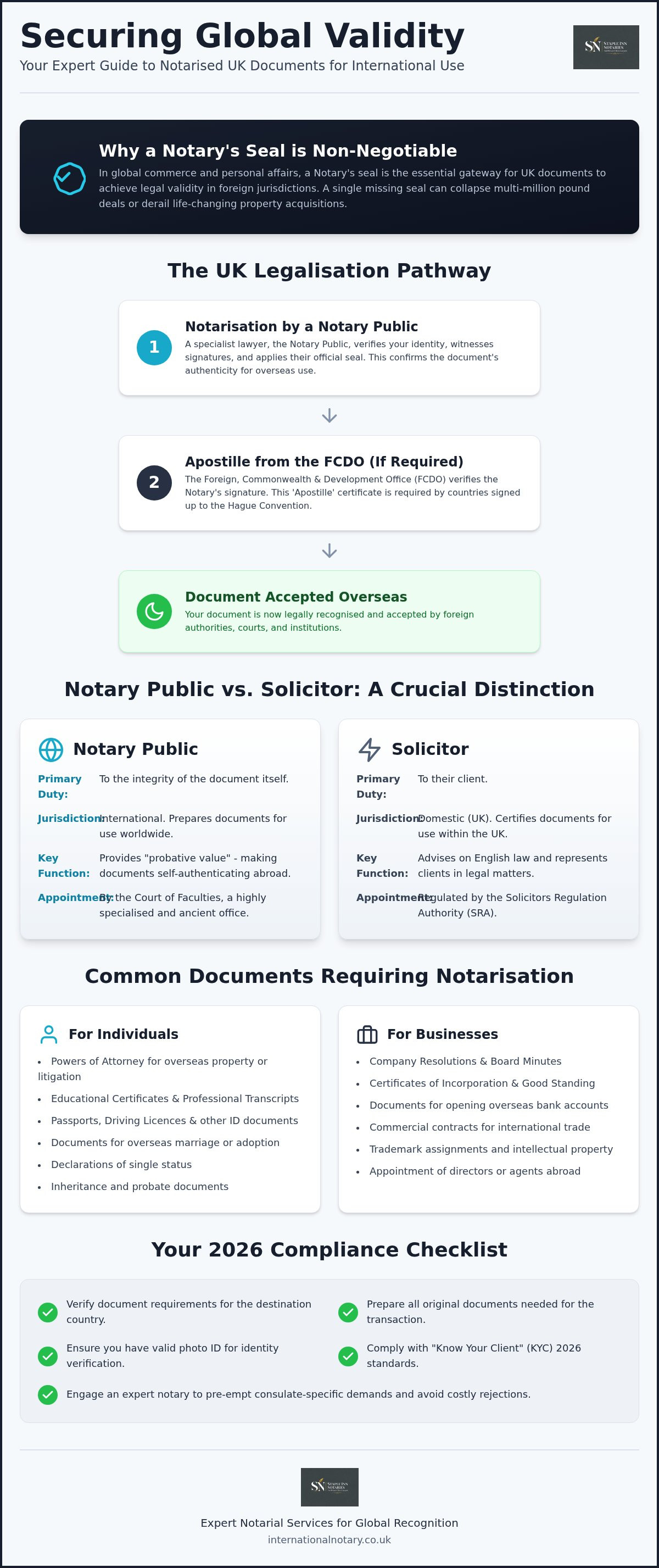
To ensure global validity, you must follow a rigid hierarchy of authentication. Bypassing a step often leads to document rejection and costly delays. The standard workflow is as follows:
Step 1: Professional Notarisation. Secure the official seal and signature from a Notary Public in Central London to authenticate the underlying facts or signatures.
Step 2: Apostille Certification. Obtain the FCDO certificate to verify the notary's standing and authority within the UK legal system.
Step 3: Embassy Attestation. Complete this final stage only if the destination country is not a member of the Hague Convention, requiring direct approval from their diplomatic mission.
Master this sequence. It is the only way to guarantee your documents hold legal weight in a foreign jurisdiction. Failure to adhere to this chain can result in the collapse of international transactions or the denial of visa applications.
Step-by-Step Guide to Getting Your Documents Notarised in the UK
Preparing notarised documents uk requires meticulous attention to detail before the formal appointment begins. You must gather all original records in their entirety. Ensure these documents aren't damaged, altered, or laminated; foreign authorities frequently reject paperwork if the physical integrity is compromised. Once your records are organised, the process moves into a rigid sequence of verification and execution designed to meet international legal standards and anti-fraud requirements.
Step 1: Verification and ID Requirements
The 2026 regulatory landscape demands strict adherence to "Know Your Client" (KYC) protocols to combat international money laundering. You'll need to present a valid, original passport and a recent proof of address. The 2026 standard for proof of address in the UK requires an original utility bill, bank statement, or council tax demand issued within the preceding three months. Beyond mere identification, the notary must verify your "capacity" and "will". This involves confirming you fully understand the legal implications of the document and aren't signing under duress. This dual verification is what gives the notarial act its superior probative value abroad.
Step 2: The Notarial Act and Signing
The core of the process is the witnessing of the signature in real-time. You must sign the document in the physical or digital presence of the notary. Depending on the destination country's specific requirements, the notary will prepare a certificate in either "public form" or "private form". In 2026, we've seen a significant rise in electronic notarisation and the use of digital seals. These e-Apostilles are increasingly accepted by Hague Convention signatories, offering a faster alternative to traditional paper-based methods. Whether digital or physical, the act remains a formal declaration of authenticity that cannot be delegated.
Step 3: Managing the Legalisation Logistics
Once the signature is witnessed, the document typically enters the legalisation chain for FCDO or embassy attestation. Managing these submissions is time-consuming and technically demanding. Many clients choose to have their notary handle these logistics entirely to ensure the document remains in a secure chain of custody. We utilise tracked, secure couriers for all sensitive legal instruments to prevent loss or interception. If your schedule prevents a visit to our centre, our Mobile Notary London service provides on-site certification at your home or place of business. This "Expert Fixer" approach eliminates travel time and ensures your transactions stay on track. For immediate assistance with your international paperwork, book your appointment today.
Expert Notarial Services in Central London: Ensuring Global Validity
Selecting a specialist to handle notarised documents uk is a tactical decision that directly impacts the timeline of your international affairs. In the fast-paced environment of the City and Central London, administrative delays are often synonymous with lost opportunities. Our firm operates as an "Expert Fixer", bridging the gap between the rigid requirements of UK law and the varied demands of foreign jurisdictions. We don't merely witness signatures. We pre-empt the specific quirks of foreign consulates, ensuring that your paperwork is executed correctly the first time. Engaging a Notary in Central London provides the professional authority required to navigate these complex global pathways.
Why Proximity to the Legalisation Office Matters
The Foreign, Commonwealth & Development Office (FCDO) and the majority of foreign diplomatic missions are concentrated within Central London. This geographic concentration is a significant advantage for our clients. By being based in the heart of the capital, we provide rapid access to the FCDO’s "Premium" legalisation service; this is essential for documents requiring same-day processing. We act as a physical bridge between UK legal standards and international requirements.
Managing embassy visits for non-Hague Convention countries is a meticulous task that requires physical attendance and an intimate knowledge of changing consulate protocols. We navigate these administrative corridors daily. This proximity allows us to streamline the legalisation chain, moving documents from our office to the FCDO and onward to the relevant embassy with maximum efficiency. You avoid the risks associated with postal delays and the confusion of managing multiple government interfaces. Our presence in the legal centre of the UK ensures your documents are handled with the urgency they deserve.
Tailored Solutions for High-Stakes Transactions
High-value business resolutions and complex probate matters require a level of precision that standard legal services often lack. We provide bespoke solutions for international trusts and estate planning, ensuring every component of the documentation satisfies the receiving authority's standards. Our approach is one of "controlled urgency". We understand that corporate deals often hinge on the immediate availability of authenticated records. This regulatory peace of mind is provided by specialist legal professionals who are deeply rooted in tradition but operate with a modern mindset.
We offer a display of specialised expertise that reduces client anxiety through accessibility and calm competence. Whether you are executing a multi-jurisdictional power of attorney or certifying a company resolution for a new overseas branch, our focus remains on procedural compliance and speed. We act as the trusted gatekeeper of your international documentation. Secure your global transactions without unnecessary narrative detours or administrative friction. Act now to ensure your paperwork meets every international standard.
Secure Your Global Transactions with Precision
The successful execution of international business or private legal matters depends entirely on the integrity of your paperwork. Navigating the multi-tiered authentication chain is a procedural necessity that requires absolute accuracy to ensure global validity. By ensuring your notarised documents uk meet the stringent 2026 regulatory standards, you mitigate the significant risks of document rejection and costly transactional delays. Every seal and signature acts as a vital gateway for your records to be recognised by foreign authorities and financial institutions.
Staple Inn Notaries operates as your dedicated gatekeeper in the heart of the capital. We are regulated by the Faculty Office of the Archbishop of Canterbury and serve as specialists in Central London apostille services. Our team provides an expert mobile notary service for corporate clients, bringing professional certification directly to your boardroom for time-critical resolutions. We eliminate administrative friction through a display of specialised expertise and a modern, fast-paced mindset. Instruct Staple Inn Notaries for Professional Document Certification to guarantee your documents are fit for purpose. Your international objectives are within reach when supported by meticulous legal preparation.
Frequently Asked Questions
How much does it cost to get a document notarised in the UK?
Fees for notarial services vary depending on the complexity of the document, the number of signatures required, and the urgency of the transaction. Professional charges typically reflect the time spent on identity verification, document drafting, and the formal application of the public seal. Additional costs often include disbursements such as FCDO legalisation fees or courier charges. Mobile notary visits for corporate clients also incur a travel fee in addition to the standard certification costs.
Can a solicitor notarise a document for use abroad?
No, a standard solicitor does not possess the authority to notarise a document for international use. Whilst many notaries are also solicitors, the two professions are distinct and regulated by different bodies. Foreign jurisdictions specifically require the seal of a Notary Public because it carries international legal weight. A solicitor’s certification is generally only valid for domestic UK purposes and will be rejected by most foreign authorities and consulates.
How long does the notarisation and apostille process take?
The duration of the process depends on the level of legalisation required. A notarisation appointment can often be completed within thirty minutes if all identification and original documents are in order. The subsequent apostille stage varies; standard FCDO processing typically takes several working days. However, using a premium service in Central London allows for same-day legalisation. This is essential for high-stakes corporate deals where time is a critical factor.
What is the difference between a certified copy and a notarised document?
A certified copy is a domestic verification where a professional confirms that a photocopy is a true likeness of an original document. In contrast, notarised documents uk involve a more rigorous authentication process by a Notary Public. This includes verifying the signatory's identity, legal capacity, and understanding of the document's contents. Unlike simple certification, notarisation is specifically designed to satisfy the evidentiary requirements of foreign courts and government registries.
Do I need to attend the notary appointment in person?
Personal attendance is a mandatory requirement for most notarial acts to ensure the integrity of the signature. The notary must witness the signing in real-time and perform a physical check of your identification documents under strict 2026 anti-fraud protocols. This ensures you are signing of your own free will and possess the necessary authority. For clients with restricted mobility, a mobile notary can attend your office or residence to perform these duties on-site.
Can you notarise a document that is not in English?
Yes, we can notarise documents written in foreign languages, provided the notary is satisfied with the document's nature and purpose. This often necessitates a professional translation to ensure the notary and the signatory fully comprehend the legal obligations being created. The notary’s certificate itself is usually drafted in English, but it can be prepared in a bilingual format if required by the destination country’s specific legal regulations.
What happens if my notarised document is rejected by a foreign authority?
Rejection usually stems from a break in the legalisation chain or a failure to meet specific consulate requirements. If a document is rejected, you must immediately identify whether the issue relates to the notarial certificate’s wording or a missing embassy attestation. Engaging an expert who understands the nuances of international law helps pre-empt these issues. We act as an "Expert Fixer" to rectify procedural errors and ensure the document achieves global validity.
Is an electronic notary seal valid for international use in 2026?
Electronic seals and e-Apostilles have gained widespread recognition amongst Hague Convention signatories under the current 2026 digital framework. Whilst highly efficient, their validity depends entirely on the receiving country's domestic laws and technical capabilities. You must confirm with the foreign recipient whether they accept digital signatures before proceeding. Many jurisdictions still require traditional "wet ink" signatures and physical embossed seals for high-value transactions, such as property transfers or complex corporate restructuring.



Comments