
How to Certify a Copy of a Passport in the UK: The 2026 Professional Guide

A common misconception persists that any professional signature will suffice when you need to certify copy of passport UK for use abroad. In reality, international document validity is a strict hierarchy where an incorrect choice often leads to costly administrative rejection. You've likely found yourself caught between conflicting advice from the Post Office, local solicitors, and foreign registries whilst facing an urgent deadline. This confusion is understandable because the requirements for domestic UK compliance differ significantly from those mandated by overseas jurisdictions.
This guide provides the professional clarity required to master these procedural hurdles and ensure your identity documents are legally valid worldwide. You'll learn the critical distinctions between solicitor and notary certifications, the specific wording required by the FCDO, and the latest 2026 Apostille requirements for Hague Convention signatories like Canada and China. By following this framework, you can secure a fast, efficient appointment in London and avoid the procedural delays that derail international legal matters. We'll examine the hierarchy of certification and the specific steps needed to guarantee global acceptance.
Table of Contents
What is a Certified Passport Copy and Why is it Required?
A certified copy is a duplicate of a primary document that has been formally verified as an authentic reproduction of the original by a regulated professional. In the context of identity documents, this process involves an authorised official examining the physical passport book and endorsing a photocopy with a specific statement, signature, and professional seal. The primary objective is to facilitate international business and legal transactions without the inherent risk of sending a physical passport through the post or across borders. Accuracy is paramount. A single error in the certification wording can lead to the immediate rejection of your entire application.
Whilst a local branch might accept a signature from a teacher or doctor for a simple UK current account, these community certifications rarely withstand the scrutiny of foreign government agencies. If you need to certify copy of passport UK for use in a foreign jurisdiction, the level of professional oversight must be significantly higher to satisfy global anti-money laundering (AML) and Know Your Customer (KYC) regulations. The certification carries immense legal weight; it serves as a deterrent against identity fraud by placing the professional reputation and regulatory standing of the certifier on the line. A professional seal confirms that the document hasn't been tampered with and that the individual presenting it is indeed the rightful owner.
Common Scenarios Requiring Passport Certification
International authorities demand certified identification for various high-stakes procedures. You'll typically require this service for:
Overseas Property Transactions: Buying, selling, or transferring land and real estate in foreign jurisdictions such as Spain, Dubai, or the United States.
Corporate KYC Checks: Opening international bank accounts or establishing corporate entities where directors must prove their identity to foreign wealth managers.
Visa and Residency Applications: Submitting documentation to foreign immigration ministries for work permits, permanent residency, or citizenship by investment programmes.
The Legal Weight of a Notarial Seal
There is a distinct difference between a document that is merely certified and one that is notarised. While many professionals can sign a photocopy, a Notary Public is a specialist legal officer whose wet-ink signature and embossed seal are registered with foreign embassies and the UK Foreign, Commonwealth & Development Office. This registration ensures worldwide recognition. A Notary doesn't just witness a signature; they verify the authenticity of the document and the identity of the person presenting it, providing a level of assurance that standard professionals cannot offer. Most civil-law countries specifically request a notarised copy because they don't recognise the authority of a standard solicitor for international matters. If your documents are destined for overseas use, seeking a professional consultation with a Notary is the only way to ensure procedural compliance.
Notary vs Solicitor vs Post Office: Selecting the Correct Certification Level
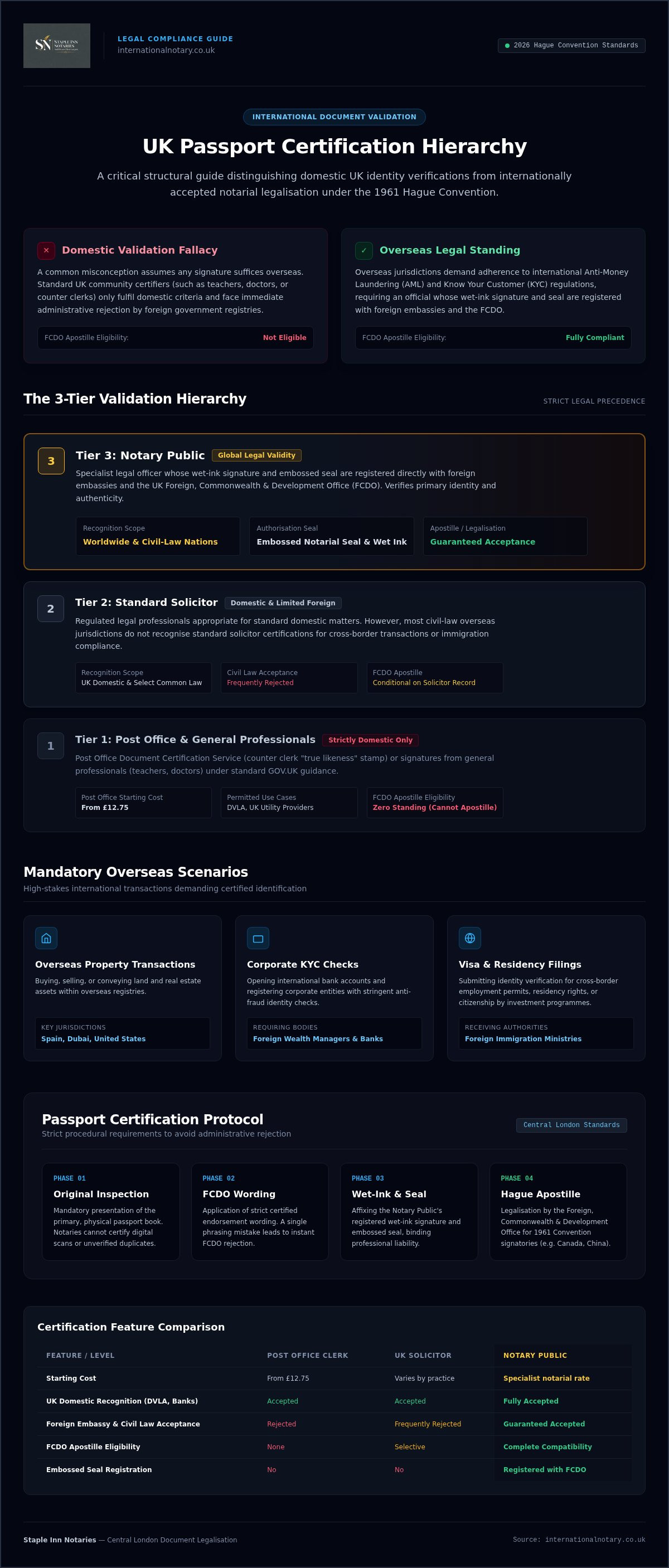
The UK legal system operates a distinct hierarchy of document validation. Choosing the wrong tier to certify copy of passport UK often results in administrative rejection, wasted fees, and missed deadlines. You must distinguish between domestic identity checks and international legal requirements. The level of authority required depends entirely on the receiving organisation and the jurisdiction in which the document will be used.
Tier 1: Post Office and General Professionals
The Post Office Document Certification Service is a high-street option designed for domestic UK compliance. For a fee starting at £12.75, a counter clerk applies a "true likeness" stamp to a photocopy. Whilst this suffices for the DVLA or certain UK utility providers, it lacks international standing. General professionals like teachers or doctors follow the GOV.UK document certification guidance for basic applications. However, these signatures cannot be apostilled by the Foreign, Commonwealth & Development Office (FCDO), making them useless for overseas residency or property matters.
Tier 2: UK Solicitors
Solicitors are regulated by the Solicitors Regulation Authority (SRA) and frequently handle domestic probate or conveyancing. They can certify documents for use within the UK legal system, typically charging between £5 and £30 for simple identity verification. Despite their professional status, many foreign jurisdictions, particularly civil-law countries in Europe and the Middle East, routinely reject solicitor certifications. If your receiving party requires a guarantee of global validity, a solicitor's signature may prove insufficient for your needs.
Tier 3: Notary Public
A Notary Public represents the highest tier of certification. Regulated by the Faculty Office of the Archbishop of Canterbury, notaries are specialist legal officers whose primary function is the authentication of documents for international use. This is the gold standard for global acceptance. Unlike other professionals, a notary's wet-ink signature and embossed seal are registered with the FCDO and foreign embassies. This registration is a prerequisite for obtaining an Apostille under the Hague Convention. Only a notary or solicitor signature can be legalised by the FCDO; a Post Office stamp will be rejected immediately.
For complex international requirements, seeking Notary Central London: Professional Certification and Legalisation Services ensures your documentation meets the exact standards of the destination country. Don't risk rejection by choosing an inadequate level of authority. If you are uncertain about the specific requirements for your destination, we recommend a professional consultation to confirm the necessary tier of certification.
How to Certify Your Passport: A Step-by-Step Procedure for 2026
To certify copy of passport UK effectively, you must adhere to a rigid procedural sequence that ensures zero administrative friction. The process begins with meticulous preparation. You must present the physical, original passport book; digital reproductions or existing photocopies are insufficient for professional notarisation. Bring the original document to your appointment to avoid immediate rejection. Accuracy at this stage is the only way to prevent costly delays in your international applications.
Step 1: Booking Your Appointment
Rapid engagement is essential for time-sensitive international matters. You may schedule a consultation via Calendly to secure a slot at our Central London office. For professionals with constrained schedules, our Mobile Notary London service provides on-site certification at your residence or place of business. Providing a high-quality digital scan in advance allows us to initiate preliminary verification, significantly reducing the duration of your physical appointment. We prioritise efficiency to match the pace of global commerce.
Step 2: The Physical Verification
During the physical verification, the Notary performs a forensic-level inspection of the document’s security features. This includes verifying the integrity of holograms, watermarks, and the Machine Readable Zone (MRZ) to ensure the instrument is genuine and hasn't been altered. Simultaneously, the Notary confirms your identity by comparing your physical presence against the passport photograph. Once satisfied, the Notary applies the mandatory certification wording: "Certified to be a true copy of the original seen by me and a true likeness of the applicant." The act is finalised with the application of the Notarial Seal and wet-ink signature, establishing the document’s legal standing.
Step 3: Document Collection and Next Steps
Efficiency defines our service model. We offer same-day collection for urgent requirements in Central London, ensuring your documentation is ready for immediate submission. However, certification is often only the first stage of the legalisation chain. You must determine if the destination jurisdiction mandates further verification via the Legalisation Office apostille service. For documents destined for Hague Convention member states, obtaining an Apostille is the final requirement for international acceptance. If your needs extend to this level of legalisation, we manage the entire submission process to eliminate procedural delays.
Beyond Certification: When Do You Require an Apostille or Legalisation?
Once you certify copy of passport UK, the document is often only halfway through its journey toward international acceptance. An Apostille is a formal certificate issued by the Foreign, Commonwealth & Development Office (FCDO) that confirms the authenticity of the Notary’s signature and seal. This step is mandated by the 1961 Hague Convention, an international treaty designed to simplify document recognition across its 125 member states. Without this government-backed verification, your notarised copy may be considered legally void by foreign authorities, regardless of the Notary’s professional standing or regulatory compliance. The Apostille acts as the final bridge between UK legal standards and foreign regulatory expectations.
The Role of the Foreign, Commonwealth & Development Office (FCDO)
The FCDO acts as the ultimate gatekeeper for UK documentation destined for overseas use. They maintain a comprehensive database of registered Notaries and verify that the seal applied to your passport copy is legitimate before the document leaves the country. In 2026, standard public processing times for postal legalisation applications remain approximately 15 to 20 working days. For time-critical matters, FCDO-registered businesses can access a next-day paper-based service to bypass these significant delays. For a deeper understanding of these procedures, consult our Apostille Services London: The Professional Guide to Document Legalisation in 2026.
Managing the Full Legalisation Chain
When you need to certify copy of passport UK for destinations not party to the Hague Convention, such as the UAE, Qatar, or Kuwait, a more complex three-stage legalisation chain is required. This process involves initial Notarial certification, an FCDO Apostille, and finally, Consular Attestation at the destination country’s embassy in London. Forgetting this final stage is a common pitfall that leads to immediate document rejection. Whilst digital e-Apostille options have expanded in 2026, many foreign immigration ministries and land registries still mandate traditional physical paper apostilles bearing wet-ink signatures and embossed seals.
Managing these administrative layers independently is often cumbersome and prone to error. Staple Inn Notaries operates as an expert fixer, handling the entire legalisation chain from initial certification to embassy filing. We eliminate procedural delays by navigating these complex regulatory requirements on your behalf, ensuring your documents arrive at their destination fully compliant. If you face an urgent international deadline, you should contact us to arrange comprehensive legalisation.
Efficient Passport Certification in Central London with Staple Inn Notaries
Securing a document that meets the rigorous standards of foreign registries requires more than a simple signature; it demands the intervention of a specialist. Staple Inn Notaries operates as the definitive "Expert Fixer" for professionals and corporate entities navigating the complexities of international identity verification. Strategically situated at Fox Court on Gray's Inn Road, our firm provides the technical expertise and procedural speed required to certify copy of passport UK without the risk of administrative rejection. We understand that in high-stakes international transactions, timing is as critical as accuracy. Our practice is built on the elimination of procedural delays, ensuring your documentation is processed with controlled urgency and meticulous attention to detail.
Our Central London Office and Mobile Services
Accessibility is a cornerstone of our service model. Our office is positioned to serve clients across the City, Holborn, and Chancery Lane, providing a central hub for those requiring immediate face-to-face verification. Recognising the time constraints faced by busy executives, we offer a dedicated Mobile Notary Central London service. This allows for the formal certification of identity documents at your private residence or corporate headquarters, removing the need for travel whilst maintaining the highest level of regulatory compliance. We prioritise rapid response times, frequently facilitating same-day appointments to ensure your international deadlines are met with precision. Act now to secure your appointment.
Choosing a specialist Notary Public over a general solicitor provides a significant advantage in global recognition. While solicitors handle domestic matters, our practice is specifically regulated by the Faculty Office of the Archbishop of Canterbury to authenticate documents for worldwide use. This specialised standing ensures that when you certify copy of passport UK through our office, the resulting document carries the necessary weight to satisfy foreign embassies and government ministries. We don't just witness documents; we verify their international validity, providing you with the reassurance that your paperwork will be accepted wherever it is presented.
Contact Staple Inn Notaries Today
Our comprehensive suite of services extends beyond simple passport and ID certification to include the notarisation of Powers of Attorney, company resolutions, and complex legalisation chains. We manage every aspect of the process, including the procurement of Apostilles and embassy attestation, ensuring a seamless transition from UK certification to international validity. Every instruction is handled with the gravity it deserves, supported by a modern, fast-paced mindset that values your time. Secure your international transaction today. Contact us for an immediate quote or appointment to ensure your documentation is handled by a trusted gatekeeper of international legal standards.
Securing Your International Documentation with Professional Precision
Navigating the hierarchy of certification is essential to avoid the administrative rejection that frequently stalls international legal matters. You now understand that whilst domestic bodies may accept basic signatures, foreign jurisdictions mandate the specialised seal of a Notary Public to satisfy global compliance standards. Selecting the correct professional to certify copy of passport UK remains the most effective way to protect your interests and ensure document validity across borders. Accuracy is not optional when dealing with immigration ministries or foreign land registries; it's the foundation of a successful application.
Staple Inn Notaries provides the expertise required to manage these complex requirements with controlled urgency. We are regulated by the Faculty Office of the Archbishop of Canterbury and maintain deep expertise in FCDO Apostille requirements to facilitate seamless international acceptance. Same-day certification is available for urgent requirements at our Central London office, ensuring your paperwork keeps pace with your professional obligations. Don't leave your documentation to chance. Book your passport certification appointment at our Central London office to secure your international transaction today. We look forward to resolving your documentation needs with professional efficiency.
Frequently Asked Questions
Can I certify my own passport in the UK?
You cannot certify your own passport or identity documents under UK regulations. The certifying official must be a regulated professional who is not related to you, living at the same address, or in a personal relationship with you. This independence ensures the integrity of the verification process and prevents conflicts of interest. For international matters, a Notary Public is the appropriate authority to perform this verification to ensure global acceptance.
How long does a certified copy of a passport remain valid?
The validity of a certified passport copy is typically determined by the receiving organisation rather than the certifying official. Most international banks, land registries, and government bodies require documents to be dated within the last three to six months to ensure the information remains current. You should always verify the specific timeframe required by your destination authority to avoid administrative delays or the need for a costly re-certification.
Does a certified passport copy need to be in colour?
Most foreign authorities and immigration ministries mandate that you certify copy of passport UK in colour to ensure all security features, holograms, and biometric details are clearly visible. Black and white reproductions are frequently rejected by overseas registries because they obscure the document's integrity. To ensure international acceptance, we recommend producing high-resolution colour photocopies that include the entire data page and any relevant signature sections before your appointment.
What is the difference between a certified copy and a notarised copy?
A certified copy is a duplicate verified by a professional, such as a solicitor or accountant, whereas a notarised copy is authenticated by a Notary Public. Notarisation carries significantly higher legal weight and is the only form of certification registered with the Foreign, Commonwealth & Development Office (FCDO) for an Apostille. Whilst a simple certification may suffice for domestic UK utilities, notarisation is the mandatory standard for most international property and corporate transactions.
Can a solicitor certify a passport for use abroad?
Whilst a UK solicitor can certify a passport, their signature is often rejected by foreign jurisdictions, particularly in civil-law countries across Europe, the Middle East, and Latin America. These authorities typically mandate the seal of a Notary Public to guarantee international validity. If your document requires an Apostille, a solicitor's signature is acceptable to the FCDO, but the final receiving body may still insist on notarial authentication to satisfy their local regulations.
How much does it cost to get a passport copy certified by a notary in London?
Fees for notarial certification in Central London vary based on the complexity of the instruction and whether you require additional services such as Apostille legalisation. We operate a transparent fee structure for identity document certification, with rates reflecting our specialised expertise and regulatory standing. For an accurate assessment based on your specific international requirements, you should contact our office directly to receive a comprehensive quote tailored to your destination country's mandates.
Is an e-Apostille valid for a certified passport copy?
The FCDO offers a digital e-Apostille for certain documents, but its acceptance for certified passport copies remains fragmented globally. Most foreign immigration ministries and land registries still mandate a traditional physical paper Apostille bearing an embossed notarial seal and wet-ink signatures. Before opting for a digital submission, you must confirm with the receiving party that they have the technical infrastructure and legal framework to accept electronic legalisation for identity documents.
What should the certification wording actually say?
To certify copy of passport UK for identity purposes, the professional must use specific wording mandated by UK and international standards. The endorsement usually states: "Certified to be a true copy of the original seen by me and a true likeness of the applicant." This statement must be accompanied by the certifier’s full name, professional capacity, practice address, contact telephone number, and the date of verification to ensure the document is legally compliant.


header.all-comments