
Company Resolution Certification: The 2026 Checklist for London Businesses

A single administrative oversight on a board resolution can halt a multi-million pound cross-border transaction in an instant. You likely recognise the frustration of navigating complex international requirements whilst facing immovable closing deadlines. In the fast-paced corridors of the City and Canary Wharf, the risk of document rejection by foreign authorities isn't just an inconvenience; it's a significant commercial liability. This guide provides a definitive, expert-led checklist for Company Resolution Certification to ensure your corporate documents carry the necessary legal weight abroad.
We'll show you exactly how to secure a legally binding document that's accepted globally, moving beyond simple witnessing to comprehensive statutory verification. You'll learn about the latest 2026 FCDO fee structures, the critical impact of the Economic Crime and Corporate Transparency Act on director verification, and the specific nuances of legalisation for non-Hague jurisdictions like the UAE. By following this streamlined process, you can eliminate procedural delays and proceed with the assurance that every regulatory mandate is fully satisfied.
Table of Contents
Understanding Company Resolution Certification for International Use
A corporate resolution is a formal document recording the decisions made by a company’s board of directors or shareholders. For international use, simple internal records are insufficient. Company Resolution Certification is the process by which a Notary Public independently verifies the authenticity of these decisions, ensuring they meet the stringent requirements of foreign legal systems. Unlike domestic filings, international transactions demand a level of scrutiny that confirms the company's legal existence and the specific authority of the individuals signing the document.
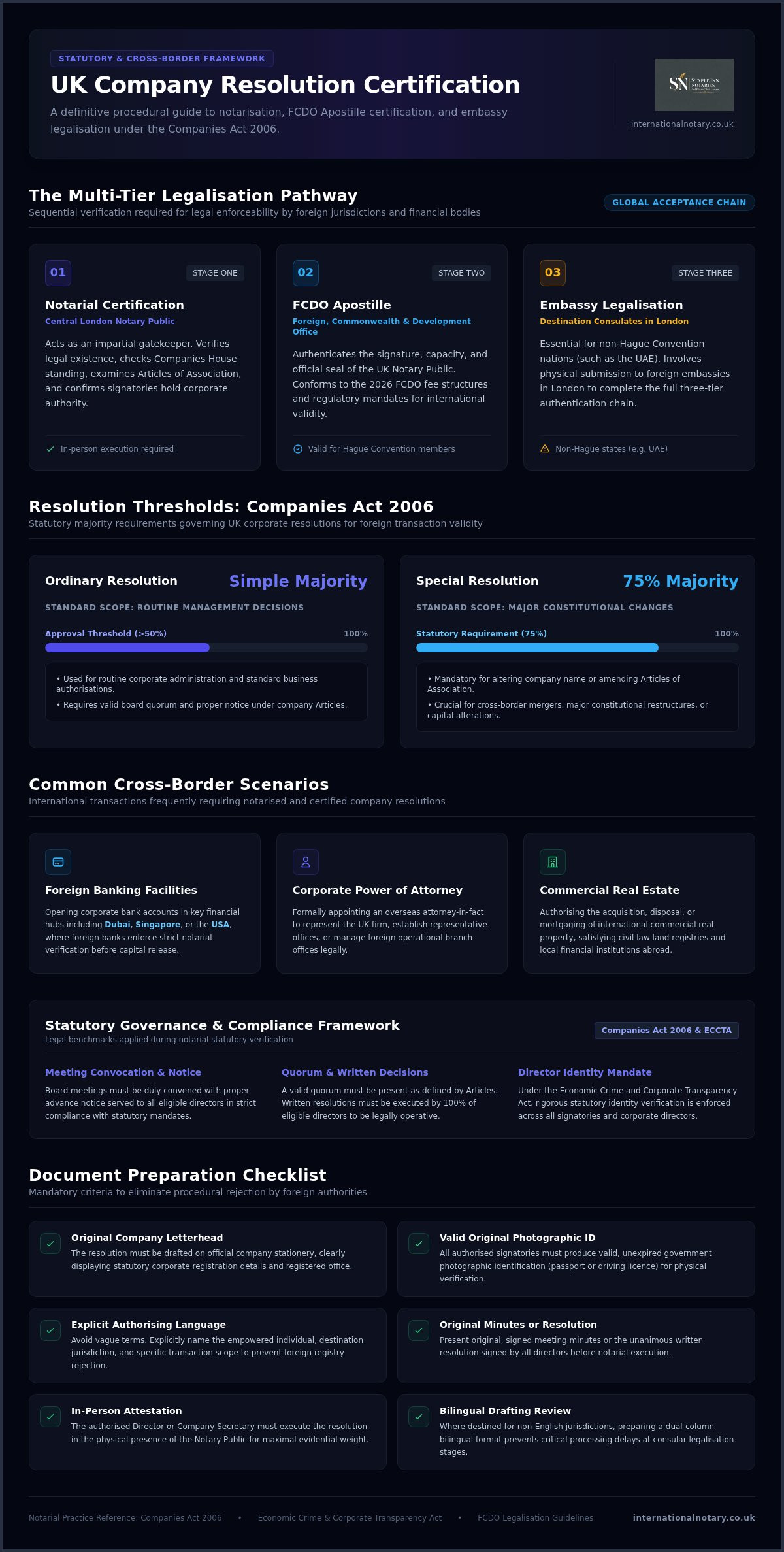
Foreign banks and government authorities cannot easily verify UK Companies House records or interpret bespoke articles of association. They rely on the Notary Public to act as an impartial gatekeeper of corporate validity. The notary meticulously investigates the company’s current standing and confirms that the resolution was passed in accordance with the Companies Act 2006. This involves distinguishing between ordinary resolutions, which are typically passed by a simple majority for routine management, and special resolutions. The latter require a 75% majority and are reserved for significant constitutional changes, such as altering the company’s name or articles. Providing this clarity ensures the foreign recipient understands the exact legal nature of the decision.
The Legal Weight of a Notarised Resolution
Notarisation provides a presumption of regularity that is recognised globally under international law. When a notary certifies a resolution, they don't simply witness a signature; they confirm that the signatories possess the specific corporate authority to bind the company. This process involves a thorough review of the company’s constitutional documents to ensure the board was quorate and the meeting was duly convened. Whilst a UK solicitor might certify documents for domestic purposes, their status is often unrecognised by foreign civil law registries or banks. A notary’s seal remains the gold standard, offering a globally accepted mark of official authorisation and strict procedural compliance.
Common Scenarios Requiring Certified Resolutions
London businesses frequently require certified resolutions when expanding into international markets or managing complex cross-border structures. Common triggers include opening corporate bank accounts in financial hubs such as Dubai, Singapore, or the USA. You may also need certification when appointing an attorney-in-fact via a Corporate Power of Attorney to manage overseas branches or authorising the acquisition of international commercial property. In these high-stakes scenarios, the speed of certification is paramount. Delays in verifying Company Resolution Certification can lead to missed transaction windows or the freezing of essential capital. If your transaction is time-sensitive, you can contact our Central London office for rapid assistance.
Essential Legal Requirements for a Valid UK Board Resolution
For a UK company to act effectively in international markets, its internal governance must be beyond reproach. Under the Companies Act 2006 statutory requirements, every board meeting must be duly convened with proper notice provided to all directors. A resolution is only valid if a quorum is present, typically as defined in the company’s Articles of Association. Whilst many firms rely on written resolutions for speed, these must be signed by all eligible directors to be effective. When seeking Company Resolution Certification, you must present either the original minutes of the meeting or the signed written resolution to the notary. The signature of the authorised Director or Company Secretary must be executed in the notary’s presence to ensure the highest level of evidential weight.
Drafting for International Acceptance
Foreign registries often reject generic resolutions that lack procedural detail. Your document should include specific authorising language that explicitly names the individual empowered to act and the exact transaction involved. If the destination country is non-English speaking, consider a bilingual format to avoid significant delays at the legalisation stage. Precision in drafting prevents the need for costly certified translations later. If you are unsure of the required wording for a particular jurisdiction, you may consult our specialist team for guidance on international standards.
Verification of Corporate Authority
The notary performs a rigorous investigative role that extends far beyond simple witnessing. This involves conducting real-time searches at Companies House to verify the company’s active status and the current appointment of its officers. We also review the Articles of Association to confirm that the directors haven't exceeded their delegated powers or restricted their ability to appoint attorneys. A Certificate of Incumbency is a supporting document that provides an official snapshot of the company’s current officers and shareholding structure to satisfy foreign due diligence. This meticulous verification ensures that the Company Resolution Certification remains robust under the scrutiny of overseas legal counsel and financial institutions.
Comparing Notarisation, Apostille, and Legalisation Requirements
International compliance for UK entities follows a rigid hierarchy of authentication. It begins with notarisation, which establishes the underlying validity of the corporate document. For most jurisdictions, this foundation is followed by an Apostille, and for a specific subset of countries, a final tier of embassy attestation is mandatory. Successfully managing Company Resolution Certification requires identifying which of these tiers applies to your target jurisdiction before the transaction begins to avoid costly rejections. In 2026, the landscape has shifted with the wider adoption of digital solutions, yet the traditional paper-based "chain of authentication" remains the requirement for many high-value transactions.
When is an Apostille Mandatory?
If the destination country is a member of the 1961 Hague Convention, the legalisation process concludes with the Foreign, Commonwealth & Development Office (FCDO). You must utilise the UK government document legalisation service to obtain an Apostille. This certificate is permanently affixed to the notarised resolution to verify the signature and seal of the Notary Public. For a detailed breakdown of the current submission protocols, consult our Apostille Services London guide. Whilst the FCDO now offers e-Apostilles for £35, many overseas registries still demand the physical £45 paper version to ensure compliance with local land and commercial laws.
Consular and Embassy Legalisation
Non-Hague jurisdictions, including the UAE, Qatar, and Kuwait, require a third level of verification. After the FCDO has issued an Apostille, the document must be presented to the relevant London embassy for consular attestation. This final step confirms the FCDO’s seal for use in the destination country’s local ministries. Each embassy operates with distinct processing times and fee structures. For example, the UAE Embassy in London enforces a strict "no bundling" policy and currently charges a consular fee of approximately £490 for a single commercial document. This multi-stage Company Resolution Certification ensures that your board’s decisions are recognised as valid legal instruments by foreign financial institutions. If you are facing a tight deadline for a Gulf-based transaction, you should contact our Central London office to coordinate the entire three-tier process through our registered business channels.
Checklist for Preparing Your Resolution for Certification
Meticulous preparation is the only safeguard against document rejection in high-stakes international transactions. In the fast-paced environments of the City and Canary Wharf, an administrative oversight can derail a closing within hours. You must treat the preparation of your corporate documents with the same rigour as the transaction itself. Company Resolution Certification requires a precise alignment of internal records, statutory filings, and individual identification. Before attending your appointment, you must confirm the resolution is printed on the company's original letterhead to establish formal corporate identity. This is a non-negotiable requirement for most foreign registries and financial institutions.
Verify that all signatories possess valid, original photographic identification, such as a current passport or driving licence.
Provide a recent copy of the company’s Articles of Association to enable a review of the board’s delegated powers.
Include a current Companies House printout to demonstrate the company’s active standing and compliance with recent ECCTA mandates.
Confirm whether the receiving party requires a bespoke Notarial Certificate or a Certificate of Incumbency to be attached to the resolution.
Documentation Required for the Notary Appointment
The notary acts as a trusted gatekeeper, which necessitates a thorough verification of all individuals involved. You must provide proof of identity for every director signing the resolution, alongside proof of their residential address, such as a utility bill or bank statement dated within the last three months. Under the Economic Crime and Corporate Transparency Act 2023, identity verification is now a live compliance requirement for all UK directors. You should also present the formal minutes of the board meeting where the resolution was passed. This evidence allows the notary to confirm the decision was reached through a quorate and duly convened process, satisfying the statutory record retention rules under Section 248 of the Companies Act 2006.
Final Review Before Legalisation
Small errors in corporate documentation often lead to disproportionate delays at the legalisation stage. You must scrutinise the text for spelling mistakes in director names or the company registration number, as these will trigger immediate rejection by the FCDO. Ensure the date of the resolution aligns logically with your proposed transaction timeline. Whilst digital signatures are becoming more prevalent, you must confirm if the recipient requires a traditional "wet ink" signature. Many overseas registries in Southern Europe, Latin America, and the Middle East still reject PDF-based electronic signatures in favour of embossed paper documents. If your transaction is time-sensitive and requires immediate attention, you can book an urgent corporate notary appointment to ensure all statutory requirements are met without delay.
Professional Corporate Notary Services in Central London
Staple Inn Notaries operates at the intersection of traditional legal rigour and modern commercial speed. Situated in the heart of London, our firm provides the proximity required by City and Canary Wharf entities for rapid document turnaround. We act as an "Expert Fixer" for corporate clients, navigating the complexities of international law with a sense of controlled urgency. When your transaction requires Company Resolution Certification, we ensure every technical detail is addressed before the document leaves our office. Our practitioners are deeply rooted in the regulations of the Faculty Office of the Archbishop of Canterbury, providing the professional authority necessary for documents to be accepted by foreign ministries and global financial institutions.
Urgent boardroom signings often demand immediate, on-site intervention. For these scenarios, we offer a mobile notary service that brings our specialised expertise directly to your offices. This eliminates the logistical delays associated with moving senior directors across London for a single signature. We don't merely witness signatures; we provide a comprehensive certification service that handles the entire legalisation chain. This includes managing submissions to the FCDO and various London embassies, ensuring your resolutions are fully attested and ready for immediate use in the destination jurisdiction.
Why London Firms Choose Staple Inn Notaries
Efficiency in corporate governance is a competitive advantage. Our firm specialises in the Corporate Power of Attorney Notarisation process, which often accompanies board resolutions in international deals. We maintain registered business accounts with the FCDO Legalisation Office, allowing us to access fast-track channels that are unavailable to the general public. This streamlined approach reduces the administrative burden on your internal legal team, allowing them to focus on the commercial aspects of the deal whilst we handle the procedural compliance. We understand that in 2026, a delay of even twenty four hours can have significant financial implications.
Secure Your Appointment Today
International deadlines wait for no one. If you require immediate assistance with Company Resolution Certification, prompt action is essential to secure your transaction timeline. Our Mobile Notary London service is available to facilitate urgent signings across the capital, providing on-site certification for both business and private matters. Don't let administrative friction jeopardise your global expansion or cross-border assets. Contact Staple Inn Notaries to organise your Company Resolution Certification and ensure your corporate documents carry the necessary weight abroad.
Securing Your Global Transactions with Statutory Precision
Ensuring your corporate decisions carry legal weight abroad requires more than a simple signature. It demands a meticulous alignment with both UK statutory requirements and the specific mandates of foreign registries. By following the 2026 checklist, you've identified the critical importance of quorate board meetings, verified director identities under ECCTA, and the tiered legalisation process. Navigating these requirements effectively allows your business to bypass administrative delays and secure international assets with absolute confidence.
Staple Inn Notaries provides the specialised expertise necessary to manage this complexity. Regulated by the Faculty Office of the Archbishop of Canterbury, we offer deep proficiency in FCDO and Embassy legalisation protocols. For urgent boardroom signings, we facilitate same-day mobile notary appointments across Central London. This responsive service ensures your Company Resolution Certification is handled with the controlled urgency your commercial deadlines demand.
Don't let procedural friction stall your international expansion. Instruct Staple Inn Notaries for your Company Resolution Certification to ensure your documentation is globally compliant. We're ready to assist with your next cross-border transaction.
Frequently Asked Questions
How long does it take to certify a company resolution in London?
Notarisation of a company resolution in Central London can often be completed on the same day during a scheduled appointment. However, the total timeframe depends on the required level of legalisation. Standard FCDO apostille processing currently takes several working days, whilst expedited business-counter services can reduce this significantly. If your transaction requires embassy attestation, you should allow additional time for specific consular processing windows, which vary between different London embassies.
Can a company resolution be notarised remotely or online?
Most international jurisdictions still require traditional wet-ink signatures witnessed in the physical presence of a Notary Public. Whilst the FCDO offers e-Apostilles for certain documents, many foreign registries and banks in Europe, the Middle East, and Latin America frequently reject digital certifications. To ensure the global validity of your Company Resolution Certification, we typically recommend a face-to-face appointment or utilise our mobile notary service for boardroom signings across London.
What is the difference between a certified copy and a notarised resolution?
A certified copy merely confirms that a photocopy is a true representation of an original document. In contrast, a notarised resolution involves a rigorous verification of the company’s internal governance. The notary investigates Companies House records, reviews the Articles of Association, and confirms that the signatories possess the specific corporate authority to bind the entity. This deeper level of scrutiny is essential for documents intended for use in foreign legal or financial systems.
Do I need an Apostille for my company resolution if it is going to Europe?
Yes, an FCDO Apostille is almost always required for company resolutions bound for European Union member states. Whilst notarisation confirms the document's internal validity, the Apostille provides the necessary international recognition of the notary's seal and signature. Most European land registries and financial institutions won't accept a UK notarial act without this government-issued certificate, as it satisfies the requirements of the 1961 Hague Convention for cross-border documentation.
Who is authorised to sign a company resolution for notarisation?
Authorisation is determined by your company’s Articles of Association and the specific wording of the resolution itself. Typically, a director or the company secretary is authorised to sign on behalf of the board. During the appointment, the notary will verify the signatory’s identity and their current standing on the Companies House register. It's vital that the individual signing has been formally empowered by a quorate board meeting to execute the specific transaction.
What happens if my notarised resolution is rejected by a foreign bank?
Rejections by foreign financial institutions usually occur due to missing legalisation tiers or a failure to meet specific local drafting requirements. If this happens, we act as an "Expert Fixer" to identify the procedural gap, whether it's a missing embassy stamp or an incorrect capacity statement. We can often rectify these issues by issuing a bespoke Notarial Certificate or a Certificate of Incumbency that provides the additional due diligence foreign compliance officers require.
How much does company resolution certification typically cost?
The cost of Company Resolution Certification varies based on the complexity of the corporate structure and the number of legalisation tiers required. Fees are generally calculated on a per-document basis or an hourly rate for extensive constitutional reviews. You must also account for mandatory disbursements, such as the £45 FCDO statutory fee for a paper-based Apostille and any applicable consular charges. We provide a transparent fee proposal once we have reviewed your specific requirements.
Can Staple Inn Notaries handle embassy legalisation on our behalf?
We provide a comprehensive service that manages the entire legalisation chain, including the FCDO Apostille and subsequent embassy attestation. This is particularly beneficial for non-Hague jurisdictions like the UAE or Qatar, where the process involves multiple government departments. By utilising our registered business channels in Central London, you avoid the logistical burden of coordinating with different consular sections, ensuring your corporate documents are processed with maximum efficiency and professional oversight.


Comments