
What Happens if an Apostille is Rejected? A Guide to FCDO Refusals

A rejected apostille application is rarely a comment on the authenticity of the underlying instrument; instead, it's almost always a failure of notarial precision. When the Foreign, Commonwealth & Development Office (FCDO) returns your paperwork with a refusal slip, the immediate concern is often what happens if an apostille is rejected and how it impacts your pending international transaction. For those managing urgent deadlines for overseas property acquisitions or complex corporate resolutions, this procedural setback can feel like a terminal blow to your commercial timeline.
It's frustrating to forfeit both time and government fees because of a technicality that remains obscured by administrative jargon. We recognise that the meticulous nature of FCDO requirements often leads to avoidable errors during the initial certification stage. This guide provides a comprehensive breakdown of common refusal reasons and the professional steps required to remediate your documentation for successful legalisation. You'll gain a clear understanding of the specific rejection criteria and a foolproof plan to secure your apostille on the second attempt, ensuring your international affairs proceed with the necessary official authorisation.
Table of Contents
Common Triggers: Why the FCDO Rejects Apostille Applications
An FCDO rejection constitutes a formal refusal by the Foreign, Commonwealth & Development Office to issue a Hague Apostille certificate. This procedural halt occurs when a document fails to satisfy the rigorous evidentiary standards mandated by the Apostille Convention for cross-border recognition. Understanding what happens if an apostille is rejected requires a technical assessment of the refusal slip, which typically cites specific deficiencies in the document's provenance or the notarial act itself. Often, these errors are entirely avoidable with professional oversight.
Technical Signature Issues and Database Errors
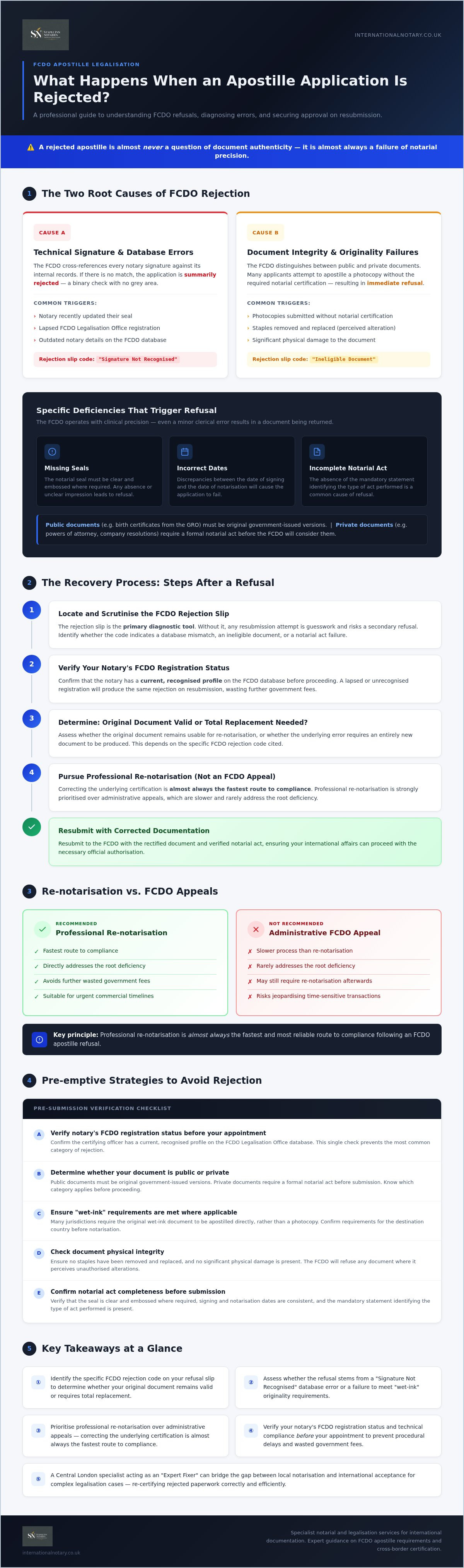
The FCDO maintains an extensive database of authorised UK notary signatures and seals. Every time a Notary Public signs a document for international use, the FCDO cross-references that signature against their internal records. If the signature is not recognised, the application is summarily rejected. This often occurs if a notary has recently updated their seal or if they haven't maintained an active registration with the FCDO's Legalisation Office. It's a binary check; if the record doesn't match, the process stops.
Selecting a verified Notary Central London ensures that your certifying officer has a current, recognised profile on this database. If your notary's details are outdated, the resulting delay can jeopardise time-sensitive commercial transactions. We frequently assist clients who have experienced rejections due to using practitioners with lapsed records, acting as an expert fixer to re-certify the paperwork correctly and efficiently.
Document Integrity and "Originality" Requirements
The distinction between public and private documents is a frequent source of confusion. Public documents, such as birth certificates from the General Register Office (GRO), must be the original government-issued versions. Private documents, including powers of attorney or company resolutions, require a formal notarial act before the FCDO will consider them. Many applicants attempt to apostille a photocopy without the required notarial certification, leading to an immediate refusal.
A common trigger for refusal is the submission of a photocopy without the correct notarial wording. Whilst some jurisdictions accept "true copy" certifications, many others require the original "wet-ink" document to be apostilled directly. If the FCDO perceives any unauthorised alterations, such as staples that have been removed and replaced or significant physical damage, they'll likely refuse the application to maintain the integrity of the legalisation chain. When considering what happens if an apostille is rejected, you must also check for these technical omissions:
Missing Seals: The notarial seal must be clear and embossed where required.
Incorrect Dates: Discrepancies between the date of signing and the date of notarisation.
Incomplete Notarial Act: The absence of the mandatory statement identifying the type of act performed.
The FCDO operates with clinical precision. Even a minor clerical error in the notarisation process will result in a document being returned. By identifying these triggers early, you can rectify the documentation before resubmitting, saving both time and additional government fees.
The Recovery Process: Immediate Steps After an Apostille Refusal
Receiving a returned document without the expected gold seal is a significant procedural setback, particularly when international business contracts or property transfers are at stake. The first step in understanding what happens if an apostille is rejected is to locate and scrutinise the FCDO rejection slip. The rejection slip serves as the primary diagnostic tool for identifying the specific technical or administrative failure within a legalisation application. Without this slip, any attempt at resubmission is merely guesswork and risks a secondary refusal.
Diagnosing the Rejection Slip
Standard FCDO refusal terminology can be opaque to those outside the legal profession. For instance, a "Signature Not Recognised" code indicates a database mismatch, whereas "Ineligible Document" suggests the paperwork itself does not meet the FCDO apostille legalisation guidance criteria. You must determine if the error lies with the document's provenance or the previous certification. If the paperwork is a corporate resolution, you might need a fresh original; if the issue is merely a missing notarial seal, a corrective certification may suffice. Consulting an experienced notary public allows for a technical audit of the failure, ensuring the root cause is addressed before resubmission.
Time is your most volatile asset. A rejection can add days or weeks to a timeline, potentially triggering penalty clauses in overseas contracts or delaying personal matters like marriage or probate. Act immediately. Analyse the slip, secure a professional review, and prepare for a swift re-submission to mitigate the impact on your deadlines.
Financial and Procedural Implications
The FCDO operates a "lost fee" policy. In almost all instances, the government does not refund the application fee for rejected documents, meaning every failed attempt increases the total cost of your legalisation project. This makes the financial burden of multiple rejections substantial, especially for corporate entities processing high volumes of paperwork. Beyond the monetary loss, repeated refusals can draw unwanted scrutiny to specific signatures or document types, potentially complicating future applications.
To minimise further costs, your second submission must be technically flawless. This involves verifying every stamp, signature, and wording against the current FCDO requirements. If you are unsure why your paperwork was returned, you may contact our notary public team for a professional assessment to prevent a recurring refusal. Our role as an expert fixer is to bridge the gap between a failed application and a successful international legalisation.
Re-notarisation vs. FCDO Appeals: Choosing the Right Path
When a document is returned without the required certification, the natural inclination for many applicants is to challenge the FCDO's decision through a formal appeal. However, administrative appeals within the UK Legalisation Office are notoriously slow and rarely result in a reversal of the initial refusal. Addressing what happens if an apostille is rejected involves a strategic choice between a lengthy contest and immediate corrective action. In almost every instance, re-notarisation is the more pragmatic and efficient path to compliance.
The Role of Corrective Notarisation
A specialist notary acts as an expert fixer by "curing" the defects that led to the initial refusal. This process involves executing a new notarial act that addresses the specific technical omissions, such as missing seals or incorrect certification wording. The Hague Conference on Private International Law apostille standards dictate the global framework for these certifications; any deviation from these norms results in rejection. Utilising a Mobile Notary London service allows for the immediate correction of paperwork at your place of business, eliminating the need for you to travel to a central office during a time-sensitive transaction.
Our Apostille or Notarisation? 2026 Legalisation Guide provides further technical clarity on the distinct roles these processes play in international document acceptance. A new certification ensures the document meets both the FCDO's internal database requirements and the specific legal standards of the destination country. Don't waste weeks on an appeal when a professional re-notarisation can resolve the issue in a single appointment.
E-Apostille Rejections: Digital Specifics
Digital certification introduces a different set of technical hurdles. Understanding what happens if an apostille is rejected in the digital sphere requires an analysis of PDF security settings and digital signature validity. The FCDO often rejects e-Apostille applications if the document contains restricted editing permissions or if the notary's digital signature doesn't align with the FCDO's technical pilot scheme requirements. Even if a document appears valid on your screen, it may fail the government's automated verification checks.
Complex corporate legalisation disputes often arise from these digital technicalities. In such cases, involving a specialist legal advisor is necessary to navigate the overlap between traditional notarial law and modern digital authorisation. We ensure that your digital documents are prepared using the correct software protocols and cryptographic standards. This meticulous approach prevents the technical database errors that frequently plague e-Apostille submissions, providing a streamlined route to international validity without the risk of a secondary refusal.
Pre-emptive Strategies for International Document Approval
Proactive document preparation is the only reliable defence against administrative delays. Understanding what happens if an apostille is rejected is less valuable than ensuring your first submission is technically unassailable. Before you attend a notarial appointment, you must confirm the practitioner’s current FCDO registration status. If a notary has recently changed their seal or updated their signature without notifying the Legalisation Office, your application will fail regardless of the document's validity. This verification is a critical first step for any high-value international transaction.
The "wet-ink" rule remains a cornerstone of FCDO policy for private documents. Unless you have specific authorisation for a certified copy, you should always submit the original instrument. Recipient countries also maintain varying standards regarding "bundled" documents. Whilst some jurisdictions allow multiple company resolutions to be covered by a single apostille, others require individual certification for every page. Clarifying these requirements with your overseas counsel before notarisation prevents the need for costly and time-consuming remediations.
The Checklist for Faultless Submission
A successful application relies on meticulous attention to physical detail. The FCDO examiners are trained to identify any signs of tampering or procedural non-compliance. Follow this technical checklist before dispatching your paperwork:
Seal Legibility: Ensure the notarial seal is clear, embossed where necessary, and perfectly matches the record held by the FCDO.
Binding Integrity: Use professional eyelets or ribbons. Any loose pages or signs that a document has been unpicked and re-stapled will trigger an immediate rejection for suspected tampering.
Attachment Precision: The notarial certificate must be firmly attached to the underlying document. A loose certificate is an invalid certificate.
Date Consistency: Verify that all signatures are dated correctly. Discrepancies between the signing date and the notarial act date are common triggers for refusal.
Leveraging Local London Expertise
Utilising a Notary London provides a distinct logistical advantage due to our proximity to the FCDO processing centres. This central location allows professional agents to navigate the "Premium Service" specifically designed for urgent business documents. This service is restricted to registered users and offers a level of oversight that postal applications cannot match. Our central proximity to the Legalisation Office allows for real-time monitoring of submissions, effectively eliminating the communication gaps that lead to rejection for urgent applications.
Professional legalisation agents act as a final filter. We review the paperwork with the clinical eye of an examiner before it ever reaches the FCDO desk. If you are managing a complex corporate resolution or a time-sensitive power of attorney, you can consult our London notary team to ensure your submission meets every technical threshold. This expert oversight is the most effective way to secure international approval on the first attempt.
The Staple Inn Approach: Expert Legalisation Support in Central London
Staple Inn Notaries operates at the intersection of rigorous regulatory compliance and rapid commercial execution. We act as an "Expert Fixer" for individuals and corporate entities whose documentation has failed to meet the FCDO's technical thresholds. We understand what happens if an apostille is rejected and, more importantly, how to reverse that outcome through precise remedial certification. Our role is to bridge the gap between a flawed application and a successful international legalisation, providing a persona of calm competence that reduces client anxiety during time-sensitive transactions.
Our location in Chancery Lane offers a distinct logistical advantage for both FCDO and embassy legalisation. Proximity to these central processing hubs allows our team to manage the entire chain of authentication, from the initial notarial act to the final delivery of the apostilled document. This comprehensive oversight ensures that every stamp, seal, and signature is verified against the most current database requirements before submission. By eliminating the communication gaps inherent in postal applications, we provide a level of responsiveness that is essential for high-value global legal transactions.
Specialist Support for Corporate and Private Clients
Complex business structures require a specialized approach to document authentication. We handle corporate power of attorney notarisation London with clinical precision, ensuring that company resolutions and signatory authorities are certified in a format that the FCDO cannot contest. For private clients, we streamline the process for international probate or property acquisitions, where a single rejection can lead to significant financial penalties or the collapse of a deal. We maintain the highest regulatory standards whilst operating with a modern, fast-paced mindset that respects your deadlines.
Meticulous document review is the foundation of our service. We don't merely witness signatures; we audit the entire instrument for potential rejection triggers. This includes checking the physical integrity of the paper, the clarity of the embossed seals, and the specific wording of the notarial certificate. This "right first time" methodology is designed to eliminate the procedural delays that often plague unassisted applications, ensuring your international affairs proceed without administrative friction.
Next Steps: Securing Your International Validity
Securing an apostille on the second attempt requires a professional intervention that addresses the root cause of the initial refusal. Whether your document was rejected for a database error or a formatting technicality, we provide the expert oversight needed to rectify the situation. You can book an urgent appointment at our Central London office or utilise our mobile service for added convenience. We operate with a sense of controlled urgency, focusing on the practical need for rapid service without compromising the gravity of legal certification. Contact Staple Inn Notaries today to rectify your document legalisation and restore your commercial timeline.
Securing International Validity for Your Documentation
Navigating FCDO refusals requires a shift from administrative frustration to methodical remediation. Whilst a rejection slip can disrupt critical timelines, it provides the exact diagnostic data needed to rectify the underlying certification. By prioritising expert re-notarisation over lengthy appeals, you ensure that your documents satisfy both UK database requirements and international legal standards. Understanding what happens if an apostille is rejected is the first step toward securing your international transaction with absolute certainty.
Staple Inn Notaries provides the specialized expertise required to navigate these technical complexities with precision. As a firm regulated by the Faculty Office of the Archbishop of Canterbury, we leverage our Central London location to provide rapid, reliable legalisation for corporate and private clients alike. Our expertise in urgent business legalisation ensures that your second attempt is technically flawless, protecting your commercial interests and reducing procedural anxiety. Book a Professional Consultation to Secure Your Apostille and restore your global timeline today. Your international objectives remain entirely achievable with the right professional oversight.
Frequently Asked Questions
Does the FCDO refund the fee if my apostille application is rejected?
The FCDO operates a non-refundable fee policy for all legalisation applications. Once the Legalisation Office processes the document, the administrative fee is forfeited regardless of whether the apostille is issued or refused. This lost fee policy highlights why understanding what happens if an apostille is rejected is critical for managing project budgets. To avoid repeated costs, ensure every technical detail is verified by a professional before your second submission is dispatched.
Can I use a solicitor instead of a notary to avoid apostille rejection?
Whilst the FCDO recognises signatures from certain UK solicitors, a Notary Public is the internationally recognised standard for cross-border transactions. Most foreign jurisdictions specifically require a notarial act for instruments like powers of attorney or company resolutions. Using a solicitor for documents intended for civil law countries often leads to rejection at the destination, even if the FCDO initially grants the apostille. Notarial certification provides a higher level of international validity.
What is the most common reason for a UK apostille being refused?
The most frequent trigger for refusal is the "Signature Not Recognised" error. This occurs when the certifying officer's signature or seal does not match the current record held in the FCDO database. Other common reasons include submitting photocopies of public documents, such as birth certificates, which must be originals, or providing private documents without a valid notarial act. Meticulous verification of the notary’s FCDO registration status is essential to prevent these failures.
How long does it take to fix a rejected apostille application in London?
The timeline for rectification depends on the complexity of the error. If the document requires re-notarisation, an appointment at our Central London office can be arranged swiftly. When combined with the FCDO premium service for business documents, the recovery process can often be completed within a few working days. However, if a new original document must be sourced from a government body, the delay will extend according to their standard issuance times.
Can a document be rejected because the notary signature is too old?
Yes, the FCDO may reject an application if a notary’s signature or seal has changed since they last updated their official record. If a practitioner has recently renewed their commission or updated their stamp without notifying the Legalisation Office, the database mismatch will trigger an automatic refusal. We maintain a current and verified record with the FCDO to ensure our clients avoid these technical database errors during the legalisation process.
What should I do if the destination country rejects an apostille that the FCDO approved?
If an overseas authority rejects a valid UK apostille, the issue usually relates to additional requirements like embassy legalisation or a certified translation. Some countries require the apostille to be issued on the original document rather than a certified copy. You should consult the recipient's counsel to identify the specific local regulation that hasn't been met. Our team can then assist in re-preparing the document to satisfy those precise international standards.
Is an e-Apostille more likely to be rejected than a physical one?
e-Apostilles face unique technical hurdles that differ from physical certifications. Rejections often stem from PDF security settings that prevent the FCDO from applying a digital seal or from the use of unauthorised digital signature software. Whilst the e-Apostille system is designed for efficiency, it requires a notary experienced in the UK's specific digital protocols. Failure to follow these technical requirements is a primary reason for what happens if an apostille is rejected in digital formats.
Can Staple Inn Notaries fix an application rejected by another provider?
Yes, we frequently act as an expert fixer for applications that were previously refused. We perform a technical audit of the FCDO rejection slip to identify the exact cause of failure before re-certifying the document. Our Central London location and deep expertise in urgent business legalisation allow us to remediate defective paperwork efficiently. We ensure the new submission meets every regulatory threshold, providing the professional authority needed for successful international document approval.


Comments