
Apostille or Notarisation? 2026 Legalisation Guide

A notary’s signature is frequently only the first half of a legal bridge that spans international borders. If you're managing a high-stakes cross-border transaction or a sensitive personal matter, the terminology often feels like a labyrinth designed to cause procedural delay. You've likely reached a point of frustration asking: do I need an apostille or notarisation to ensure my Power of Attorney or company resolution is actually accepted by a foreign registry? We understand the pressure of tight deadlines and the very real fear of document rejection at a distant border.
This 2026 guide provides the technical clarity required to navigate the UK’s legalisation framework with absolute certainty. You'll understand the precise distinction between the notary’s verification of identity and the FCDO’s authentication of that notary’s standing. We'll outline the latest Hague Convention updates for countries like China and Viet Nam, explain why the paper-based apostille remains the global gold standard despite digital shifts, and provide a streamlined path to securing your documentation from our Central London office. Move forward with the confidence that your legal paperwork is beyond reproach.
Table of Contents
Understanding the Core Differences: Notarisation vs Apostille
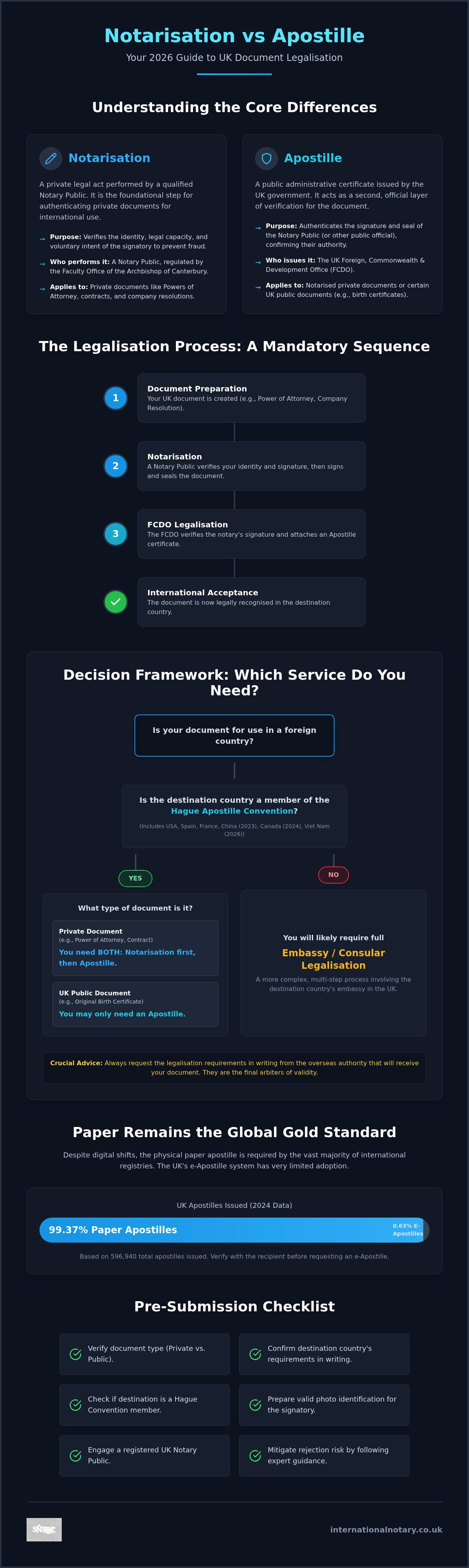
Deciding do I need an apostille or notarisation requires understanding that these are two distinct stages in a single verification chain. Notarisation is a private legal act where a Notary Public certifies the execution of a document. In contrast, an apostille is a public administrative act issued by the UK government to confirm the notary's authority. Both share a common objective: ensuring your UK documentation is legally recognised within a foreign jurisdiction.
The fundamental rule is that an apostille cannot exist in isolation for private documents. It acts as a second layer of security. The Foreign, Commonwealth & Development Office (FCDO) won't issue an apostille unless the document already bears a recognised professional signature, such as that of a notary or solicitor. This creates a mandatory sequence where notarisation typically precedes legalisation. Understanding this hierarchy is essential for avoiding costly rejections at foreign registries.
The Role of the Notary Public in London
A Notary Public in London serves as the primary gatekeeper for international transactions. Regulated by the Faculty Office of the Archbishop of Canterbury, the notary's duty is to verify the identity, legal capacity, and voluntary willingness of the person signing the document. This meticulous process prevents fraud and ensures that the document is fit for its intended purpose abroad. As an "Expert Fixer," the notary ensures the specific requirements of the receiving country are met before the document leaves the UK. Notarisation stands as the primary layer of document authentication for all international use. Secure your certification today.
The Function of the Apostille Certificate
The Apostille and Legalisation Services provided by the FCDO serve to verify the notary’s standing rather than the document’s content. Under the Hague Apostille Convention, this certificate confirms that the signature and seal on the document belong to a validly appointed official. While the UK has introduced the e-Apostille, 2024 data indicates that only 0.63% of the 596,940 apostilles issued were electronic. This confirms that physical paper apostilles remain the standard for the vast majority of international registries. Whether you require a traditional paper certificate or a digital version, the apostille provides the final government-backed seal of approval required for global acceptance.
The Decision Framework: When Do You Need Which Service?
Determining exactly do I need an apostille or notarisation depends entirely on the specific instructions provided by your overseas legal counsel or the foreign registry. They are the final arbiters of validity. If you're dealing with a private document, such as a contract or a Power of Attorney, notarisation is almost universally the mandatory first step. Conversely, certain public documents issued by UK government bodies, like an original birth certificate or a decree absolute, might only require an apostille directly from the Foreign, Commonwealth & Development Office (FCDO) without prior notary intervention. Always request these requirements in writing to prevent administrative delays.
The 2026 landscape has seen a gradual shift towards digitisation, yet the e-Apostille remains a specialized solution with strict limitations. While the FCDO offers an electronic option, many international registries still demand physical wet-ink signatures and embossed seals. Before opting for a digital certificate, you must verify that the receiving institution has the technical infrastructure to authenticate it. For most high-value professional transactions in Central London, the traditional paper-based chain of trust remains the safest path to ensure compliance with official apostille requirements globally.
The Hague Apostille Convention Explained
The Convention simplified international document legalisation amongst member states by replacing the cumbersome embassy attestation process with a single certificate. If your document is destined for a member nation, an apostille is the standard requirement. This includes major jurisdictions such as the USA, Spain, and France, as well as recent additions like China (2023), Canada (2024), and Viet Nam (2026). When you ask do I need an apostille or notarisation for these countries, the answer is frequently both. Learn more about our apostille services to see how we manage this for you.
Common Scenarios for London Professionals
In our Central London practice, we frequently manage three primary scenarios that require integrated legalisation. First, buying property abroad usually requires a notarised and apostilled Power of Attorney to grant your foreign lawyer the necessary authority. Second, international company expansion necessitates notarised company resolutions and certificates of incorporation to satisfy foreign commercial registries. Finally, overseas job applications often require notarised and apostilled educational certificates or DBS checks to prove professional standing. If your situation falls into these categories, you should contact our Central London office to initiate the process immediately.
The Verification Chain: Why You Often Need Both
Legalisation is the comprehensive umbrella term describing the multi-stage process of validating a UK document for international use. When clients ask do I need an apostille or notarisation, they are usually inquiring about a single link in a larger, rigid chain of authority. This sequence is hierarchical and must be followed precisely to ensure validity. It typically adheres to a 1-2-3 progression: initial notarisation by a qualified Notary Public, followed by the issuance of an apostille by the Foreign, Commonwealth & Development Office (FCDO), and finally, if required, consular or embassy legalisation. Disrupting this order almost inevitably results in document rejection at the foreign border, leading to significant delays in international transactions.
Attempting to bypass the initial notarisation stage is a frequent cause of procedural failure. The FCDO maintains a database of registered signatures and seals; they will only authenticate a document that has been signed by a recognised official. Consequently, if a private document lacks a notary's seal, the legalisation chain is broken before it begins. Getting the sequence right from the outset is the only way to avoid forfeited government fees and the administrative burden of restarting the entire process. When you're facing tight deadlines, understanding that you likely need both services is the first step toward a successful outcome.
Beyond the Apostille: Consular and Embassy Legalisation
For countries that are not signatories to the Hague Convention, or those with specific additional requirements such as the UAE or Qatar, the apostille is merely an intermediate step. These jurisdictions require a final 'seal' of approval from their own embassy or consulate in London. This additional layer of scrutiny ensures the document meets the specific domestic standards and regulatory frameworks of the destination country. Navigating these varying requirements demands specialized expertise to ensure your paperwork is not returned for minor technical errors. You may explore our legal advisory services for complex cases to ensure every link in your specific verification chain is secure.
Corporate Requirements for Central London Firms
High-value international business transactions demand a level of certification that a standard solicitor's signature cannot provide. For board resolutions, mergers, or acquisitions, foreign registries and international banks often insist on corporate power of attorney notarisation London professionals trust. A Notary Public provides a higher level of international recognition than a solicitor, which is critical when dealing with sensitive corporate governance documents. Our office operates with the controlled urgency required for time-sensitive transactions, ensuring that your documentation is both compliant and delivered within the narrow windows often found in international finance and cross-border commercial law.
A Practical Checklist for Successful Legalisation
Securing international document recognition is a methodical process that leaves no room for administrative oversight. Before asking do I need an apostille or notarisation, you must obtain precise instructions from the receiving party abroad. This written confirmation prevents the common error of procuring the wrong level of certification. If you remain uncertain about the specific sequence, asking do I need an apostille or notarisation should be your first action when speaking with our team to avoid procedural delays.
Your preparation should follow these core requirements:
Verify whether the foreign registry requires original documents or if certified copies are acceptable.
Check that your identification documents haven't expired; a notary cannot accept an invalid passport or driving licence.
Confirm the preferred format of legalisation. While the UK issued nearly 600,000 apostilles in 2024, the vast majority were physical.
Determine if the recipient accepts an e-Apostille. Ensure your document is eligible, as many certificates, such as birth or marriage records, are currently excluded from the digital process.
Preparing for Your Notary Appointment
Efficiency is paramount. When attending your appointment, you must present a valid photographic ID alongside a recent proof of address. It's vital that you don't sign the document before the meeting. The notary’s primary function is to witness the act of signing to certify its authenticity. If you cannot travel to our office, you can find details on preparing for your appointment with a Mobile Notary London to facilitate on-site certification at your premises.
Common Pitfalls to Avoid
Document rejection often stems from a misunderstanding of professional designations. Many foreign jurisdictions specifically require a Notary Public and will not accept a solicitor’s signature. Similarly, attempting to apply for an apostille on a document that hasn't been properly notarised is a guaranteed path to failure. The FCDO will reject any application that lacks the necessary professional certification. Consider language barriers as well. Some countries require a certified translation to be bound with the notarised document. Ignoring these linguistic requirements can stall your transaction for weeks. To avoid these setbacks, contact our Central London office for expert guidance on your specific legalisation path.
Streamlining the Process with Staple Inn Notaries
When you are caught in the complexity of international document validation, the primary question remains: do I need an apostille or notarisation? Staple Inn Notaries serves as the "Expert Fixer" for both private and corporate clients in Central London. By consolidating the entire chain of trust into a single professional workflow, we eliminate the friction of dealing with multiple agencies. Our office manages the progression from initial certification to final government authentication with the controlled urgency your deadlines demand. We act as a trusted gatekeeper, ensuring that every seal and signature is applied with meticulous precision.
Managing both notarisation and the apostille through a single professional office provides a significant advantage in terms of efficiency and risk mitigation. Instead of navigating the FCDO's administrative requirements yourself, you benefit from our established procedural knowledge and direct proximity to the legal heart of London. Situated near Chancery Lane and Holborn, our firm is ideally positioned for urgent business matters requiring rapid turnaround. Being regulated by the Faculty Office of the Archbishop of Canterbury provides the professional authority required to ensure your documents carry the necessary weight in foreign jurisdictions. This high level of regulation offers peace of mind that your documentation is beyond reproach.
Our Comprehensive Legalisation Service
Our approach encompasses every necessary stage of the verification chain. This includes initial notarisation of signatures, FCDO apostille procurement, and, where necessary, complex embassy attestation for non-Hague countries. We provide bespoke solutions tailored to the specific needs of private individuals and corporate entities alike. Whether you are dealing with a property sale in Spain or a complex corporate merger in the Middle East, our team ensures every link in the chain is secure. Staple Inn Notaries organises the full legalisation programme to meet tight international deadlines, allowing you to focus on your transaction rather than the paperwork.
Booking Your Professional Consultation
We offer flexible appointment structures to accommodate the fast-paced nature of international commerce. You may visit our Central London office for a formal consultation or utilise our mobile notary service for on-site certification at your premises. This responsiveness ensures that even the most time-sensitive documents are processed without delay. Book an appointment directly via Calendly to secure a time that fits your schedule. For those requiring a specific breakdown of costs or a timeline for complex legalisation, contact Staple Inn Notaries today for an efficient legalisation quote and resolve the question of do I need an apostille or notarisation with absolute certainty.
Ensure Global Acceptance for Your Legal Documents
Navigating the UK’s legalisation framework requires a precise understanding of the hierarchy between professional certification and government authentication. Notarisation serves as the essential first layer, verifying the identity and capacity of the signatory, whilst the apostille provides the secondary government-backed confirmation of the notary’s standing. Maintaining this rigid sequence is the only way to avoid the administrative rejection of your Powers of Attorney or corporate resolutions at foreign borders.
When you ask do I need an apostille or notarisation, the answer is often found in the specific requirements of the receiving jurisdiction. Our Central London firm, regulated by the Faculty Office of the Archbishop of Canterbury, specialises in providing a seamless "one-stop" solution for both private individuals and corporate entities. We operate with a modern, fast-paced mindset to ensure your documents are processed with the controlled urgency your international transactions require. Don't let procedural confusion stall your progress abroad.
Secure your notarisation and apostille with Staple Inn Notaries today. We look forward to facilitating your global success.
Frequently Asked Questions
Do I always need a notary public before I can get an apostille?
You don't always require a notary for public documents issued directly by UK government bodies, such as original birth, marriage, or death certificates. However, for private documents like a Power of Attorney or a company resolution, notarisation is a mandatory prerequisite. The FCDO will only issue an apostille if the document bears the signature of a recognised public official. When clients ask do I need an apostille or notarisation, we typically advise that private legal acts require both.
Can I get an apostille without a notary's signature?
Yes, you can obtain an apostille without a notary's signature if the document is an original UK public record. This includes certificates issued by the General Register Office or documents signed by specific court officials. For any private legal document, the FCDO requires the signature and seal of a Notary Public or solicitor before they can authenticate the paperwork. Without this professional certification, the application will be rejected, resulting in unnecessary delays for your international project or transaction.
How long does the legalisation process typically take in London?
The timeframe for the legalisation process in London depends on the service level selected. Standard postal applications to the FCDO can take up to 25 working days plus postage time. However, by utilising a registered agent in Central London, the process is significantly accelerated. Professional services can often secure an apostille as fast as the next working day for registered businesses. This streamlined approach is essential for corporate entities and private individuals facing tight international transaction deadlines.
What is an e-Apostille and is it accepted in all countries?
An e-Apostille is a digital certificate issued by the FCDO to authenticate electronic signatures on PDF documents. While it offers a modern alternative to paper, it's not yet universally accepted. Many foreign registries and banks still demand physical documents with wet-ink signatures and embossed seals. In 2024, only 0.63% of UK apostilles were electronic. You must verify with the receiving party abroad whether they have the technical infrastructure to accept and verify a digital e-Apostille before proceeding.
Does an apostille certificate have an expiry date?
An apostille certificate does not have a technical expiry date under the Hague Convention. However, the underlying document or the receiving institution abroad may impose their own validity periods. Foreign registries often require documents, such as criminal record checks or certificates of no impediment, to be less than three or six months old. It's critical to check the specific requirements of the destination country to ensure your legalised paperwork remains valid for your intended transaction or residency application.
Why might the FCDO reject my document for an apostille?
Rejection typically occurs if the document lacks the correct professional certification or if the official's signature is not on the FCDO's registered database. If you are unsure and asking do I need an apostille or notarisation, remember that skipping the notary stage for a private contract is a primary cause of rejection. Other reasons include using photocopies that haven't been properly certified or submitting documents with significant physical damage that obscures the official seals or signatures during the scanning process.
Can a standard solicitor provide an apostille for international use?
A solicitor cannot issue an apostille; only the Foreign, Commonwealth & Development Office has the authority to do so in the UK. While a solicitor can certify certain documents for legalisation, many foreign jurisdictions specifically require the higher authority of a Notary Public. For high-value transactions or countries with civil law systems, a notary's seal is often the only acceptable form of certification. Using a notary ensures broader international recognition and reduces the risk of rejection by foreign authorities.
What is the difference between legalisation and an apostille?
Legalisation is the entire multi-step process of making a UK document legally valid for use in another country. An apostille is a specific type of certificate issued as part of that process under the Hague Convention. For countries that are not members of the Convention, legalisation requires further steps beyond the apostille, such as embassy or consular attestation. Understanding this distinction is vital for ensuring your documentation follows the correct verification chain for your specific destination, whether it's France, Dubai, or China.


Comments