
Asset Protection Trust UK: A Professional Guide to Safeguarding Wealth in 2026
- PPC Guyz Google & Semrush Certified
- Jul 26
- 12 min read

Updated: Aug 10
Is your family home a private legacy or a future asset for the local authority to claim? For many, the prospect of losing a lifetime of hard-earned wealth to care costs or probate delays is a source of significant distress. You've likely seen the aggressive online advertisements from unregulated providers promising "bulletproof" solutions, yet these often lack the legal rigour required to withstand HMRC scrutiny. Establishing a legitimate asset protection trust UK is not about finding a loophole; it's about employing a regulated legal framework to ensure your estate passes to the next generation with absolute certainty.
We understand that the complexity of UK trust law can feel overwhelming, particularly with the IHT nil-rate band frozen at £325,000 until 2031 and new restrictions on property reliefs taking effect in April 2026. This guide clarifies the professional standards required for robust wealth safeguarding. You'll discover how to protect your savings whilst avoiding the common pitfalls of "trust traps" that can lead to deprivation of asset charges. We provide a clear breakdown of the 2026 regulatory landscape, the role of professional trust administration, and the specific steps needed to reduce probate costs and ensure your family's future remains secure.
Table of Contents
What is an Asset Protection Trust in the UK?
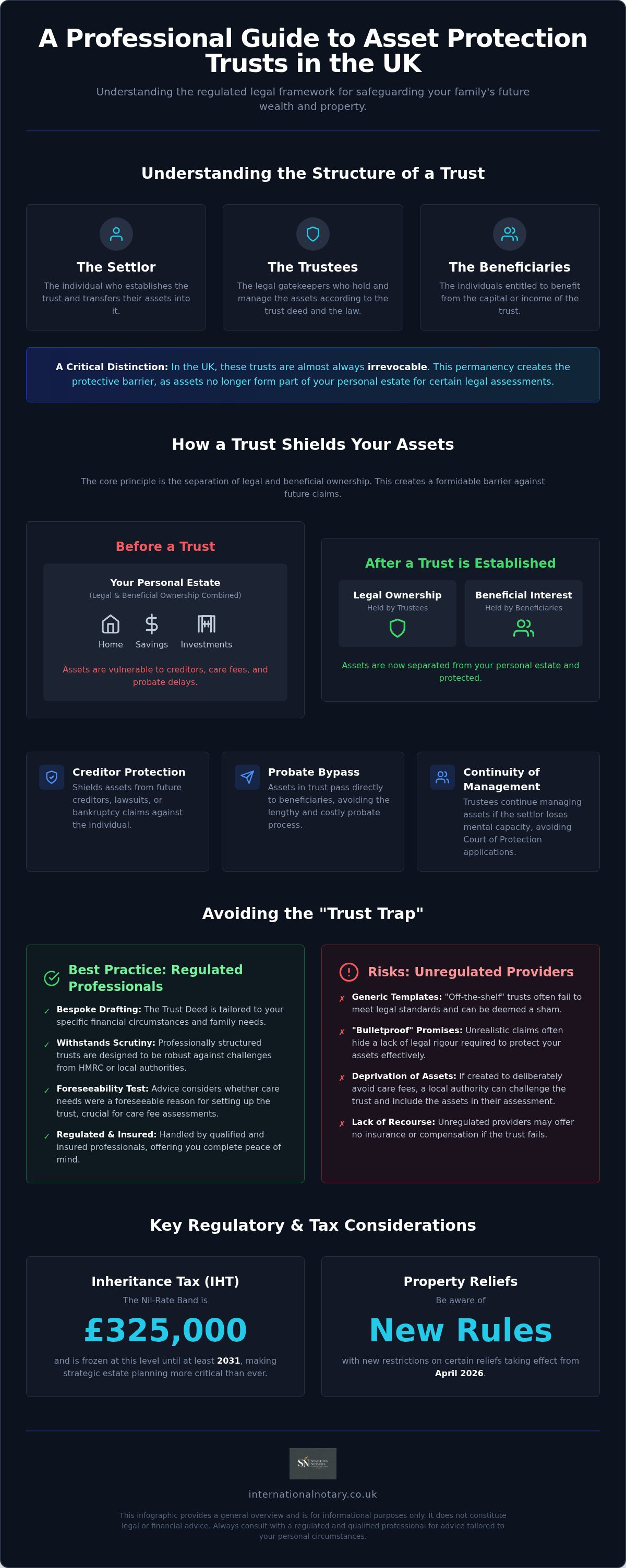
An What is an Asset Protection Trust? is a sophisticated legal arrangement where a person, known as the settlor, transfers the legal ownership of their assets to a group of individuals or a company called trustees. These trustees hold and manage those assets for the benefit of specific individuals, known as beneficiaries. While the term asset protection trust UK is widely used in professional circles, you'll often encounter marketing terms like "Family Protection Trusts" or "Lifetime Trusts" in the public domain. These labels often simplify the gravity of the legal shift occurring; you're essentially divesting yourself of legal title to ensure the long-term security of your estate.
The structure relies on three distinct roles. As the settlor, you're the one who establishes the rules. The trustees act as the legal gatekeepers, ensuring the trust operates within the bounds of the law and your specific instructions. Finally, the beneficiaries are those entitled to the capital or income generated by the trust. In a UK context, these structures are almost always irrevocable. This means once the assets are transferred, the decision can't be easily reversed. This permanency is what creates the protective barrier, as the assets no longer form part of your personal estate for certain legal or tax assessments.
The Legal Framework of UK Trusts
The robustness of these arrangements is rooted in established legislation, primarily the Law of Property Act and the Trustee Act 2000. These statutes dictate how trustees must behave and how property must be handled. Every valid trust requires a precisely drafted "Trust Deed". This document is the constitutional heart of the arrangement. Generic, "off-the-shelf" templates frequently fail to meet the rigorous standards set by HMRC or local authorities. Without bespoke drafting that accounts for your specific financial circumstances, a trust may be deemed a sham, leaving your assets vulnerable to the very risks you sought to avoid.
Common Assets Placed in Protection Trusts
The family home is the most frequent asset placed into a trust. Through careful drafting, a settlor can transfer the legal title whilst retaining a life interest, which provides a guaranteed right to reside in the property. Beyond residential property, clients often include investment portfolios and significant cash reserves. For business owners, transferring business interests into an asset protection trust UK requires meticulous administration. This often involves company resolution certification and notarisation to ensure the transfer is recognised both domestically and internationally. Using a regulated professional ensures these transitions are documented with the necessary precision to withstand future challenges.
The Mechanics of Protection: How Trusts Shield Assets
The effectiveness of an asset protection trust UK hinges on the absolute separation of legal and beneficial ownership. When you transfer assets into a trust, you relinquish legal title. The trustees become the legal owners, whilst the beneficiaries hold the beneficial interest. This creates a formidable barrier. Because the settlor no longer personally owns the property or capital, these assets are typically shielded from future creditors or legal claims against the individual. For a detailed understanding of how different structures impact your liabilities, consult the UK government guidance on trusts and taxes.
Beyond immediate protection, trusts serve as a strategic tool for probate bypass. Assets held within a trust do not form part of your estate for probate purposes. This means they can be distributed to beneficiaries immediately upon death without the delays and costs associated with obtaining a Grant of Probate. Additionally, trusts provide vital continuity. If a settlor loses mental capacity, the trustees continue to manage the assets according to the trust deed. This avoids the need for a potentially intrusive and lengthy Court of Protection application.
The Role of the Trustee
Trustees are bound by strict fiduciary duties. They must act in the best interests of the beneficiaries at all times. Choosing a professional trustee often provides greater security than appointing family members, as professionals possess the technical expertise to manage complex tax filings and compliance. Meticulous record-keeping is a legal necessity. Our team facilitates the Trust Administration process by ensuring that all documentation, including annual accounts and trustee resolutions, meets the highest regulatory standards.
Safeguarding Against Divorce and Bankruptcy
Trusts are instrumental in keeping family wealth within the bloodline. By placing an inheritance into a trust rather than gifting it directly, you can protect a child’s assets from being considered in their own future divorce settlements or bankruptcy proceedings. This creates a "ring-fencing" effect. Ring-fencing describes the legal segregation of assets within a trust to ensure they remain protected for the specific use of beneficiaries as supported by the management standards in the Trustee Act 2000. This protective envelope ensures that wealth remains accessible only to those you intended to benefit. If you require assistance with the formal certification of trust documents, our specialists at Staple Inn Notaries can provide the necessary professional oversight.
The Care Fee and Tax Debate: Myth vs. Reality
The effectiveness of an asset protection trust UK is frequently misunderstood due to conflicting information regarding local authority powers. Marketing myths often suggest that placing a home in a trust provides an absolute shield against care home fees. In reality, local authorities possess the legal right to "look through" a trust if they suspect a deliberate deprivation of assets. This occurs when a person intentionally reduces their capital to qualify for means-tested support. The "Foreseeability" test is the primary metric used in these investigations. If you were in good health and had no reasonable expectation of needing care when the trust was established, the council's ability to challenge the transfer is significantly diminished.
Taxation remains another area where precision is mandatory. Lifetime transfers into most trusts are governed by the "Relevant Property" regime. If the value of the assets transferred exceeds your £325,000 nil-rate band, an immediate 20% IHT entry charge applies. However, a couple can effectively transfer assets worth up to £650,000 without triggering this upfront cost. Beyond the entry charge, these trusts are subject to periodic charges of up to 6% every ten years and exit fees when capital is distributed. For those transferring property, Capital Gains Tax (CGT) at 24% may apply to gains, although "gift hold-over relief" can sometimes defer this liability. You should consult official government guidance on trusts to understand how these rules apply to your specific portfolio.
Navigating Local Authority Assessments
In 2026, the upper capital limit for means-tested care in England remains a critical threshold. If your assessable assets exceed £23,250, you are typically required to self-fund the full cost of your residential care. Establishing a trust whilst in robust health provides a much stronger legal defence. It's essential to document a clear, non-care related motivation for the trust, such as protecting a child's inheritance from future bankruptcy or ensuring the continuity of a family business. This documentation serves as vital evidence if the local authority ever reviews your financial history.
Trusts and Inheritance Tax (IHT) Planning
Integrating these structures into a wider Wills and Estate Planning strategy is the only way to ensure long-term tax efficiency. Whilst the nil-rate band is frozen at £325,000 until April 2031, the rising value of London property means more estates are falling into the tax net. A well-managed trust can help manage this exposure over decades. By planning early, you ensure that the trust serves its primary purpose of wealth preservation without creating an unforeseen tax burden for your beneficiaries. We focus on creating defensible, transparent structures that satisfy both HMRC requirements and your family's long-term objectives.
Professional Administration: Avoiding the "Trust Trap"
Generic templates represent a significant risk to London property owners seeking long-term security. These documents often lack the specific clauses required to manage high-value estates or complex family dynamics. Relying on an unregulated "estate planner" instead of a regulated Notary or Solicitor can leave your assets vulnerable to legal challenges and administrative failure. A professionally drafted asset protection trust UK is not merely a document; it is a regulated legal framework that requires meticulous ongoing management to remain valid. Regulated professionals are subject to rigorous oversight by the Faculty Office or the Solicitors Regulation Authority, providing you with essential recourse and indemnity. Unregulated firms often disappear after the initial sale, leaving families to navigate complex legal disputes alone.
HMRC Compliance and the TRS
The mandatory Trust Registration Service (TRS) is now a central pillar of UK trust administration. Almost all express trusts, regardless of their tax liability, must be recorded on this central register. Ignoring these duties invites severe penalties and can invalidate the protective benefits of the structure. Trustees are legally required to register a new trust on the HMRC system within 90 days of its establishment. We provide the technical expertise to manage these filings, ensuring your records are accurate and up to date. Maintaining this compliance is essential for proving the legitimacy of the trust to third parties, including banks and local authorities.
The Value of Notarial Oversight
Notarisation provides a level of official validity that standard legal drafting lacks, particularly when international assets are involved. Property held in Spain, Dubai, or the USA requires documentation that meets specific jurisdictional standards for authenticity and legalisation. Our firm ensures that every component of your asset protection trust UK is certified to the highest evidentiary level, facilitating seamless cross-border asset management. We specialise in reviewing and rectifying existing trust structures that have been poorly administered or incorrectly registered by previous advisers. This "Expert Fixer" approach is vital for restoring the legal integrity of your estate planning. We provide the rapid, authoritative service needed to correct administrative oversights before they result in financial loss or regulatory penalties.
Ensure your wealth is protected by a structure that meets every regulatory requirement. Consult our Notary Public London specialists today to secure your family's future with a professionally certified trust.
Securing Your Legacy with Staple Inn Notaries
Transitioning from understanding the legal theory to implementing a robust asset protection trust UK requires a shift toward formal action. Whilst information provides clarity, only regulated professional guidance offers the necessary protection against future challenges from HMRC or local authorities. We operate with a sense of controlled urgency. This ensures your wealth is safeguarded through precise legal certification without unnecessary procedural delays. Our role is to provide the certainty that your estate planning is handled by specialists who are deeply rooted in regulation and traditional legal standards.
Our firm often acts as the "Expert Fixer" for complex estate planning. Many clients come to us with existing trust structures that were poorly drafted by unregulated entities or lack the necessary international validity. We meticulously review these arrangements to identify vulnerabilities, rectifying administrative errors before they escalate into contentious probate disputes. This authoritative oversight is essential for London property owners whose estates demand a higher level of regulatory compliance. We don't just provide documents; we provide a defensible legal fortress for your family's future.
Our Private Client Legal Services
We provide a comprehensive suite of services designed to work in harmony with your trust. This includes drafting bespoke Trust Deeds that reflect your specific family dynamics and long-term objectives. Beyond the initial setup, we offer ongoing Probate Administration and professional trust management. Our role as a gatekeeper for international documentation ensures that your assets, whether domestic or foreign, remain secure and legally valid across multiple jurisdictions. We also integrate Wills and Lasting Powers of Attorney to ensure your protection is holistic and absolute.
Next Steps for Asset Protection
Taking the first step toward securing your estate is straightforward. We offer consultations at our Central London office or through our mobile notary service for your convenience. To make our initial meeting as efficient as possible, we recommend preparing a summary of your financial assets, including property valuations and investment details. This allows us to move swiftly from assessment to implementation. Speed and precision are the hallmarks of our service. We understand the time-sensitive nature of wealth preservation and work to eliminate procedural delays at every stage.
Don't leave your family's future to chance. Secure your estate with regulated experts who understand the gravity of wealth preservation. Contact Staple Inn Notaries today to begin the process of safeguarding your legacy through a professionally managed asset protection trust UK.
Implementing Professional Safeguards for Your Estate
Establishing an asset protection trust UK is a definitive step toward ensuring that your family home and savings remain within your bloodline. You've seen that the validity of these structures depends entirely on precise drafting and rigorous adherence to HMRC compliance standards. By choosing a regulated professional over an unregulated "estate planner", you eliminate the risks associated with administrative failure and legal challenges. Our firm provides the high-level professional authority required for such complex arrangements. These structures are not merely documents; they are active legal frameworks that require expert oversight to remain robust against future scrutiny.
Staple Inn Notaries is regulated by the Faculty Office of the Archbishop of Canterbury and specialises in high-value estate planning and international legalisation. Whether you require a consultation at our Central London office or through our mobile notary service, we operate with the efficiency your financial security demands. Your legacy is too valuable to be left to chance or unregulated schemes. Our team is ready to act as your trusted gatekeeper for all international and domestic documentation, providing the rapid response and meticulous care your estate deserves.
Protect your assets with expert legal guidance from Staple Inn Notaries and gain the absolute certainty that your wealth is handled by seasoned specialists. We look forward to securing your family's future.
Frequently Asked Questions
Is an asset protection trust legal in the UK?
Yes, an asset protection trust UK is a legitimate legal structure recognised under English law. Its validity depends on the precise drafting of the Trust Deed and strict adherence to the Trustee Act 2000. It's not a loophole but a formal arrangement for managing wealth through the separation of legal and beneficial ownership. You must ensure the trust is registered with the HMRC Trust Registration Service to maintain its legal standing and transparency.
Can an asset protection trust avoid care home fees?
A trust can protect assets from care fee assessments only if it wasn't established for the primary purpose of avoiding them. Local authorities apply the "deliberate deprivation of assets" rule to challenge transfers made when the need for care was foreseeable. In 2026, if your assessable assets exceed £23,250, you'll typically face full self-funding for residential care. Timing and documented non-care motivations are the critical factors for a successful legal defence.
Will I lose control of my house if I put it in a trust?
You relinquish legal ownership to the trustees, but you don't necessarily lose the right to live in your property. Most modern trust deeds are drafted to include a life interest, granting you a guaranteed right to reside for as long as you wish. This ensures you maintain personal security whilst the protective barrier of the trust remains intact. It's a strategic trade-off between absolute legal title and the long-term preservation of family wealth.
How much does an asset protection trust cost to set up and run?
The costs vary depending on the complexity of your estate and the level of professional administration required. You'll typically encounter an initial setup fee for the bespoke drafting of the trust deed and subsequent annual fees for tax compliance, such as filing trust tax returns. It's important to view these costs as an investment in regulatory certainty. We recommend requesting a clear fee schedule from a regulated professional before committing to any structure.
Do I still have to pay Inheritance Tax if my assets are in a trust?
Assets in an asset protection trust UK are still subject to the UK tax regime. If the value transferred exceeds your £325,000 nil-rate band, you'll face an immediate 20% IHT entry charge on the excess. Additionally, most relevant property trusts are subject to periodic charges of up to 6% every ten years. These structures are primarily designed for asset protection and probate efficiency rather than as a tool for total inheritance tax avoidance.
What is the difference between a solicitor and an unregulated estate planner?
Regulation and accountability are the primary differences. Solicitors and Notaries are regulated by bodies like the Faculty Office or the SRA, meaning they must hold professional indemnity insurance and adhere to strict ethical codes. Unregulated estate planners often lack these safeguards, leaving you with little recourse if the trust is challenged or fails. Choosing a regulated professional ensures your estate planning meets the highest evidentiary standards required by HMRC.
Can I sell my house if it is held in an asset protection trust?
Yes, your trustees can sell the property held within the trust. The proceeds from the sale remain trust assets and can be used to purchase a replacement home or be invested for the benefit of the beneficiaries. This flexibility allows you to downsize or relocate whilst maintaining the protective wrapper of the trust. Every transaction must be authorised through formal trustee resolutions to ensure continued compliance with the trust's governing document.
What happens to the trust when I die?
The assets held in the trust pass to your beneficiaries according to the specific instructions in the Trust Deed. Because these assets don't form part of your personal estate, they bypass the probate process entirely. This eliminates the lengthy delays and administrative costs associated with obtaining a Grant of Probate. Your family gains immediate access to their inheritance, providing financial continuity and certainty during a difficult period.


Comments