
Undue Influence Will Claims UK: Assessing Evidence and Next Steps

What if a relative’s close involvement in a will-maker’s life raises concern, but doesn’t establish that the will was coerced? For families considering undue influence will claims UK, suspicion, dependence or an unexpected inheritance may prompt questions, but none is decisive on its own.
Bereavement and family tensions can make events difficult to assess objectively. In England and Wales, the issue is whether coercion overbore the person’s free will when they made the will, not simply whether someone persuaded or assisted them. The person alleging undue influence must prove it; vulnerability alone does not create a presumption.
This guide explains the legal test and the kinds of evidence that may help, including relevant records, witness accounts and gaps in the available information. It also sets out practical next steps and distinguishes undue influence from other grounds for challenging a will. Staple Inn Notaries provides contentious probate and will-dispute support to help assess the facts and consider proportionate options, without assuming the outcome.
Table of Contents
Undue influence in a UK will: what the concern means and what it does not
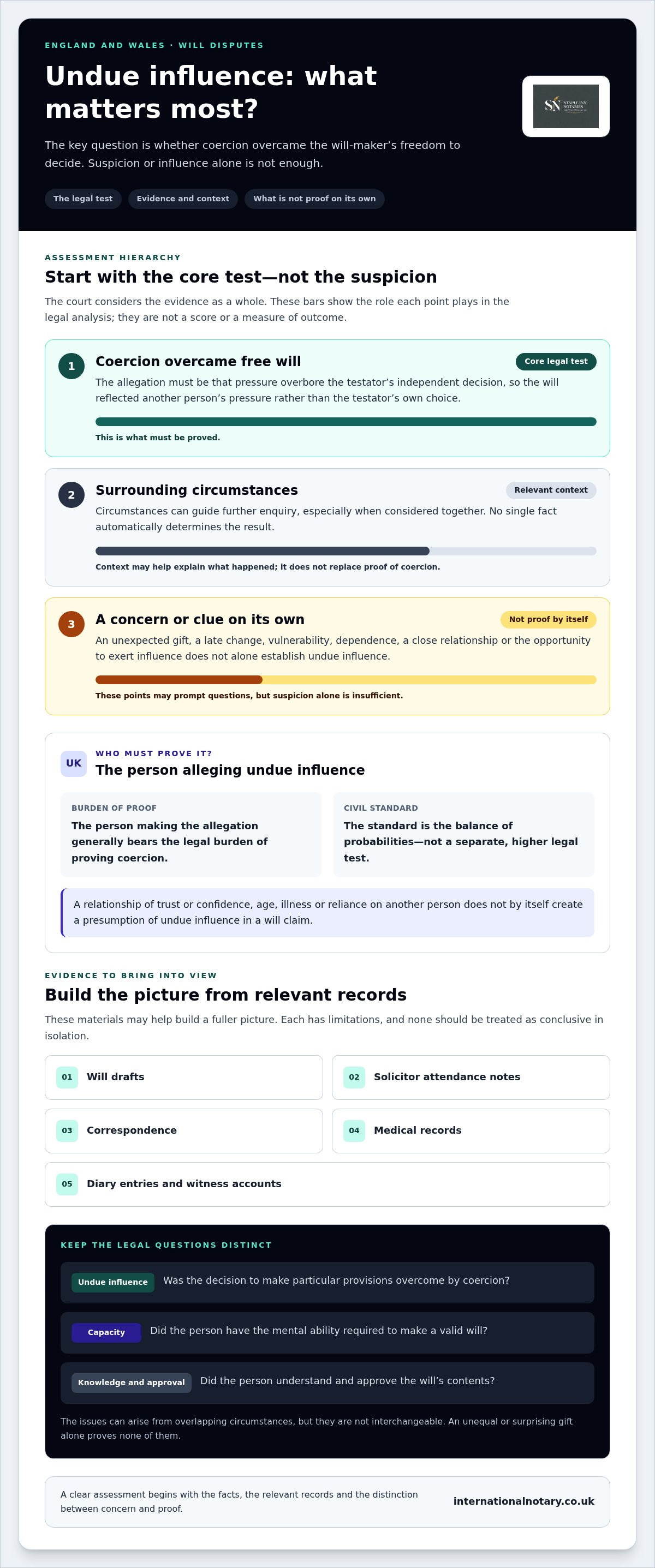
A will that appears inconsistent with the deceased’s expressed wishes or close relationships can raise difficult questions. But an unexpected gift, a late change or one person’s involvement in preparing the will does not, by itself, establish undue influence. In undue influence will claims UK, the central question is whether pressure went beyond persuasion and overcame the will-maker’s freedom to decide.
In a will dispute, undue influence means coercion that overbears the testator’s free will, so the will reflects another person’s pressure rather than the testator’s independent decision. Affection, dependence, persuasion or the opportunity to exert influence may form part of the circumstances, but none automatically proves coercion. The focus is on what happened and how it affected the will-maker’s decision.
This section concerns the law of England and Wales. Scotland and Northern Ireland have separate legal systems and their rules differ. For wider background on the doctrine, see Undue influence in English law.
When does influence become coercion?
The central question is whether the testator’s independent decision was overcome. A relative who discusses a will, explains their needs or offers practical help may be persuasive without removing the will-maker’s genuine choice. By contrast, threats or sustained pressure that leave the person feeling unable to refuse could be relevant to an allegation of coercion. The distinction depends on the evidence and circumstances, not on one behaviour viewed in isolation.
How is undue influence different from other will concerns?
Undue influence concerns coercion affecting the decision to make particular provisions. Testamentary capacity is different: it concerns whether the person had the mental ability required to make a valid will. Knowledge and approval asks whether they understood and approved the will’s contents. These issues can arise from overlapping circumstances, but they are not interchangeable. An unequal or surprising gift may prompt an enquiry, but alone it proves none of them.
Keep these categories distinct when recording your concerns. A clear assessment starts by identifying what troubles you, then considering which legal issue the available facts may relate to. A wider guide to grounds for contesting a will can explain how undue influence sits alongside other possible challenges.
The legal test for undue influence in a will and who must prove it
In England and Wales, the person alleging that a will resulted from undue influence generally bears the legal burden of proving it. The civil standard is the balance of probabilities. The allegation can be difficult to establish because the evidence must show coercion, not simply that another person had influence or an opportunity to exert it.
For undue influence will claims UK, the person making the allegation must prove that coercion overbore the will-maker’s independent decision; suspicion, dependence or a close relationship alone is not enough. The court examines the evidence as a whole. The circumstances surrounding the will may be relevant, but no single fact automatically determines the result.
In Wingrove v Wingrove (1885), the court described the relevant pressure as conduct that overcomes the testator’s free agency. In Re Edwards [2007] EWHC 1119 (Ch), the court considered how undue influence in a will may be established through evidence and surrounding circumstances. These authorities help explain why a claimant must prove coercion and why an allegation is assessed in its full factual context. The standard remains the civil standard of proof, not a separate, higher legal test.
Why will claims are not assessed like some lifetime transactions
A relationship of trust or confidence does not, by itself, create a legal presumption of undue influence in a will claim. That differs from certain lifetime transactions, where particular relationships and circumstances may affect how a transaction is examined. In a will dispute, a close bond, age, illness or reliance on another person may be relevant context, but none automatically shifts the burden of proof. The Law Commission’s proposed reforms discuss possible changes to wills law; proposals should not be mistaken for the law currently in force.
Suspicious circumstances can guide further enquiry. For example, a sudden change to a will while the testator relies heavily on a potential beneficiary may prompt questions about who arranged the appointment and what was said. Those facts may matter, but without evidence of coercion they do not establish undue influence.
How capacity and knowledge and approval fit into the analysis
Testamentary capacity asks whether the person had the mental ability required to make a will. Undue influence asks whether coercion overcame their independent choice. Knowledge and approval concerns whether they understood and approved the will’s contents. A medical record or unusual change may prompt more than one line of enquiry, but the legal questions remain distinct. For other potential grounds, see a broader guide to challenging a will.
For a fact-specific assessment, Staple Inn Notaries’ contact details provide a route to discuss your concerns with its contentious probate team. Tailored advice can help clarify what the available evidence may establish and which proportionate options to consider.
What evidence can support or weaken an undue-influence will claim?
For undue influence will claims UK, evidence is most useful when it helps reconstruct events around the making of the will. A document or witness account rarely settles the issue on its own. Consider how each item fits the timeline, whether it is reliable and whether other evidence supports or contradicts it.
Vulnerability may provide context, but it does not, by itself, prove coercion. Medical information, dependence on a relative or reduced contact with others may help explain the circumstances. The question is what the evidence shows about the testator’s choices and the events surrounding the will.
Documents and professional records
Compare drafts with the final will. A sequence may show whether a change was discussed over time or appeared abruptly, although timing alone proves little. Solicitor attendance notes and communications can help clarify who gave instructions and whether the testator spoke independently. Consider medical records for their relevance to the particular issue; they are not proof of influence by themselves. The Law Commission report on will reform discusses concerns about the difficulty of proving undue influence under the current law.
Relationships, timing and witness accounts
Changes in access, isolation, dependency or a beneficiary’s role in arranging appointments may form part of the factual picture. For each witness, note what they personally observed, when they observed it and whether their account is consistent with records made at the time. A changed will or strained family relationship needs context: earlier wishes, the testator’s reasons and events around the time may all help explain it.
Build a connected chronology rather than relying on a single striking fact. Assess each item by its source, timing and reliability, then note where accounts agree, conflict or leave gaps. Comparing the evidence in this way can help distinguish a concern worth examining from an assumption the evidence does not support.
How to assess concerns and prepare before seeking advice
Before deciding what to do, turn your concern into a clear, factual account. In undue influence will claims UK, careful preparation helps separate what you personally observed from what you suspect or have heard from others. It also gives an adviser a useful starting point for assessing the evidence and proportionate options.
Build a clear chronology and evidence file
Record relevant events in date order, including changes in the person’s health or contact with family, discussions about their wishes, the preparation of the will and any events that prompted concern. If you do not know a date, mark it as approximate. Avoid presenting an assumption about someone’s motive as an established fact.
Keep a straightforward record of material you lawfully hold or can access. For each copy, note where it came from and when you received it. Secure original documents and avoid writing on them, altering or destroying them, or circulating sensitive records unnecessarily. Make a separate list of people who may have first-hand information, with a brief note of what each person could have observed.
Questions that help clarify the next step
Before seeking advice, consider preparing answers to these questions:
Which will, or change to a will, concerns you, and what specifically appears troubling?
What do you know directly, and what comes from another person or remains uncertain?
What records are available, and who may have relevant first-hand knowledge?
Has probate been applied for or granted, as far as you know?
Probate status and timing can affect the practical options available, so include any known developments and when you became aware of them. Do not assume that a particular step is still available or that a deadline applies without advice on the facts and relevant rules.
A focused discussion can consider the will, your chronology, available records, possible evidence gaps and proportionate options. Staple Inn Notaries’ legal advisory services include advice relevant to estate and will concerns. The aim is to understand the position, not to assume that a claim will succeed.
Gather what you can and keep it organised. The firm’s contact page provides details for discussing will-dispute concerns with Staple Inn Notaries.
Undue influence will claims in Central London: understand your options
Concerns about a will can feel urgent, particularly where probate is progressing or family relationships are strained. Tailored contentious-probate advice can help you assess the will, available evidence and practical options in context. For undue influence will claims UK, the assessment should focus on what the evidence may establish, what remains uncertain and whether another will concern also needs consideration. No assessment can guarantee a particular outcome.
Staple Inn Notaries provides will-dispute support in Central London and the wider London area. A discussion can begin with the will or relevant provisions, your chronology, the records available to you and the specific events that prompted concern. The aim is to clarify the issues and identify proportionate next steps, not to treat suspicion as proof.
What to prepare for an initial discussion
Organise the information you already have. A concise file is more useful than a large bundle with no explanation. Consider bringing:
The will or relevant extracts, if lawfully available, and any known earlier version.
A brief chronology of significant events, including changes to instructions or contact.
A list of potential witnesses, noting what each person may have observed first-hand.
Details of available records and any known probate developments.
Any time-sensitive practical concerns you want to raise.
Keep originals secure and make clear which information is uncertain or based on someone else’s account. Avoid contacting relatives or potential witnesses in a way that could intensify conflict or affect recollections. If you are unsure whether a document can properly be accessed or shared, raise that question during the discussion.
Choosing an informed next step
Advice can help distinguish an undue-influence concern from questions about testamentary capacity or knowledge and approval, and consider how the evidence relates to each issue. Appropriate options depend on the individual circumstances, available records and any gaps that need to be addressed. Probate developments may also affect practical decisions, so mention what you know and when you learned it.
If your concern relates to preventing uncertainty in your own future planning, consider seeking advice about making or updating a will. Information about discussing an existing will dispute is available through Staple Inn Notaries’ contact page. Share the key facts and available documents so the firm can help you understand the issues and consider proportionate options.
Take an informed next step on your will concern
An unexpected will or a difficult family history can raise serious questions, but neither establishes undue influence on its own. For undue influence will claims UK, the key is whether reliable, connected evidence supports an allegation that coercion overcame the will-maker’s independent decision. A clear chronology, relevant records and a careful distinction between direct observations and assumptions can help bring the issue into focus.
Staple Inn Notaries provides contentious probate and will-dispute support, alongside private-client legal advisory services in Central London and the wider London area. Tailored advice can help assess the facts, identify evidence gaps and understand proportionate options. It cannot guarantee that a will can be challenged successfully, but it can help you make a more informed decision about what to do next.
Discuss your will concern with Staple Inn Notaries. Share the key facts and records available to you, and take the next step with a clearer understanding of your position.
Frequently Asked Questions
What is undue influence in a will in the UK?
Undue influence in a will means coercion that overcomes the person’s independent decision, so the will reflects pressure rather than their free choice. Ordinary persuasion, help or close involvement does not automatically amount to coercion. The legal position described here concerns England and Wales; Scotland and Northern Ireland have different legal systems. A will that appears unexpected may prompt questions, but its contents alone do not establish undue influence.
How do you prove undue influence in a will?
You must provide evidence capable of showing that coercion overbore the will-maker’s free decision. The person alleging undue influence generally bears the burden of proof, assessed on the balance of probabilities. Courts consider the circumstances together, rather than treating suspicion, a close relationship or opportunity as proof. For undue influence will claims UK, a clear chronology linking reliable records and first-hand accounts may help explain what happened and where evidence remains incomplete.
Can an elderly person’s will be challenged because someone influenced them?
An elderly person’s will can be challenged if evidence supports a legally recognised ground, including coercion that overcame their independent choice. Age, illness, reliance on a relative or vulnerability alone does not prove undue influence or automatically shift the burden of proof. Relevant questions include what pressure was exerted, how the will was prepared and what the person’s circumstances were at the time. Each case depends on its evidence and context.
What evidence is needed for an undue influence will claim?
No single document or witness is required in every case. Potentially relevant material includes earlier and later will drafts, a solicitor’s attendance notes, correspondence, medical records, contemporaneous diary entries and witness accounts. These may help establish timing, instructions, access or changes in contact, but each has limitations. Assess reliability and first-hand knowledge, then compare sources in a connected chronology. Vulnerability may provide context, but it does not itself prove coercion.
Is undue influence the same as lack of testamentary capacity?
No. Testamentary capacity concerns whether the person had the mental ability required to make a will. Undue influence concerns whether coercion overcame their free decision. Knowledge and approval is another distinct question, concerning whether the person understood and approved the will’s contents. The same circumstances, such as illness or another person’s involvement, may prompt more than one enquiry, but each ground has a separate legal test and must be assessed on its own evidence.
How long do I have to challenge a will for undue influence in the UK?
There is not a simple universal deadline that can safely be applied to every undue-influence will challenge. The position and practical options may depend on the circumstances, including whether probate has been granted or the estate distributed. Do not assume the six-month period often cited for claims under the Inheritance (Provision for Family and Dependants) Act 1975 applies to a will-validity challenge. Seek tailored advice promptly, especially if probate is progressing.
Does a changed or unfair will prove undue influence?
No. A changed will, unequal gift or provision that appears unfair may raise questions, but it does not, on its own, prove that anyone coerced the will-maker. The person’s reasons, the timing of instructions, relevant documents and reliable witness evidence need to be considered together. Staple Inn Notaries provides contentious probate and will-dispute support in Central London. A fact-specific assessment can help clarify what the available evidence may establish.


Comments