
Tax Lawyer London: Estate & Wealth Planning Guide

Are you concerned about personal tax, inheritance tax or the administration of an estate? Each raises different questions about family assets and the steps to take. If you’re searching for a Tax Lawyer London, start by defining the issue you need help with.
It can be difficult to work out how tax rules, a will and estate administration fit together. The right questions depend on your circumstances and the documents involved. This guide explains how to identify the private-client issue, what information to prepare and how to make a discussion about your estate-planning needs more focused.
Staple Inn Notaries provides private-client services including inheritance tax planning, wills and estate planning, trust administration and probate administration. Its specialist lawyers are regulated by the Faculty Office of the Archbishop of Canterbury. The guidance below offers a practical route from identifying your concern to preparing for a discussion with the London team.
Table of Contents
Tax Lawyer London: When a Private-Client Tax Concern Needs Legal Advice
Are you reviewing how your estate may pass to your family, or dealing with tax questions after someone has died? These situations can call for different advice. A Tax Lawyer London search may relate to either, but this guide focuses on private-client matters connected with estate planning, inheritance tax, trusts and probate.
A tax lawyer advises on tax-related legal rights, obligations and planning within their area of expertise. Tax law covers different specialist fields, so the relevant experience depends on the issue. For estate matters, it is useful to distinguish questions about planning and legal arrangements from tasks such as preparing a tax return.
Which tax concerns can intersect with estate planning?
Inheritance tax planning is one part of a wider estate plan. A will records how a person intends their estate to be dealt with, while a trust may form part of arrangements for holding or managing assets. These choices can raise connected legal and tax questions. Valuing and administering an estate after a death can raise different ones. The implications depend on the documents, assets and circumstances involved, so a general example cannot determine the right approach for an individual.
For a broader introduction, see the existing guide to inheritance tax advice in London. The Inheritance Tax in the UK overview also provides general background. Neither is a substitute for checking current rules or considering the facts of a particular estate.
When should you seek tailored advice?
Consider a tailored discussion when reviewing an estate plan, deciding whether a will or trust still reflects your circumstances, or administering an estate where tax questions have arisen. A change in family circumstances, asset ownership or intended beneficiaries may affect the issues to consider. During administration, personal representatives may need to understand how their responsibilities relate to the estate’s assets and documents.
Online examples can explain terminology, but they cannot account for all the facts of your situation. The documents, ownership arrangements, family relationships and timing may all matter. Tax rules can also change, so check current law, thresholds and allowances against authoritative, up-to-date sources before relying on them, particularly if you are responding to an hmrc tax warning or new compliance guidance. Don’t base a decision on an old example alone.
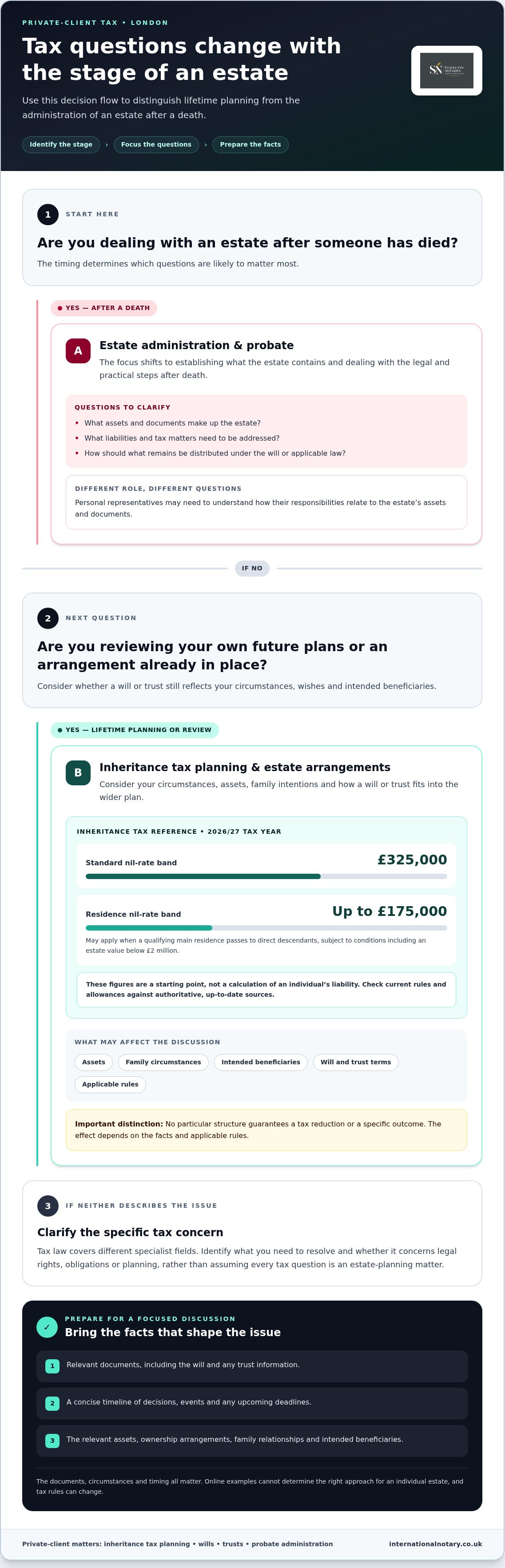
Start by identifying what you need to resolve: are you planning for the future, reviewing an arrangement already in place, or dealing with an estate after a death? That distinction helps clarify whether private-client legal advice is relevant and what information will be useful.
How Tax Advice Connects with Inheritance, Trusts, and Probate
Tax questions can arise at different stages of an estate’s life cycle. During a person’s lifetime, planning may involve reviewing assets, family intentions and how a will or trust fits into wider arrangements. After a death, the focus shifts to identifying and administering the estate. This may involve addressing tax matters alongside the legal and practical steps required.
Inheritance tax planning and an individual’s estate
Inheritance tax planning involves considering a person’s circumstances, assets, intended beneficiaries and the law that applies. The aim is to understand issues that may affect the estate and consider how existing arrangements align with the person’s wishes. No particular structure guarantees a tax reduction or a specific outcome; the effect depends on the facts and applicable rules.
For the 2026/27 tax year, the standard inheritance tax nil-rate band is £325,000. A residence nil-rate band of up to £175,000 may also apply where a qualifying main residence is passed to direct descendants, subject to conditions including an estate value below £2 million. These figures are a starting point, not a calculation of an individual’s liability. Check the Official UK Inheritance Tax Guidance for current rules and allowances, and use any dedicated 2026 thresholds guide alongside advice on your circumstances.
Inheritance tax planning considers potential tax exposure and estate arrangements during a person’s lifetime. Probate administration concerns the legal authority and practical work needed to deal with a deceased person’s estate, including identifying assets, addressing liabilities and distributing what remains in accordance with the will or applicable law. The two can intersect, but they are not interchangeable. A personal representative administering an estate may face different questions from someone reviewing their own future plans.
Trusts, wills, and estate administration
A will sets out a person’s wishes for distributing their estate and may appoint executors to carry them out. A trust may form part of some estate plans, but its relevance depends on its purpose, terms, assets and the circumstances of the people involved. Its tax and administrative consequences cannot be assessed from the word “trust” alone. A London trust-planning guide can provide further context on how trusts may fit into planning.
Estate planning takes place during a person’s lifetime and may involve coordinating a will, assets and trust arrangements. Estate administration begins after death: personal representatives establish what the estate contains, deal with required legal and financial matters, then distribute it. Tax advice may be relevant at either stage, but the questions and documents differ. A Tax Lawyer London search can be a starting point when you need to clarify how private-client legal issues relate to your plans or an estate being administered.
If you’re considering inheritance tax planning, trusts or probate administration, you can discuss your private-client circumstances with the London team.
How to Assess the Right Tax-Law Support for Your Situation
First identify the issue and the work you expect the legal adviser to undertake. Legal planning, preparing a tax return and representing someone in a dispute are different tasks. This guide focuses on private-client legal issues connected with inheritance tax planning, wills, trusts and probate.
Match the concern to the relevant type of guidance
Use this comparison to describe your concern and gather relevant records. It is a starting point, not a conclusion about your legal or tax position.
A Tax Lawyer London search may bring up different kinds of services. Legal planning considers rights, obligations and arrangements in light of your instructions. Tax-return preparation involves compiling and submitting a return using relevant financial information. Dispute representation concerns formal steps in a disagreement with a tax authority. State which task you need, rather than assuming the label “tax advice” covers them all.
Understand the scope before work begins
Explain the concern in plain terms, the outcome you’re seeking and the documents you want considered. For example, distinguish between reviewing a will as part of wider inheritance tax planning and addressing tax questions during estate administration. The legal work and advice depend on your circumstances, documents and instructions. A clear scope helps establish which questions the discussion will cover and what information is still needed.
Consider whether the adviser can explain the process clearly: what they will review, what further information may be required and how they will communicate their advice. These are practical ways to assess whether the proposed work matches your concern. GOV.UK provides guidance on trusts and tax for general reference, but it does not assess your individual documents or circumstances.
Staple Inn Notaries’ specialist lawyers are regulated by the Faculty Office of the Archbishop of Canterbury. Regulation provides a professional framework, not a guarantee of a particular result. If your concern relates to inheritance tax planning, trusts, wills or probate administration, discuss your private-client matter with the London team.
How to Prepare for a Tax-Law Consultation in London
A little preparation can make a discussion about inheritance tax planning, trusts or probate administration more focused. You don’t need to resolve the legal question before speaking with an adviser. Set out what has happened, what you’re unsure about and what you hope to understand.
Documents and background information to organise
Use this sequence to organise the essentials. Not every document will be relevant, so begin with what relates directly to your concern:
State the question. Summarise the issue in a few sentences, such as reviewing an estate plan or understanding a tax matter arising during estate administration.
Write a short timeline. Note key events, decisions and correspondence in date order. Include any known deadlines or upcoming steps, and distinguish confirmed dates from estimates.
Summarise the circumstances. Outline relevant family relationships, your intentions and the assets involved. A high-level description is useful at first; detailed records can follow if needed.
Gather relevant records. Depending on the matter, these may include a current or earlier will, trust documents, estate records, asset information, letters from HMRC or other correspondence. Include documents that explain the issue, not every financial record you hold.
Before your discussion, organise a concise account of the concern, a timeline, relevant will or trust documents, estate records and correspondence where they exist, a summary of assets and family circumstances, and any known deadlines. Check current tax figures against authoritative sources such as GOV.UK or HMRC guidance. Figures in saved articles or old correspondence may no longer reflect current rules.
Keep sensitive personal and financial information secure. Don’t send confidential documents through an unsecured channel; use an appropriate method for sharing records. If you’re reviewing a will as part of wider planning, a wills and estate-planning guide can also provide broader context on will-making.
Questions to bring to the discussion
Prepare a short list of questions to clarify the scope and practical next steps. For example, ask:
Which legal and tax issues does my concern raise, and what falls outside the proposed work?
Which current rules or thresholds may be relevant, and how will they be considered in light of my circumstances?
What process should I expect, and what information or documents would help you assess the matter?
What are the anticipated next steps, and are there any dates I should be aware of?
A Tax Lawyer London consultation is more productive when the adviser can see both the question and its context. Your records need not be perfect. Make the timeline clear, identify gaps honestly and bring the documents that relate to the issue.
To discuss inheritance tax planning, wills, trusts or probate administration, contact the London legal team about your private-client matter.
Discuss Your Tax and Estate-Planning Needs with a London Legal Team
Once you’ve identified the concern and organised the relevant information, discuss how it fits your wider circumstances. An inheritance tax question may connect with your will, intended beneficiaries, assets or an existing trust. If you’re administering an estate, the focus may instead be on probate responsibilities and tax issues arising during that process. Setting out which situation applies helps frame a focused discussion.
Private-client support for estate and inheritance matters
Staple Inn Notaries provides private-client legal services covering inheritance tax planning, wills and estate planning, trust administration and probate administration. The work can address the documents, assets, family circumstances and objectives relevant to your matter. The aim is to help you understand the legal issues and consider appropriate next steps, not to promise a particular tax saving or result.
Private-client estate matters can involve different questions from corporate tax concerns. The work depends on the issue raised and the instructions provided. Where tax rules or thresholds are relevant, they need to be considered in the context of your circumstances and checked against current authoritative information.
Staple Inn Notaries’ specialist lawyers are regulated by the Faculty Office of the Archbishop of Canterbury. This identifies the regulatory framework for their legal work; it does not guarantee a particular outcome. Clear advice starts with a clear account of what you need help to understand.
Arrange a discussion in Central London
When you make contact, describe the matter briefly and state whether you’re planning for your own estate or dealing with an estate after a death. Note the main question you want addressed, any significant event or decision, and whether a deadline is approaching. If you’ve organised relevant documents, mention the types of records you have. Share sensitive material only through an appropriate secure channel.
You don’t need to resolve every detail before taking this step. A concise outline gives the legal team a practical starting point and helps establish what further context may be needed. Staple Inn Notaries serves private clients in Central London and the wider London area, with guidance focused on the circumstances of the matter rather than a generic example.
If you’re ready to discuss inheritance tax planning, wills, estate planning, trusts or probate administration, discuss your private-client matter with the London legal team. Set out the issue clearly, include any relevant timing and bring the information you have to hand.
Take the next step with a clear brief
Estate planning is not a one-off decision. Your priorities, family circumstances and assets may change, so keep your documents organised and review whether they still reflect your intentions. A clear question is a practical starting point, even if you don’t yet know which legal or tax issue it raises.
If you searched for a Tax Lawyer London, Staple Inn Notaries’ specialist lawyers, regulated by the Faculty Office of the Archbishop of Canterbury, provide private-client support covering inheritance tax planning, wills, trusts and probate administration. Advice should be grounded in your circumstances, not treated as a promise of tax savings or a particular result.
Set out what you’re planning or dealing with and note any relevant timing. Discuss your estate or inheritance tax planning needs with the London team.
Frequently Asked Questions
What does a tax lawyer in London do?
A Tax Lawyer London may advise on legal issues involving tax, including how tax rules relate to a person’s rights, obligations or estate arrangements. The work depends on the lawyer’s specialism and the facts involved. A private-client matter might concern the legal effect of a will or trust, while tax-return preparation is a separate task. Identify the issue you need addressed before seeking advice.
Can a tax lawyer help with inheritance tax planning?
A lawyer working in private-client matters can help you consider inheritance tax alongside your estate arrangements. For example, you might want to understand how a proposed change to your will relates to your wider plans. Advice depends on the assets, documents and circumstances involved, and no planning arrangement guarantees a particular tax result. Make sure any figures or rules you rely on are current.
When should I speak to a lawyer about inheritance tax?
Consider speaking to a lawyer when making or reviewing estate arrangements, or when you’re responsible for dealing with an estate and need to understand related legal questions. A significant change in your family or asset circumstances may also prompt a review. If an estate is being administered, note any correspondence or dates that may require action. Online examples cannot resolve a question specific to your situation.
What is the difference between a tax lawyer and an accountant?
A tax lawyer focuses on legal rights, obligations, interpretation of tax rules and planning within their area of expertise. An accountant commonly works with financial records, tax calculations and return preparation. Their roles can overlap in a wider matter, but one doesn’t automatically replace the other. A question about the legal effect of a trust, for example, differs from compiling figures for a tax return. Be clear about the task you need completed.
Can a tax lawyer advise on trusts and estate planning?
A lawyer working in private-client matters may advise on how trusts and estate arrangements relate to your intentions and legal circumstances. The relevance of a trust depends on its purpose, terms, assets and the people involved; the label alone doesn’t establish its effect. A proposed trust should be considered alongside the will and wider estate plan, rather than in isolation. Advice should reflect your instructions and current rules.
What documents should I prepare before speaking to a tax lawyer?
Start with the records most closely related to your question. These could include a current or previous will, trust paperwork, estate correspondence, asset information and relevant letters from HMRC. Prepare a short note describing the issue, key dates and any decisions already made. You don’t need to gather every financial document before an initial discussion. Keep sensitive records secure and share them only through an appropriate channel.
How much does it cost to speak to a tax lawyer in London?
The cost depends on the scope and complexity of the work, the documents involved and what you need the lawyer to do. There’s no single figure that applies to every private-client matter. Before instructing a lawyer, ask what the proposed work covers, how charges are calculated and whether the initial discussion is chargeable. This helps you understand the financial terms before work begins.



Comments