
Remote Wills by a London Lawyer: Safe & Simple Guide

What if the part of making a will that can happen remotely isn’t the part that makes it legally effective? Wills by a lawyer done remotely can let you give instructions and review a draft from home, but careful drafting and correct signing remain essential.
It’s understandable to wonder whether a remote conversation can cover details that matter, particularly when family relationships, property or other personal circumstances affect your wishes. A lawyer-led process can use video calls, telephone and email to gather your instructions and prepare a will around your situation. Clear information about your family, assets and intended beneficiaries helps make those instructions useful.
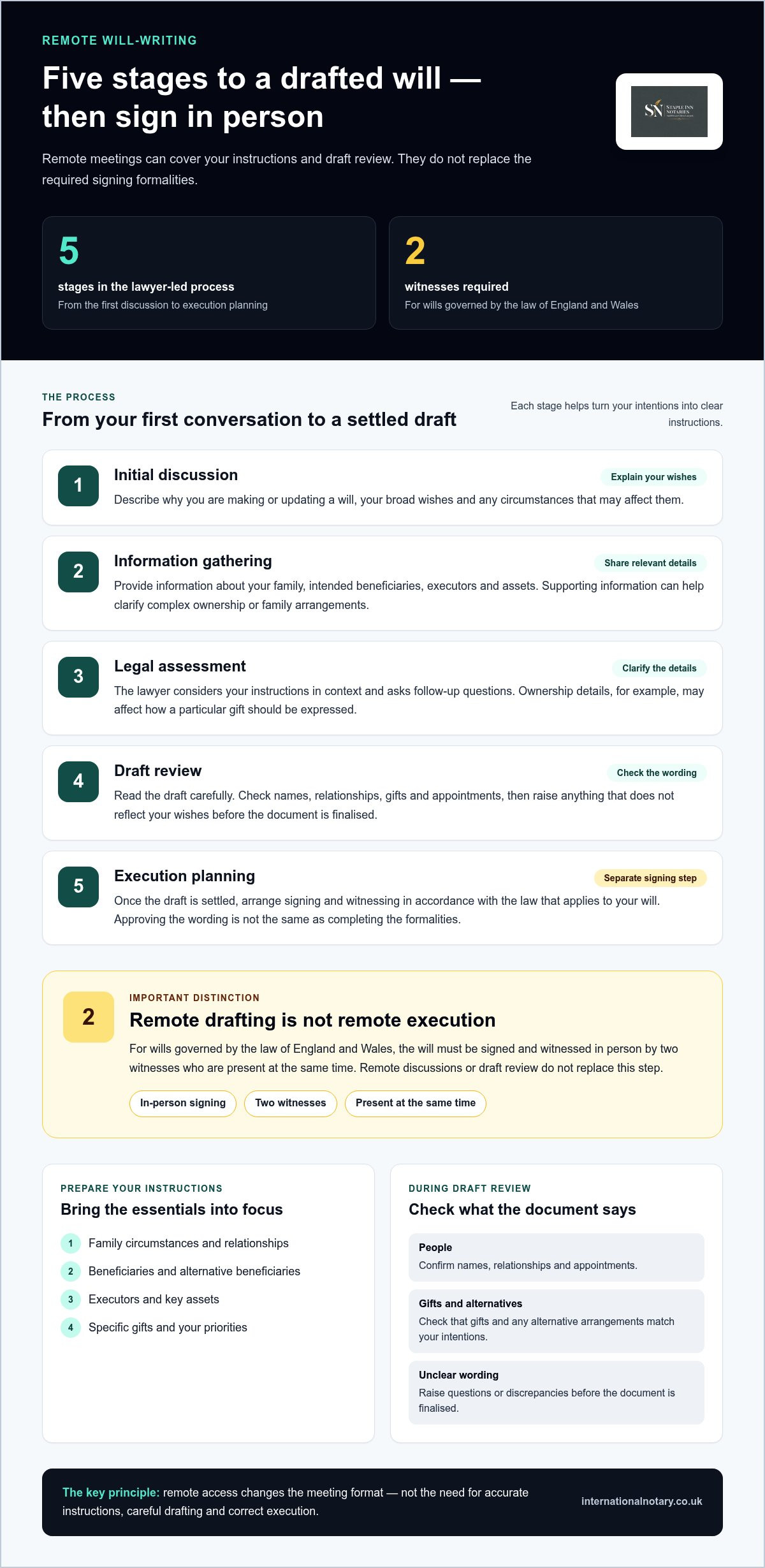
For wills governed by the law of England and Wales, remote instruction and drafting are separate from execution: the will must be signed and witnessed in person by two witnesses who are present at the same time. This guide explains each stage, what to prepare before speaking with a lawyer, and why remote drafting does not remove the need to follow the signing formalities correctly.
Table of Contents for Wills by a lawyer done remotely
What does having a will written remotely by a lawyer involve?
Wills by a lawyer done remotely means you can give instructions and discuss your circumstances with a lawyer without every conversation taking place face to face. The lawyer considers your needs and prepares a draft based on what you tell them. Remote access changes the meeting format, not the need for careful legal work or accurate information.
A will records how you want your estate to be dealt with after your death. The general legal context is outlined in Will (law), but the rules for a particular document depend on the relevant jurisdiction. Remote discussions or drafting do not, by themselves, establish that a will is valid. The document must also meet the applicable execution requirements.
What can be handled remotely during will-writing?
Remote discussions can cover your family circumstances, the people you want to benefit, your choice of executors and how you want your estate distributed. A lawyer can ask questions to clarify your objectives, then share a draft and discuss anything unclear by video, telephone or email. You can consider the wording and raise questions before the document is finalised.
Some instructions need more discussion. If you want to make different provision for children from different relationships, for example, or leave a particular asset to someone, the lawyer may need to understand the wider context and how that asset is owned. Further discussion or document review can help clarify your instructions before drafting proceeds.
How is a lawyer-led service different from an online will form?
An online form generally collects standardised answers and uses them to generate a document. A lawyer-led process adds an assessment of your circumstances: the lawyer can ask follow-up questions where a decision, relationship or ownership detail may affect the drafting. A form may help record straightforward information, but entering an answer does not necessarily resolve an ambiguity.
That difference can matter in practical ways. A property might be jointly owned, a beneficiary might die before you, or you may want a gift to pass to someone else if the first recipient cannot inherit. These details can affect how your instructions should be expressed. A lawyer can clarify what you intend before drafting instead of treating each response as a complete instruction.
Explain your priorities in plain language. Identify who you want to benefit, who should manage the estate and what should happen if your first choice cannot act or inherit. The lawyer can then assess whether the proposed wording reflects your intentions and identify anything that needs further discussion.
This focused explanation sits within wider London will-writing guidance, which covers the broader process of making a will. Remote access can make discussions and draft review more convenient, but it does not replace individual legal advice, precise instructions or correct execution.
How does remote will-writing with a lawyer work, step by step?
A structured process gives you opportunities to explain your intentions, answer questions and check the wording before the will is prepared for signing. Wills by a lawyer done remotely still depend on the quality of your instructions. A clear picture of your circumstances helps the lawyer assess what needs attention, while unclear or changing instructions may require further discussion.
Initial discussion. Explain why you’re making or updating a will, your broad wishes and any circumstances that may affect them. The lawyer can identify the main issues to explore rather than assuming a short list of answers captures your objectives.
Information gathering. Provide relevant details about your family, intended beneficiaries, executors and assets. If ownership or family arrangements are not straightforward, supporting information can help clarify what you mean.
Legal assessment. The lawyer considers your instructions in context and asks focused follow-up questions. For example, the ownership of an asset may affect how a gift of that asset should be expressed.
Draft review. Read the draft carefully and raise any wording that does not reflect your wishes. Discuss questions and requested amendments before the document is finalised.
Execution planning. Once the draft is settled, arrange the separate signing and witnessing step in accordance with the law that applies to your will. Approving the wording is not the same as completing those formalities.
Take time over the first stages. If you’re unsure how to describe a wish, explain the outcome you want and why. A lawyer can test whether the instruction is clear, identify possible gaps and ask what should happen if a beneficiary or executor cannot take up their role. This is more useful than trying to fit a complicated intention into a single form field.
At draft review, check names and relationships as well as the provisions. Confirm that gifts are described as intended, that the people appointed to administer the estate are correct, and that any alternatives match your priorities. Raise discrepancies promptly; silence should not be treated as confirmation that the draft reflects your wishes.
For wills governed by the law of England and Wales, the temporary remote-witnessing provisions have expired. The Law Society’s account of those exceptional provisions is available in The Law Society’s guidance on video-witnessing wills. It should not be taken to mean that video witnessing is currently a substitute for in-person execution. The lawyer can discuss the applicable formalities as part of execution planning.
There is no reliable fixed timetable for every matter. The time required depends on factors such as the complexity of your circumstances, how quickly you provide information and whether your instructions need clarification. To discuss your circumstances as part of a wills and estate-planning enquiry, contact Staple Inn Notaries in Central London.
Is a remotely prepared will legally valid in the UK?
It can be, but remote discussions or drafting alone do not determine whether a will is legally valid. The document must meet the execution requirements that apply to it, which depend on the relevant UK jurisdiction and the individual circumstances. A draft shared by email or reviewed on a video call is not, by itself, a completed and executed will.
This distinction matters because there is no single set of will formalities for the whole UK. England and Wales, Scotland and Northern Ireland have separate legal systems, so a process that applies in one jurisdiction should not automatically be assumed to apply in another. If your circumstances involve more than one jurisdiction, the applicable law may need careful consideration.
Why remote drafting and signing are separate steps
A lawyer may take instructions and prepare or revise a draft remotely. Signing and witnessing are separate steps, and sharing or approving a draft electronically does not replace the applicable execution formalities. Follow the lawyer’s instructions for the final document, including how it must be signed and witnessed. Do not assume that a video call or electronic signature is sufficient.
For wills governed by the law of England and Wales, the temporary measure that allowed video witnessing expired on 31 January 2024. As at October 2026, the will must be witnessed in person by two witnesses who are present at the same time. Wills witnessed remotely between 31 January 2020 and 31 January 2024 remain valid under the temporary provisions. These details are jurisdiction-specific and should not be applied automatically to a will governed by another UK legal system.
Which UK jurisdiction’s rules may apply?
England and Wales, Scotland and Northern Ireland each have distinct rules concerning wills and their execution. Scotland has adopted measures permitting remote execution, but that does not make the Scottish approach interchangeable with the current requirements in England and Wales. Northern Ireland also has its own legal framework; do not rely on rules for another jurisdiction as a substitute for advice on a will governed by Northern Irish law.
The relevant considerations may extend beyond where you currently live. You may have moved between parts of the UK, own property in another jurisdiction or have other cross-border circumstances. These facts can make it necessary to assess which law governs the will and whether additional issues need attention. No single rule can safely resolve every combination of residence, assets and personal circumstances.
For Wills by a lawyer done remotely, treat the draft and its execution as connected but distinct stages. Before signing, establish which jurisdiction’s requirements apply and follow the lawyer’s specific directions for completing the final document. If your circumstances cross legal boundaries, raise that at the outset so the relevant issues can be considered before the will is executed.
What should you prepare before a remote will-writing appointment?
A little preparation helps you explain your intentions clearly and gives the lawyer a useful starting point. You do not need to resolve every legal question in advance. Gather what you know, note anything uncertain and be ready to explain your priorities. Wills by a lawyer done remotely still involve individual legal advice; your notes support that discussion but do not replace it.
Information to gather before giving instructions
Bring together the details most likely to shape your instructions. A written overview is useful, even if some figures or arrangements need confirming later.
Family and relationships: names of close family members, dependants and anyone you intend to benefit, with relevant relationships and contact details.
Executors: names and contact details of people you may want to appoint, plus any alternative choices you’re considering.
Assets and liabilities: an outline of property, savings, investments, business interests and significant debts or other liabilities. Note how key assets are owned if you know.
Existing arrangements: copies or details of any existing will, trust or other estate-planning documents, including arrangements you may want to retain, change or discuss.
Gifts and priorities: list specific items or sums you hope to leave, who should receive them, and an alternative recipient if your first choice cannot inherit.
You do not need to provide a complete balance sheet. The aim is to give the lawyer a reliable overview and identify questions that need follow-up. If you’re unsure whether an asset belongs in your estate or how it is held, flag that uncertainty rather than guessing.
When family circumstances need particular care
Some family arrangements call for more explanation than a list of names. A second marriage, children from an earlier relationship, dependants or unequal gifts can make it especially important to explain who you want to benefit and why. For example, you may want to provide for a current partner while also making provision for children from a previous relationship. The right drafting depends on the full circumstances, so a standard answer may not capture your intentions.
Note any concerns you want the lawyer to understand, including tensions between competing priorities. If you’re considering different provisions for family members, explain the outcome you hope to achieve rather than trying to decide the legal wording yourself. The lawyer can explore the relevant issues with you; your preparation is not a final instruction.
Also note whether any property, accounts or other assets are held outside the UK, or whether your family has important connections to another country. These details may need specific legal consideration. Bring related documents if available, and list your questions so they are not overlooked during the appointment.
Prepare your notes, identify what you’re unsure about and discuss your circumstances directly. Contact Staple Inn Notaries about wills and estate planning in Central London.
How to move forward with remote will-writing from a lawyer
Remote access can make it easier to discuss your will without every conversation taking place in person. The essentials remain the same: clear objectives, accurate information, careful legal drafting and proper execution. Use this sequence to prepare for a lawyer-led discussion:
Clarify your objectives. Consider who you want to benefit, who you may appoint as executor and what matters most to you.
Gather relevant information. Note your family circumstances, beneficiaries, assets, existing arrangements and any questions or uncertainties.
Explain the context. Discuss how your circumstances relate to your wishes, including family or cross-border factors that may need careful consideration.
Review the draft. Check that names, appointments and provisions reflect your intentions, and raise anything that needs clarification.
Follow execution guidance. Treat signing and witnessing as a separate legal step, and follow the lawyer’s instructions for the applicable jurisdiction.
This is a practical framework, not a substitute for legal advice. A lawyer can assess your circumstances, ask follow-up questions and identify where the wording needs careful attention. That individual focus is central to Wills by a lawyer done remotely: the meeting format may change, but the instructions and advice are directed to your situation.
What to expect when seeking lawyer-led will advice
An initial discussion should establish what you want your will to achieve and which personal, family or financial circumstances may affect the drafting. Staple Inn Notaries provides wills and estate-planning support in Central London and the wider London area, with specialist lawyers regulated by the Faculty Office of the Archbishop of Canterbury. Where relevant, wider private-client considerations such as trusts or inheritance tax planning may also form part of the discussion.
Be open about anything you’re unsure about. If your wishes involve different provisions for family members or assets with particular ownership arrangements, explaining the background helps the lawyer identify questions to resolve before the document is finalised. You do not need legal terminology or a finished plan. Start with the outcome you hope to achieve.
Take the next step with confidence
Organise your notes and mark any decisions you’re still considering. During the discussion, explain your priorities plainly and raise concerns early. After receiving a draft, review it carefully and ask about any provision that does not appear to match your instructions. The final document must still be executed in accordance with the applicable law; remote advice or draft approval does not replace that step.
Staple Inn Notaries’ wills and estate-planning support provides a route to tailored lawyer-led guidance. Prepare your information and discuss your will-writing requirements.
Turn your intentions into a considered plan
A will is a personal statement of priorities, not merely a document to complete. Before taking the next step, consider what you want your arrangements to achieve and which questions you’d like professional advice to address. Wills by a lawyer done remotely can make it possible to have that focused discussion without requiring every meeting to take place in person.
Staple Inn Notaries provides wills and estate-planning services in Central London and the wider London area, supported by specialist lawyers regulated by the Faculty Office of the Archbishop of Canterbury. The firm’s wider private-client expertise includes trust administration and inheritance tax planning, which may be relevant when considering how your wishes fit into your broader estate arrangements.
You do not need to have every answer ready. Bring your priorities, explain any uncertainties and use the discussion to establish what needs attention. A clear, considered starting point can help you move forward with confidence.
Arrange a conversation with Staple Inn Notaries about your will and take the next step towards a plan shaped around your circumstances.
Frequently Asked Questions
Can a lawyer write a will remotely?
Yes. A lawyer can take instructions and prepare a will through remote discussions and document exchange. This can be useful if travel is difficult or you prefer to talk from home, provided the lawyer can understand your wishes and circumstances. Remote preparation is not the same as completing an online form without individual advice. The final document still needs to be executed in accordance with the applicable law.
Do I need a video call to make a will remotely?
No. A video call is one way to discuss your instructions, but it is not the only option. Depending on the matter, communication may take place by telephone or email, or through a combination of channels. What matters is being able to explain your wishes and respond to questions clearly. A video discussion does not, by itself, complete the signing or witnessing of the will.
Is an electronically signed will valid in England and Wales?
An electronic signature alone does not meet the usual execution requirements for a will in England and Wales. As at October 2026, the will must be physically signed and witnessed in person by two witnesses who are present at the same time. The Law Commission’s proposals for electronic wills have not changed the law. Do not rely on a scanned signature, typed name or digital signing platform as a substitute for proper execution.
Can I arrange remote will-writing if I live outside London?
Staple Inn Notaries focuses on Central London and the wider London area. Remote discussions can support the will-writing process, while the law governing your will depends on your circumstances, not simply where you live. Explain your location and any relevant jurisdictional details when discussing your requirements.
Can a lawyer help with a will involving overseas assets?
A lawyer can consider overseas assets as part of the wider picture and identify issues that may affect your instructions. Property held abroad, for example, may raise questions about ownership, local succession rules or how arrangements interact across jurisdictions. Provide details of where the asset is located and any documents you hold. Cross-border estates need individual consideration; do not assume one will automatically deals with every asset in every country.
How much does remote will-writing with a lawyer cost?
The cost depends on the work required and the circumstances involved, so a single figure would not reliably represent every matter. Straightforward instructions may differ from those involving trusts, business interests, overseas assets or more complex family arrangements. Raise costs when making an enquiry with Staple Inn Notaries so they can be discussed in relation to your requirements.
Can I change my will after it has been drafted remotely?
Yes. If the document is still a draft, tell the lawyer what you want changed before it is finalised. If you’ve already signed the will, do not make handwritten alterations or assume that attaching a note will change its legal effect. Changes to an executed will need to follow the appropriate legal process and execution formalities. Explain the change you want, including any new family or asset circumstances.



I contacted estate and trust attorneys in North Carolina because I wanted a more organised approach to managing my estate. The consultation helped me understand my options for asset distribution, trusts, and planning for unexpected circumstances. I was happy with the personalised attention and the practical information provided throughout the process. https://cwlesq.com/