
Professional Company Resolution Certification in Westminster: A 2026 Corporate Checklist
- PPC Guyz Google & Semrush Certified
- 2 days ago
- 12 min read

A signed company resolution remains a mere internal memorandum until professional certification transforms it into a globally recognised instrument of authority. For firms operating within the political and financial heart of the capital, engaging a notary public Westminster is the definitive step in ensuring that corporate mandates are not merely signed, but legally indisputable in foreign jurisdictions. You likely recognise the mounting pressure of an impending international closing date, where the fear of a foreign bank rejecting your documentation threatens to derail a critical transaction.
This article provides the professional clarity required to ensure your corporate documents are legally bulletproof for every overseas requirement. We provide a rigorous 2026 checklist that bridges the gap between simple internal signatures and international validity. You will gain a clear understanding of the distinction between certified copies and notarised resolutions, the current apostille requirements following recent regulatory shifts, and the essential identity verification protocols now mandated under the Economic Crime and Corporate Transparency Act 2023.
Table of Contents
Understanding Company Resolution Certification for International Use
A Corporate Resolution serves as the formal expression of a board's collective will, yet its domestic validity does not automatically translate to international acceptance. For Westminster-based firms engaging in cross-border acquisitions or opening foreign credit facilities, a standard internal document is insufficient. International authorities require a verified extract of board decisions, authenticated by a professional who stands outside the company's internal structure. This is a critical distinction. Whilst a company secretary may certify a copy for UK use, foreign banks and land registries typically reject self-certified documents due to the lack of independent verification. They require an assurance that the document is not merely a copy, but a legally binding record of an authorised corporate act.
The certification process involves more than a simple signature. A notary public Westminster performs a dual function: verifying the identity of the directors and confirming their specific authority to bind the company. Whether the board has passed an ordinary resolution for day-to-day management, a special resolution for constitutional changes, or a written resolution for rapid decision-making, the notary ensures the act complies with the firm's Articles of Association. This rigorous oversight prevents the rejection of documents at the point of use, providing the "Expert Fixer" intervention that high-stakes deals require. Secure your documentation early to avoid procedural friction during the final stages of your transaction.
The Legal Weight of a Notarised Resolution
Notarisation shifts a document from a private internal record to an internationally recognised legal instrument. In most civil law jurisdictions, a notarised resolution carries a "presumption of authenticity." This means the foreign court or bank accepts the document as genuine without further proof. This status is vital when forming overseas subsidiaries or managing high-value property disposals. Without this professional seal, your transaction risks indefinite delays at the closing table. The notary's seal acts as a bridge, transforming a local decision into a globally recognised mandate.
Who Can Certify a UK Company Resolution?
There is often confusion regarding the authority of solicitors versus notaries. While solicitors possess broad powers within the UK, their seal lacks the universal recognition required for international commerce. Only a Notary Public, regulated by the Faculty Office of the Archbishop of Canterbury, holds the specific office necessary for cross-border certification. Companies House acts merely as a repository for filings; it doesn't provide the individualised certification required by foreign institutions. Professional indemnity requirements and stringent regulatory oversight ensure that every act performed by a notary public Westminster meets the exacting standards of the global legal community.
Legal Standards and Regulatory Requirements in 2026
By August 2026, the regulatory framework governing corporate documentation in the United Kingdom has reached a new level of stringency. Compliance is no longer a matter of internal record-keeping; it is a prerequisite for international viability. The full implementation of the Economic Crime and Corporate Transparency Act 2023 (ECCTA) has transformed the notarisation process into a critical compliance checkpoint. Every director and Person with Significant Control (PSC) must now have their identity verified through a rigorous statutory process. When you engage a notary public Westminster, they don't just witness a signature. They perform essential Anti-Money Laundering (AML) and Know Your Customer (KYC) obligations that ensure your firm's resolutions meet these updated transparency standards. This level of scrutiny is what prevents document rejection by foreign regulatory bodies and offshore financial institutions.
While the procedural foundations remain anchored in the Companies Act 2006, the methods of execution have modernised through digital transformation. Electronic signatures are now common, yet their international acceptance depends on the notary’s ability to certify the digital audit trail. E-notarisation requires a sophisticated technical framework to ensure that digital seals are tamper-evident and meet the high standards of foreign jurisdictions. A professional notary public Westminster manages this complexity, providing a bridge between traditional legal certainty and modern digital efficiency. If your transaction involves tight deadlines, our mobile notary London services can facilitate these high-stakes verifications directly at your corporate headquarters.
Corporate Authority and the Articles of Association
Before any certification is issued, the notary must meticulously scrutinise the firm's Articles of Association. This step is vital to confirm that the resolution was passed according to the company's specific quorum requirements. It isn't enough for a director to sign a document; they must possess the explicit constitutional power to bind the company for that specific transaction. The notary examines the internal constitution to prevent ultra vires acts, ensuring the resolution is legally indisputable. This expert examination protects the firm from future litigation and ensures the document's validity in foreign courts.
Signatory Verification Standards
Identity verification in 2026 demands a higher standard of proof than in previous years. While remote verification technologies have advanced, many international jurisdictions still require the physical presence of the signatory before a notary. Acceptable identification typically includes current biometric passports and recent utility bills, with enhanced due diligence protocols applied to non-UK directors. Maintaining original wet-ink signatures whilst simultaneously creating secure digital records provides a dual layer of security. This methodical approach ensures that your corporate mandates are recognised by even the most conservative foreign registries.
Notarisation vs Self-Certification: Why Professional Verification is Mandatory
Relying on internal certification for an international transaction is a high-risk strategy that frequently ends in document rejection. Whilst a company secretary's signature suffices for domestic Companies House filings, it carries negligible weight with a foreign bank or land registry. These overseas entities require an independent official to verify that the individual signing the resolution actually possesses the constitutional authority to bind the firm. This is where the notary public Westminster becomes essential. We establish a clear chain of authority that starts within your boardroom and ends with a globally recognised legal instrument. This professional verification protects your firm against future claims of unauthorised signatures, ensuring the transaction remains legally indisputable in any jurisdiction. Don't risk a multi-million pound deal for the sake of a procedural shortcut.
The cost of a failed transaction far outweighs the professional fee of a notary. When a foreign counterparty or regulator identifies a lack of independent authentication, the resulting delays can lead to missed closing dates and breached contracts. A notary public Westminster provides the assurance of validity that international commerce demands. By meticulously checking the company's internal records against the signatures provided, the notary acts as a trusted gatekeeper. This process creates a presumption of truth that allows foreign officials to accept your corporate mandates without further investigation. It's the difference between a document that is merely signed and one that is legally active on the global stage.
Comparison of Certification Methods
Choosing the correct level of verification is critical for procedural success. Self-certification is low cost but carries a near-certain risk of international rejection. Solicitor certification offers moderate cost and is valid for many UK-specific legal acts, yet it lacks the universal recognition required for cross-border banking or property deals. Notarial certification involves a professional fee but provides universal international validity. Only a notary verifies both the identity of the signatory and their specific authority under the company's Articles of Association, providing a comprehensive legal shield for the firm's actions.
The Role of the Apostille and Legalisation
In many instances, the notary's seal is simply the first step in a multi-layered legalisation process. For countries that are signatories to the Apostille Convention, the document must also be legalised by the Foreign, Commonwealth & Development Office (FCDO). This apostille certificate confirms the notary's standing to the foreign government. If your transaction involves a non-Hague Convention country, further consular or embassy legalisation will be required. Integrating Notary Central London services into your corporate workflow ensures these complex requirements are managed with precision and speed, preventing administrative friction from stalling your international expansion.
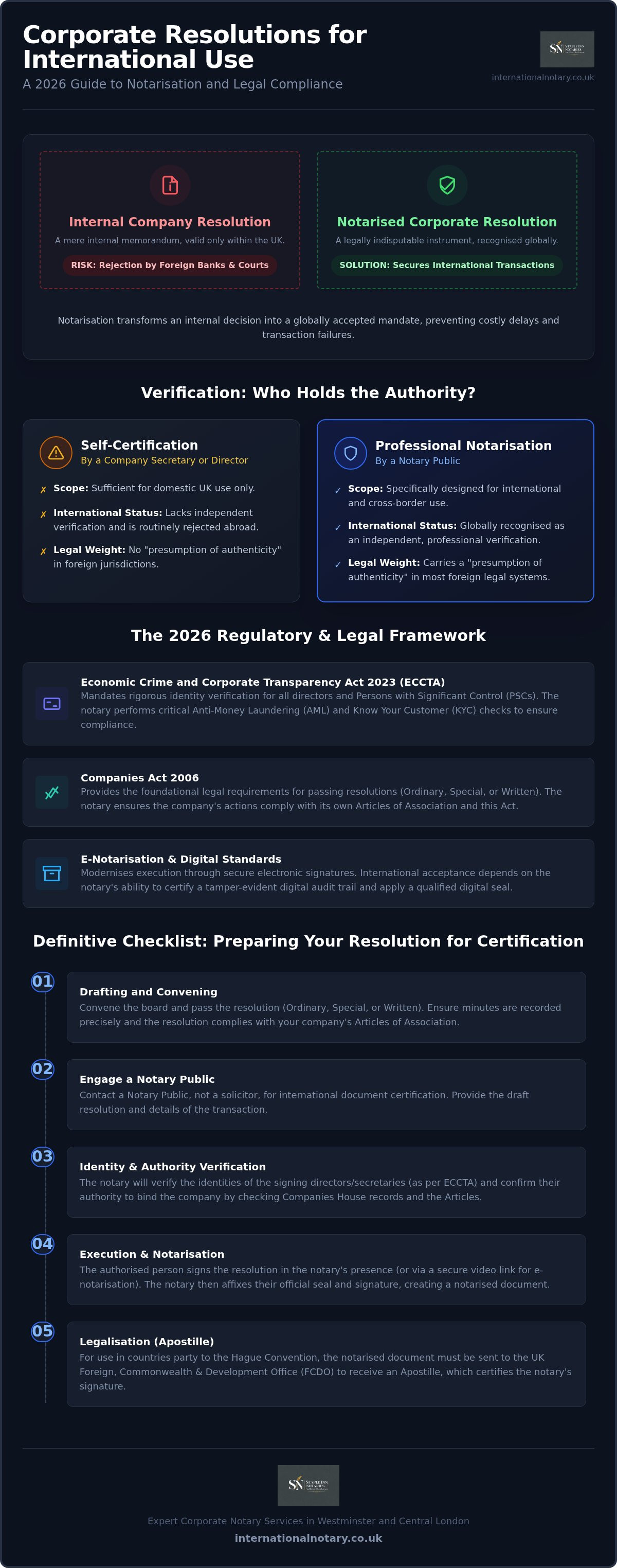
The Definitive Checklist: Preparing Your Resolution for Certification
Eliminate procedural delays by adhering to a methodical preparation strategy. To ensure your resolution is ready for a notary public Westminster, you must follow a rigorous sequence that satisfies both UK corporate law and the specific requirements of the receiving jurisdiction. Systematic preparation is the only way to avoid the administrative friction that leads to missed closing dates. Every detail, from the phrasing of the "Resolved" text to the physical presence of the signatories, must be managed with precision. This checklist serves as your professional roadmap for successful international certification.
Step 1: Drafting the Resolution. Use precise language that explicitly references the specific transaction, such as a credit facility, property disposal, or subsidiary formation. Vague resolutions are often rejected by foreign legal departments.
Step 2: Convening the Board. Ensure the board meeting is held in accordance with your Articles of Association. Record the minutes correctly, as the notary may need to inspect the original minute book or a signed copy to verify the resolution's adoption.
Step 3: Gathering Corporate Records. Collate the firm's constitutional documents, including the Articles of Association and the current Register of Directors. These records prove the identity and authority of those authorised to bind the company.
Step 4: Scheduling the Appointment. Determine if an office visit or a mobile service is more efficient. Engaging a notary public Westminster for an on-site visit at your corporate headquarters can significantly accelerate the process for multiple signatories.
Step 5: Executing the Document. Directors must sign the resolution in the physical presence of the notary. This contemporaneous witnessing is a mandatory requirement for the issuance of a notarial certificate of authority.
Essential Documentation for the Notary
The notary requires a comprehensive evidence trail to verify the firm's active status and internal authority. If the receiving jurisdiction demands proof of current standing, you must obtain a Certificate of Good Standing from Companies House. Additionally, provide clear evidence of the company's registered office and the specific text of the resolution. This documentation allows the notary to conduct the necessary due diligence before the appointment, ensuring a rapid turnaround for your transaction. For urgent requirements, book your professional notary certification to secure your international closing date.
Pre-Appointment Verification
Accuracy is the foundation of international validity. You must ensure that all names on the corporate resolution match the signatories' biometric passports exactly; even minor discrepancies can lead to immediate rejection by foreign banks. Determine if a corporate power of attorney notarisation London is required to supplement the resolution, especially for complex cross-border deals. Finally, confirm whether the document requires a certified translation into the target language before the notarial act proceeds. Taking these steps early prevents the "Expert Fixer" from encountering avoidable hurdles during the final certification phase.
Expert Corporate Notary Services in Westminster and Central London
Staple Inn Notaries operates as the definitive "Expert Fixer" for corporate entities requiring high-level certification within the capital's primary business districts. Our strategic presence in Central London allows us to serve the City of Westminster, the West End, and the City with unparalleled responsiveness. When managing multi-million pound transactions, the luxury of time is rarely available. We understand the controlled urgency required to meet international closing dates, providing a seamless transition from boardroom execution to global legal validity. By engaging a notary public Westminster, your firm secures a partner capable of navigating the most complex jurisdictional requirements with precision. We provide comprehensive support that extends beyond the initial notarial act, encompassing FCDO apostille services and embassy legalisation for non-Hague Convention territories. Secure your transaction today.
Mobile Notary London: We Come to Your Office
Senior executives and board members often operate under restrictive schedules that make office visits impractical. Our Mobile Notary London service minimises disruption by facilitating on-site certification directly at your corporate headquarters. We conduct the necessary verification of board minutes and witness signatures in situ, ensuring that the legal chain of authority is established without requiring directors to leave their desks. Once the documents are executed, we manage the rapid transit of the paperwork to the Legalisation Office, accelerating the process for time-sensitive cross-border deals. This elite service level is designed specifically for the fast-paced environment of W1 and the surrounding districts.
Why Choose Staple Inn Notaries?
Selecting the right professional is a matter of risk management for any corporate legal department. We offer deep expertise in international corporate law, ensuring that every notarial certificate we issue meets the specific standards of the receiving jurisdiction. Our reputation for meticulousness and speed is well-established within the London legal market, making us the preferred choice for City law firms and multinational corporations alike. We maintain transparent fee structures, providing clear costings that allow for accurate project budgeting. When you appoint a notary public Westminster from our firm, you are choosing a regulated specialist who prioritises the elimination of procedural delays. We act as the trusted gatekeeper for your international documentation, ensuring every resolution is legally bulletproof before it leaves the UK.
Securing Your International Corporate Mandates
Transitioning from a signed internal document to a globally recognised legal instrument requires more than administrative intent; it demands professional authentication. By following the 2026 corporate checklist, firms can navigate the complexities of identity verification under the Economic Crime and Corporate Transparency Act whilst ensuring their resolutions withstand the scrutiny of foreign banks. Engaging a notary public Westminster provides the necessary independent oversight to confirm both signatory identity and constitutional authority. This methodical approach eliminates the risk of document rejection and protects the firm against future claims of unauthorised action.
Staple Inn Notaries operates from a strategic Central London location, offering the specialised expertise in international legalisation required for high-stakes deals. We're regulated by the Faculty Office of the Archbishop of Canterbury, ensuring every act of certification meets the highest regulatory standards. Our team understands the time-sensitive nature of corporate transactions and maintains a mindset of controlled urgency to meet your deadlines. Don't let procedural friction delay your international expansion. Contact Staple Inn Notaries to organise your Company Resolution Certification today. We provide the professional certainty your global operations require.
Frequently Asked Questions
What is the difference between a certified copy and a notarised resolution?
A certified copy merely confirms that a document is a true replica of an original held by the company. In contrast, a notarised resolution involves a notary witnessing the actual signing and verifying that the directors possess the constitutional authority to bind the firm. Foreign institutions usually demand the latter to ensure the corporate act is legally valid and authorised.
How long does the company resolution certification process take in London?
The timeframe depends on the complexity of the verification required and the final destination of the document. Standard notarisation is often completed within 24 hours. If your transaction requires an apostille or embassy legalisation, we manage these additional layers with controlled urgency to meet your specific closing dates and prevent administrative delays.
Does a company resolution require an apostille for use abroad?
Most international jurisdictions require an apostille to validate the signature and seal of the notary public Westminster. This certificate is issued by the Foreign, Commonwealth & Development Office (FCDO). Transactions involving countries that aren't signatories to the Hague Convention will necessitate further legalisation through the relevant embassy or consulate in London.
Can a mobile notary certify our company resolution at our Westminster office?
Yes, our mobile service allows a notary to attend your corporate headquarters directly. This facilitates the on-site verification of board minutes and the witnessing of multiple executive signatures without requiring your senior team to travel. It's a highly efficient solution for City law firms and multinational corporations managing urgent international mandates.
Which corporate officers are required to sign the resolution for the notary?
The signatories must be those specifically authorised by the board or defined within the company's Articles of Association. This typically involves one or more directors. The notary will check your firm's internal constitution to ensure the individuals signing have the legal power to execute the resolution on behalf of the company.
What happens if our company resolution is rejected by a foreign bank?
Rejection is often the result of insufficient verification or a lack of proper legalisation. We identify the specific procedural error, such as a missing apostille or an inadequate certificate of authority, and rectify the document immediately. Our role is to ensure your corporate instruments are indisputable and meet the stringent standards of overseas financial regulators.
Can you certify resolutions for companies registered outside of the UK?
We can certify resolutions for non-UK companies provided we can verify the firm's legal standing and the signatories' authority. This usually requires you to provide an original certificate of incumbency or a similar document from the local corporate registry. We then authenticate the execution of the resolution for use in a third jurisdiction.
Do we need to provide the original board minutes to the notary?
The notary must verify that the resolution was properly passed in accordance with the firm's quorum requirements. You should provide the original minute book or a signed copy of the minutes from the relevant board meeting. This evidence allows the notary public Westminster to issue a certificate that confirms the resolution is a true record of an authorised corporate act.


Comments