
LPA Checklist: 2026 Guide for London Estates
- PPC Guyz Google & Semrush Certified
- 4 days ago
- 12 min read

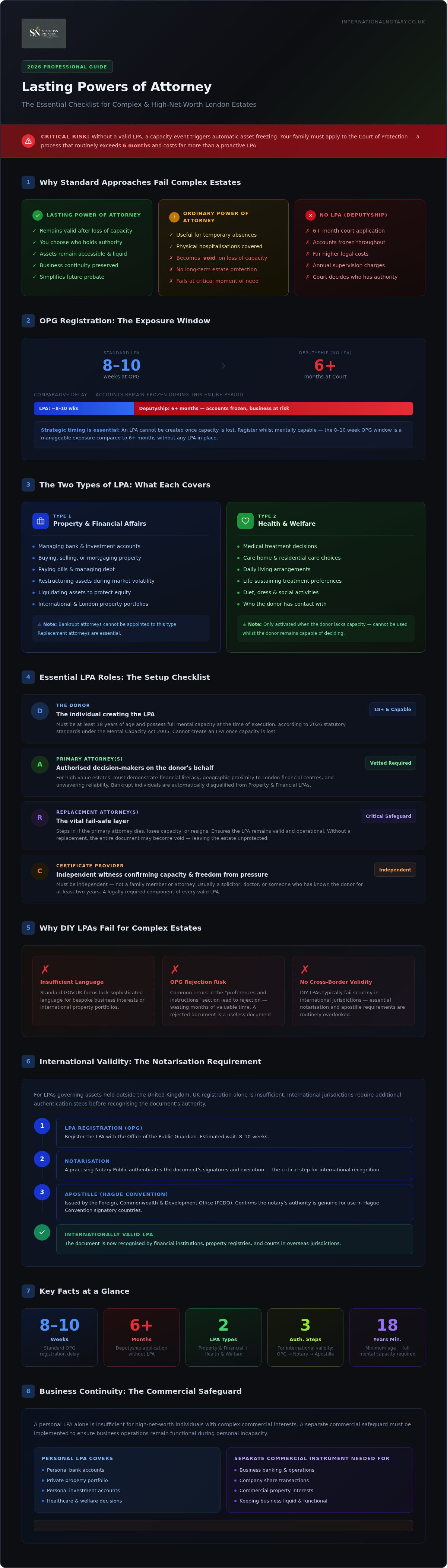
A standard Lasting Power of Attorney (LPA) is frequently insufficient to protect high-net-worth London estates or complex commercial interests from immediate asset freezing. You recognise that estate planning is vital, yet the current eight to ten week registration delay at the Office of the Public Guardian (OPG) creates a dangerous period of exposure for your business operations and private wealth. This 2026 guide provides a definitive, professional checklist to ensure your Lasting Powers of Attorney (LPA) are legally robust, strategically sound, and fully prepared for the scrutiny of international jurisdictions.
We've designed this framework to address the specific complexities of multi-jurisdictional assets and the critical role of notarisation in maintaining cross-border validity. You'll gain a clear understanding of how to structure your documents to prevent administrative paralysis. We'll outline the precise steps required to achieve a legally infallible result, moving from initial instruction to final registration with the clinical efficiency your estate demands. Peace of mind requires more than a form; it requires a strategic legal safeguard.
Table of Contents
The Strategic Necessity of Lasting Powers of Attorney in 2026
Under the Mental Capacity Act 2005, a Lasting Power of Attorney (LPA) serves as a robust legal instrument that allows an individual to appoint trusted persons to manage their affairs should they lose the ability to do so. It isn't merely a precautionary form; it's a strategic necessity for anyone with significant London-based assets. Waiting for a health or cognitive crisis before addressing this requirement is a critical error. By the time a crisis occurs, the legal window for creating an LPA has often closed, leaving your estate in a state of administrative paralysis.
If you fail to establish an LPA whilst healthy, your family must apply to the Court of Protection for a Deputyship order. This route is fraught with difficulty and creates immediate risks for your estate:
Protracted Delays: Applications often exceed six months, during which time accounts remain frozen.
Escalated Costs: Legal fees and ongoing annual supervision charges far outweigh the investment in a proactive LPA.
Loss of Autonomy: The Court, not you, decides who is granted authority over your wealth and healthcare.
Contrast this with an Ordinary Power of Attorney. Whilst useful for temporary absences or physical hospitalisations, an Ordinary Power becomes legally void the moment you lose mental capacity. Only the "Lasting" version provides the long-term security required for complex estates. Establishing Lasting Powers of Attorney (LPA) now ensures that your transition of authority is controlled, cost-effective, and immediate.
Why DIY LPAs Often Fail for Complex Estates
Standard GOV.UK forms are designed for simple, domestic scenarios. They often lack the sophisticated language required to manage bespoke business interests or international property portfolios. Common errors in the "preferences and instructions" section frequently lead to rejection by the Office of the Public Guardian (OPG), wasting months of valuable time. As Expert Fixers, we ensure your documentation is technically precise and future-proofed against potential legal challenges from disgruntled parties. A rejected document is a useless document.
The 2026 Legal Landscape for London Property Owners
London property owners face unique pressures in 2026. Market volatility requires the ability to liquidate or restructure assets at short notice to protect equity. If your capital is locked due to incapacity, your estate's value may diminish rapidly without an authorised signatory to act. There's also a vital synergy between your LPA and Probate Administration planning. A well-structured LPA ensures a seamless transition of authority that simplifies the eventual probate process. The Donor is the individual creating the LPA who must possess the requisite mental capacity according to 2026 statutory standards at the time of execution. Secure your interests now to avoid the freeze.
The Essential LPA Setup Checklist: Roles and Responsibilities
Establishing a legally resilient framework for your estate begins with a precise allocation of roles. The Donor is the individual creating the document; they must be at least 18 years of age and possess the requisite mental capacity to understand the scope and effect of the authority they are granting. In the context of 2026 London estates, the complexity of the Donor’s portfolio often dictates a more rigorous approach to selecting those who will hold the power. Lasting Powers of Attorney (LPA) are not merely administrative forms. They are powerful legal delegations that require a clinical assessment of every participant's suitability.
Attorneys are the individuals authorised to make decisions on your behalf. Whilst many individuals instinctively choose family members, this role demands more than just personal trust. Effective attorneys for high-value estates must demonstrate high levels of financial literacy, geographic proximity to London’s financial centres, and unwavering reliability. If an attorney is bankrupt or has a history of financial mismanagement, their appointment to a Property and Financial Affairs LPA will be void. You must also appoint Replacement Attorneys. This secondary layer acts as a vital fail-safe, ensuring the document remains valid if your primary attorney becomes unable to act due to death, loss of capacity, or resignation.
How to Select Your Attorneys Strategically
Strategic selection involves evaluating potential attorneys for emotional resilience and potential conflicts of interest. You must decide whether your attorneys will act "jointly" or "jointly and severally." Choosing "jointly" requires all attorneys to agree on every decision, which offers maximum security but risks total administrative deadlock if one attorney dies or disagrees. "Jointly and severally" allows attorneys to act both together and independently. This provides the agility needed for fast-paced commercial environments, ensuring that business operations are not stalled by a single individual's absence. For those managing complex trusts, appointing a professional attorney alongside a family member often provides the necessary technical balance.
The Role of the Certificate Provider
The Certificate Provider is an independent participant who verifies that you understand the document's implications and are acting of your own free will. This role is a mandatory safeguard against fraud and coercion. Engaging a Notary Central London specialist as your Certificate Provider significantly strengthens the document. Their professional status adds a layer of evidentiary weight that can deter future litigation from disgruntled beneficiaries. The certificate provider must conduct a two-part assessment to ensure the donor understands the document's scope whilst verifying that their decision remains free from external coercion or fraudulent intent. If you require assistance in securing your estate with professional oversight, our team provides the certification necessary for complex requirements.
Health & Welfare vs. Property & Financial: A Comparison Framework
High-net-worth London estates require a dual-pronged approach to legal delegation. Lasting Powers of Attorney (LPA) are divided into two distinct instruments: Property and Financial Affairs, and Health and Welfare. Each serves a specific function within your broader estate plan, yet they are most effective when utilised in tandem. A Property and Financial Affairs mandate authorises your attorneys to manage bank accounts, execute property sales, and handle complex tax or pension requirements. A critical distinction lies in the timing of activation. With your express consent, a Financial LPA can be utilised whilst you still retain capacity, allowing attorneys to handle administrative burdens immediately. This is particularly useful for individuals who travel frequently or manage multi-jurisdictional assets.
Conversely, a Health and Welfare LPA remains dormant until a medical professional confirms you lack the capacity to make your own decisions. It governs medical interventions, daily care regimes, and sensitive decisions regarding life-sustaining treatment. Relying on only one instrument creates a strategic void. Without financial authority, your attorneys cannot fund the specific care requirements or residential preferences outlined in a welfare mandate. This "Double Protection" strategy is the standard for London professionals, ensuring that your financial liquidity is used to facilitate your personal care wishes without delay.
Bespoke Instructions for Financial LPAs
Standard forms often lack the technical depth required for sophisticated portfolios. You must include specific investment powers, particularly if you employ discretionary fund management (DFM). Without these tailored clauses, your attorneys may be legally barred from delegating investment decisions to professional managers. You should also address business interests and partnership voting rights within this framework. For directors, ensuring your personal document aligns with your corporate power of attorney notarisation London strategy is essential to prevent a total cessation of company operations. Precision in these instructions prevents the "frozen" assets that often follow a loss of capacity.
Tailoring Health and Welfare Preferences
Section 5 of the Health and Welfare form is the most critical element of your welfare planning. You must decide whether to grant your attorneys the power to give or refuse consent for life-sustaining treatment. Whilst you can document specific care preferences, avoid making these instructions so restrictive that they hinder your attorneys' ability to act in your best interests during unforeseen medical scenarios. It's also vital to coordinate this document with any existing "Advance Decision" or Living Will. If these documents conflict, the one signed most recently will generally take legal precedence, which can lead to confusion amongst medical practitioners during a crisis.
The Registration Process and International Validity
Submission to the Office of the Public Guardian (OPG) represents the final hurdle in activating your Lasting Powers of Attorney (LPA). Digital applications are the preferred route for efficiency in 2026, though paper-based submissions remain a requirement for specific complex structures. Once the OPG receives the application, a statutory four-week objection window begins. This period allows the "people to be told" to raise concerns regarding the donor's capacity or the attorneys' suitability. Current OPG processing times typically range from eight to ten weeks. Do not delay your submission.
Once registered, the original document is your primary legal authority. Keep it secure. Most financial institutions, pension providers, and medical practitioners require certified copies rather than the original. A certified copy is a photocopy of your Lasting Powers of Attorney (LPA) that has been signed and dated by a solicitor or notary to confirm it is a true copy of the registered original. This protects your original from loss or damage whilst allowing multiple attorneys to manage different aspects of your estate simultaneously across various London branches.
For estates with international assets, standard registration is insufficient. Foreign banks and land registries often require embassy legalisation London services to verify the document's authenticity.
The Notary Advantage for Overseas Assets
Foreign jurisdictions rarely accept a standard UK LPA at face value. Banks in the EU, Middle East, or Asia often demand notarial certification to prove the document's authenticity under their own legal standards. We facilitate this through precise notarisation and the procurement of an Apostille. An Apostille is a formal certificate issued by the Foreign, Commonwealth & Development Office that verifies the Notary's seal on your LPA for use in any Hague Convention country. This additional step is vital for those managing overseas property portfolios or offshore accounts.
Handling OPG Rejections and Errors
Administrative errors are the most common cause of registration failure. The signing sequence is absolute: the donor signs first, then the certificate provider, and finally the attorneys. Any deviation results in a "Notice of Non-Registration." Witness errors, such as an attorney witnessing the donor's signature or missing dates, are equally fatal. Rectifying these errors often involves a full resubmission and additional delays. Professional proofreading ensures your document is technically perfect before it enters the OPG queue. If you require assistance with international document validity, book a consultation with our specialist team.
Business Continuity and Complex Estate Solutions
Every London director must distinguish between their personal life and their commercial obligations. A standard Lasting Powers of Attorney (LPA) often fails to address the specific fiduciary duties of a company director. If you're the sole director of a private limited company, your incapacity without a dedicated Business LPA could lead to the company being struck off the register. This occurs because banks will freeze corporate accounts the moment they're notified of a director's loss of capacity, halting payroll and supplier payments immediately. You cannot afford this level of operational exposure.
You shouldn't assume your spouse or children possess the technical acumen to manage a complex corporate entity. Appointing a professional attorney for your business interests ensures that your commercial legacy isn't compromised by emotional decision-making or financial inexperience. It's also vital to review your company’s Articles of Association. Many older Articles don't explicitly permit attorney-led decision-making, which can create a legal impasse that requires court intervention to resolve. Your LPA strategy must be integrated with your Inheritance Tax Planning and any existing Trust administration. A fragmented approach leads to tax inefficiencies and administrative friction upon the eventual transfer of assets.
Protecting the Family Business
A Business LPA acts as a fail-safe for operational continuity. It ensures that strategic contracts are signed, tax obligations are met, and employees are paid on time. In one instance, our Expert Fixer team resolved a situation where a London-based technology firm faced a total operational freeze after its founder suffered a stroke. Because a pre-registered Lasting Powers of Attorney (LPA) was already in place, we facilitated the immediate appointment of an interim manager, preventing a catastrophic breach of client service level agreements. Without this foresight, the company would have faced liquidation within weeks.
Final Checklist for High-Value Estates
Before finalising your documentation, perform a clinical review of your entire estate structure. Ensure every element is aligned for rapid execution. Use the following audit points to verify your readiness:
Conduct a comprehensive audit of all domestic and international assets to ensure they're covered by the appropriate mandate.
Verify that your chosen attorneys have the specific liability coverage and professional background to manage complex financial instruments.
Perform a final review of your "Life-Sustaining Treatment" choices to ensure they reflect your current values and medical preferences.
Ensure your Articles of Association are updated to recognise the authority of an appointed attorney.
Secure your estate with a professionally drafted LPA today. Our team provides the specialized expertise required to navigate the complexities of 2026 estate law with precision and speed.
Securing Your Estate for 2026 and Beyond
Proactive estate planning is the only definitive way to prevent the administrative paralysis that follows a loss of capacity. By establishing your Lasting Powers of Attorney (LPA) now, you bypass the risks associated with the Court of Protection and ensure your commercial interests remain functional through a dedicated business mandate. Remember that standard registration is often insufficient for those with multi-jurisdictional portfolios; international validity requires the precision of notarial certification and legalisation to ensure your documents are recognised by foreign registries and financial institutions.
Staple Inn Notaries operates as your expert gatekeeper for complex legal documentation. As specialists in international asset notarisation regulated by the Faculty Office of the Archbishop of Canterbury, we provide the technical rigour required for high-value London estates. If you face a time-sensitive requirement, we offer urgent mobile notary appointments throughout Central London to certify your documents without delay. Contact Staple Inn Notaries for Expert LPA Guidance to ensure your legacy is protected by professional precision. Protect your assets today for a secure tomorrow.
Frequently Asked Questions
What is the current OPG registration fee for an LPA in 2026?
The Office of the Public Guardian (OPG) requires a standard application fee for each document submitted for registration. You should consult the official GOV.UK portal for the specific 2026 statutory rates, as these figures are subject to periodic adjustment by the Ministry of Justice. Reductions or exemptions may be available if the donor meets specific criteria regarding their annual income or receipt of means-tested benefits.
Can I have one LPA for my personal finances and another for my business?
You can and should maintain separate documents to distinguish your personal wealth from your commercial obligations. A dedicated Business LPA allows you to appoint attorneys with the specific professional expertise required to manage corporate operations, whilst your personal document focuses on domestic estate management. This separation ensures that your business remains functional without burdening family members with technical commercial decisions.
How long does it take for a Lasting Power of Attorney to be registered?
Registration typically requires between eight and ten weeks from the date the application is received by the Office of the Public Guardian. This timeframe includes a mandatory four-week statutory waiting period designed to allow for any objections from the "people to be told." You must account for these administrative delays within your estate planning to ensure your Lasting Powers of Attorney (LPA) are active before a crisis occurs.
What happens if I lose mental capacity before my LPA is registered?
Your attorneys can still apply to register the document if you lose capacity after the signing process is complete. If you lose capacity before the document has been drafted and signed, your family will be forced to apply for a Deputyship order through the Court of Protection. This alternative is significantly more expensive, involves ongoing court supervision, and typically takes several months to resolve.
Do I need a Notary Public to certify my Lasting Power of Attorney?
A Notary Public is essential if you intend to use your document to manage assets located outside the United Kingdom. Whilst a standard domestic application does not strictly require a notary, foreign banks and land registries often demand notarial certification and an Apostille to recognise the document's authority. We provide the specialized certification necessary to ensure your Lasting Powers of Attorney (LPA) possess international validity.
Can an attorney sell my London property to pay for care home fees?
An attorney acting under a Property and Financial Affairs mandate has the legal authority to sell your property if the transaction is in your best interests. This power is frequently utilised to liquidate assets for residential care funding or medical expenses. You may include specific instructions or restrictions within the document if you wish to limit the attorney’s power regarding your primary residence.
What is the difference between a Health and Welfare LPA and a Living Will?
A Health and Welfare LPA is a broad delegation of power that allows attorneys to make decisions about your daily routine and medical care. A Living Will, known legally as an Advance Decision, is a more narrow document used specifically to refuse certain types of medical treatment. If you create an LPA after an Advance Decision, the power granted to your attorneys may override your previous specific refusals.
Can I cancel or change my LPA after it has been registered with the OPG?
You may revoke your document at any time provided you still possess the mental capacity to do so. This requires the execution of a formal Deed of Revocation, which must be sent to the Office of the Public Guardian to remove the document from the register. If you wish to change your appointed attorneys, the most secure method is to revoke the existing mandate and execute a new one.


Comments