
London Probate: Professional Guide for Executors 2026
- PPC Guyz Google & Semrush Certified
- 5 days ago
- 13 min read

Executing a last will and testament in the capital is rarely a simple administrative task; it is a high-stakes legal undertaking where a single valuation error can trigger significant HMRC penalties. For those managing high-value London property or complex international shareholdings, the burden of Probate Administration often arrives at the most challenging emotional period. You likely feel a profound responsibility to honour a legacy whilst fearing the intricate compliance requirements of the 2026 tax landscape. It's a common anxiety. The pressure to move quickly must not compromise the meticulous precision that the law demands. Act with certainty. Secure the estate.
This professional guide provides the clarity required to navigate estate complexities with authority, ensuring you obtain the Grant of Probate without unnecessary delay. We'll outline the essential steps to protect assets from devaluation, mitigate the risk of inheritance disputes, and ensure every beneficiary receives their exact legal entitlement. By adopting a structured and expert-led approach, you can discharge your duties with confidence and secure the estate's future against administrative risk. Follow these protocols. Ensure compliance. Protect the legacy.
Table of Contents
What is Probate Administration? Defining the Executor's Mandate
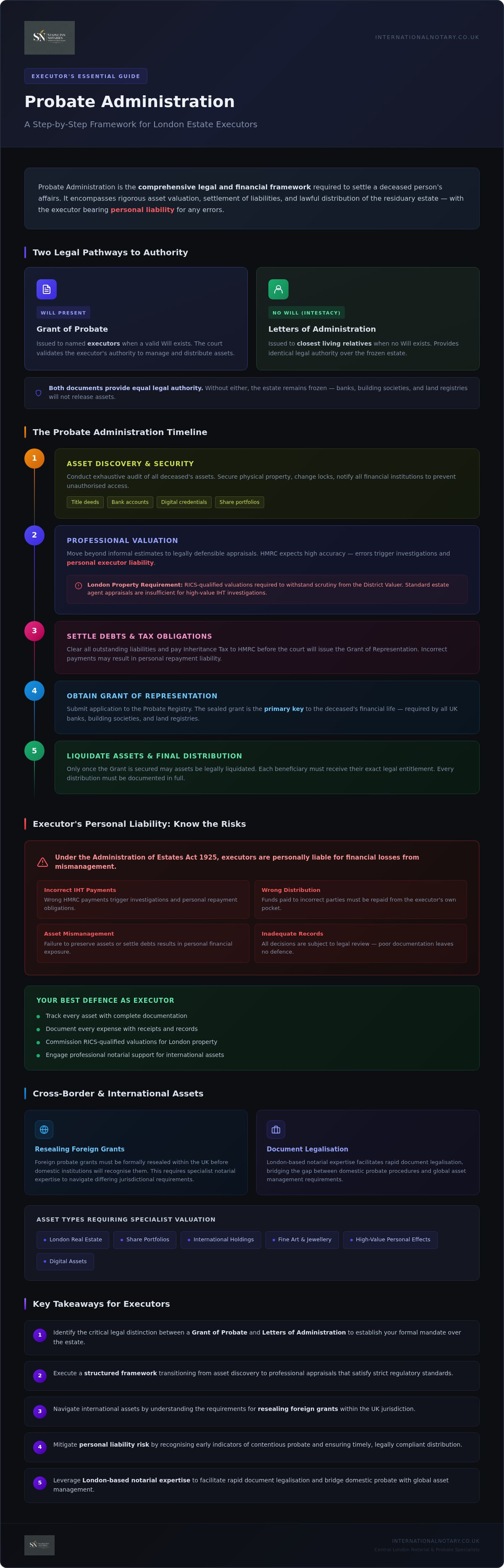
Probate Administration is the comprehensive legal and financial framework required to settle a deceased person's affairs with absolute precision. It's a process that extends far beyond the mere reading of a Will; it encompasses the rigorous valuation of assets, the settlement of outstanding liabilities, and the final, lawful distribution of the residuary estate. For executors managing London-based assets or high-value portfolios, this mandate requires a high degree of procedural accuracy to ensure the estate remains protected from external claims or regulatory scrutiny.
The process begins by determining the correct legal path based on the deceased's testamentary status. When a valid Will is present, the court issues a Grant of Probate to the named executors. In instances of intestacy, where no Will exists, the court instead issues Letters of Administration to the closest living relatives. Whilst the terminology differs, both documents provide the same essential legal authority. Professional Probate Administration becomes essential once an estate exceeds the small estate thresholds typically set by financial institutions, as the risk of administrative error increases alongside the complexity of the assets involved.
Grant of Representation: The Official Authorisation
The Grant of Representation acts as the primary key to the deceased's financial life. UK banks, building societies, and land registries operate under stringent anti-money laundering and fraud prevention protocols; they won't release significant funds or transfer property titles without seeing a sealed grant from the Probate Registry. This document provides the legal certainty these institutions require to indemnify themselves against future disputes. The Grant of Representation serves as the court's formal validation of an executor's legal authority to manage and distribute the deceased's assets. Without it, the estate remains frozen and inaccessible.
The Legal Responsibility of the Executor
Acting as an executor is a fiduciary role that carries significant personal weight. You aren't just an administrator; you're a legal shield for the estate's value. Under the Administration of Estates Act 1925, you have a statutory duty to collect and preserve the assets with due diligence. This means you're personally liable for any financial losses resulting from mismanagement, such as failing to settle debts or paying the incorrect amount of Inheritance Tax to HMRC. If you distribute funds to the wrong party, you may have to repay those sums from your own pocket. Meticulous record-keeping is your best defence. Track every asset. Document every expense. Act with the knowledge that your decisions are subject to legal review.
The Probate Administration Timeline: A Step-by-Step Framework
Effective estate management begins with an exhaustive audit of the deceased's assets. You must act with urgency to secure physical property, change locks where necessary, and notify all financial institutions to prevent unauthorised access or asset depletion. This initial discovery phase involves gathering every piece of documentation, from title deeds to digital login credentials, to form a complete picture of the estate's value. Don't rely on guesswork. Precision is the standard by which your performance as an executor will be measured.
Once you've identified the assets, the process of Probate Administration moves from discovery to valuation. This transition requires moving beyond informal estimates to professional, legally defensible appraisals. HMRC expects a high degree of accuracy; errors here can lead to lengthy investigations and personal liability for the executor. Once the net value is established, you must settle any outstanding debts and taxes before the court will issue the Grant of Representation. Only then can you legally liquidate assets and move toward final distribution.
Valuing London Property and Complex Assets
London real estate requires RICS-qualified valuations to withstand scrutiny from the District Valuer. Standard estate agent appraisals are often insufficient for high-value properties where the risk of an Inheritance Tax (IHT) investigation is elevated. Beyond property, you must account for share portfolios, international holdings, and high-value personal effects like jewellery or fine art. If the current distribution of these assets doesn't align with the beneficiaries' needs or tax positions, you might consider a deed of variation after death to redirect assets and improve the estate's overall tax efficiency. Meticulous valuation protects you from future claims of negligence.
Managing Inheritance Tax (IHT) Requirements
The 'pay before grant' rule is a significant hurdle in the timeline. You're required to submit the IHT400 form and pay any tax due within six months of the end of the month in which the death occurred. For 2026, you must ensure that IHT400 forms are submitted and any tax liabilities are settled within six months of the date of death to remain compliant with current HMRC regulations. Identify all available allowances, such as the standard nil-rate band and the residence nil-rate band, to shield the estate from unnecessary tax burdens. If you're managing complex international assets, a professional probate administration service can help you navigate these filings with the required technical precision.
With the tax cleared and the grant in hand, you can begin the final phase: collection and distribution. You'll liquidate bank accounts, sell property, and settle any remaining liabilities. Throughout this process, you must maintain impeccable estate accounts that document every penny entering or leaving the estate. These accounts provide a transparent record for the beneficiaries and serve as your final legal shield. Once the accounts are approved, you can distribute the residuary estate according to the Will or the rules of intestacy. Complete the task. Secure the discharge. Close the estate.
Cross-Border Assets and International Probate Requirements
Managing an estate with a global reach introduces layers of jurisdictional complexity that domestic Probate Administration rarely encounters. When assets are held in the US, the Middle East, or across Europe, the UK Grant of Probate is not automatically recognised by local registries. Foreign financial institutions often demand that the executor's authority be verified through a process of resealing or independent certification before they release funds or transfer titles. This requirement can significantly extend the administration timeline, particularly when dealing with civil law jurisdictions that operate under distinct succession principles. Act with foresight. Identify every foreign asset early.
For assets located within the European Union, the EU Succession Regulation (Brussels IV) continues to dictate which country's laws apply to the estate, even though the UK is now a third-party state. This regulation impacts how London-based executors manage property in France, Spain, or Italy, often requiring a formal choice of law statement within the Will itself. Without this, the estate may be subject to the forced heirship rules of the country where the property is situated. Navigating these conflicts requires a methodical approach to ensure the deceased's wishes are upheld across every border. Secure the assets. Verify the jurisdiction.
Notarial Certification for Overseas Property
Foreign land registries are notoriously risk-averse and will not accept a standard UK court document at face value. You will typically require a Notary Central London to certify true copies of the Grant of Probate and formally verify the executor's identity. This notarial act is a prerequisite for embassy legalisation London, a process required by many non-Hague Convention countries to authorise the sale of international real estate or the closure of foreign bank accounts. Certify the documents. Enable the sale. Protect the estate from procedural delays.
Apostille and Legalisation for International Estates
The Foreign, Commonwealth & Development Office (FCDO) plays a central role in this international chain of authority by issuing apostille certificates. An apostille confirms the signature and seal of the notary, making the document legally valid in countries that are party to the Hague Convention. For time-sensitive property transactions in jurisdictions like the UAE or China, urgent apostille and legalisation services are essential to prevent the collapse of a sale or the accrual of foreign tax penalties. We act as the bridge between London's legal requirements and overseas procedural demands, coordinating directly with foreign legal counsel to ensure every document meets local standards. Act swiftly. Ensure validity. Maintain momentum.
Precision in international Probate Administration is not optional; it is the only way to avoid the freezing of assets in multiple jurisdictions. By synchronising the UK probate process with the specific legalisation requirements of the target country, you reduce the risk of administrative deadlock. This proactive management is vital for maintaining the estate's value and ensuring that beneficiaries are not left waiting for years due to avoidable documentation errors. Follow the protocol. Secure the global legacy.
Mitigating Risk: Avoiding Contentious Probate and Disputes
Effective Probate Administration requires more than just processing paperwork; it demands a proactive strategy to immunise the executor against personal liability and future litigation. Disputes often arise from a lack of transparency or perceived delays, which can lead beneficiaries to question the executor's competence or the validity of the Will itself. Recognise the red flags early. Unexpected claims from estranged relatives, sudden changes to a Will shortly before death, or assets that don't align with the deceased's known wealth are all indicators of potential conflict. Act with decisive precision to neutralise these risks before they escalate into costly court proceedings.
One of the most critical steps in protecting yourself is the placement of statutory notices under Section 27 of the Trustee Act 1925. By advertising the death in The Gazette and local newspapers, you provide a legal window for unknown creditors to come forward. If you distribute the estate without these notices and a creditor later emerges, you may be held personally responsible for the debt. Similarly, the doctrine of Laches serves as a defence against claimants who sit on their rights for too long, but it only protects executors who have maintained a brisk and documented pace of administration. Don't delay. Advertise for creditors. Protect your personal assets.
Common Causes of Will Disputes in London
London estates frequently face challenges under the Inheritance (Provision for Family and Dependants) Act 1975, where claimants argue they haven't been left reasonable financial provision. Disputes also commonly centre on lack of testamentary capacity or undue influence, particularly in high-value estates. When the deceased's mental state is questioned, professional corporate power of attorney notarisation London provides a contemporaneous record of the individual's ability to understand complex legal documents. This notarial evidence can be vital in proving that the deceased was acting of their own free will and possessed the required capacity at the time of execution.
The Executor’s Defence: Meticulous Estate Accounts
Your ultimate shield against beneficiary disputes is the production of exhaustive estate accounts. These accounts must detail every asset realised, every debt settled, and every administrative expense incurred during the process. You must also account for 'ademption', where a specific gift in the Will no longer exists, and 'abatement', which occurs when the estate's debts exceed its value and legacies must be reduced. Once the accounts are approved by the beneficiaries, the finality of the process is reached through the 'Assent'. This is the formal document that transfers the legal title of London property from the executor to the rightful beneficiary. If you are facing potential disputes or require expert guidance on asset distribution, contact our London probate specialists to secure your position.
Maintain open lines of communication. Provide regular updates to beneficiaries to prevent the friction that stems from uncertainty. A transparent executor is a protected executor. By following these rigorous protocols, you ensure that the distribution is final, the creditors are satisfied, and your personal liability is extinguished. Secure the discharge. Finalise the accounts. Close the file with confidence.
Professional Probate and Notarial Support in Central London
Executing an estate in a global financial hub requires more than local legal knowledge; it demands an infrastructure capable of handling cross-border certification with absolute speed. In the high-pressure environment of Central London, delays in document processing can lead to the collapse of property sales or the expiration of international financial offers. Staple Inn Notaries operates as the essential bridge between domestic estate settlement and the rigorous requirements of international legalisation. We provide the technical precision required to ensure that your Probate Administration remains on track, regardless of where the assets are situated. Act with authority. Eliminate procedural friction.
Our firm is regulated by the Faculty Office of the Archbishop of Canterbury, ensuring that every certification we issue carries the weight of official authorisation required by foreign registries and domestic institutions alike. We understand that executors often manage these duties alongside demanding professional schedules. To accommodate this, our mobile notary services provide a streamlined solution for urgent signatures, allowing you to execute necessary documentation at your office or residence without interrupting your workflow. This commitment to efficiency defines our role as the Expert Fixer for complex estates. Secure the documents. Maintain the pace.
Why a Notary-Led Approach Benefits Executors
A notary-led approach is particularly advantageous for estates involving business interests, corporate resolutions, or complex shareholdings. We provide direct access to specialists who possess a deep understanding of both UK probate requirements and the nuances of global mobility. This dual expertise allows us to anticipate the specific hurdles of international jurisdictions before they become obstacles. Whether you're certifying a company resolution to liquidate foreign holdings or verifying an executor's identity for a global bank, our focus remains on accuracy and rapid conclusion. We don't just process paperwork; we provide the legal certainty required to conclude Probate Administration with finality. Focus on the legacy. Let us handle the compliance.
Next Steps: Engaging Professional Assistance
Preparing for your initial consultation is the first step toward a successful administration. You should begin by collating a comprehensive list of all known assets and liabilities, including account numbers, property titles, and any existing share certificates. If the estate includes international elements, identify the specific jurisdictions involved so we can advise on the necessary legalisation path immediately. Having this information ready allows us to provide a clear, structured roadmap for the months ahead. You don't have to manage this burden in isolation. Contact Staple Inn Notaries for expert Probate Administration support and ensure your duties are discharged with professional excellence. Gather your documents. Schedule your consultation. Secure the estate today.
Securing the Estate with Procedural Precision
The complexities of 2026 estate management require a transition from administrative oversight to rigorous legal execution. You now understand the necessity of precise valuations to satisfy HMRC, the critical nature of resealing grants for international assets, and the protective value of statutory notices. Effective Probate Administration is the only mechanism that ensures every beneficiary's entitlement is protected whilst shielding you from personal liability. Act with the authority your mandate requires. Don't leave the estate's security to chance.
As specialists in international notarial services, we provide the Central London expertise needed to bridge the gap between domestic probate and global legalisation. Our practice is regulated by the Faculty Office of the Archbishop of Canterbury, ensuring that every document meets the highest standards of international validity. Secure Professional Probate Administration Support in London to facilitate a rapid and compliant conclusion to the estate. By engaging expert support, you ensure that every procedural requirement is met with surgical precision. Discharge your duties with confidence. Your legacy of careful stewardship starts here.
Frequently Asked Questions
How long does probate administration typically take in London in 2026?
A standard estate generally requires nine to twelve months to conclude, though this timeline extends for complex portfolios or those requiring HMRC clearance. In 2026, the processing times at the Central London Probate Registry remain subject to administrative fluctuations. Act with urgency to submit accurate documentation early. Delays often stem from incomplete asset discovery or contested valuations, so meticulous preparation is your best defence against a protracted timeline.
Can I administer an estate myself, or do I need a professional?
You are legally permitted to manage the process independently, but professional Probate Administration is strongly advised for estates with high-value property or international assets. The role carries significant personal liability for any errors in tax filing or debt settlement. If you miscalculate Inheritance Tax or overlook a creditor, you're personally responsible for the shortfall. Professional oversight mitigates this risk and ensures you meet every statutory deadline with precision.
What happens if the deceased person held assets in a foreign country?
Foreign assets usually require a separate legal process, such as resealing the UK Grant of Probate or obtaining a fresh grant in the relevant jurisdiction. You'll likely need notarised and apostilled copies of UK court documents to satisfy international financial institutions. Coordinate with a London notary to legalise these papers. This ensures your authority is recognised across borders and prevents the freezing of overseas bank accounts or property titles.
What are the current Inheritance Tax thresholds I need to be aware of?
For 2026, the standard nil-rate band remains at £325,000, supplemented by the residence nil-rate band of £175,000 for main residences left to direct descendants. Spouses and civil partners can combine these allowances to reach a total threshold of £1 million. It's vital to verify current HMRC rules, as exceeding these limits triggers a 40% tax rate on the surplus. Identify all available exemptions early to protect the estate's value.
How do I search for a probate record or a missing will in England and Wales?
Search the government's Find a Will service for any grants already issued in England and Wales. To locate a missing Will, contact the deceased's bank and solicitors or search the National Will Register. If these avenues fail, you must administer the estate according to the rules of intestacy. Don't assume a Will doesn't exist. Exhaust all search options to avoid the legal complications of an incorrect distribution.
Is an executor personally liable for the debts of the deceased?
Executors face personal liability if they distribute assets without first settling all valid debts and taxes. You must place statutory notices for creditors to protect your personal assets from future claims. If a debt emerges after distribution and you failed to advertise, the creditor can pursue you directly for payment. Secure your position. Use the legal protections provided by the Trustee Act 1925 to extinguish unknown liabilities.
What is the difference between probate and trust administration?
Probate administration is the one-time process of settling an estate after death, whilst trust administration involves the ongoing management of assets held within a trust. Trusts are often established to protect assets for minors or to manage long-term family wealth outside the probate process. Each requires a distinct set of legal duties. Trustees must manage assets according to the trust deed, whereas executors focus on the immediate distribution of the deceased's estate.
How much does professional probate administration cost in Central London?
Fees in Central London are typically structured as either a fixed fee or an hourly rate based on the estate's complexity. Costs vary significantly depending on the volume of assets, the presence of international holdings, and the tax status of the deceased. Request a comprehensive fee proposal before engaging any specialist. Ensure it includes all anticipated disbursements, such as court fees and valuation costs, to maintain full transparency over the estate's finances.


Comments