
London Guide: Filing Your Company Confirmation Statements

Updated: Sep 3
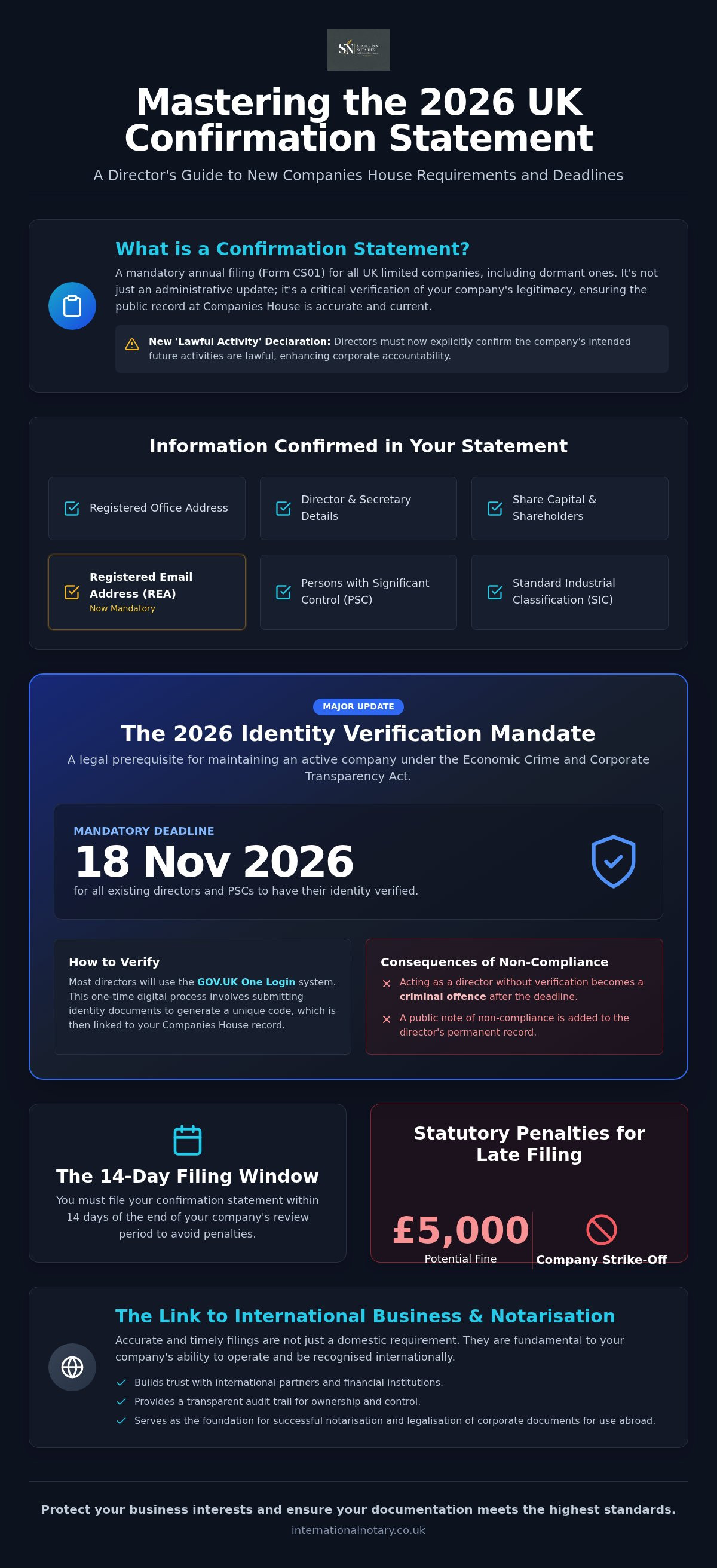
In 2026, a confirmation statement is no longer a mere administrative update; it's a critical verification of corporate legitimacy and lawful intent. You likely feel the mounting pressure of the 14-day filing window or the looming 18 November deadline for mandatory identity verification. It's understandable that these evolving statutory obligations regarding confirmation statements create a sense of urgency, especially when the risk of a £5,000 fine or a company strike-off is a reality. Maintaining compliance shouldn't be a source of constant anxiety for London directors.
This guide provides the expert insights you need to master the complexities of Companies House filings with absolute precision. We'll examine the specific requirements for identity verification, clarify the updated fee structures, and detail the essential link between accurate filings and your firm's international business validity. By following this structured approach, you'll ensure your corporate standing remains impeccable whilst avoiding the pitfalls of late submission. We'll provide a clear roadmap through the new regulatory environment to protect your business interests and ensure your documentation meets the highest standards of professional scrutiny.
Table of Contents
What is a Confirmation Statement (Form CS01)?
All UK limited companies, including dormant entities, must submit a Confirmation statement (previously an annual return) at least once every 12 months. This statutory obligation ensures that the public record held by Companies House remains accurate and reflects the current standing of the business. Since the implementation of the Economic Crime and Corporate Transparency Act 2023, the scope of these filings has expanded. It's no longer just an administrative box-ticking exercise. It's a formal declaration of your company's ongoing legitimacy. A critical 2026 compliance pillar involves the mandatory verification of the 'Lawful Activity' statement. Directors must now explicitly confirm that the company's intended future activities are lawful, providing a baseline of accountability that the Registrar of Companies monitors closely.
The Purpose of Corporate Transparency
Maintaining the integrity of the UK's central register is vital for global trust. When international partners or financial institutions evaluate your business, they rely on the veracity of the information filed at Companies House. Accurate confirmation statements facilitate smoother international business transactions by providing a transparent audit trail of ownership and control. This transparency isn't merely for domestic oversight. It serves as the foundation for international document legalisation. Without a verified and up-to-date record, securing the necessary certifications for cross-border operations becomes significantly more complex. The Registrar now holds enhanced powers to challenge inconsistent data, making meticulous filing a prerequisite for operational stability.
Information Confirmed in the Statement
The statement serves to verify several key data points rather than acting as a mechanism for reporting brand-new changes. You must confirm the registered office address and the mandatory Registered Email Address (REA). Current details for all directors, secretaries, and Persons with Significant Control (PSC) are also required. Additionally, the filing covers the company’s share capital, shareholder list, and Standard Industrial Classification (SIC) codes. If any of this information has changed since your last filing, you're often required to update the specific record before or alongside the statement submission. This ensures that the snapshot provided by the CS01 is entirely current. For London-based firms engaging in high-value corporate actions, ensuring these details match your internal board minutes is essential for subsequent notarisation. Precision here prevents delays in your broader corporate strategy. File accurately to protect your standing.
The 2026 Identity Verification Mandate
The landscape for filing confirmation statements has shifted significantly following the implementation of the Economic Crime and Corporate Transparency Act. By 18 November 2026, every company director and Person with Significant Control (PSC) must have their identity verified through the new statutory framework. This is not a voluntary upgrade. It's a legal prerequisite for maintaining an active company. Filing a statement without these verified identities now carries severe consequences, including the addition of a public note of non-compliance to the director's record. This mandate serves a vital purpose. It creates a robust barrier against corporate identity theft and fraudulent filings that have historically undermined the integrity of the UK register. By ensuring every officer is a verified individual, the Registrar of Companies can effectively combat economic crime whilst protecting legitimate business owners from unauthorised changes to their corporate records.
Verifying Identity for New and Existing Directors
Most directors will utilise the GOV.UK One Login system for a one-time verification process. This digital-first approach requires the submission of primary identity documents to generate a unique personal code. This code must then be linked to the individual's record at Companies House to satisfy the verification requirement. For existing directors, the transition period ends on 18 November 2026. After this date, acting as a director without a verified identity becomes a criminal offence. Non-UK resident directors of London companies face specific challenges, as they may lack the standard UK credentials required for the automated digital route. These individuals must often rely on professional intermediaries to bridge the gap and ensure their status is correctly recorded. When you prepare to File your confirmation statement, the system will now cross-reference these verified identities, making it impossible to bypass this security layer without triggering a red flag.
The Role of Professional Intermediaries
Authorised Corporate Service Providers (ACSPs) play a pivotal role in this new regulatory ecosystem. These regulated entities, including established legal professionals, are authorised to perform identity checks and report them directly to the Registrar. This is particularly relevant for international board members who require Passport and ID Certification to validate their credentials. Professional verification ensures compliance amongst diverse and complex shareholding structures where digital-only methods might fail. Our specialists frequently assist in the certification of documentation for overseas directors, ensuring their identity is established to the highest regulatory standards. If your board includes international members, securing expert Passport and ID Certification in London is an essential step in your annual compliance cycle. This professional oversight prevents administrative delays and ensures your corporate documentation remains beyond reproach.
Filing Deadlines, Fees, and Statutory Penalties
Precision in timing is the hallmark of effective corporate governance. A company's 'review period' typically spans 12 months, concluding on the anniversary of its incorporation or the date of the previous filing. Once this window closes, you have exactly 14 days to submit your confirmation statements to Companies House. The fee structure as of 1 February 2026 demands £50 for digital submissions, whilst paper filings incur a significantly higher cost of £110. It's vital to distinguish between the filing deadline and the 'payment period' concept. You're required to pay the statutory fee only once within a 12-month window. This allows you to file multiple statements during that time without additional cost if your company details change frequently, ensuring your public record remains beyond reproach.
Step-by-Step Filing Procedure
Efficiency dictates a digital-first approach. Log in to the Companies House WebFiling service using your company's secure authentication code. Review and update PSC details and your registered office information immediately to reflect current reality. The 2026 standards require a formal 'Lawful Activity' declaration. This statement confirms that the company's intended operations remain within legal bounds, aligning with the latest identity verification requirements and anti-fraud measures. Submit the document via the secure portal and process the statutory payment. Once the 'Accepted' notification arrives, your compliance for the period is secured.
Consequences of Non-Compliance
Failure to act within the 14-day window triggers immediate and severe repercussions. Financial penalties issued by Companies House start at £150 and can escalate to £5,000 for persistent non-compliance. The risks extend far beyond monetary loss. Directors face personal prosecution for a failure to file, which is a criminal offence under the Companies Act 2006. Compulsory strike-off action represents the ultimate sanction. If the Registrar believes a company is no longer operating, they will initiate proceedings to remove it from the register. This results in the freezing of all company assets, which then pass to the Crown under the principle of bona vacantia. Don't leave your firm's existence to chance. Swift, accurate filing is the only way to safeguard your corporate standing and ensure the continued validity of your international operations.
Updating Company Information: Beyond the Statement
A common misconception amongst directors is that the annual filing serves as a primary vehicle for reporting all corporate changes. In reality, specific alterations to your company structure must be reported to Companies House before you submit your confirmation statements. This ensures the statement remains a verification of an already accurate record rather than a corrective tool. Accurate Standard Industrial Classification (SIC) codes are also vital. These codes determine how your business is categorised for financial and regulatory reporting, and incorrect classification can lead to complications with banking facilities or insurance providers. Even dormant companies are not exempt from these rigorous requirements. A failure to maintain an active record, regardless of trading status, invites the same penalties and risks of strike-off action discussed in earlier sections.
Changes to People with Significant Control (PSC)
A Person with Significant Control is generally defined as an individual who holds more than 25% of the company's shares or voting rights. They may also exercise significant influence through other means, such as the right to appoint or remove a majority of the board. When control or influence within your firm shifts, you must report these changes within a 14-day window. Maintaining an accurate PSC register carries immense legal gravity. It is a cornerstone of the UK's transparency framework. Inaccurate PSC data can lead to criminal liability for directors and can severely complicate international due diligence processes when you seek to expand into foreign markets.
Registered Office and Email Management
The 2026 mandates have introduced stricter requirements for a company's registered office. It must now be a 'physical address' where documents can be delivered and recorded. Using a simple PO Box is no longer sufficient. Additionally, every entity must provide a monitored Registered Email Address (REA). This address is for official correspondence from the Registrar and must be kept current at all times to ensure you receive critical legal notices. If you need to relocate your office or change your constitutional documents urgently, our Mobile Notary London service can facilitate on-site certification of board minutes and resolutions. This ensures your updates are legally robust and ready for immediate filing, even during time-sensitive corporate restructures.
Ensuring your corporate data is synchronised across all platforms is essential for seamless operations and international validity. If you require professional assistance with certifying company resolutions or verifying director identities for your next filing, consult our Central London specialists to secure your company's standing.
The Link Between Filings and International Notarisation
An up-to-date Companies House record is the bedrock of international document legalisation. Foreign jurisdictions and financial institutions require absolute certainty regarding a company's standing before they'll recognise its authority. When you file confirmation statements, you provide the fresh evidence of corporate existence that notaries require to perform their duties. Without this current data, the chain of verification breaks. This is particularly critical for overseas property deals or high-value asset transfers where evidence of authority is scrutinised by foreign land registries. Ensure your corporate power of attorney notarisation London is supported by current filings to avoid rejection by overseas authorities. A notary's role is to verify company standing before certifying board minutes, and they cannot do so if the public record is stagnant or inconsistent.
Certifying Company Resolutions
Cross-border jurisdictions frequently demand notarised board minutes to validate corporate decisions. Before a notary can certify these minutes, they must independently verify the company's status via the Registrar. The confirmation statement acts as the definitive source for verifying the current list of authorised directors and their specific powers. If your public record is outdated, the notary cannot confirm that the signatories have the requisite authority to bind the company. We also provide professional certification of statutory declarations for international use, which relies heavily on the transparency established through your annual filings. Maintain your records. Protect your authority. Precise filings ensure that your board resolutions carry the weight they require in foreign courts and registries.
Preparing for International Expansion
Proving your company's existence to foreign embassies is a standard requirement for establishing global subsidiaries or bidding for international contracts. The confirmation statement serves as primary evidence that the entity is in good standing and hasn't been struck off. For documents to be legally recognised abroad, you'll likely require an Apostille Central London. This legalisation process involves the Foreign, Commonwealth & Development Office (FCDO) and often requires a notary's prior certification. Strategic advice for London firms is simple: treat your filings as a prerequisite for global growth. Any discrepancy between your internal board resolutions and the public record will cause significant delays at the legalisation stage. Act decisively to ensure your corporate documentation is ready for the global stage. Efficiency in filing today prevents procedural bottlenecks in your international expansion tomorrow.
Securing Your Corporate Standing for 2026 and Beyond
Maintaining an accurate public record is no longer an optional administrative task; it's the definitive benchmark of your company's legitimacy. We've explored the critical nature of the 14-day filing window and the rigorous new identity verification mandates that now govern all UK directors. Protect your standing. By ensuring your confirmation statements are filed with precision, you protect your firm from financial penalties and the severe risk of compulsory strike-off action. This baseline of compliance is essential for any London business seeking to engage in international trade or cross-border property transactions.
Staple Inn Notaries provides the specialised expertise required to navigate these evolving statutory obligations. As regulated professionals by the Faculty Office and specialists in Company Resolution Certification, we operate from our Central London location to deliver rapid, authoritative service. Our role as a trusted gatekeeper ensures your corporate documentation meets the highest standards of international validity. Secure your corporate compliance with Staple Inn Notaries today. With the right professional partner, you can manage your regulatory duties with absolute confidence and focus on your company's global growth.
Frequently Asked Questions
What is the difference between an annual return and a confirmation statement?
The confirmation statement replaced the annual return in 2016 to simplify the reporting process. Whilst the old annual return required a full snapshot of company data every year, the confirmation statement only requires you to verify that the information held by Companies House is current. If no changes have occurred, you simply confirm the existing record. This shift focuses from re-submitting data to verifying its accuracy, reducing the administrative burden on directors whilst maintaining a transparent public record.
Do I need to file a confirmation statement if my company is dormant?
Yes, dormant companies must file a confirmation statement every 12 months to maintain their position on the central register. Failure to do so implies the company is no longer required, which triggers compulsory strike-off action by the Registrar. Even if your entity is not actively trading, you must confirm the registered office, director details, and share capital. Maintaining this record is essential for protecting the company name and ensuring the entity remains legally valid for any future commercial operations.
What happens if I miss the 14-day filing deadline for my CS01?
Missing the 14-day window for confirmation statements results in immediate regulatory scrutiny and potential financial penalties. Companies House can issue fines starting at £150, which may escalate to £5,000 for persistent non-compliance. Beyond monetary loss, the Registrar may assume the company is defunct and initiate strike-off proceedings. Directors also risk personal criminal prosecution for failing to meet their statutory duties. Prompt action is required to rectify any late filings and safeguard your firm's ongoing legal standing.
How do I verify my identity for Companies House in 2026?
You verify your identity using the GOV.UK One Login system or through an Authorised Corporate Service Provider in 2026. This process requires submitting primary identification to obtain a unique personal code, which links to your company record. For non-UK residents, professional intermediaries provide the necessary certification to satisfy the Registrar. Completing this verification before November 2026 is essential to avoid public non-compliance notes and potential criminal liability for acting as a director.
Can I change my company's directors while filing the confirmation statement?
No, you cannot use the confirmation statement to appoint or remove directors; these changes must be reported separately using forms AP01 or TM01. The confirmation statement serves only to verify the information that is already on the public record. If you have made changes to your board, you must ensure those filings are accepted by Companies House before you submit your CS01. This ensures your annual verification reflects an accurate snapshot of your corporate structure, which is vital for international validity.
Is there a fee for filing a confirmation statement at Companies House?
There is a mandatory statutory fee for filing a confirmation statement, which is currently £50 for digital submissions. If you choose to file via paper, the cost increases to £110. This fee is payable once every 12 months, regardless of how many confirmation statements you file within that period. Digital filing is the preferred method for London firms, offering both a lower cost and faster processing times through the secure WebFiling portal.
What is the 'Lawful Activity' statement required in the 2026 filing?
The 'Lawful Activity' statement is a mandatory declaration introduced by the Economic Crime and Corporate Transparency Act 2023. Directors must now explicitly confirm that the company's intended future activities will be lawful. This requirement aims to combat economic crime and increase corporate transparency across the UK. You must complete this declaration as part of your annual filing process. Failure to provide this confirmation will result in your statement being rejected, leading to statutory penalties and strike-off risks.
How can a London notary help with my company's statutory filings?
A London notary facilitates the certification of company resolutions and board minutes that support your statutory filings. When your business engages in international transactions, foreign authorities often require notarised evidence of your company's standing and director authority. We verify your current Companies House record before providing the necessary legalisation and apostille services. Our Central London team ensures your documentation is beyond reproach, allowing you to meet both domestic compliance and international legal requirements with absolute efficiency.


Comments