
Lasting Powers of Attorney Lawyer London: Expert Support

Updated: 7 days ago
What if the person you trust most isn’t the right person to make every decision on your behalf? Choosing attorneys and defining their authority are among the most important parts of arranging an LPA. A Lasting Powers of Attorney Lawyer London can help you turn your intentions into clear instructions and guide you through the formal steps involved.
It’s understandable to feel unsure about which LPA you need, what information to prepare or how much authority to give your attorneys. Staple Inn Notaries’ specialist lawyers provide LPA guidance as part of a wider private-client practice, helping you consider the choices and formalities involved.
This article explains how a lawyer can support you, which decisions deserve careful thought and what to expect when arranging an LPA in London. You’ll learn how Property and Financial Affairs LPAs differ from Health and Welfare LPAs, what to prepare before seeking advice, and how preparing an LPA differs from notarising a power of attorney for overseas use. With a clearer understanding of the process, you can decide what to do next.
Table of Contents
When should you speak to a Lasting Powers of Attorney lawyer in London?
Consider making an LPA before a health change or other unexpected event makes it harder to put your wishes into effect. A Lasting Power of Attorney is a legal document that authorises people you choose, known as attorneys, to make specified decisions for you. Those decisions may concern your finances and property, or your health and welfare. For a general overview of the Lasting Power of Attorney (LPA), see the linked reference.
Planning ahead matters because the donor, the person making the LPA, needs to understand what they are doing and be able to make the relevant decisions when creating it. An LPA isn’t simply a form to complete on someone else’s behalf. Speaking to a lawyer early can help the donor consider who they trust, what authority to grant and how their instructions should reflect their circumstances.
This guide concerns LPAs in England and Wales. Scotland and Northern Ireland have different arrangements, so the rules and documents aren’t interchangeable. An LPA is also different from a power of attorney intended for use overseas. Advice on preparing an LPA isn’t the same as notarising a document for another country, and a domestic LPA doesn’t automatically meet another country’s requirements.
What can an LPA lawyer help you decide?
A lawyer can help clarify the donor’s priorities and the intended scope of an attorney’s authority. This means discussing practical questions, such as who should act, whether replacement attorneys should be named and how the donor wants decisions to be approached. The right choices depend on the individual’s relationships, needs and preferences.
A lawyer can also explain the information and decisions needed, highlight points that call for careful thought and help express the donor’s instructions clearly. Staple Inn Notaries’ specialist lawyers are regulated by the Faculty Office of the Archbishop of Canterbury. Advice can help you understand the process, but it doesn’t guarantee that an LPA will be registered or that a particular outcome will follow.
When is tailored advice especially useful?
Some circumstances call for more detailed consideration. A donor may, for example, have a complex family arrangement, run a business or own property jointly with another person. These factors can raise questions about who should make decisions and how the donor’s intentions should be recorded. A lawyer can help identify where instructions need clarification and consider whether the provisions reflect the donor’s stated preferences.
It may also be useful to consider an LPA alongside a will and broader estate planning, particularly when plans for assets and future arrangements are connected. Staple Inn Notaries provides private-client support with LPAs, wills and estate planning, tailored to the donor’s circumstances. Its legal advisory services can help bring related considerations into view.
Property and financial affairs or health and welfare: which LPA fits?
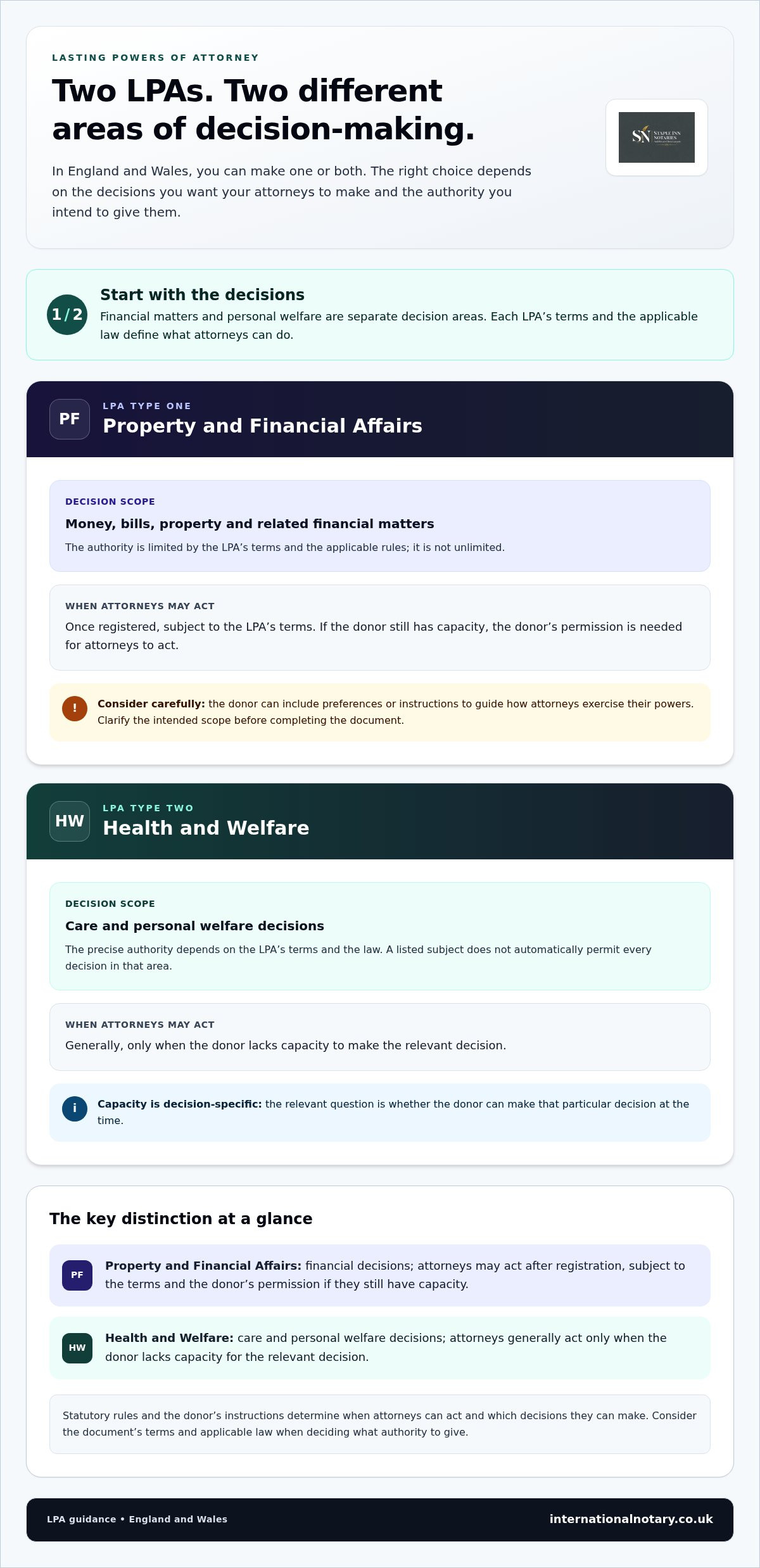
In England and Wales, there are two types of Lasting Power of Attorney (LPA), each covering a different area of decision-making. You can make one or both. The right choice depends on the decisions you want your attorneys to make and the authority you intend to give them. Use this comparison as a starting point, then consider the document’s terms and applicable law.
Statutory rules and the donor’s instructions determine when attorneys can act and which decisions they can make. For current information on making, registering and managing an LPA, consult official government guidance on LPAs. A Lasting Powers of Attorney Lawyer London can help you understand how your intentions may be reflected in the document.
What does a property and financial affairs LPA cover?
This LPA can authorise attorneys to deal with financial matters such as paying bills and managing property. It doesn’t give them unlimited authority: their role is defined by the LPA and governed by the applicable rules. The donor can include preferences or instructions to guide how attorneys exercise their powers, so consider the wording carefully.
After registration, attorneys may act while the donor still has capacity only if the donor permits it and the LPA’s terms allow it. If the donor wants help with practical financial tasks while retaining control, this distinction deserves particular attention. Clarify the intended scope before completing the document.
What does a health and welfare LPA cover?
This type of LPA concerns personal welfare and care decisions, including day-to-day living arrangements and future medical support. When planning ahead for progressive conditions that may affect mental capacity, resources like neeryvillecare.com can provide practical insight into everyday care needs. The precise authority depends on the LPA’s terms and the law. A listed subject shouldn’t be treated as automatic permission to make every decision in that area. Attorneys generally act only when the donor lacks capacity to make the specific decision. Capacity is decision-specific, so the relevant question is whether the donor can make that decision at the time.
Consider whether you need authority over financial matters, welfare matters or both. If the choice or wording is difficult, tailored LPA advice can help you examine the options and express your preferences clearly. Discuss LPA advice with Staple Inn Notaries.
Does an LPA lawyer add value if the forms are publicly available?
You can access official LPA forms and guidance and prepare an application yourself. Professional advice isn’t a universal requirement, and some people may feel confident working through the process independently. The decision depends on the donor’s circumstances, the complexity of their instructions and how comfortable they are interpreting formal guidance. Legal support can help apply those requirements to the donor’s situation, rather than simply provide a form.
Preparing an LPA yourself gives you direct control over the paperwork and may suit straightforward arrangements where the donor’s wishes are clear. Tailored legal assistance gives you the opportunity to discuss choices, check whether instructions are clear and address circumstances that don’t fit neatly into a standard form. A Lasting Powers of Attorney Lawyer London can guide the donor through those decisions while leaving the choice of attorneys and final instructions with them.
What can be difficult to resolve without tailored advice?
Choosing attorneys and replacements involves more than naming people the donor trusts. Consider whether those people understand the donor’s priorities, can take on the intended role and are suitable for the authority being given. Family relationships, differing views or complex finances may make the decision less straightforward.
Instructions also need to communicate the donor’s wishes clearly. A preference that seems obvious to the donor may be open to different interpretations later. Legal advice can help identify ambiguity, make the wording more coherent with the donor’s intentions and explain formal steps in plain language. Follow current Office of the Public Guardian guidance on forms and execution requirements. Requirements can change, so don’t rely on an old copy or informal assumptions.
Preparing the LPA yourself may suit someone with clear arrangements who is comfortable following official guidance. Advice may be particularly helpful if the donor wants to compare options, has complicated family or financial circumstances, or is unsure how to express a preference. Either way, the donor needs to consider carefully who should act and what authority to grant.
When might a notarial power of attorney be different?
A domestic LPA is made under the arrangements for England and Wales. A power of attorney intended for use overseas may need to meet the requirements of the relevant foreign authority, which may ask for notarisation or legalisation. These steps authenticate or prepare a document for its intended use; they don’t create or replace an England and Wales LPA. Having an LPA doesn’t automatically meet another country’s requirements.
Be clear about the document’s purpose before arranging it: is the authority intended to operate under the LPA framework in England and Wales, or is a separate document needed for use abroad? If LPA planning sits alongside other private-client matters, Staple Inn Notaries’ legal advisory services can provide a connected perspective. Choose support according to the donor’s circumstances and the document’s intended purpose.
How to prepare for an LPA advice meeting in London
A little preparation can make an LPA advice meeting more focused. You don’t need to have every decision settled in advance. Give the lawyer a clear picture of the donor’s wishes and circumstances, then identify the points that need advice. Use this checklist before meeting a Lasting Powers of Attorney Lawyer London.
Clarify the donor’s aims. Note what they want the LPA to achieve and which decisions they may want attorneys to make. Consider whether their priorities concern property and finances, health and welfare, or both. Record any concerns about the authority they intend to give.
List potential attorneys and replacements. Write down the people the donor is considering and why each may be suitable. Think about whether to name replacement attorneys and note any questions about how the chosen people might work together.
Summarise relevant circumstances. Make private notes about family arrangements, property ownership, business interests and financial matters that could affect the donor’s choices. You don’t need to send sensitive personal or financial details by email as an initial step. Keep relevant facts to discuss through an appropriate channel during the advice process.
Record preferences and boundaries. Note what the donor wants attorneys to take into account, any limits or preferences they wish to express and areas where they’re uncertain. Clear examples can help explain what matters, without assuming that every preference can be recorded as a binding instruction.
Gather connected questions. Consider whether the LPA raises related questions about wills, estate planning or trusts. These are distinct matters, but discussing the wider context may help identify what advice is needed and what should be addressed separately.
Write down questions about the process. Ask for an explanation of the drafting, signing and registration stages relevant to the donor’s circumstances. Clarify who needs to participate, which formalities apply and what information is needed at each stage. Requirements can depend on the case, so seek current guidance rather than relying on old forms or assumptions.
Staple Inn Notaries provides LPA advice through its Central London practice as part of its wider private-client work. Use the meeting to discuss the donor’s intentions, understand the decisions ahead and identify points that need further consideration. The firm’s specialist lawyers are regulated by the Faculty Office of the Archbishop of Canterbury.
Keep your notes concise and bring the questions that matter most. If broader planning is relevant, mention it so the discussion can distinguish LPA decisions from separate estate-planning needs. To discuss an LPA advice meeting, contact Staple Inn Notaries about LPA advice.
LPA support from Staple Inn Notaries: clear advice and a practical next step
Arranging an LPA involves personal decisions as well as formal paperwork. Staple Inn Notaries provides Lasting Powers of Attorney support within its wider private-client practice, helping donors consider how their wishes, relationships and circumstances relate to the authority they plan to grant. Its specialist lawyers are regulated by the Faculty Office of the Archbishop of Canterbury, and the practice serves clients in Central London and across the wider London area.
An LPA can sit alongside a will or broader estate planning, but each has a distinct legal function. A will sets out arrangements for a person’s estate after death; an LPA authorises chosen attorneys to make specified decisions for the donor under its terms. Considering these documents together may bring related planning questions into focus, without treating one as a substitute for the other.
What to expect from a focused LPA discussion
A useful discussion starts with the donor’s aims. The lawyer can explore proposed attorneys, replacement arrangements, the decisions the donor wants to cover and any questions that need advice. If circumstances are complex, such as differing family views or financial arrangements that need careful consideration, explain the relevant context so the discussion addresses the real issues, not just the form.
The discussion can also clarify the options and formal stages relevant to the donor’s situation. This may include explaining what information is needed to prepare the document, which signing requirements apply and how registration fits into the process. Details depend on the case and current requirements. Advice can help you understand the steps, but it can’t guarantee registration or a particular outcome.
Keep the discussion focused on the donor and the law of England and Wales. A Lasting Powers of Attorney Lawyer London can help translate the donor’s intentions into clear instructions and identify points that need further thought. Bring your questions even if some decisions are still open; the discussion can help separate what the donor has decided from what remains to be explored.
Take the next step with a London LPA lawyer
Planning early gives the donor time to consider their choices and discuss them without unnecessary pressure. Outline the enquiry and provide preferred contact details through the form, then use the discussion to identify the advice needed for the donor’s circumstances. Share only the information necessary to explain the enquiry at this stage.
Start the conversation when you’re ready. Submit an LPA enquiry through the contact form to discuss tailored LPA support from Staple Inn Notaries.
Put your LPA plans into motion
Making an LPA is a practical step towards formally recording your intentions. You don’t need to have every detail settled before seeking advice. Start with what matters most to the donor, then use a focused discussion to identify choices that need further thought.
Staple Inn Notaries’ private-client work brings LPA planning together with wills and estate planning while keeping the purpose of each document clear. Its specialist lawyers are regulated by the Faculty Office of the Archbishop of Canterbury. For tailored guidance from a Lasting Powers of Attorney Lawyer London, explain the donor’s circumstances and the questions you would like to resolve.
Planning early gives you space to consider the options calmly and make informed decisions. Take the next step when you’re ready: Discuss your LPA requirements with our team.
Frequently Asked Questions
Is a lawyer required to make a Lasting Power of Attorney in England and Wales?
No. You can use the official forms and guidance to make an LPA without instructing a lawyer. Legal advice is optional, not a universal requirement. It may be useful if the donor’s circumstances or proposed instructions are complex, or if they’re unsure how to express their wishes. A Lasting Powers of Attorney Lawyer London can explain the choices and formalities, while the donor remains responsible for deciding whom to appoint and what authority to grant.
Can an LPA be used before it is registered with the Office of the Public Guardian?
No. An LPA must be registered with the Office of the Public Guardian before attorneys can use it. Signing the document alone doesn’t give attorneys authority to act under it. Registration is a separate stage, so allow for it when planning ahead. Until registration is complete, an attorney can’t rely on the LPA to manage the donor’s affairs or make decisions on their behalf.
Can one person be appointed as attorney for both types of LPA?
Yes. The same person can be appointed under both a Property and Financial Affairs LPA and a Health and Welfare LPA. The donor should consider whether that person is suitable for each role, since the documents cover different areas of decision-making. They can also appoint different attorneys for each LPA. Think about the responsibilities involved and whether the proposed attorneys can act in accordance with the donor’s wishes.
What happens if someone loses mental capacity without an LPA?
If a person can no longer make a particular decision and has no LPA covering it, relatives don’t automatically gain legal authority to decide for them. Someone may need to apply to the Court of Protection to become a deputy, with the court determining the application and the deputy’s authority. The appropriate route depends on the situation and the decision involved. This can be a significant responsibility, so seek advice on the relevant process.
Can an attorney make decisions when the donor still has mental capacity?
It depends on the LPA type and its terms. Under a registered Property and Financial Affairs LPA, an attorney may act while the donor has capacity if the donor permits it and the document allows it. A Health and Welfare attorney can generally act only when the donor lacks capacity to make the specific decision. An attorney must not treat their appointment as permission to override a decision the donor can make themselves.
Can a UK LPA be used to manage property in another country?
Not automatically. Whether an LPA made in England and Wales can be used for overseas property depends on the law and requirements of the country where the property is located, as well as the relevant institution’s procedures. A foreign authority may require a separate power of attorney, notarisation or legalisation. Before relying on a UK LPA abroad, establish what the local rules require; domestic registration alone doesn’t guarantee acceptance overseas.
Can an existing LPA be changed or cancelled?
An LPA can generally be revoked by the donor while they have the mental capacity to do so. To change its terms, the usual approach is to revoke the existing LPA and make a new one, rather than edit the registered document. The formal steps matter, and the Office of the Public Guardian must be notified as required. If the donor has lost capacity, they can’t simply alter or cancel the LPA themselves; obtain advice on the circumstances.



Comments