
Inheritance Tax Threshold 2026 UK: Allowances, Rates and Who Pays

Updated: Oct 10
What if the £325,000 figure isn’t the full inheritance tax threshold 2026 UK families can use? It is the standard nil-rate band, but eligible estates may also benefit from a residence nil-rate band. Unused allowances may sometimes transfer between spouses or civil partners, too. The amount an estate can pass on tax-free therefore depends on more than one headline figure.
If you’re unsure whether an estate could face inheritance tax, the answer depends on details such as who inherits the home, the estate’s value, lifetime gifts and any applicable reliefs. The threshold is a starting point, not a universal tax-free amount.
This guide explains the main 2026/27 allowances, how they can combine and when the standard 40% rate may apply. It also covers how property, spouses, gifts and reliefs can affect the calculation, including circumstances that may reduce or remove an allowance. Use it to identify the details that matter, then consider consulting chartered accountants at fvaccounts.com or seeking tailored estate advice if your circumstances need closer assessment.
Table of Contents
What is the inheritance tax threshold in the UK for 2026?
The inheritance tax threshold is the value an estate can pass on before inheritance tax (IHT) is generally due. For the 2026-27 tax year, the standard nil-rate band is £325,000. A residence nil-rate band of up to £175,000 may also apply if the eligibility rules are met. The inheritance tax threshold 2026 UK families can use therefore depends on the estate and who inherits.
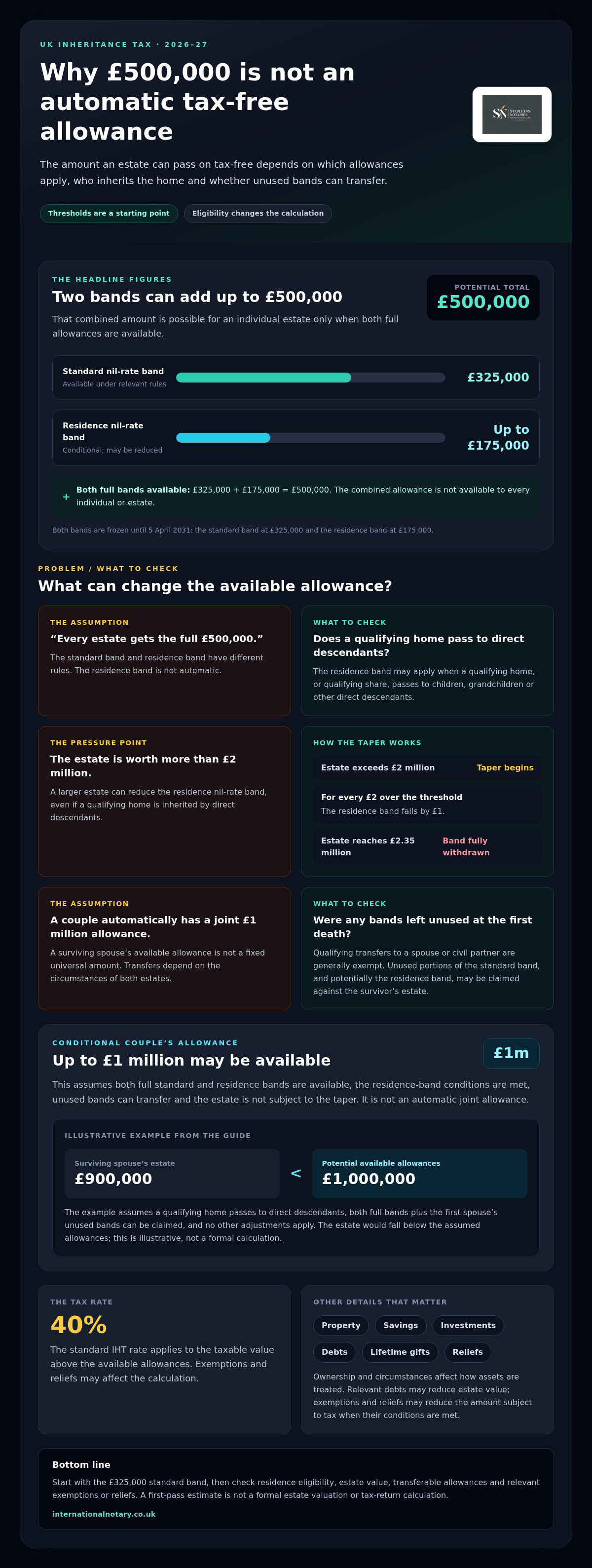
In 2026-27, the standard nil-rate band is £325,000 and the residence nil-rate band is up to £175,000. The combined £500,000 allowance is not available to every individual or estate.
These figures are allowances, not tax rates. The standard IHT rate is 40% on the taxable value above the available allowances, although exemptions and reliefs may affect the calculation. For a broader historical and structural overview, see Inheritance tax in the United Kingdom.
What is the standard nil-rate band in 2026?
The nil-rate band (NRB) is the amount an individual’s estate can generally pass on without IHT, subject to the relevant rules and exemptions. It remains £325,000 in 2026-27 and is frozen at that level until 5 April 2031.
The NRB is one part of the estate’s tax calculation. It does not mean every asset or transfer is treated in the same way. Property, savings, investments and lifetime gifts may be subject to different rules, while exemptions or reliefs can alter the final amount assessed.
When can the residence nil-rate band increase the threshold?
The residence nil-rate band (RNRB) can add up to £175,000 when a qualifying home is passed to direct descendants, such as children or grandchildren. If the full RNRB and standard NRB are available, an individual’s estate may have allowances totalling £500,000. This is conditional, not automatic: an estate may not qualify if there is no qualifying residence passing to direct descendants.
The RNRB is also reduced for larger estates. It falls by £1 for every £2 that the estate’s value exceeds £2 million, and is fully withdrawn when the estate reaches £2.35 million. The RNRB is frozen at £175,000 until 5 April 2031. To assess whether it applies, consider the home, its beneficiaries and the estate’s overall value, rather than relying on the headline threshold alone.
How do the UK inheritance tax allowances work together?
Allowances can combine, but they do not all work in the same way. This table summarises the main provisions for 2026-27. Whether they apply depends on the estate, the beneficiaries and the deceased’s circumstances.
The spouse or civil partner exemption is separate from transferable allowances. If the first person to die leaves assets to their spouse or civil partner, that transfer is generally exempt. Any unused proportion of their NRB, and potentially their RNRB, may also be claimed against the survivor’s estate later. The amount available depends on how the first estate used its allowances, the couple’s history and the conditions applying to the second estate.
Can married couples and civil partners combine inheritance tax allowances?
Potentially. If the relevant conditions are met, unused bands from the first death can increase the allowances available on the survivor’s death. This may mean a couple has up to £1 million in combined NRB and RNRB allowances, assuming both full bands are available, the RNRB conditions are met and the estate is not subject to its taper. It is not an automatic joint allowance.
A surviving spouse’s potential IHT allowance is not a universal fixed amount. It depends on unused transferable bands, qualifying assets and the circumstances of both estates.
Who can claim the residence nil-rate band?
The RNRB may apply when a qualifying residence, or a qualifying share in one, is passed to direct descendants, such as children or grandchildren. It is tapered by £1 for every £2 that the estate exceeds £2 million, and is fully withdrawn at £2.35 million. See the current Inheritance Tax thresholds and rules for the detailed criteria. Ownership, the will and the estate’s value can all affect eligibility.
For example, assume a surviving spouse’s estate is valued at £900,000, includes a qualifying home passed to direct descendants, and can claim both full bands plus the first spouse’s unused bands. Assuming no other adjustments apply, the available allowances could total £1 million, so the example estate would fall below that figure. This is illustrative, not a formal calculation. For tailored inheritance tax advice in London, contact the private client team.
Which estate details can change the inheritance tax bill?
The inheritance tax threshold 2026 UK is only one part of the calculation. An estate may include property, savings, investments and other assets, and ownership and the deceased’s circumstances affect how each is treated. Relevant debts may reduce the estate’s value, while exemptions and reliefs may reduce the amount subject to tax if their conditions are met.
Lifetime gifts need separate consideration from assets held at death. Some gifts may be potentially exempt transfers: broadly, they can become exempt if the giver survives for seven years, although exceptions and other rules may apply. The annual gift exemption, currently £3,000, and certain small or wedding gifts have separate conditions. These exemptions are not extra nil-rate bands, and a gift should not be assumed to be tax-free without checking the circumstances.
For a plain-language overview of gifts and estate calculations, read how to boost your tax-free allowance. Keep a clear record of what was given, when, to whom and, where relevant, its value. These details can be important when an estate is assessed.
How do gifts affect inheritance tax?
If the giver dies within seven years of making a potentially exempt transfer, it may be brought into the IHT calculation. Taper relief may reduce the tax on a gift if the giver survives for between three and seven years, but it does not simply reduce the gift’s value or automatically remove a liability. The outcome depends on the full transfer and estate history. Gifting can also affect a person’s own financial security, so it is not suitable for everyone.
Do property, trusts and reliefs change the calculation?
A qualifying home passed to direct descendants may support a residence nil-rate band claim, subject to eligibility and the estate-value taper. The property’s ownership and the terms of the will can therefore matter. Trusts can also affect how assets are held and administered, but their IHT treatment depends on the trust type, its terms and relevant events. Blended families may need particular care to ensure estate documents reflect intended beneficiaries and family arrangements.
Business and agricultural assets may qualify for relief, but eligibility and the amount of relief depend on current law and the asset’s circumstances. From 6 April 2026, 100% Agricultural Property Relief and Business Property Relief is capped at £2.5 million per person; qualifying value above the cap receives 50% relief. The allowance can transfer between spouses and civil partners. Check the rules for the particular estate before relying on any relief. A hypothetical estate total can illustrate the process, but it cannot replace a formal valuation or tax calculation.
How can you estimate whether an estate exceeds the 2026 threshold?
A first-pass estimate can show whether an estate may need closer review, but it is not a formal valuation, an IHT calculation or a tax return. The inheritance tax threshold 2026 UK calculation depends on the assets and liabilities, available allowances, lifetime gifts and any reliefs that can be claimed.
List the assets. Include property, bank and building society accounts, investments, personal possessions and other assets relevant to the estate.
Deduct relevant debts. Record liabilities and gather evidence, as allowable deductions may affect the estate’s net value.
Assess exemptions and allowances. Consider spouse or civil partner exemptions, available nil-rate bands, qualifying reliefs and the treatment of lifetime gifts. Check the conditions before assuming an exemption or relief applies.
Illustrative example only: assume a sole estate has assets valued at £600,000 and evidenced debts of £20,000, leaving a provisional net figure of £580,000. If the full £325,000 nil-rate band and £175,000 residence nil-rate band are available, and there are no other adjustments, £80,000 would be above those allowances. If the residence band is not available, the provisional amount above the standard band would instead be £255,000. These figures do not account for other gifts, reliefs or valuation issues and are not individual tax advice.
What information should executors gather first?
Start with a clear inventory of property, bank accounts, investments, possessions and relevant liabilities. Also gather records of lifetime gifts, trust interests, insurance arrangements and any earlier transfers between spouses or civil partners. Keep supporting evidence, including statements, valuations and documents showing ownership.
Valuation dates matter. Assets must be assessed using the applicable rules and evidence for the estate, not simply an old purchase price or informal estimate. A rough calculation can help organise the enquiry, but it does not replace a formal estate valuation or the figures required for reporting.
When should an executor seek specialist estate advice?
Complex property ownership, overseas assets, trusts, business interests or disputed valuations can make an estimate difficult. For estates involving commercial assets or complex tax positions, professional firms such as Coombs Chartered Accountants can assist with tax calculations and records. Executors remain responsible for accurate estate administration and applicable reporting, so check current HMRC guidance for filing requirements and payment arrangements. Current guidance states that IHT is generally due by the end of the sixth month after the month of death, and an IHT400 is due within 12 months of death.
Wills and estate documents affect how assets pass and how family arrangements are reflected. Include will and estate advice in that review. For tailored support with estate or inheritance tax planning, contact the private client team.
What to do next for inheritance tax planning in 2026?
Use the 2026 thresholds as a prompt to review your estate, not as a complete plan. The inheritance tax threshold 2026 UK figure that may apply depends on your assets, ownership, family arrangements, gifting history and the law in force when the estate is assessed.
Start your review with these practical steps:
Update your record of property, savings, investments, business interests, debts and other significant assets.
Check which allowances or exemptions may be relevant, including any unused bands transferred from a spouse or civil partner.
Keep clear records of gifts, trust arrangements and changes in asset ownership.
Review your will and related estate documents after significant changes in your family or finances.
Rules can change. For example, current legislation provides for most unused pension funds to be brought within the inheritance tax estate from April 2027. Review your planning in light of current law and relevant changes, rather than relying on an old estimate or assuming a particular relief will apply.
How do wills and estate planning fit into inheritance tax planning?
A clear, up-to-date will can set out who is to inherit and support orderly estate administration. It does not, by itself, remove an inheritance tax liability. Its effect depends on the assets, ownership and applicable rules.
Blended families may need particular care when considering beneficiaries, a shared home and the interests of a surviving partner and children. General information explains the framework, but tailored advice needs to account for the individual estate and family circumstances.
Where can London families get tailored estate planning support?
Staple Inn Notaries provides wills and estate planning, inheritance tax planning and probate administration for clients across Central London and the wider London area. The firm can consider estate documents and administration in the context of the relevant family and asset arrangements. Explore the firm’s legal advisory services for further information.
Discuss your circumstances and the estate-planning support you need. Contact Staple Inn Notaries.
Take the next step with a clear estate plan
The inheritance tax threshold 2026 UK is not one fixed tax-free amount for every estate. The £325,000 nil-rate band may be supplemented by a residence nil-rate band of up to £175,000 when the qualifying conditions are met. Unused allowances may also affect a surviving spouse or civil partner’s estate.
Potential liability depends on the full estate picture: asset values, debts, lifetime gifts, ownership and any applicable exemptions or reliefs. A first estimate can help identify what needs attention, but complex family arrangements or assets may call for a more detailed assessment. Keep wills, asset records and gift information under review as circumstances and rules change.
Staple Inn Notaries provides wills, estate planning and inheritance tax planning as part of its private client services, supporting individuals and families in Central London and the wider London area. Planning should reflect your circumstances, not just the headline threshold.
Discuss your estate planning requirements with the team. Arrange a discussion about your estate and take a considered step towards clearer planning.
Frequently Asked Questions
Can a married couple have a £1 million inheritance tax allowance?
Potentially. A couple may be able to use two £325,000 nil-rate bands and two residence nil-rate bands of up to £175,000 each, giving a possible combined total of £1 million. Unused portions may transfer to a surviving spouse or civil partner, subject to the rules and estate circumstances. The residence bands require qualifying conditions, and the survivor’s estate may face a taper, so the full amount is not guaranteed.
Is the residence nil-rate band included in the inheritance tax threshold?
Yes. It is an additional allowance that may increase the total amount an estate can pass on before inheritance tax is due. For 2026-27, it is worth up to £175,000, on top of the standard nil-rate band. It generally requires a qualifying residence to pass to direct descendants, such as children or grandchildren, and is tapered for larger estates. Eligibility is not automatic and depends on the estate and its beneficiaries.
How much inheritance tax do you pay above the threshold?
The standard inheritance tax rate is 40% on the taxable value above the allowances, after applicable exemptions or reliefs have been considered. It is not usually charged on the whole estate simply because its value exceeds a threshold. A reduced 36% rate may apply if at least 10% of the net estate is left to a registered charity. The calculation depends on the estate’s details and the rules that apply.
What happens if an estate is worth more than £2 million?
The residence nil-rate band is reduced by £1 for every £2 that the estate’s value exceeds £2 million. It is fully withdrawn when the estate reaches £2.35 million. This taper affects that particular allowance, not the standard nil-rate band. The final calculation may also depend on qualifying assets, gifts, debts and any transferable allowances. Assess the estate’s value and eligibility carefully before relying on a headline threshold.
Are inheritance tax thresholds changing in 2026?
The standard nil-rate band remains £325,000 and the residence nil-rate band remains up to £175,000 for 2026-27; both are frozen until 5 April 2031. Separate relief rules do change: from 6 April 2026, 100% Agricultural Property Relief and Business Property Relief is capped at £2.5 million per person, with qualifying value above that receiving 50% relief. Check current HMRC guidance for the rules relevant to an individual estate.
Do you pay inheritance tax on gifts made before death?
Some gifts may be included in the inheritance tax calculation if the giver dies within seven years of making them. A potentially exempt transfer may become exempt if the giver survives that period, although different rules can apply to some transfers. Taper relief may reduce tax on certain gifts if the giver survives at least three years, but it does not reduce the gift’s value. Annual and other gift exemptions have separate conditions and limits.



Comments