
Fixed Fee Probate London: Understand the Scope Before You Instruct

What if the fixed fee you’re comparing covers only the probate application, while you still need to manage the rest of the estate? With fixed fee probate London, the headline figure matters less than the work it covers. It’s reasonable to want cost certainty, but a clear scope is essential: an executor’s responsibilities may extend beyond obtaining a grant to valuing assets, dealing with tax and debts, and distributing the estate.
This guide explains how fixed-fee arrangements differ, what to look for in the written terms, and how an estate’s circumstances can affect the work required. You’ll learn how to compare grant-only support with broader administration, and what to check about extra work, disbursements and VAT. Staple Inn Notaries provides probate administration support in Central London and across the wider London area. Use the guidance below to identify what the estate may need before you instruct.
Table of Contents
What does fixed-fee probate in London mean?
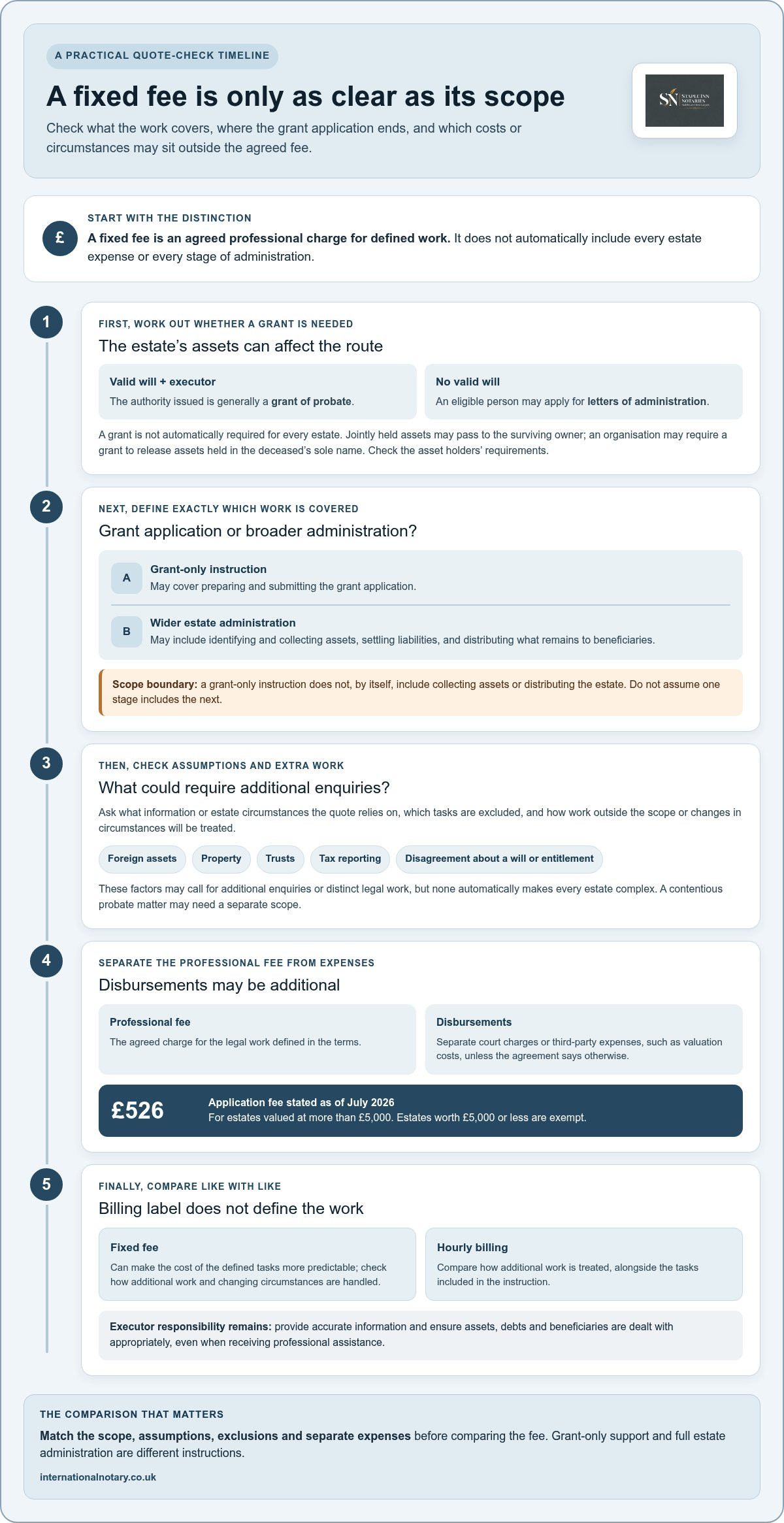
A fixed fee is an agreed professional charge for a defined piece of probate work. It covers the tasks set out in the terms, not automatically every expense of administering an estate. Disbursements, such as court fees or third-party valuation costs, are separate unless the agreement says otherwise.
“Probate” can refer to different stages of work. A grant application obtains the legal authority needed to deal with certain estate assets. Estate administration is broader and can involve identifying and collecting assets, settling liabilities, and distributing what remains to beneficiaries. The legal process of probate includes related steps, but a fixed-fee instruction may cover only a defined part of them.
When considering fixed fee probate London, focus on whether the agreed work matches the estate and the executor’s responsibilities, not simply on whether the fee is fixed. Read the scope alongside the assumptions, exclusions and terms for additional work.
What work might a fixed-fee probate service cover?
The written scope should say whether the work is limited to preparing and submitting a grant application or includes wider estate administration. It should also explain how related tasks and work outside the agreed scope will be treated. A grant-only instruction does not, by itself, include collecting assets or distributing the estate.
Executors retain legal responsibilities even when they receive professional assistance. They must provide accurate information and ensure that assets, debts and beneficiaries are dealt with appropriately. Staple Inn Notaries provides probate administration as part of its private-client legal support. See its private-client legal advisory services.
When is a grant of probate or letters of administration needed?
Where there’s a valid will and an executor is applying for authority to administer the estate, the document issued is generally a grant of probate. If there’s no valid will, an eligible person may instead apply for letters of administration. The grant is issued through the Probate Registry, with applications handled by HMCTS.
A grant isn’t automatically required for every estate. Whether one is needed can depend on how assets are owned and on the requirements of the organisations holding them. For example, jointly held assets may pass to the surviving owner, while a bank or other institution may require a grant before releasing assets held in the deceased’s sole name. Check the asset holders’ requirements when deciding what support the estate needs.
What should a fixed-fee probate quote include or exclude?
A useful quote makes the boundaries of the work clear. For fixed fee probate London, assess the tasks, assumptions and expenses together rather than treating the quoted professional fee as the total cost of administering the estate. Disbursements and other third-party charges are separate unless the terms expressly include them.
Use this checklist to review the written scope:
Work covered: Does it say whether the service includes gathering information about the estate and liabilities, preparing the grant application, or wider administration?
Grant or full administration: Is the instruction limited to obtaining the grant, or does it extend to collecting assets, settling liabilities and distributing the estate?
Exclusions: Are tasks outside the agreed scope identified, with an explanation of how additional work will be handled?
Disbursements: Are court charges and third-party expenses, such as valuations, listed separately from the professional fee?
Assumptions: Does the quote explain what information or estate circumstances the scope relies on?
These details let you compare equivalent services. A grant-only service and full estate administration are different instructions, even if both are described as probate services. For procedural information, consult official government guidance on applying for probate. The application fee is a separate court charge: as of July 2026, it is £526 for estates valued at more than £5,000, while estates worth £5,000 or less are exempt.
Which probate tasks should the agreed scope identify?
Look for a clear description of whether the work involves identifying assets and liabilities, preparing information for the application, applying for the grant, or administering and distributing the estate. Don’t assume that one stage includes the next. The quote should also explain what happens if circumstances change or a task falls outside its stated assumptions. Staple Inn Notaries provides probate administration support, with the scope shaped around the estate and the work required.
Which estate factors can affect the work required?
Foreign assets, property, trusts, tax reporting, or disagreement about a will or entitlement may call for additional enquiries or distinct legal work. The effect depends on the circumstances; none of these factors automatically makes every estate complex. A contentious probate matter may need a separate scope from routine administration. For tax-related considerations, read this inheritance tax advice guide.
Staple Inn Notaries provides probate administration support in Central London and across the wider London area. Contact Staple Inn Notaries to discuss the estate and the assistance required.
Fixed-fee probate versus hourly billing: how can London executors compare?
A fixed fee and an hourly rate describe how professional fees are calculated, not necessarily how much of the estate’s work is covered. Fixed fee probate London can make the cost of defined tasks more predictable, but the label doesn’t mean every task or estate expense is included. Compare the written terms with the work the estate is likely to require.
What are the practical differences between fixed and hourly fees?
A fixed fee can make budgeting more straightforward when the task is clearly defined and the estate fits the stated assumptions. It sets an agreed charge for that work, not an automatic cap on every cost connected with the estate. If new issues arise, the terms explain how they’re handled.
Hourly billing records the time spent, which can be useful when the work is difficult to define at the outset. The total may be less predictable, so check the hourly rates and how updates on time and fees will be provided. Neither structure is always cheaper or more suitable. The estate’s circumstances and the work required are what matter.
How can executors assess whether a quote is genuinely comparable?
Compare equivalent instructions. Check whether each proposal covers the same stages, from applying for a grant to later administration, then review the assumptions, exclusions, disbursements and division of responsibilities. For example, a quote for a grant application isn’t comparable with one that includes subsequent estate administration.
Keep the accepted quote and terms with the estate records. They provide a reference if the work changes or questions arise about what was agreed. GOV.UK’s guidance on applying for probate explains the application process. The professional fee arrangement is separate and should set out the legal work being undertaken.
How does probate administration progress after instruction?
After an executor instructs a probate professional, work generally moves from gathering information to seeking the appropriate grant and, where included in the agreed scope, administering the estate. This sequence is a guide, not a guaranteed timetable. Progress depends on the estate’s circumstances, how quickly information becomes available and the requirements of relevant authorities. For fixed fee probate London, knowing what is covered at each stage helps executors prepare and keep the process organised.
What information should an executor prepare?
Start by locating the will and death certificate, then gather records that help establish what the deceased owned and owed. This initial information may include:
the original will and details of named executors;
bank, savings, investment and pension information;
property details and any available valuations;
records of debts, bills, loans and other liabilities; and
relevant financial records, including information that may assist with tax reporting.
This is a practical starting point, not a complete or definitive document list. The information and HMRC forms required depend on the estate’s circumstances. If records are incomplete, note what’s missing and where further information may be available. This helps identify outstanding enquiries early.
Which responsibilities remain with the executor?
Professional assistance can help organise information, explain procedural steps and progress agreed work, but it doesn’t transfer the executor’s responsibilities. Executors remain responsible for decisions and duties involved in administering the estate. Keep records of key information, decisions and correspondence, and raise uncertainties promptly so they can be considered in context.
The administration commonly follows these stages:
1. Initial review: Provide information about the will, beneficiaries, assets and known liabilities so the estate and required support can be understood.
2. Estate information gathering: Identify assets and debts, obtain relevant details, and establish what further records or valuations may be needed.
3. Tax and application preparation: Consider the estate’s reporting requirements and prepare the relevant information for the grant application.
4. Grant application: Submit the appropriate application with the required supporting information. The authority’s process and any follow-up requests can affect progress.
5. Estate administration: After the grant, deal with estate assets and liabilities, then distribute the estate in accordance with the will or applicable rules, where these tasks form part of the instruction.
For a fuller overview of the executor’s role, read this executor duties timeline. Staple Inn Notaries provides probate administration support in Central London and the wider London area. Discuss probate administration support for the estate.
Where can London executors get probate administration support?
Executors in Central London and the wider London area can get probate administration and private-client legal support from Staple Inn Notaries. The firm’s specialist lawyers are regulated by the Faculty Office of the Archbishop of Canterbury. The work is considered in light of the estate’s assets and circumstances, and the assistance the executor requires.
If you’re considering fixed fee probate London, agree the scope of the instruction before work begins. A clear discussion can distinguish grant-related assistance from wider estate administration and identify matters that may need separate attention. For related private-client guidance, see the firm’s legal advisory services in London.
What can specialist probate administration support help with?
Probate administration support can help executors understand and progress the estate’s administration, with the work shaped around the estate and the executor’s requirements. Depending on the circumstances and agreed scope, related private-client matters may include inheritance tax planning, trusts or estate planning. Establish which tasks are being undertaken and where the executor retains responsibility.
Contentious probate is distinct from routine administration. A disagreement concerning a will or an entitlement may require separate legal work and a clearly defined scope; don’t assume it falls within an ordinary administration instruction.
What is the next step for an executor in London?
Prepare a brief outline before discussing support. Note whether there’s a will, who the executors are, what assets and liabilities are known, whether property or trusts are involved, and what decisions or issues need attention. You don’t need every record in hand. A concise summary helps focus the initial discussion on the estate and the assistance required.
Use the discussion to clarify the proposed work, its boundaries and how additional issues will be handled. Keep the agreed scope with the estate records as a practical reference while administration progresses.
Discuss probate administration with Staple Inn Notaries and outline the estate’s needs.
Clarify the scope before you instruct
A fixed fee is useful only when the agreed work is clear. Before choosing fixed fee probate London support, check whether the instruction covers the grant application alone or extends to estate administration, and understand how disbursements and work beyond the stated scope are treated. Comparing the same tasks and assumptions gives you a more meaningful basis for assessing arrangements.
Prepare a brief outline of the estate, including known assets, liabilities and any questions about the will or administration. This helps focus the scope discussion on the support you need and the responsibilities you’ll retain as executor.
Staple Inn Notaries provides probate administration and private-client legal services in Central London and the wider London area. The firm is operated by specialist lawyers regulated by the Faculty Office of the Archbishop of Canterbury, bringing a specialist legal background to estate matters.
Take the next step by discussing the estate and the work required. Discuss probate administration with our team to clarify the scope and move forward with greater clarity.
Frequently Asked Questions
Is fixed-fee probate suitable for every estate?
Not necessarily. Suitability depends on the estate’s circumstances and the work included in the agreed scope. A straightforward grant application differs from broader administration involving complex assets, tax reporting or disputes. Before instructing, establish which tasks the professional fee covers, which expenses are separate and how additional work will be handled. Assess the fee structure against the service required, rather than relying on the words “fixed fee” alone.
What is usually included in a fixed-fee probate service?
There’s no universal list of inclusions. An arrangement may cover defined work such as preparing estate information or handling a grant application, while administration after the grant may involve further tasks. Read the written terms for the specified work, assumptions, exclusions and third-party expenses. Check whether the arrangement covers only the application or also later stages. The phrase “fixed fee” doesn’t explain what professional work is included.
How much does fixed-fee probate in London cost?
There’s no single fee for every London estate. The professional fee depends on the agreed scope and the estate’s circumstances, while court fees and other third-party expenses may be separate. Before instructing, make sure the work covered, fee basis, exclusions and disbursements are clearly set out. Staple Inn Notaries provides probate administration support in Central London and across the wider London area, tailored to the matter.
What happens if an estate becomes more complex after probate work starts?
If new assets, tax issues, overseas property or a dispute comes to light, the work required may change. The engagement terms should explain how changes to scope are handled and how additional work is agreed. Keep a record of instructions, decisions and information supplied, and raise new developments promptly. This helps clarify what has changed and what further steps may be needed to progress the administration.
Can a fixed-fee probate service include estate administration after the grant?
Yes, if the agreed scope expressly includes administration after the grant. Applying for the grant and administering the estate are distinct stages. Later work may include collecting assets, settling liabilities and distributing the estate. Review the written terms to see which stages and responsibilities are covered. Don’t assume a fee for a grant application includes complete administration; the scope should describe the work being undertaken.
How long does probate take in London?
There’s no reliable universal timeframe for probate in London. Progress can depend on the estate’s circumstances, how complete the information is, any tax requirements and the relevant authority’s processing. An advertised timeframe shouldn’t be treated as a guaranteed outcome for every matter. Executors can help keep work organised by gathering accurate records and responding promptly to requests, although this can’t determine how quickly external processes will be completed.
Do executors still have responsibilities when a probate professional is instructed?
Yes. Instructing a probate professional doesn’t automatically remove an executor’s responsibilities. Professional assistance can support defined legal and administrative tasks, but executors remain involved in estate decisions and must provide accurate information when carrying out their duties. The engagement terms should make the division of work clear. Keep records of decisions and instructions, and consult the executor duties timeline referenced in this guide for a fuller overview.



Comments