
Embassy Legalisation London: Professional Guide for 2026
- PPC Guyz Google & Semrush Certified
- Jul 28
- 11 min read

Updated: 5 days ago
What if the primary obstacle to your international business deal isn't the commercial terms, but a single missing seal from a diplomatic mission in London? For many corporate entities and private individuals, the administrative hurdle of embassy legalisation London remains a source of significant procedural anxiety. You likely recognise that securing international document acceptance requires more than a simple signature. It demands a precise, three-stage sequence of notarisation, FCDO apostille, and final consular attestation. This process is unforgiving; a single error at the foundational level can trigger a cascade of rejections and missed deadlines.
This professional guide clarifies the complexities of the 2026 legalisation landscape. You will master the hierarchical requirements necessary to ensure your documentation carries full legal weight in your target jurisdiction. We examine the critical role of the notary public in establishing validity and provide a clear framework for managing the entire workflow with speed and precision. Secure your international interests. Avoid the friction of bureaucratic delays. Follow this expert roadmap to guarantee your documents are ready for global scrutiny.
Table of Contents
Understanding the Multi-Stage Embassy Legalisation Process
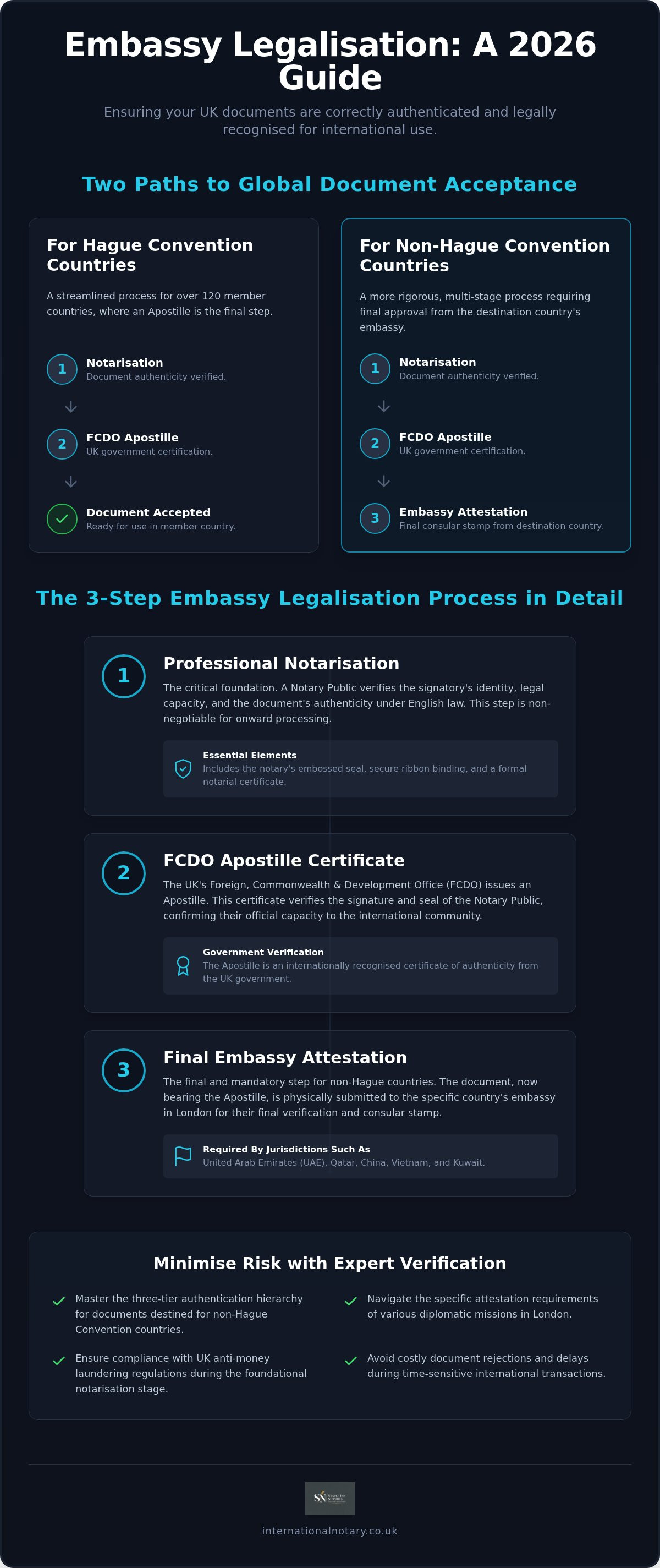
Embassy legalisation is not a singular event. It's a multi-layered chain of authentication designed to provide foreign governments with absolute certainty regarding the origin and validity of a UK document. Whilst many countries accept a simple FCDO apostille, those outside the 1961 Hague Convention require a final layer of scrutiny: the consular stamp. This specific requirement makes embassy legalisation London a critical service for businesses expanding into emerging markets. Central London serves as the global nexus for this activity, housing the highest density of diplomatic missions in the world. This proximity allows for the rapid physical transit of documents between notarial offices, the Foreign, Commonwealth & Development Office, and various embassies.
The Role of the Hague Convention
The Hague Apostille Convention was established to simplify the legalisation process amongst member states. However, several significant global economies remain outside this treaty. For documents destined for these jurisdictions, the apostille is merely an intermediate step rather than the final destination. The process is more rigorous and time-sensitive. Countries requiring full embassy attestation include the United Arab Emirates (UAE), Qatar, China, Vietnam, and Kuwait. In these instances, the document must be physically presented to the relevant consulate for final verification after the UK government has already certified the notary's standing. Failure to follow this precise hierarchy results in immediate document rejection at the destination.
Why Professional Notarisation is the Critical Foundation
Diplomatic missions don't legalise "raw" or unverified documents. They certify the authority of the previous official in the chain. Consequently, the entire process relies on the integrity of the initial certification. A Notary Public London acts as the primary gatekeeper, conducting rigorous identity checks and verifying the signatory's capacity to bind a company. This is especially vital for Corporate Powers of Attorney or Board Resolutions where the stakes of a transaction are high.
Embassies look for specific physical markers of validity. These include the notary's embossed seal, a secure binding ribbon, and a formal notarial certificate. Without these elements, the FCDO won't issue an apostille, and the embassy will certainly reject the filing. Establish this foundation correctly to avoid the friction of procedural failure. We ensure every document meets these exacting standards before it enters the government workflow. Precision at this stage is the only way to guarantee acceptance abroad.
Step 1: Professional Notarisation in Central London
The first stage of embassy legalisation London is the formal notarial act. This is a non-negotiable requirement. A notary public does not merely witness a signature; they certify the document's authenticity and the legal capacity of the parties involved. For international transactions, the most frequently notarised documents include Corporate Powers of Attorney, Board Resolutions, and Educational Certificates. This certification provides the necessary assurance to foreign consulates that the document is valid under English law.
Compliance with UK anti-money laundering regulations is central to this stage. Every signatory must undergo rigorous identity verification. We require original proof of identity and residential address before any certification can proceed. For complex business arrangements, corporate power of attorney notarisation London involves additional checks into the company's constitutional documents. Time is often a critical factor. Our mobile notary services provide an efficient solution for City-based law firms and directors, allowing for the execution of documents at your office without disrupting your schedule.
Certifying Corporate and Commercial Documents
Commercial filings often require more than a simple signature. When certifying Company Resolutions or Certificates of Incorporation, we frequently verify the entity's status via Companies House. Many embassies, particularly those in the Middle East, require a "Certificate of Good Standing" to be notarised alongside the primary document. In a corporate environment, managing multi-signatory documents requires meticulous coordination. We ensure each director's authority is verified and documented to prevent rejection at the consular level.
Personal Document Certification
Personal documentation, such as degrees or birth certificates, follows a distinct protocol. Gulf embassies, including those for Qatar and the UAE, have specific "look and feel" requirements for the notarial certificate. A common pitfall is using a solicitor's certification where a full notarial act is mandatory. This error leads to immediate rejection by the FCDO. We provide the precise wording and secure binding necessary to meet these international standards. If you require immediate assistance with your documentation, you can book a consultation with a notary in London to ensure your paperwork is prepared correctly from the outset.
Step 2: Obtaining the FCDO Apostille Certificate
Once the notary has completed the act, the document must proceed to the Foreign, Commonwealth & Development Office (FCDO). This government body acts as the secondary link in the chain of authentication. Their sole function is to verify that the signature and seal of the notary public are genuine. They do this by cross-referencing the notary's details against their own database of registered practitioners. The result of this verification is the Apostille certificate. This is a physical A4 sheet, permanently attached to your document and embossed with the official FCDO seal. It's a critical component of embassy legalisation London, as no foreign consulate will accept a UK document without this state-level endorsement.
Whilst the UK government has introduced the e-Apostille, its application remains limited in 2026. Most diplomatic missions in London still demand physical, wet-ink signatures and paper-based certificates. For countries like China or the UAE, a digital apostille is currently insufficient for the subsequent attestation stage. Stick to the physical process to ensure global compatibility. This ensures your paperwork survives the rigorous scrutiny of consular officials who expect traditional methods of verification.
FCDO Submission Requirements
Precision is mandatory at this stage. The FCDO will reject any document that shows signs of tampering or follows an incorrect notarial format. Ensure your paperwork is correctly bound with a secure ribbon and seal. A complete submission requires a formal cover sheet and the payment of the appropriate statutory fees. Most corporate clients bypass the Milton Keynes postal hub in favour of the London business counters to avoid the delays associated with the standard mail service. Rejections often occur when a solicitor signature is used for documents that legally require a notary's seal. We verify every document before submission to eliminate this risk.
Urgent Processing for London Businesses
International deals rarely wait for postal turnaround times. For urgent commercial matters, we utilise the FCDO premium service to achieve 24-hour turnaround. This accelerated track is primarily accessible through registered agents who maintain established accounts with the Legalisation Office. It's a vital tool for the expert fixer managing a closing deadline. In 2026, the FCDO continues to operate a tiered fee structure where premium business applications incur a significantly higher per-document charge compared to the standard postal route. This investment is often negligible compared to the cost of a delayed international contract. We manage this entire submission on your behalf, ensuring the document moves swiftly from the notary's desk to the FCDO counter.
Step 3: Final Embassy Attestation and Consular Filing
The final stage of embassy legalisation London is the application of the consular stamp. This act represents the sovereign recognition of the UK government’s authority, as expressed through the FCDO apostille. Without this final attestation, documents destined for jurisdictions like the UAE, Qatar, China, or Vietnam remain legally void in those territories. Each diplomatic mission operates under its own specific set of protocols. Some require physical attendance during highly restrictive morning windows, whilst others have transitioned to mandatory online pre-filing systems. Managing these idiosyncratic requirements is where the logistical expertise of a professional service becomes indispensable.
Opening hours for consular sections are often limited to a few hours each morning. A delay in arrival or a minor error in the application form can result in a lost day of processing. We maintain a constant presence at these missions, navigating the varying submission methods that range from walk-in counters to secure drop-boxes. Our role is to act as the physical link between the UK authorities and the foreign diplomatic staff, ensuring your documents are processed with the necessary urgency.
Consular Fees and Payment Methods
Financial management at the consular level is notoriously complex. Embassies rarely offer a uniform payment experience. You may find that some missions only accept postal orders or specific bank transfers, whilst others have integrated modern card payment systems. Budgeting for these costs requires precision; commercial attestation fees for corporate contracts are significantly higher than those for personal documents like birth certificates. We manage these disbursements on your behalf to prevent the delays that occur when a payment is rejected or incorrectly calculated. Precision in fee handling is vital for maintaining the momentum of your international filing.
Managing Translations and Supporting Evidence
Many jurisdictions require that documents are accompanied by a certified translation into the target language. For example, documents for use in certain Middle Eastern or South East Asian countries often require an Arabic or Vietnamese translation. This translation itself may need to be notarised and apostilled to be accepted by the embassy. Beyond the primary document, you must often provide a suite of supporting evidence. This typically includes formal covering letters, copies of the signatory’s passport, and occasionally, certificates from the London Chamber of Commerce. We ensure that every piece of supporting documentation is present and correct before the filing occurs.
If your international transaction depends on a precise timeline, don't leave the final stage to chance. You can book an apostille and legalisation service in London to ensure every consular requirement is met without delay.
Streamlining Your International Documents with Staple Inn Notaries
Navigating the rigorous hierarchy of embassy legalisation London requires more than just administrative effort; it demands a strategic approach to document validity. Many corporate entities and legal professionals find that attempting to manage the FCDO and consular stages independently leads to fragmented workflows and avoidable delays. Staple Inn Notaries functions as the single point of contact for your international documentation needs, providing a seamless transition from the initial notarial act to final consular attestation. By consolidating these steps under the supervision of a regulated specialist, you ensure that every seal and signature is applied in accordance with the destination country’s specific requirements. We operate with a modern mindset, understanding that in global commerce, a day’s delay is a day’s loss.
Our position as a firm regulated by the Faculty Office of the Archbishop of Canterbury provides a level of professional weight that unregulated agencies cannot provide. We don't just facilitate the process; we verify the readiness of every document before it enters the government chain. This proactive scrutiny is the hallmark of the "Expert Fixer" persona, designed to reduce client anxiety through competence and accessibility. Whether you are dealing with a single power of attorney or a complex suite of corporate resolutions, our managed service ensures your paperwork is returned ready for immediate use abroad.
Our Managed Legalisation Workflow
The process begins with an initial consultation to map out the specific chain of authentication required for your target jurisdiction. We don't rely on generic templates. Instead, we tailor the notarial certificate to meet the exact expectations of the receiving embassy. Once the document is notarised, our secure handling protocol takes over. We manage the physical courier of documents between our office, the FCDO business counters, and the various diplomatic missions across Central London. You receive real-time updates on consular processing times, allowing you to manage your transaction timelines with confidence. We anticipate potential bottlenecks before they manifest, ensuring a brisk and purposeful progression.
Expertise in High-Value Commercial Matters
Our firm is uniquely equipped to handle bulk document sets required for international mergers, acquisitions, or high-value property deals. These transactions often involve multiple signatories and strict deadlines that leave no room for procedural errors. We possess specialised knowledge of the attestation patterns for the UAE, Qatar, Kuwait, and China, ensuring that even the most complex corporate filings are accepted on the first attempt. If you are managing a time-sensitive international deal, don't leave the final stages of your documentation to chance. Request an urgent legalisation quote from Staple Inn Notaries today and secure the expert oversight your documents deserve.
Securing Global Acceptance for Your International Documentation
The successful execution of embassy legalisation London depends on a rigid adherence to the three-tier chain of authentication. By establishing a foundation of professional notarisation, you eliminate the primary cause of rejection at the FCDO and consular levels. Navigating the specific, often restrictive, requirements of individual diplomatic missions requires a managed approach that prioritises both legal precision and logistical speed. As specialists in Central London corporate legalisation regulated by the Faculty Office of the Archbishop of Canterbury, we provide the authoritative oversight necessary for high-value global transactions.
Don't allow administrative friction to jeopardise your international business objectives. Our comprehensive managed service oversees the entire hierarchy, from the initial notarial act to the final consular return. Secure your urgent Embassy Legalisation in London today and ensure your documents carry full legal weight in any jurisdiction. Move forward with the confidence that your paperwork is verified, compliant, and ready for immediate global use.
Frequently Asked Questions
What is the difference between an apostille and embassy legalisation?
An apostille is a certificate issued by the UK government that is sufficient for countries belonging to the 1961 Hague Convention. Embassy legalisation is a further requirement for non-member states; it involves a final attestation by the destination country's consulate in London. This process creates a complete chain of authentication from the notary to the foreign mission.
How long does embassy legalisation take in London?
Turnaround times vary significantly depending on the specific mission's administrative capacity and current submission protocols. Whilst the FCDO stage can be completed within 24 hours via premium business services, the consular stage typically adds between three to ten working days to the total timeline. We monitor these fluctuations daily to provide accurate estimates for urgent commercial deals.
Do I need to attend the embassy in person for document attestation?
Personal attendance is rarely mandatory for the applicant. Most diplomatic missions allow registered agents or professional notarial firms to submit documents on behalf of their clients via secure counters or drop-boxes. This managed approach bypasses the logistical challenges of restrictive opening hours and ensures that the embassy legalisation London process is handled with professional precision.
Why was my document rejected by the embassy after being notarised?
Rejections frequently occur due to procedural errors such as using a solicitor's signature instead of a full notarial act. Other common causes include the absence of a required certified translation or the failure to obtain the mandatory FCDO apostille before consular submission. Ensuring the document is correctly bound and sealed is vital for gaining consular acceptance.
Can a solicitor perform embassy legalisation, or do I need a notary?
A notary public is almost always required for international document validation. Most foreign embassies in London will not recognise a solicitor's certification for documents destined for their home jurisdictions. Notarial acts carry a higher level of international legal weight and satisfy the specific regulatory requirements of foreign governments and diplomatic staff.
How much does embassy attestation cost in London?
Consular fees are set independently by each embassy and are subject to frequent changes based on current exchange rates and internal policies. Commercial documents generally attract higher statutory fees than personal paperwork like birth or marriage certificates. We manage these disbursements directly at the consular counter to ensure the correct amounts are paid without delay.
Is a digital e-Apostille accepted by embassies for attestation?
Most embassies currently require a physical, paper-based apostille with a wet-ink signature and an embossed seal. Whilst digital options are expanding, the majority of non-Hague countries still demand traditional document formats for their final consular stamp. We recommend the physical route in 2026 to avoid the high risk of rejection at the embassy stage.
Which countries require embassy legalisation instead of just an apostille?
Countries that are not signatories to the Hague Apostille Convention require full attestation. Key jurisdictions for UK businesses include the United Arab Emirates, Qatar, China, Vietnam, and Kuwait. Always verify the specific requirements of your destination state before beginning the authentication chain to ensure your documents are legally fit for purpose.


Comments