
e-Apostille UK: Digital Document Legalisation in London

Updated: Aug 26
Why are sophisticated international entities still tethered to physical couriers when the UK's digital legalisation framework offers a superior, high-security alternative? You likely recognise that in a globalised economy, the delay of a single physical signature can jeopardise a multi-million pound transaction. Securing an e-Apostille UK is no longer a luxury but a strategic necessity for those operating under urgent deadlines. It is a transition that demands a move from traditional methods toward a more efficient, digitally-driven protocol.
The distinction between simple scanned copies and verified digital originals frequently creates confusion, often leading to a legitimate fear of document rejection by foreign authorities. This article provides the clarity needed to master these complexities, ensuring your digital documents meet every stringent notarial protocol required for international validity. We will examine the specific FCDO requirements for electronic legalisation, the essential role of a Notary Public in London, and the precise steps necessary to guarantee a rapid turnaround for your sensitive commercial data.
Table of Contents
What is an e-Apostille? Understanding Digital Legalisation in the UK
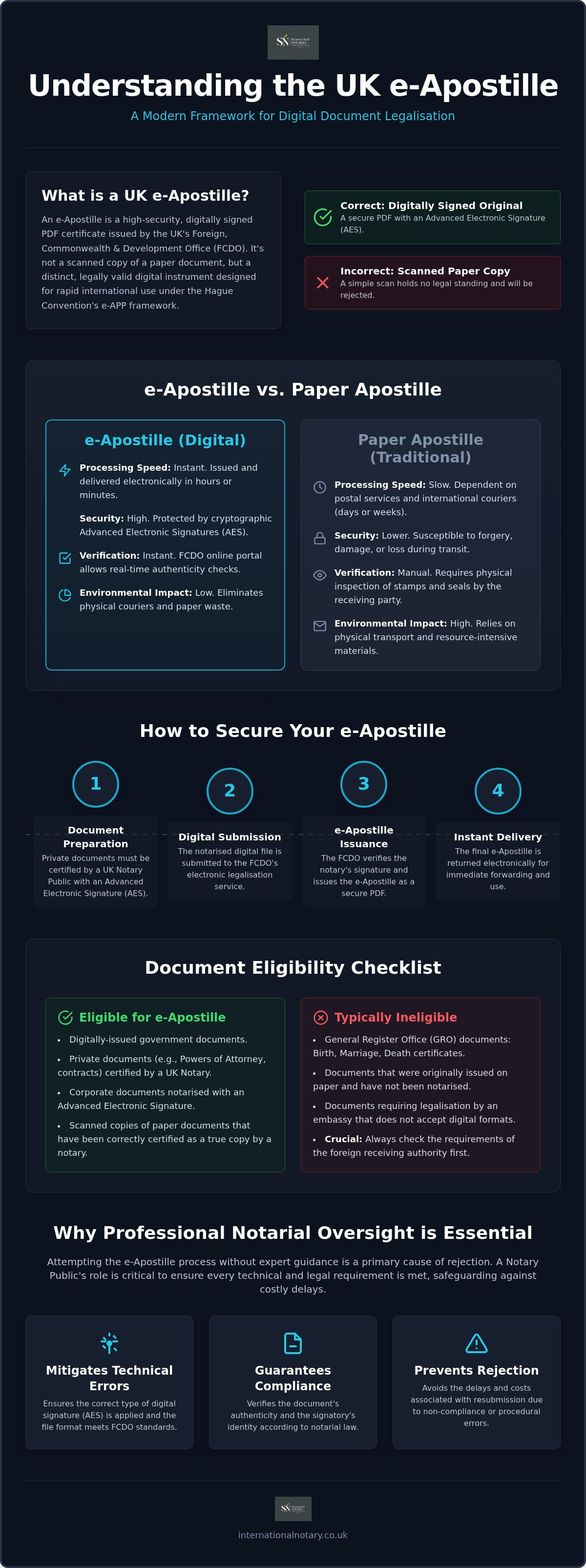
The e-Apostille UK represents a fundamental evolution in how the Foreign, Commonwealth & Development Office (FCDO) validates documents for international use. It is not a mere electronic scan of a physical document. Instead, it's a sophisticated, digitally signed PDF certificate that serves as the primary evidence of a document's authenticity. This shift towards digital-first legalisation is driven by the necessity for rapid processing in a globalised economy, effectively eliminating the delays and environmental costs associated with physical courier services. Whilst traditional paper certificates remain available, the digital alternative is increasingly becoming the standard for modern international business.
Distinguishing between a digital original and a scanned copy is critical for procedural compliance. A scanned version of a paper apostille possesses no legal standing and will be rejected by foreign authorities. The e-Apostille UK is a distinct legal instrument, issued under the framework of the Hague Convention’s Electronic Apostille Programme (e-APP). This programme standardises digital certificates amongst member states, ensuring that a document legalised in London is recognised with the same authority as its physical counterpart in jurisdictions across the globe.
The Legal Weight of Digital Signatures in 2026
For a document to qualify for an e-Apostille, it must bear an Advanced Electronic Signature (AES) that meets current UK standards. This cryptographic protocol ensures that the signatory's identity is uniquely linked to the document, making any subsequent alterations detectable. A simple typed name or a static image of a signature is insufficient for legalisation purposes. Under the Electronic Communications Act, these advanced signatures carry full legal weight, provided they are applied in accordance with international notarial law. Our role is to ensure your documentation adheres to these rigorous standards before submission, preventing costly delays caused by technical non-compliance.
Security and Verification: The Digital Advantage
Digital legalisation provides a level of security that traditional physical stamps cannot replicate. The FCDO operates an online verification service, allowing foreign authorities to confirm the authenticity of an e-Apostille instantly. This real-time validation capability offers several advantages:
Fraud Mitigation: Cryptographic signatures are significantly harder to forge than wet-ink stamps or embossed seals.
Data Integrity: Encryption protocols protect the document whilst in transit, ensuring the notarised content remains unaltered.
Instant Accessibility: Receiving parties can download and verify the document the moment it's issued, facilitating faster commercial outcomes.
By utilising these modern encryption standards, the e-Apostille framework provides a robust and transparent path for international document acceptance. It reflects a sophisticated intersection of tradition and technology, maintaining the gravity of notarial certification whilst embracing the speed of digital commerce.
Eligible Documents for e-Apostille UK Processing
Success in digital legalisation depends entirely on the provenance of the document. The FCDO maintains strict criteria for the e-Apostille UK service, and misidentifying a document's eligibility is a primary cause of procedural delay. Generally, documents fall into two categories: those issued as digital-native files by government bodies and private documents that require professional notarial certification. If your document was originally issued on paper, it cannot simply be scanned and uploaded. It must be notarised as a digital copy by a qualified professional who can attest to its authenticity within the digital framework.
Ineligible documents often cause the most significant commercial disruptions. Currently, the FCDO does not permit digital legalisation for most General Register Office documents, including birth, marriage, or death certificates. These instruments typically require the traditional paper-based route. Identifying these restrictions early prevents the frustration of rejection and ensures your international deadlines remain intact. If you are uncertain about your document's status, our Apostille and Legalisation Services can provide immediate clarity on the correct path forward.
Corporate and Business Documentation
For entities operating across borders, the speed of digital processing is a vital strategic asset. We specialise in the corporate power of attorney notarisation London firms rely on for overseas board meetings and high-value asset management. Additionally, digital Certificates of Incorporation and Articles of Association issued directly by Companies House are ideal candidates for the e-Apostille UK process. Board resolutions and minutes can also be validated digitally, provided they are correctly witnessed and certified by a Notary Public in London to satisfy stringent foreign bank compliance and regulatory standards.
Academic and Professional Qualifications
Global mobility frequently hinges on the rapid verification of UK-based qualifications. Degrees, PhDs, and professional certifications from recognised bodies such as the ACCA or GMC can be processed through the digital framework with high efficiency. A critical prerequisite involves the issuing institution verifying the digital transcript or certificate before an e-Apostille is granted. This verification stage ensures the receiving authority in the destination country has absolute confidence in the credential's integrity. Employment letters and references for visa applications also benefit from this streamlined approach, significantly reducing transit times for international relocations and professional secondments.
E-Apostille vs. Paper Apostille: Choosing the Correct Format
Selecting the appropriate legalisation format is a critical decision that influences both the speed of your transaction and its ultimate validity. While the e-Apostille UK offers a streamlined digital alternative, the traditional paper certificate remains indispensable for specific jurisdictions and document types. The primary differentiator is the turnaround time. A digital certificate can often be issued within 24 hours of submission, whereas the standard paper route typically requires five working days plus courier transit. However, speed should never supersede certainty. You must confirm that the foreign recipient is equipped to accept and verify a digital PDF. If they require a physical stamp on a tangible sheet of paper, the digital version will be useless.
FCDO fees for both services are comparable. Total expenditure varies, however, when accounting for auxiliary costs. Paper legalisation necessitates secure courier delivery to and from the legalisation office, adding both cost and logistical complexity. Conversely, the digital route eliminates these physical transit fees but may involve specific notarial certification costs to ensure the document meets the Advanced Electronic Signature standards discussed previously. We aim to eliminate these procedural delays by identifying the correct format at the outset.
International Acceptance and Jurisdiction Trends
Global adoption of digital legalisation is inconsistent. Nations such as the USA, Spain, and Australia are highly digital-ready and frequently prefer the efficiency of the electronic format. In contrast, many jurisdictions across the Middle East and Asia still mandate physical 'wet ink' signatures and embossed seals as a prerequisite for legal recognition. Consultation with a Notary Central London is essential here. We provide the jurisdictional expertise required to navigate these regional preferences, ensuring you don't waste time on a digital application that a foreign ministry will ultimately reject.
Physical Requirements: When Paper is Non-Negotiable
Certain documents are technically excluded from the digital framework. Birth, marriage, and death certificates issued by the General Register Office (GRO) almost always require the paper-based route. If your document requires subsequent embassy attestation, a physical apostille is usually mandatory. Most embassies are not yet integrated into the e-APP system and require a physical document to apply their own consular stamps. This 'hybrid' risk is a common pitfall. Even if the FCDO issues an e-Apostille, it is worthless if the next link in the legalisation chain cannot process a digital file. Always verify the full sequence of requirements before choosing your format.
The Procedure: How to Secure Your e-Apostille Step-by-Step
Securing an e-Apostille UK requires a precise sequence of technical and legal actions. It begins with the initial verification stage. Here, the notary must confirm the document's authenticity and ensure the signatory possesses the requisite authority. This is a rigorous duty. It prevents international fraud and ensures the document's integrity before it enters the digital legalisation pipeline. Once verified, the document is converted into a compliant PDF format, ready for the technical upload to the FCDO's secure portal.
The submission process is entirely digital. Unlike the paper route, there're no physical envelopes or courier logs. Instead, the document's transmitted through an encrypted gateway designed to handle sensitive commercial data. After the FCDO completes its checks, you'll receive the legalised PDF via a secure link or email. This file contains the digital certificate embedded directly within the document's metadata, ensuring the apostille and the document remain permanently linked. You can then share this file instantly with overseas partners, eliminating the days typically lost to international shipping.
The Role of the Notary Public in Digital Certification
A notary's involvement in the digital environment is specialised and highly regulated. We apply a unique digital seal and a cryptographically secure signature to the PDF. This process differs significantly from physical notarisation. When notarising a signature, we witness the act of signing in real-time, often using digital platforms. When certifying a copy, we attest that the digital version's a true representation of the original. Crucially, the FCDO will only issue an e-Apostille if the notary's digital signature is already registered on their internal database. It's a prerequisite. Without this registration, the application will be summarily rejected, causing significant delays.
Utilising a Mobile Notary for Urgent Digital Files
For corporate entities in the City, time is the most valuable commodity. Our Mobile Notary London service facilitates the e-Apostille UK process by bringing the verification stage directly to your office. We perform on-site identity checks whilst simultaneously preparing the digital files for legalisation. This approach is particularly effective for City law firms and corporate headquarters that require immediate action on high-stakes documentation. It removes the need for staff to travel, allowing your team to focus on the transaction whilst we manage the procedural complexities. By integrating identity verification with digital preparation, we create a seamless path to the FCDO portal.
If you require an urgent digital certification for a cross-border deal, you can book our professional legalisation services to ensure your documents are processed with total precision.
Why Professional Notarial Oversight is Essential for e-Apostilles
Attempting a "DIY" approach to digital legalisation often results in expensive international delays. While the FCDO portal is accessible, the technical requirements for a successful e-Apostille UK application are stringent and unforgiving. Small errors in PDF metadata, incorrect digital signature levels, or a failure to verify the underlying authority of a signatory will trigger an immediate rejection. These procedural failures don't just cost time. They can jeopardise high-value business deals where every hour is critical. As specialists regulated by the Faculty Office of the Archbishop of Canterbury, we provide the meticulous oversight necessary to navigate these technical requirements whilst maintaining the speed required by the international business community.
Professional oversight ensures full compliance with international standards and Faculty Office regulations. We act as the "Expert Fixer" for London's corporate sector. We troubleshoot complex document structures that automated services simply cannot handle. Our role is to serve as a trusted gatekeeper. We ensure that every digital certificate we process carries the full weight of international validity. By choosing professional notarial handling, you eliminate the uncertainty of digital submission and secure a document that is guaranteed to be accepted by the receiving authority.
Expertise in Complex Corporate Legalisation
Corporate structures often involve multi-jurisdictional elements that require a sophisticated understanding of both UK and foreign legal frameworks. We specialise in handling these complexities. Our London-based team maintains a deep working knowledge of the FCDO Legalisation Office's specific requirements, which are subject to frequent updates. We perform exhaustive pre-submission checks. These audits significantly reduce the rejection rate for digital documents, ensuring that your e-Apostille UK is issued correctly the first time. This level of detail is particularly vital for documents destined for jurisdictions with evolving digital adoption policies.
Controlled Urgency: Meeting Tight Global Deadlines
Global commerce operates across conflicting time zones. Our streamlined process is designed with a sense of controlled urgency. We ensure your legalised documents are ready for the start of the business day in Hong Kong, Dubai, or New York. This rapid turnaround provides the peace of mind that only a regulated, London-based professional service can offer. We remove the logistical burden from your team, allowing you to focus on the commercial objectives of your transaction. Don't risk your international standing on technical errors. Contact Staple Inn Notaries for urgent e-Apostille support in Central London to secure your digital documents with expert precision.
Accelerate Your International Documentation Strategy
The transition to digital legalisation represents a significant shift in global administrative standards. By utilising the e-Apostille UK framework, you effectively eliminate the logistical bottlenecks of physical couriers and paper-based processing. Success hinges on precise verification and adherence to the FCDO's technical protocols. We've explored how eligibility depends on document origin and why professional notarial oversight is the only way to guarantee acceptance by foreign authorities. As a firm regulated by the Faculty Office of the Archbishop of Canterbury, we combine traditional legal gravity with the speed required by modern corporate entities.
Operating from our Central London location, we provide the specialist expertise in corporate international law necessary to navigate even the most complex multi-jurisdictional requirements. Our team's dedicated to ensuring your documents move as fast as your business interests. Secure your urgent e-Apostille with Staple Inn Notaries today and experience a streamlined path to global compliance. We're here to facilitate your international success with precision and speed.
Frequently Asked Questions
How long does it take to get an e-Apostille in the UK?
Issuance typically occurs within 24 hours of submission to the FCDO portal. This timeframe is significantly shorter than the standard five-day turnaround required for physical documents. Whilst the digital process is remarkably efficient, the total duration depends on the initial notarisation being completed correctly. We ensure all technical prerequisites are met to maintain this rapid pace for our corporate clients.
Can I get an e-Apostille for a UK birth or marriage certificate?
No, birth, marriage, and death certificates issued by the General Register Office (GRO) are currently ineligible for the digital service. These official records must be legalised using the traditional paper-based route with a physical apostille attached. Attempting to upload a scan of these certificates will result in a rejection. We can facilitate the correct paper legalisation process for these specific documents through our Central London office.
Which countries accept the UK's digital e-Apostille?
Any member of the Hague Convention that has fully implemented the Electronic Apostille Programme (e-APP) should accept the e-Apostille UK. This includes jurisdictions such as the USA, Spain, and Australia. However, many countries in the Middle East and Asia still require physical "wet-ink" signatures for legal recognition. You must always confirm the digital readiness of the receiving authority before proceeding with an electronic application.
How much does a UK e-Apostille cost compared to the paper version?
The FCDO statutory fee is identical for both digital and paper formats. Choosing the digital route often reduces overall expenditure by eliminating international courier costs and secure handling fees associated with physical transit. However, you should account for the professional notarial fees required to prepare a compliant digital original. We provide a streamlined service that balances these costs against the necessity for rapid international document delivery.
What is the difference between an e-Apostille and a digital signature?
A digital signature is a cryptographic method used by a signatory or notary to sign a document, whilst an e-Apostille is the official government certificate that validates that signature. The e-Apostille UK is issued by the FCDO to confirm the origin of the document and the authority of the professional who signed it. One is an act of execution; the other is an act of state-level legalisation.
Can I use an e-Apostille for property transactions in Spain or Dubai?
An e-Apostille is generally accepted for property transactions in Spain, as the Spanish authorities are well-integrated into the e-APP framework. Conversely, property deals in Dubai usually require embassy attestation, which currently necessitates a physical paper apostille. Because requirements vary by jurisdiction and specific land registry offices, we recommend verifying the acceptable format with your overseas legal counsel before submission.
Do I need to see a notary in person for an e-Apostille?
Identity verification is a mandatory legal requirement, but it doesn't always necessitate a visit to our office. We can utilise our mobile notary service to meet you at your Central London headquarters or employ approved digital identification protocols. The key is ensuring that the notary can confidently attest to your identity and authority before applying their registered digital signature to the document for FCDO submission.
How do I verify if a digital e-Apostille is genuine?
You can verify the authenticity of a digital certificate via the FCDO's official online verification service. By entering the specific certificate number and date of issue, foreign authorities can instantly confirm that the document is genuine and has not been altered since legalisation. This real-time validation is a primary security advantage of the digital system, providing absolute confidence to international banks and government agencies.



Comments