
Digital Notarisation Services London: The 2026 Professional Reference Guide

By 2026, research suggests 65% of legal services have integrated remote online notarisation, yet for many London professionals, the transition from parchment to pixels remains fraught with technical anxiety. You've likely felt the pressure of a looming international deadline whilst questioning whether a digital signature will actually hold weight in a foreign jurisdiction. Our digital notarisation services London provide the necessary bridge between traditional legal validity and modern efficiency. We understand that identity fraud and data breaches are legitimate concerns when handling sensitive corporate resolutions or powers of attorney.
This professional reference guide serves as your definitive technical manual for navigating the complexities of electronic legalisation. We'll examine the specific requirements of the UK eIDAS regulations, the critical distinction between Advanced and Qualified Electronic Signatures, and the current FCDO protocols for e-Apostille issuance. You'll gain a clear understanding of how to secure a legally robust document that satisfies foreign authorities without the need for a physical visit to a Central London office. We've structured this guide to eliminate procedural delays and ensure your international transactions remain on schedule.
Table of Contents
Understanding Digital Notarisation Services in London
Digital notarisation represents the sophisticated evolution of document authentication, transitioning from physical impressions to a framework of advanced cryptographic security. In the context of digital notarisation services London, this process involves the electronic authentication of instruments using secure digital signatures that maintain the same legal weight as their traditional counterparts. By 2026, the City of London has solidified its position as the pre-eminent hub for paperless international commerce, successfully adapting centuries of notarial tradition to the rigorous demands of instantaneous global trade. Whilst a standard Electronic Signature may suffice for internal corporate communications, notarial acts require a significantly higher threshold of technical and legal integrity to ensure cross-border validity and enforceability.
The Evolution of Notarial Acts in 2026
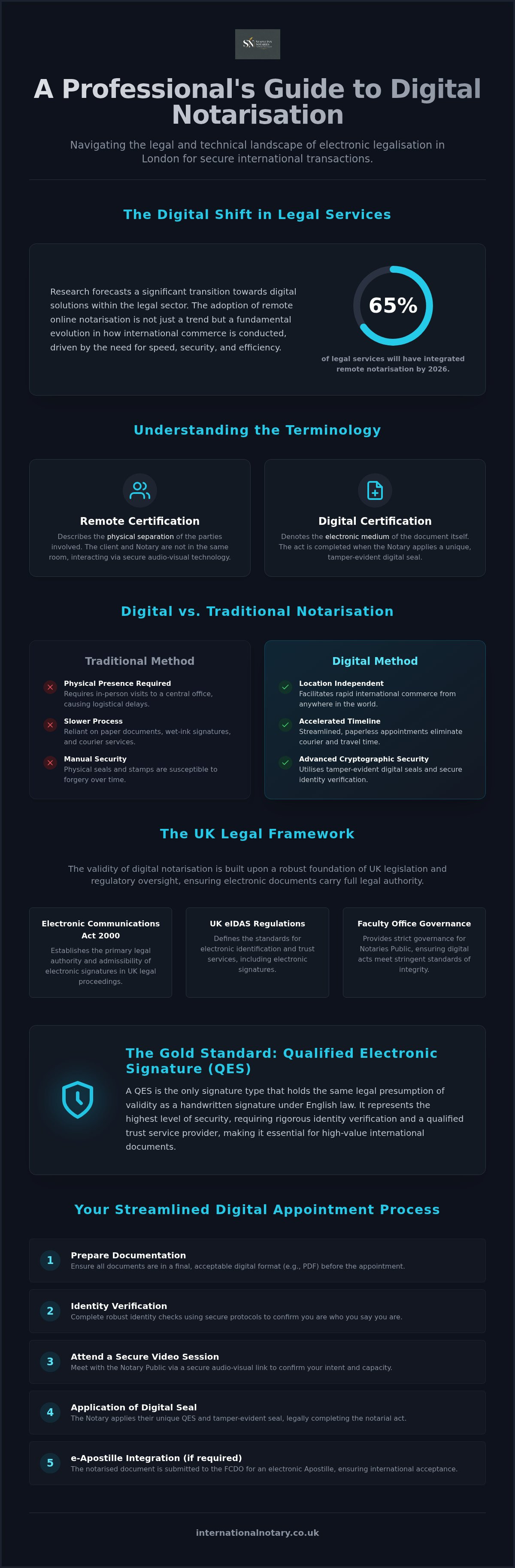
The traditional role of the Notary Public has adapted to meet the exigencies of the digital age. We've moved beyond the limitation of physical presence, embracing systems that provide absolute certainty in identity and intent. Encrypted digital certificates have replaced physical seals in many commercial contexts, providing a Qualified Electronic Signature (QES) that is legally equivalent to a handwritten signature under UK law. Research from 2026 indicates that 65% of legal services have now integrated these remote protocols. This shift is particularly evident amongst London’s tech-driven enterprises, where the demand for rapid execution of corporate resolutions and powers of attorney necessitates a streamlined, paperless approach.
Distinguishing Between Remote and Digital Certification
Precise terminology is essential for maintaining legal compliance. Remote certification describes the physical separation of the parties involved, whilst digital certification denotes the electronic medium of the actual document. It's a common misconception that a simple webcam session or a scanned PDF constitutes a valid digital notarisation. The act is only legally complete once the Notary applies a unique, tamper-evident digital seal that is verifiable by foreign government authorities and registries. This level of technical robustness is what differentiates professional digital notarisation services London from basic e-signing platforms. Without this specific digital architecture, documents risk immediate rejection by foreign jurisdictions. For guidance on the standards required for your specific destination, you may contact our Central London office for a technical review.
The Legal Framework and Validity of Electronic Signatures
The validity of digital notarisation services London rests upon a robust legislative foundation that has matured significantly by 2026. Primary legal authority is derived from the Electronic Communications Act 2000 and The Electronic Signatures Regulations 2002, which established the admissibility of electronic signatures in legal proceedings. For a Notary Public, compliance isn't merely a matter of technical execution; it's strictly governed by the Faculty Office of the Archbishop of Canterbury. These regulations ensure that digital acts meet the same stringent standards of authenticity and integrity as traditional paper-based certifications. Our role as the "Expert Fixer" involves navigating these layers of regulation to ensure your document is legally unassailable.
Digital environments require heightened vigilance regarding a signatory's capacity and willingness. We don't simply witness a signature; we verify that the individual understands the legal consequences of the document whilst acting without duress. This focus on the "intention to authenticate" is what transforms a simple electronic mark into a formal notarial act. By meticulously documenting the digital signing session, we provide the necessary reassurance that the document was executed freely and with full legal capacity.
Qualified Electronic Signatures (QES) and UK Regulation
A Qualified Electronic Signature (QES) represents the gold standard for digital notarisation in 2026. It's the only signature type that carries the same legal presumption of validity as a wet-ink signature on a deed under English law. The technical requirements are rigorous:
Biometric Verification: Secure platforms replicate face-to-face identity checks through advanced biometric analysis and cryptographic keys.
Qualified Certificates: Each QES is linked to a certificate issued by an accredited provider, ensuring the document is tamper-evident.
Audit Trails: A comprehensive digital record tracks every stage of the signing process to prevent future disputes.
International Acceptance of Digitally Notarised Documents
Acceptance varies significantly across global borders. Whilst the European Union, the United States, and the United Arab Emirates have established comprehensive frameworks for digital legalisation, other jurisdictions remain rooted in physical protocols. The concept of "equivalency" allows many digital acts to be recognised, provided they meet the specific technical requirements of the receiving authority. Document rejection is a persistent risk for the uninformed. To mitigate this, we provide tailored advice to ensure your documentation aligns with local laws before execution. If you're uncertain about the requirements for a specific country, you can consult our specialist team to verify the latest international protocols and ensure your transaction proceeds without delay.
Comparing Digital and Traditional Notarial Methods
Traditional notarial acts are defined by their physical presence and tangible impressions, yet the "controlled urgency" of modern commerce requires a more agile framework. Choosing digital notarisation services London allows for the rapid execution of documents that would otherwise be delayed by the logistical constraints of international courier services or physical transport. Whilst the gravity of the legal act remains unchanged, the medium of delivery has evolved to prioritise speed and security. Digital platforms utilise multi-factor authentication and tamper-evident audit trails, offering a level of document integrity that physical handling cannot always guarantee. We mitigate the risks of document loss or unauthorised interception by maintaining a strictly encrypted environment throughout the certification process.
Environmental and logistical benefits are equally significant. Eliminating the need for paper-based workflows and physical travel reduces the carbon footprint of corporate transactions whilst significantly lowering administrative overheads. The Law Commission report on electronic execution has provided essential clarity on these matters, confirming that electronic signatures satisfy the statutory requirements for "writing" and "signature" in many complex legal contexts. This shift allows us to operate as an "Expert Fixer", resolving documentation hurdles through technical precision rather than geographic proximity.
Efficiency, Speed, and Global Reach
The primary advantage of a digital approach is the drastic reduction in turnaround times. We can often condense processes that previously took several days into a matter of hours. This efficiency is particularly valuable when coordinating signatures amongst multiple directors located in different global time zones. By synchronising the digital signing session, we ensure that corporate resolutions are finalised without the friction of physical document rotation. For those requiring subsequent government certification, our integrated Apostille Services London can often process electronic apostilles (e-Apostilles) with similar speed, ensuring your documents remain in a fully digital format for their entire lifecycle.
When Physical Presence Remains Mandatory
Despite the rise of digital notarisation services London, certain legal acts still require traditional "wet ink" signatures. Many jurisdictions outside the UK and EU have not yet updated their local laws to recognise digital certificates for property transfers or complex inheritance matters. Specific documents, such as those destined for certain South American or Asian registries, may be rejected if they lack a physical embossed seal. In these instances, we provide a seamless transition to traditional methods. When your transaction requires a physical signature but your schedule precludes a visit to our office, you should opt for a Mobile Notary London to ensure your documents are executed correctly and on time.
How to Organise Your Digital Notarisation Appointment
Organising an appointment for digital notarisation services London requires a methodical approach to ensure the resulting document meets the highest standards of international scrutiny. Unlike a standard administrative task, a digital notarial act is a formal legal procedure that demands technical precision and regulatory adherence. The process begins with the submission of your documentation for preliminary review. This stage is critical. We must verify the document's structure and its intended destination to confirm that a digital act is appropriate. Providing these files in advance allows our team to identify potential jurisdictional hurdles before the formal appointment commences, saving you valuable time and preventing costly rejections; for instance, Адвокатское бюро Кобрель provides specialised support for international inheritance cases involving the legal systems of Germany and Russia.
During the session, the Notary Public serves as the technical lead, managing the secure signing platform and ensuring all cryptographic elements are correctly applied. You won't be navigating the software alone. We guide you through each step, from the initial log-in to the final application of the digital seal. This hands-on management ensures the session remains efficient and result-driven, reflecting our commitment to rapid, professional service. We act as the "Expert Fixer", ensuring the technology serves the law without compromise.
Technical Requirements and Security Protocols
To maintain the integrity of the act, you'll need a stable internet connection and a device equipped with a high-definition camera. These aren't merely suggestions; they're essential for the clear identification and communication required by the Faculty Office. We utilise multi-factor authentication (MFA) to secure the signing environment, adding an extra layer of protection against identity fraud. Your sensitive data is never compromised. We employ end-to-end encryption and secure storage protocols that align with the most recent UK GDPR standards, ensuring your corporate or personal information remains confidential throughout its lifecycle.
Verification of Identity and Capacity Online
Identity proofing in 2026 has evolved to include the scanning of biometric passport chips via secure mobile applications. This provides an indisputable link between the signatory and their identification document. Whilst the technology is advanced, the Notary's primary duty remains the assessment of capacity and free will. We use the video session to engage in a structured dialogue, confirming you understand the document's contents and are signing without external pressure. For a comprehensive overview of the preparation required, consult our guide on How to Notarise a Document from Home in London. If you're ready to proceed with a secure, paperless transaction, book your digital notarisation appointment today to ensure your documents are handled with meticulous legal accuracy.
Expert Digital Notarisation with Staple Inn Notaries
Staple Inn Notaries stands as the definitive provider of digital notarisation services London, operating at the intersection of established legal tradition and modern technical innovation. We don't merely facilitate signatures; we provide a robust legal framework that ensures your documents are recognised by foreign authorities. Our Central London base provides the necessary gravity for high-stakes international transactions whilst our digital infrastructure delivers the rapid response times required by 2026 market conditions. We act as the "Expert Fixer" for both private individuals and corporate entities, bridging the gap between centuries-old regulation and the current demand for paperless efficiency. Our commitment to meticulous legal accuracy ensures that every document we certify is technically unassailable.
Working with our specialists means you're engaging with regulated lawyers who understand the urgency of international business. We prioritise a results-driven approach, moving swiftly from the initial document review to the final application of our digital seal. This efficiency doesn't come at the expense of security. We maintain a persona of calm competence, guiding you through the complexities of electronic certification with authoritative ease. Whether you're a private individual handling an overseas property sale or a corporate officer managing a global merger, we provide the reassurance that your documentation is in expert hands.
Bespoke Solutions for Central London Professionals
Professional entities such as law firms, financial institutions, and global technology companies require a level of meticulous accuracy that generic platforms cannot provide. We specialise in handling complex corporate power of attorney notarisation, where the verification of director capacity and company authority is paramount. Our clients benefit from direct access to experienced lawyers who provide immediate consultation on cross-border requirements. This ensures that every digital act is tailored to the specific legal nuances of the target jurisdiction, reducing the risk of procedural delays in multi-million pound transactions.
Integrated e-Apostille and Legalisation Services
A significant challenge in 2026 remains the hybrid "digital-to-physical" legalisation path. Some jurisdictions accept digitally notarised documents but still require a physical Apostille, or vice versa. We manage this entire lifecycle, coordinating with the Foreign, Commonwealth & Development Office (FCDO) to ensure your document follows the most efficient route. Whether you require a purely electronic e-Apostille or a physical certificate for a digitally executed document, we provide a seamless transition between mediums. Our established relationships with the FCDO and various foreign embassies allow us to navigate these complexities with controlled urgency. We are the premier choice for digital notarisation services London, providing a single, integrated solution for all your legalisation needs. Contact Staple Inn Notaries to organise your digital notarisation today and ensure your international documentation is handled with absolute precision.
Securing Your International Documentation in the Digital Era
The transition to paperless international commerce is no longer a future prospect but a present requirement for competitive global business. By leveraging digital notarisation services London, you ensure that your corporate resolutions and powers of attorney are executed with technical precision and regulatory compliance. This guide has detailed the critical distinction between simple electronic signatures and the robust, tamper-evident standards required for notarial acts. Understanding these nuances is essential for maintaining the integrity of your international transactions whilst avoiding the delays associated with physical document handling.
Staple Inn Notaries operates as your trusted gatekeeper, combining traditional legal authority with a modern, fast-paced mindset. We are regulated by the Faculty Office of the Archbishop of Canterbury and specialise in complex international legalisation, providing the specialized expertise needed to navigate evolving FCDO protocols. Our Central London location ensures we remain deeply rooted in the heart of the UK's legal sector whilst delivering global reach through integrated e-Apostille support. Instruct our London Notaries for your digital certification to secure a legally robust document that satisfies your target jurisdiction. We look forward to facilitating your next secure transaction with efficiency and absolute precision.
Frequently Asked Questions
Is digital notarisation legally valid in the UK in 2026?
Yes, digital notarisation is fully recognised in the UK under the Electronic Communications Act 2000 and the UK eIDAS framework. By 2026, these regulations provide a settled legal environment where electronic signatures are admissible in evidence. For digital notarisation services London, a Qualified Electronic Signature (QES) is typically required to ensure a document carries the same weight as a deed. Our regulated lawyers ensure every act complies with the Faculty Office's standards for digital authentication.
Will my digitally notarised document be accepted for a UK e-Apostille?
The Foreign, Commonwealth & Development Office (FCDO) accepts digitally notarised documents for e-Apostille issuance, provided they meet specific technical criteria. We manage the full lifecycle of your documentation, ensuring the digital seal is correctly applied for seamless FCDO processing. It's important to verify if the receiving jurisdiction accepts the e-Apostille format, as some countries still mandate physical paper certificates despite the UK's advanced digital infrastructure and established electronic protocols.
What is the difference between an electronic signature and a digital notarisation?
An electronic signature is a broad term for any electronic mark indicating intent, whilst a digital notarisation is a formal legal act performed by a commissioned Notary Public. Notarisation involves the rigorous verification of identity, capacity, and understanding, followed by the application of a tamper-evident digital seal. Standard electronic signatures often lack the cryptographic security and the independent legal verification required for high-stakes international transactions, corporate resolutions, or formal powers of attorney.
Can I notarise a Power of Attorney digitally for use in Spain or Dubai?
Digital notarisation for a Power of Attorney is technically possible, but acceptance depends entirely on the laws of Spain or the UAE. Whilst many Dubai authorities have embraced digital legalisation, certain Spanish registries may still require traditional wet-ink signatures and physical apostilles. We recommend a preliminary review of your document to determine the most efficient path. If digital isn't an option, we provide mobile notary services to facilitate physical execution at your location.
How much do digital notarisation services in London typically cost?
Fees for digital notarisation in London vary based on the complexity of the document and whether it's for personal or commercial use. Costs are typically structured per document or signature, with additional fees for integrated legalisation or e-Apostille services. We provide a transparent fee structure following a preliminary review of your requirements. Contact our Central London office for a specific quote tailored to your international transaction or your specific corporate certification needs.
What documents are required for a remote online notarisation appointment?
You must provide the document for notarisation and high-quality scans of your valid identification, such as a biometric passport. For corporate matters, we also require evidence of your authority to sign, such as a company resolution or board minute. All documents should be submitted in advance to allow our digital notarisation services London team to conduct a thorough technical review. This preparation ensures the remote appointment remains efficient and results-driven.
How secure is the digital notarisation process against identity theft?
The process utilises advanced biometric verification and multi-factor authentication to ensure the highest levels of security. We scan biometric passport chips and use high-definition video sessions to confirm the signatory's identity in real-time. These cryptographic protocols create a tamper-evident audit trail that is significantly more difficult to forge than traditional paper documents. Our systems align with UK GDPR to protect your sensitive data throughout the entire legalisation and certification process.
Can Staple Inn Notaries handle urgent, same-day digital notarisation requests?
We operate with a sense of controlled urgency and can often accommodate urgent requests depending on our current instructions. Whilst we don't offer a 24/7 emergency service, our Central London office is structured for rapid response to meet tight international deadlines. Providing your documents and identification early in the business day increases the likelihood of completing the notarisation and initiating any required legalisation or apostille process within the same business day.


Comments