
Contentious Probate: Understanding Will and Inheritance Disputes

What if challenging the will isn’t the only way to address an inheritance dispute? Contentious Probate covers disagreements about a will, the administration of an estate or who should benefit. Family tension alone, however, doesn’t establish a legal claim. If assets may be distributed before concerns are examined, it can be difficult to know what to do first, particularly when responsibilities are unclear or evidence is incomplete.
Start by establishing the facts before taking an irreversible step. The right approach depends on the nature of the disagreement, the documents available and how far estate administration has progressed. A concern about a will’s validity, for example, needs a different assessment from a dispute about an executor’s decisions.
This article explains common types of contentious probate dispute, the information that can help clarify them and proportionate steps to consider before matters escalate. It also explains when specialist advice can help you understand your position and the practical risks of delay, so you can make informed decisions rather than act on assumptions.
Table of Contents
What does contentious probate mean in England and Wales?
Contentious probate concerns disputes about a will, the administration of an estate or a person’s entitlement to benefit after someone has died. It differs from routine probate administration, which involves dealing with the estate and obtaining authority to administer it. The two can overlap: an estate may be in administration when a disagreement arises about the will or an executor’s decisions.
Contentious probate is the area of law concerned with disputes about a will, estate administration or entitlement after death, but not every disagreement gives rise to a legal claim. Disappointment or suspicion may warrant careful consideration, but the concern needs to be assessed against the relevant legal issue and evidence. The facts matter.
Which disputes can fall under contentious probate?
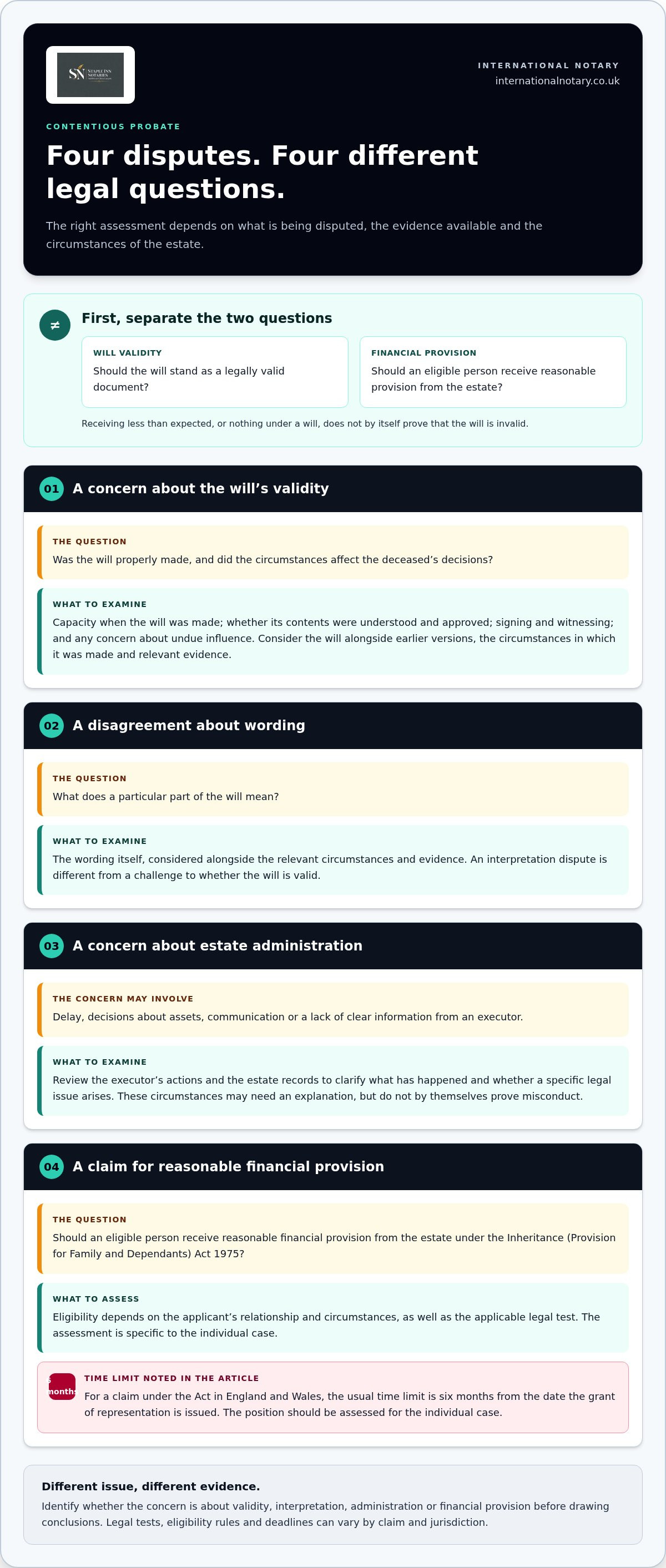
Disputes may concern whether a will is valid, what its wording means, how an executor has handled the estate or whether someone should receive financial provision. A validity challenge questions whether the will was properly made. An administration dispute focuses on decisions or conduct after death. A claim under the Inheritance (Provision for Family and Dependants) Act 1975 raises a separate question: whether the estate has made reasonable financial provision for an eligible person.
Each type of dispute calls for different questions and potentially different evidence. The will and earlier versions, correspondence, information about the circumstances in which it was made and estate records may all be relevant, depending on the issue. These examples aren’t exhaustive, and none establishes the merits of a claim without examining the facts. A general overview of contesting a will explains some circumstances in which validity may be questioned.
Does every inheritance disagreement mean a will can be challenged?
No. Being left less than expected, or receiving nothing under a will, doesn’t by itself prove that the will is invalid. A validity challenge and a claim for reasonable financial provision are different routes, with different legal questions. The first concerns the will’s legal status; the second asks whether provision from the estate may be justified under the 1975 Act. Knowing the difference can help you identify what needs to be assessed.
To clarify your concern, separate what you know from what you suspect, then identify the decision or document in question. Our supporting guide to the grounds for contesting a will explores validity challenges in more detail. An initial assessment can help establish whether the issue concerns the will, estate administration or financial provision, without assuming that a family disagreement is automatically actionable.
What legal issues can lead to a contentious probate dispute?
A dispute may concern the legal validity or meaning of a will, the way an estate is being administered or whether someone should receive financial provision. These issues involve different legal questions and evidence. A will-validity dispute asks whether the will should stand; a financial-provision claim asks whether the estate should provide for an eligible person. Distinguishing between them helps identify what needs assessing instead of treating every concern as the same kind of challenge.
Will validity, interpretation and concerns about influence
A validity challenge may raise questions about the deceased’s capacity when the will was made, whether they understood and approved its contents, whether it was properly signed and witnessed, or whether undue influence affected their decisions. An interpretation dispute is different: it concerns what particular wording means. In either case, the document needs to be considered alongside the relevant circumstances and evidence. A supporting guide to undue influence claims explores that issue in more detail.
Executor disputes and claims for reasonable financial provision
Concerns about estate administration can involve delay, decisions about assets, communication or a lack of clear information. These circumstances may need an explanation, but they don’t by themselves prove misconduct. Reviewing the executor’s actions and the estate records can help clarify what has happened and whether a specific legal issue arises.
Separately, the Inheritance (Provision for Family and Dependants) Act 1975 allows eligible people to seek reasonable financial provision from an estate. Eligibility depends on the applicant’s relationship and circumstances, as well as the applicable legal test. For a claim under the Act in England and Wales, the usual time limit is six months from the date the grant of representation is issued. Acting promptly matters, and the position should be assessed for the individual case.
Legal tests, eligibility rules and deadlines can vary according to the type of claim and jurisdiction. If you’re unsure whether a concern is about validity, administration or financial provision, specialist contentious probate guidance can help clarify the issue and relevant next steps. Staple Inn Notaries supports private clients with contentious probate in Central London and across the wider London area. Read about our legal advisory services or find our details on the contact page.
What evidence and information matter in a contentious probate case?
Useful evidence depends on the issue in dispute. A concern about how a will was signed calls for different material from a question about estate accounts or an executor’s decisions. Start with a clear record, preserve what you already have and avoid treating suspicion as established fact. The evidence needed must be assessed against the specific claim and current law.
Which documents may help clarify the dispute?
Depending on the circumstances, relevant records may include:
The current will and any earlier versions you can lawfully access.
The grant of probate or letters of administration, and estate accounts or asset information provided to you.
Correspondence between beneficiaries, executors and other relevant parties, including information requests and responses.
For concerns about capacity or influence, relevant medical or contemporaneous records, where lawfully available.
Access to documents isn’t automatic. Confidentiality, privacy and disclosure rules may restrict what you can obtain or share, particularly in relation to medical records. Don’t try to access private information without authority. The Law Society’s guidance for practitioners provides professional context on disputed wills, but the records needed depend on the individual case.
How should beneficiaries and executors record events?
A concise chronology can organise the information and expose gaps, but it doesn’t prove a claim by itself. Record dates as accurately as possible and mark uncertainty rather than filling gaps from memory.
Write down the concern and identify the decision, document or action it relates to.
Preserve relevant documents in their original form. Keep copies securely and don’t annotate or alter the originals.
Record key dates, conversations, decisions, information requests and responses. Note who was involved and whether each detail comes from direct knowledge, recollection or someone else.
List unanswered questions, such as an unexplained delay or missing account, without making unsupported allegations about the reason.
Keep the account factual. Separate what you observed from what you infer, and retain relevant correspondence rather than deleting messages that may provide context. For routine administration, an executor-duties timeline can help distinguish ordinary estate tasks from the specific conduct you’re concerned about. In Contentious Probate, an organised chronology helps a specialist assess what is known, what remains uncertain and which records may need further consideration.
How can contentious probate disputes be resolved proportionately?
Speaking with a specialist doesn’t commit you to a legal claim or mean the dispute must escalate. Advice can help clarify the issue, identify relevant evidence and assess possible options before you decide how to proceed. The proportionate route depends on the disagreement, the estate’s circumstances and whether the parties are willing to engage.
When might negotiation or mediation be worth considering?
Structured discussion can help parties identify what they agree on, narrow the disputed issues and consider practical proposals. This can be valuable where family members need to maintain an ongoing relationship. Mediation offers a more organised setting for those conversations. It isn’t mandatory or suitable in every case, and its outcome depends on the people involved and the circumstances.
When might a dispute require formal legal proceedings?
If the parties can’t resolve a dispute and a legal issue needs a binding decision, formal proceedings may be considered after specialist assessment. The appropriate procedure, potential costs and any applicable deadline depend on the claim. Don’t assume that informal discussions pause a time limit or that proceedings are the only next step. Get advice on the specific facts before deciding.
Staple Inn Notaries provides private client support for contentious probate alongside probate and estate administration. This support can help distinguish resolution options and clarify what further assessment may be needed. Find details of our legal advisory services and how to contact us.
Where can you seek contentious probate guidance in Central London?
A focused discussion can help clarify what kind of dispute you’re facing, which facts are known, what documents you have and whether any immediate concerns need attention. You might want to explain a question about a will, an executor’s actions or the timing of estate distributions. The aim is to understand the issue and possible next steps, not to assume that a claim will follow.
What should you prepare before seeking advice?
You don’t need a complete case file to begin. A concise summary can make the discussion more productive. Note:
Your relationship to the deceased and your role, if any, in the estate.
The main concern and a short chronology of relevant events, including important dates.
Correspondence, the will, grant documents or estate information already available to you.
Any immediate concerns, such as a known plan to distribute assets or information requests that remain unanswered.
Keep the account factual. Mark details you’re unsure about and distinguish what you witnessed from what you’ve been told. Don’t delay seeking guidance solely because you haven’t obtained every document. Access to estate information may depend on your position and the circumstances.
How does contentious probate guidance fit with estate administration?
Advice about a dispute is distinct from routine estate administration, such as dealing with assets and progressing probate. The issues can overlap: an administration question may reveal a concern that needs separate assessment, while a dispute may affect how the estate is handled. Staple Inn Notaries provides private client support for contentious probate alongside probate and trust administration, helping you consider the issue in its estate context without promising a particular outcome.
Staple Inn Notaries operates in Central London and across the wider London area. If you’re considering how to prevent future uncertainty, our guide to will writing in London offers further context on planning ahead.
To prepare for a discussion, explain what has happened and what concerns you. You can find details on the Staple Inn Notaries contact page.
Take a clear, proportionate next step
A disagreement about an estate doesn’t automatically mean a will can be challenged. First identify whether the concern relates to the will, estate administration or financial provision, then organise relevant documents and key dates. A clear chronology can expose questions that need answering, while specialist guidance can help you consider proportionate options before deciding how to proceed.
Contentious Probate concerns can be difficult to assess, particularly when family relationships and estate responsibilities overlap. Staple Inn Notaries provides private client support for contentious probate and probate administration in Central London and across the wider London area. A focused discussion can help clarify the issue and the information that may matter, without assuming a particular course or outcome.
Discuss your contentious probate concerns with Staple Inn Notaries. Explain what has happened and what you’re worried about. A clear understanding of the facts is a practical first step towards deciding what to do next.
Frequently Asked Questions
What is contentious probate?
Contentious probate is a broad term for disputes connected with a will or the administration and distribution of an estate. Issues may include whether a will is valid, how it should be interpreted, an executor’s conduct or a claim for reasonable financial provision. The label doesn’t establish that a legal claim exists. The facts, available evidence and applicable law determine what options may be open in a particular case.
Can I challenge a will if I think its outcome is unfair?
Feeling that a will is unfair doesn’t, by itself, establish grounds to challenge its validity. A validity dispute concerns how the will was made or whether it meets the relevant legal requirements. A separate claim may seek reasonable financial provision under the Inheritance (Provision for Family and Dependants) Act 1975. Which route, if any, may apply depends on your relationship to the deceased, your circumstances, the evidence and the relevant jurisdiction.
How long do I have to contest a will in England and Wales?
There isn’t one deadline for every contentious probate claim. Time limits depend on the legal basis and circumstances, and some claims have particularly short periods. Delay may affect your options, so don’t rely on a general online timeframe or assume discussions pause a deadline. Identify the potential issue promptly and seek advice based on current law, the type of claim and relevant grant or estate dates.
What evidence is needed for a contentious probate dispute?
Relevant information may include the will and earlier versions, estate correspondence, accounts and a dated chronology. If the concern relates to capacity or influence, contemporaneous medical or other records may matter where they’re lawfully available. No single document necessarily proves a claim. Preserve original records, distinguish direct knowledge from assumptions, and don’t access or share confidential information without authority. The evidence needed depends on the specific issue.
Does contentious probate always go to court?
No. Depending on the dispute and the parties’ circumstances, some issues may be clarified through direct discussion or correspondence, or explored in mediation. None of these approaches guarantees agreement, and formal proceedings aren’t an automatic next step. A legal assessment can help identify proportionate options, risks and procedural requirements. Staple Inn Notaries provides contentious probate support in Central London and across the wider London area.
Can an executor be challenged for delaying probate?
A delay alone doesn’t prove that an executor has acted improperly. The reason for it, the estate’s complexity, communication and steps already taken all need consideration. Keep a dated record of requests and responses, and note any practical consequences. If your concern remains, advice can help clarify the executor’s role and what next steps may be appropriate in light of the estate’s circumstances.
Is contentious probate the same as a claim under the Inheritance Act?
No. Contentious probate is an umbrella term for different disputes involving wills and estates. A claim under the Inheritance (Provision for Family and Dependants) Act 1975 is one specific type: it concerns reasonable financial provision for eligible applicants. It’s distinct from arguing that a will is invalid. Eligibility, evidence and any deadline require individual assessment under current law, taking account of the claim and circumstances.


Comments