
2026 Agent Rules: London Business Filing Changes

Updated: Sep 3
Is your firm prepared for the most significant overhaul of Companies House filing procedures in over a century, or will the new regulatory framework halt your operations? The Economic Crime and Corporate Transparency Act (ECCTA) introduces a rigorous framework that demands a precise understanding of new statutory obligations, particularly regarding the authentication of those who act as intermediaries for corporate entities. You'll likely feel the pressure of shifting timelines and the weight of mandatory identity verification requirements. It's a reasonable concern, as failing to adapt to these protocols could result in the rejection of vital corporate filings and changes on behalf of client businesses (required for agents starting no earlier than November 2026).
This guide clarifies the transition to Authorised Corporate Service Provider (ACSP) status and outlines how to secure your standing before the window closes. We provide the technical insight necessary to navigate these administrative shifts with confidence. Our analysis examines the precise steps for obtaining verified status, the role of a Notary Public in certifying your credentials, and the strategic timeline you must follow to remain compliant with the Registrar of Companies' evolving mandate. Secure your professional standing today.
Table of Contents
Companies House Identity Verification: The November 2026 Filing Deadline
Presenter Requirements for Filing Changes on Behalf of Client Businesses
The Strategic Importance of Authorised Corporate Service Providers (ACSPs)
Compliance Roadmap: Preparing Your Firm for the ECCTA Transition
Expert Notarial Verification for London Businesses and Agents
Companies House Identity Verification: The November 2026 Filing Deadline
The Economic Crime and Corporate Transparency Act 2023 represents the most significant transformation of the UK's corporate registry in nearly two centuries. It empowers Companies House to act as a proactive regulator rather than a passive recipient of information. This legislative shift aims to combat fraud and money laundering by ensuring the integrity of every entry on the register. Central to this effort is the mandatory identity verification of all directors, Persons with Significant Control (PSCs), and agents. By verifying identities, the Registrar can effectively eliminate the use of fictitious names and "straw man" appointments that have historically facilitated economic crime.
The Shift from Spring to November 2026
The implementation timeline for these requirements has evolved to allow for a phased and stable transition. Whilst initial expectations pointed toward an earlier rollout, the scale of verifying over 7 million individuals prompted a strategic delay. This adjustment is not a reason for complacency. Instead, it's a critical window for London firms to formalise internal compliance structures. Agents currently utilising existing service accounts must prepare for the mandatory shift to Authorised Corporate Service Provider (ACSP) status. You'll need this designation to continue submitting updates and changes on behalf of client businesses (required for agents starting no earlier than November 2026). Do not wait for the deadline to act. Early adoption ensures your firm avoids the inevitable bottleneck of last-minute registrations.
Who is Affected by the New Presenter Rules?
The new rules apply to anyone interacting with the register. This includes every director of a UK company and every individual who files documents on their behalf. If your firm manages corporate secretarial tasks, your staff are classified as "presenters". These individuals must verify their identity directly with Companies House or through a registered ACSP. Without this verification, the Registrar will reject any attempt to submit filings and changes on behalf of client businesses (required for agents starting no earlier than November 2026). The distinction between new and established agents is clear: while existing accounts have a transition period, the eventual requirement for verified status is universal. Audit your team now. Identify every individual who holds filing permissions. Ensure their documentation is ready for the upcoming verification protocols.
Presenter Requirements for Filing Changes on Behalf of Client Businesses
The transition to the new Companies House digital gateway necessitates a fundamental shift in how professional agents interact with the corporate register. Under the revised framework, the Registrar no longer accepts filings from anonymous or unverified sources. Every professional intermediary must establish a verified identity to facilitate submissions and changes on behalf of client businesses (required for agents starting no earlier than November 2026). This requirement ensures that every action taken on the register is traceable to a specific, authenticated individual. It effectively eliminates the risk of fraudulent filings that have previously compromised the accuracy of the UK’s corporate data. Compliance is not optional; it's the new standard for corporate governance.
Mandatory Identity Verification for Agents
The role of the "authorised presenter" is central to the integrity of the new system. To achieve this status, agents must undergo a rigorous identity check, providing high-quality primary documentation such as a valid passport or biometric residence permit. Once verified, this identity is cryptographically linked to your presenter account, creating a secure digital handshake with Companies House. This process is mandatory for all individuals who intend to submit digital or paper documents. Prepare your documentation now. For firms managing international clients, ensuring your corporate power of attorney notarisation London is in order remains a prerequisite for establishing filing authority. Secure these certifications early to avoid procedural delays.
To successfully verify a professional presenter, you must collate the following items:
Current valid passport or government-issued photo identification.
Proof of professional standing or registration with a relevant oversight body, such as the SRA or ICAEW.
Documentary evidence of the agent's authority to act for the specific company entity.
Biometric data captured through the official Companies House digital identity service.
Managing Client Portfolios under ECCTA
Managing a diverse portfolio of client businesses requires precise administrative discipline under the Economic Crime and Corporate Transparency Act. Agents must maintain exhaustive records of their own verification status and the authorisation levels granted by each client entity. The use of statutory declarations may be required to confirm the legitimacy of an agent's right to act, particularly in complex corporate structures involving multiple layers of ownership or international parent companies. Precise record-keeping is vital during the verification transition to avoid service disruptions. As you prepare to submit filings and changes on behalf of client businesses (required for agents starting no earlier than November 2026), ensure your internal databases mirror the Registrar's new transparency standards. If you require professional assistance with document certification, a notary public London can provide the necessary legal assurance to expedite your ACSP registration and ensure your firm remains a trusted gatekeeper of corporate information.
The Strategic Importance of Authorised Corporate Service Providers (ACSPs)
The Authorised Corporate Service Provider (ACSP) status is the new cornerstone of the UK’s corporate filing infrastructure. Under the Economic Crime and Corporate Transparency Act, the Registrar of Companies will only accept filings from individuals who've verified their identity or through an intermediary that has attained ACSP status. This designation isn't granted lightly. It's reserved for entities already subject to a supervisory body for anti-money laundering (AML) purposes, such as solicitors, accountants, and notaries. By channeling filings through these regulated professionals, Companies House ensures that the data entering the register has been vetted by experts bound by stringent ethical and procedural codes. This system creates a protective barrier against the infiltration of illicit actors into the UK’s business ecosystem.
Why Notaries are Essential for ACSP Verification
Notaries Public occupy a unique position within the ACSP framework due to their historical role as high-trust public officers. Regulated by the Faculty Office of the Archbishop of Canterbury, a British Notary provides a level of certification that carries weight both domestically and internationally. For London firms, utilising a notary as an ACSP partner simplifies the complex task of identity verification. We act as the "Expert Fixer," resolving documentation discrepancies before they trigger a rejection from the Registrar. This specialised oversight is particularly vital when managing filings and changes on behalf of client businesses (required for agents starting no earlier than November 2026). Our involvement guarantees that every submission meets the precise evidentiary standards required by the new regime, providing a seamless path to compliance for both the agent and the corporate entity.
The Relationship between HMRC and Companies House Requirements
The implementation of ECCTA requires a rigorous alignment between HMRC tax adviser registration and Companies House filing authorisation. Many agents already hold an Agent Services Account with HMRC, but this doesn't automatically grant ACSP status. You must ensure your AML supervision is current and that your professional standing is recognised by the Registrar. Coordinating these AML checks across both platforms is essential for maintaining your authority to act. If your firm provides tax or accountancy services, you'll need to demonstrate that your existing regulatory oversight meets the heightened standards of the 2023 Act. Failing to synchronise these requirements could lead to a suspension of your ability to process updates and changes on behalf of client businesses (required for agents starting no earlier than November 2026). Ensure your firm meets these professional benchmarks well ahead of the November deadline to maintain uninterrupted service delivery.
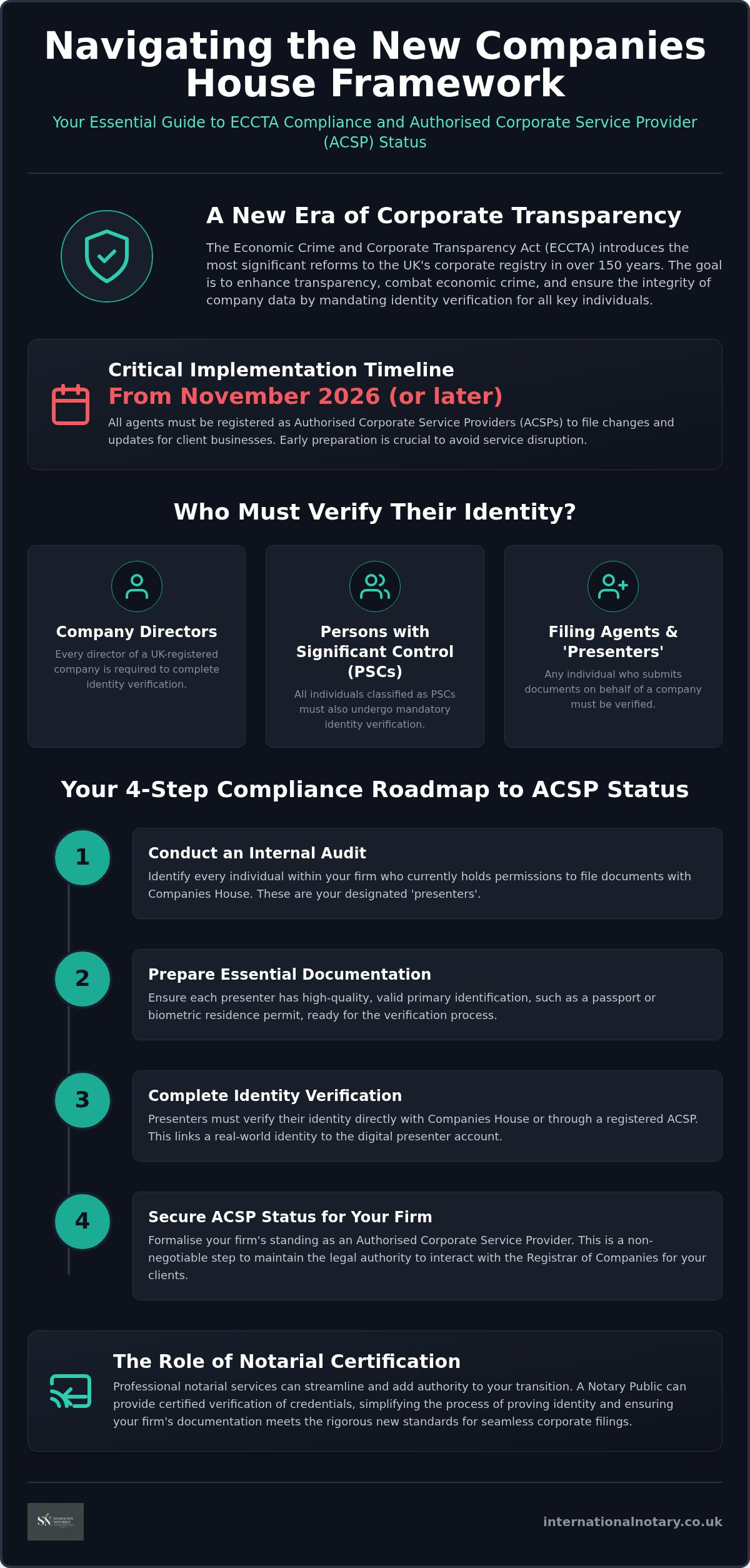
Compliance Roadmap: Preparing Your Firm for the ECCTA Transition
Success under the new regulatory regime requires a systematic audit of your firm's current filing capabilities. You must first identify every individual within your organisation who holds a presenter account or possesses the authority to submit documentation. This audit should categorise staff based on their level of access and the frequency of their interactions with the register. Once identified, you must collate high-quality identification documents for these individuals, ensuring that all credentials are current and meet the Registrar's stringent standards. This proactive approach prevents the administrative paralysis that will occur if your presenters are unverified when you attempt to submit updates and changes on behalf of client businesses (required for agents starting no earlier than November 2026).
Step-by-Step Identity Certification
The certification process demands more than a simple photocopy of a passport. You must provide primary identification documents, such as a valid UK or international passport, alongside secondary evidence like recent utility bills or bank statements that confirm a residential address. For professional agents, evidence of registration with a regulatory body is also essential. Engaging a Notary Public London ensures these documents are certified with the necessary legal authority to be accepted by Companies House. Registration as an Authorised Corporate Service Provider involves a formal application to the Registrar of Companies to confirm supervised anti-money laundering status, a process that becomes the mandatory gateway for professional filing activity starting no earlier than November 2026.
Avoiding Delays in Corporate Filings
The risks of ignoring this roadmap are severe. Non-compliant firms face the immediate rejection of all submissions, which can lead to missed statutory deadlines, financial penalties, and potential prosecution for directors. Establishing a relationship with a Central London notary provides the ongoing support needed to manage these risks effectively. A mobile notary can visit your office to certify documents for multiple partners simultaneously, significantly reducing procedural downtime. This ensures that all updates and changes on behalf of client businesses (required for agents starting no earlier than November 2026) are signed by verified individuals and processed without friction. By standardising your internal verification protocols now, you protect your firm's reputation and ensure the continued delivery of seamless corporate services.
Expert Notarial Verification for London Businesses and Agents
Staple Inn Notaries operates as a vital strategic partner for firms navigating the complexities of the Economic Crime and Corporate Transparency Act. We provide the technical precision required to certify identity documents and company resolutions with absolute certainty. Our role is to ensure that your presenters meet the Registrar’s standards, allowing your firm to continue processing updates and changes on behalf of client businesses (required for agents starting no earlier than November 2026). We understand the urgency of these regulatory shifts. By acting as a trusted gatekeeper, we mitigate the risk of administrative delays that could otherwise compromise your firm's operational continuity. Our practitioners bring a modern, fast-paced mindset to traditional legal certification, ensuring your filings move through the system without friction. Secure your standing. Protect your filings.
Central London Office and Mobile Services
Efficiency is the hallmark of our corporate service model. For firms located within the City or the West End, our central London office provides a rapid environment for document certification. However, we recognise that senior partners and directors often operate on demanding schedules. Our Mobile Notary London service addresses this by bringing expert certification directly to your boardroom or private office. This is particularly effective for certifying statutory declarations or company resolutions during urgent board meetings or complex transaction closings. By providing on-site verification, we ensure that every individual authorised to submit filings and changes on behalf of client businesses (required for agents starting no earlier than November 2026) is fully compliant without disrupting their daily responsibilities. We eliminate procedural delays by handling the technical verification at the source of the transaction. Eliminate delays. Ensure compliance.
Apostille and Legalisation for International Entities
Managing the UK interests of overseas corporations presents unique challenges under the ECCTA framework. International documents often require additional layers of verification to satisfy the Registrar of Companies. Our Notary Central London specialists are experts in the apostille and legalisation process, ensuring that documentation from foreign jurisdictions carries the necessary international validity. We bridge the gap between foreign legal standards and UK regulatory requirements. Whether you're managing a UK branch or a subsidiary of a global entity, we provide the meticulous oversight needed to verify overseas directors and PSCs. This comprehensive approach guarantees that your firm remains an authorised conduit for corporate information, regardless of the jurisdictional origin of the underlying data. Our service is designed to reduce client anxiety through specialised expertise and highly responsive delivery. Verify globally. Act locally.
Securing Your Firm’s Standing in a Transparent Registry
The implementation of the Economic Crime and Corporate Transparency Act marks a definitive end to anonymous corporate filings in the United Kingdom. Professional agents must now prioritise the formalisation of their ACSP status and the verification of their presenters to maintain operational continuity. This transition requires meticulous attention to detail and a robust understanding of the Registrar’s new evidentiary standards. By establishing these protocols today, you ensure that your firm remains an authorised gateway for submitting updates and changes on behalf of client businesses (required for agents starting no earlier than November 2026).
Staple Inn Notaries provides the authoritative oversight necessary for this transition. We're regulated by the Faculty Office of the Archbishop of Canterbury and possess specialist expertise in corporate and international notarial services. Whether you visit our convenient Central London location or utilise our mobile service for on-site certification, we deliver a highly efficient solution tailored to the City’s requirements. Secure your professional identity verification with Staple Inn Notaries today. We're here to ensure your firm’s filings remain seamless and fully compliant.
Frequently Asked Questions
What is the November 2026 deadline for Companies House filings?
The November 2026 deadline represents the critical transition point for professional agents to secure verified identity status under the ECCTA. While some requirements began in 2025 for new directors, existing agents have until this date to register. This is essential for submitting updates and changes on behalf of client businesses (required for agents starting no earlier than November 2026). Failing to meet this milestone will result in an immediate suspension of your firm's ability to interact with the Registrar’s digital portal.
Who needs to undergo identity verification under the ECCTA?
Identity verification is mandatory for all company directors, Persons with Significant Control (PSCs), and any individual filing documents as a presenter. This universal requirement ensures every action on the register is traceable to a specific, authenticated person. Professional agents acting as intermediaries must also verify to maintain their standing. It's a comprehensive measure designed to eliminate the use of fictitious names and fraudulent appointments across the UK's corporate registry.
Can a Notary Public certify my identity for Companies House?
Yes, a Notary Public is an authorised official capable of certifying identity documents for Companies House. As regulated public officers, our certification carries the high-level professional authority required by the Faculty Office and the Registrar. We verify the authenticity of your primary identification documents and confirm your professional credentials. This specialised oversight ensures your verification application is processed without the delays often associated with less formal certification methods.
What is an Authorised Corporate Service Provider (ACSP)?
An Authorised Corporate Service Provider (ACSP) is a regulated entity, such as a notary or solicitor, that has registered with the Registrar of Companies. ACSPs are authorised to verify the identities of their clients and submit documents on their behalf. This status is reserved for firms already supervised for anti-money laundering purposes. It's the primary gateway for professional firms to manage filings and changes on behalf of client businesses (required for agents starting no earlier than November 2026).
What happens if I fail to verify my identity by the deadline?
Failing to verify your identity by the statutory deadline will result in the immediate rejection of all submitted filings. Beyond administrative disruption, non-compliance is a criminal offence that may lead to financial penalties or prosecution for the individuals involved. It also risks the company being struck off the register for failing to provide accurate information. Ensure your presenters are verified early to protect your firm’s reputation and operational legality.
Do I need to verify my identity if I already have an HMRC agent account?
Having an HMRC agent account doesn't exempt you from the new Companies House identity verification requirements. While both systems require anti-money laundering supervision, the ECCTA introduces a distinct digital identity handshake specific to the corporate register. You must link your verified identity to your presenter account regardless of your existing tax adviser status. Aligning these two regulatory frameworks is essential for maintaining your firm’s full suite of professional services.
How does a mobile notary help with urgent corporate filings in London?
A mobile notary provides on-site certification at your Central London office, significantly reducing procedural downtime for busy partners. We visit your premises to certify identity documents and company resolutions simultaneously, ensuring your firm meets urgent filing deadlines. This service is particularly valuable during high-stakes board meetings or transaction closings where rapid certification is critical. It offers a streamlined solution that balances the gravity of legal compliance with the practical need for speed.
What documents are required for professional presenter verification?
Professional presenters must provide high-quality primary identification, typically a valid UK or international passport. You also need secondary evidence of residential address, such as a utility bill or bank statement dated within the last three months. For agents, proof of professional registration with a supervisory body like the SRA or ICAEW is also required. We ensure these documents are notarised to the precise standards demanded by the Registrar’s new transparency protocols.


Comments