
Will writing for blended families in the UK: protect the people you care about

What if providing security for your partner today could leave your children with no inheritance tomorrow? It’s a risk worth addressing when planning a blended-family estate. If you’re researching “will writing for blended family UK”, the key question is how to provide for your partner while making your wishes for your children clear and effective.
You may want your surviving partner to remain in the family home and feel financially secure, while also ensuring your children’s future doesn’t depend on decisions made later. In England and Wales, unmarried partners and stepchildren don’t automatically inherit under intestacy rules. A surviving spouse or civil partner may inherit under rules that don’t reflect your intentions. The law differs in Scotland and Northern Ireland.
A carefully drafted will can set out who benefits, when and how. This guide explains the practical differences between mirror wills, life-interest trusts and discretionary trusts, and why a surviving partner may otherwise be able to change their will or redirect assets they inherit. It also covers the family, property and asset details to organise before making or updating a will.
Table of Contents
Why will writing for a blended family in the UK needs careful planning
Providing for a current partner while preserving an intended inheritance for children from an earlier relationship can create competing priorities. A will needs to address both rather than assume that what feels fair within the family will happen automatically. The right provisions depend on your relationships, what you own and what you want your estate to provide.
A blended family may include a spouse or civil partner, children from one or both partners’ earlier relationships, stepchildren or children legally adopted into the family. These connections can affect who benefits under a will and who may have rights if there is no valid will. The rules are not uniform across the UK: this section focuses on England and Wales, and different rules apply in Scotland and Northern Ireland.
What can happen if someone in a blended family dies without a will?
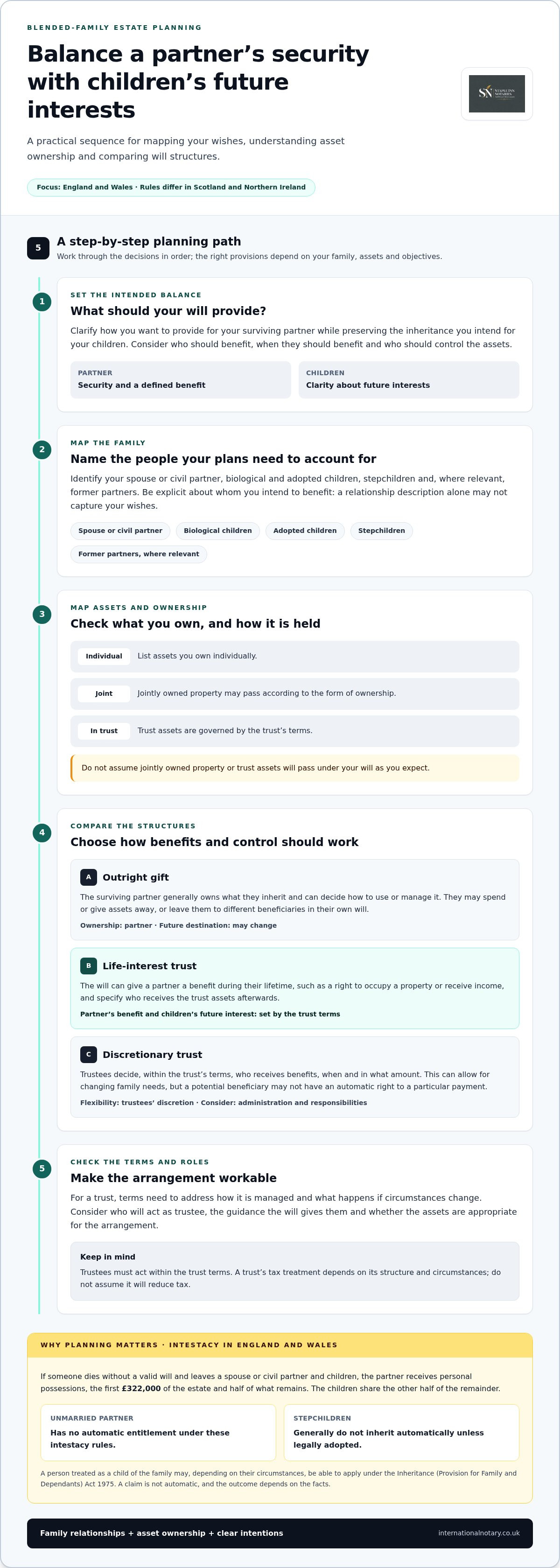
Without a valid will, intestacy rules determine who inherits, not the deceased’s personal wishes. In England and Wales, where someone leaves a spouse or civil partner and children, the partner receives personal possessions, the first £322,000 of the estate and half of what remains. The children share the other half of the remainder. The outcome can differ in Scotland and Northern Ireland.
An unmarried partner has no automatic entitlement under intestacy in England and Wales, whatever the length of the relationship. Stepchildren who haven’t been legally adopted generally don’t inherit automatically either. However, a person treated as a child of the family may, depending on their circumstances, be able to apply under the Inheritance (Provision for Family and Dependants) Act 1975. A claim isn’t automatic, and its outcome depends on the facts.
Which family relationships and assets should the will address?
Identify your spouse or civil partner, biological and adopted children, stepchildren and, where relevant, former partners. Be explicit about whom you intend to benefit. Describing someone by their relationship alone may not capture your wishes, particularly when children from different relationships are involved.
Then establish which assets you own individually, which are jointly owned and which are held in trust. Jointly owned property may pass according to the form of ownership, while trust assets are governed by the trust’s terms. Neither should be assumed to pass under your will as you expect. Blended-family estate planning means coordinating family relationships, asset ownership and intentions so your will can set out who should benefit and how. The right approach depends on your circumstances.
How will structures can balance a partner’s security with children’s inheritance
The key differences between will structures are who can benefit, when they can benefit and who controls the assets. An outright gift gives a beneficiary ownership. A trust can set conditions on how assets are used or distributed. Neither approach guarantees a particular inheritance or tax result. The appropriate choice depends on the assets, family relationships and your objectives.
Outright gifts and life-interest trusts: what is the practical difference?
An outright gift can give a surviving partner immediate ownership of an asset or share of the estate, subject to the will’s terms and applicable law. They can generally decide how to use or manage what they inherit. But once the assets belong to them, they may spend or give them away, or leave them to different beneficiaries in their own will. Children from the first relationship may therefore not receive the inheritance the deceased intended for them.
A life-interest trust takes a different approach. The will can provide for a partner to benefit from an asset during their lifetime, for example by giving them a right to occupy a property or receive income. It can also specify who is to receive the trust assets afterwards. The partner’s interest and the children’s future interest depend on the trust terms.
Those terms also define the trustees’ powers and responsibilities. They need to address how the trust is managed and what happens if circumstances change. A life-interest trust can give a survivor a defined benefit without giving them unrestricted ownership of the trust assets, but it isn’t automatically suitable for every estate.
When might discretionary trusts enter the discussion?
A discretionary trust may be considered when you want trustees to decide, within the trust’s terms, who receives benefits, when and in what amount. This flexibility may be relevant if family needs could change or beneficiaries have different circumstances. Unlike someone with a fixed entitlement, a potential beneficiary may not have an automatic right to a particular payment.
Discretion brings administration and trustee responsibilities. Trustees must act within the trust terms, and their decisions may affect family relationships, particularly if beneficiaries have different expectations. Consider who will act as trustee, what guidance the will gives them and whether the assets are appropriate for this arrangement. A trust’s tax treatment depends on its structure and circumstances, so don’t assume it will reduce tax.
For will writing for blended family UK circumstances, compare the practical effect of each structure on the survivor’s security and the children’s future interests. Legal advisory services can help assess the will, trust provisions and wider estate-planning objectives together. To discuss your circumstances, use the firm’s contact page.
Comparing blended-family will options against your priorities
There’s no single structure that suits every family. Compare the options by asking four practical questions: does your partner need immediate financial provision, when should your children inherit, how much flexibility do you need, and who will administer the arrangement? The table summarises general differences, not a recommendation. The effect depends on the will’s wording, the assets and the relevant law.
Ownership matters too. A will generally deals with assets that form part of the estate, but some jointly owned property may pass by survivorship, depending on how it is held. A mortgage, business interest, trust asset or property outside the UK can add further considerations. Review ownership documents alongside the will rather than assuming every asset can be distributed through it.
How should you weigh a partner’s needs against children’s future interests?
Consider the survivor’s housing, income and care needs, as well as their age and financial independence. Assess the children’s ages, needs and existing resources too. Equal shares aren’t compulsory, but if you intend different provision for a partner or particular children, make that intention clear and consider how the arrangements will work in practice. Family discussions may help clarify priorities, but you needn’t disclose sensitive decisions before you’re ready.
What circumstances can make one option less suitable?
Joint ownership, mortgage conditions, business assets and overseas property can affect what a will can achieve. Remarriage, changes in relationships or a beneficiary’s changing needs may also make an existing plan unsuitable. Review the relevant documents and rules rather than relying on assumptions about legal or tax effects. The companion article, Inheritance Tax Advice London: Professional Estate Protection Strategies for 2026, explores the tax-planning context. Tailored will writing for blended family UK circumstances should consider your priorities, ownership arrangements and wider estate plan together.
What to prepare before arranging a blended-family will
Organising some key information can make a will-planning discussion more focused. Work through four steps: map your family relationships, list your assets and liabilities, identify your priorities, then consider provisions that may fit your circumstances. Preparation won’t determine the right structure by itself, but it can reveal questions that need attention.
Which information helps a will-writing discussion run efficiently?
Start with a family tree. Include your spouse or civil partner, children, stepchildren, dependants and relevant previous relationships. Note which children are yours, your partner’s or legally adopted, and record any particular needs or circumstances that may affect your intentions.
Next, prepare an asset and document list. Include property and how it is owned, mortgages and other significant liabilities, business interests, savings, investments and assets held in trust. Gather existing wills, trust documents and relevant agreements. Ownership arrangements can affect whether an asset passes under a will, so review these documents together rather than in isolation.
Write down your priorities: what provision your partner may need, what you intend your children to receive and whether you have concerns about timing, control or administration. You can also note your preferred executors and, where applicable, your wishes about guardians for minor children. This gives the discussion a practical starting point without requiring you to resolve every decision in advance.
When should you review an existing will?
Revisit your arrangements after significant changes, such as marriage, entering a civil partnership, separation, a birth or death in the family, or a change in the assets you own. In England and Wales, marriage or civil partnership generally revokes an existing will unless it was made in contemplation of that marriage or partnership. Rules differ across the UK, so consider the effect in the relevant jurisdiction.
Don’t assume an older will still reflects your wishes or works with your current ownership, trust arrangements and family circumstances. The estate-planning overview Wills and Inheritance Tax Planning London provides wider context for blended-family planning. Tax and trust implications depend on the facts and applicable rules.
For will writing for blended family UK circumstances, the appropriate drafting and review process depends on your documents, family relationships and assets. There’s no fixed timeline or outcome that applies to every family. Discuss your will-planning circumstances with Staple Inn Notaries.
Choosing tailored will writing for a blended family in London
A blended-family will should reflect your family, the assets you own and the intentions you want your estate to carry out. A standard template may not address how your partner’s needs relate to children from an earlier relationship, or how property ownership and existing trusts affect the plan. Tailored will writing for blended family UK circumstances starts with understanding those details before considering drafting options.
Staple Inn Notaries provides wills and estate-planning services for private clients in Central London and the wider London area. The firm’s specialist lawyers are regulated by the Faculty Office of the Archbishop of Canterbury. Its related services include trust administration, probate administration and contentious probate, supporting a joined-up consideration of how estate-planning provisions may operate during administration.
What should a tailored will-planning discussion cover?
A focused discussion should review who you intend to benefit, the relationships between family members, how property and other significant assets are owned, and any existing wills, trusts or relevant agreements. It should also clarify what you want each provision to achieve. For example, is your priority to provide a partner with a defined benefit, direct assets to children later, or allow trustees discretion if family needs change?
Each approach has trade-offs. Clear drafting can record your intentions and explain how provisions fit together, but no wording can guarantee that a dispute will never arise. The suitability of a trust or other arrangement depends on your circumstances, the assets involved and the applicable law. Estate planning may also need to consider inheritance tax, without assuming a particular tax outcome.
How can you take the next step with confidence?
Before an initial discussion, summarise your priorities and gather useful documents: an outline of family relationships, details of property ownership and significant assets, and copies of existing wills, trust documents or agreements. Note any questions about your partner’s provision, your children’s future inheritance, executors or trustees. You don’t need to have chosen a structure in advance. The aim is to make your circumstances and objectives clear.
Put your family’s intentions into a clear plan
Effective will writing for blended family UK circumstances starts with recognising that a partner’s immediate needs and children’s future inheritance may call for different provisions. The right approach depends on your family relationships, asset ownership and objectives. Outright gifts, life-interest trusts and discretionary trusts each involve different rights, levels of control and administrative responsibilities.
Before making or updating a will, bring together details of your family, assets, property ownership and existing estate-planning documents. Review them as a whole and seek advice tailored to your circumstances. Inheritance rules vary across the UK, so the relevant jurisdiction also matters.
Staple Inn Notaries provides wills and estate-planning services, alongside trust administration, probate administration and contentious probate. A discussion of your intentions and documents can clarify the drafting options to consider.
Discuss your will and estate-planning requirements. Taking a considered step now can help you express your wishes with greater clarity and confidence.
Frequently Asked Questions
Is a stepchild automatically entitled to inherit under a will in the UK?
No. A stepchild can inherit under a will if the will names them or otherwise clearly includes them, but being a stepchild alone doesn’t automatically make them a beneficiary. If there’s no valid will, intestacy rules apply instead. In England and Wales, stepchildren generally don’t inherit automatically unless legally adopted. Rules differ across the UK, so don’t assume this position applies in Scotland or Northern Ireland.
Can I leave my home to my children but let my partner live there?
Potentially. A will may provide for your partner to occupy or otherwise benefit from a home during their lifetime, while specifying who may inherit it later. The provision and any trust terms need to set out how that benefit works in practice. The home’s ownership, mortgage terms, other estate documents and your family’s circumstances all matter. This arrangement isn’t automatically suitable, and its effect depends on careful drafting and the relevant law.
What happens if I remarry after making a will in the UK?
The effect depends on the jurisdiction and applicable rules. In England and Wales, marriage generally revokes an existing will unless it was made in contemplation of that marriage. Rules may differ in Scotland and Northern Ireland. Don’t assume an earlier will still reflects your intentions after marrying. Review it in light of your new circumstances and obtain advice on the rules that apply to your estate and, where relevant, the location of your assets.
How can a will provide for my new spouse and children from an earlier relationship?
A will can make outright gifts or include trust provisions that give a spouse a defined benefit while setting out who may inherit assets later. These approaches differ in control, flexibility and administration. For will writing for blended family UK circumstances, the right option depends on your assets, ownership arrangements and priorities, such as your partner’s housing needs and the children’s future provision. Tailored advice can help assess the options, but no structure removes every risk of conflict.
Do all children have to receive equal shares in a blended-family will?
No. In England and Wales, equal shares aren’t automatically required, and a will can specify different gifts or shares for different beneficiaries. Consider your reasons and explain your intentions clearly in the drafting. A person who believes reasonable financial provision hasn’t been made may, depending on their circumstances, have a potential claim under applicable law. Unequal provision doesn’t automatically invalidate a will, but a will doesn’t guarantee that it can’t be challenged.
Should a blended family use a trust in a will?
A trust may help specify who can benefit from assets, when they can benefit and the terms that apply. It may be worth considering when a partner’s benefit and children’s later interests need to be addressed separately. However, trusts involve administration and trustee responsibilities. Suitability depends on the assets, family relationships, objectives and tax considerations. Don’t assume a trust guarantees asset protection or tax savings; seek guidance tailored to your circumstances.
Does UK inheritance law work the same way in England, Scotland and Northern Ireland?
No. Succession and will rules aren’t uniform across the UK: England and Wales, Scotland and Northern Ireland have distinct legal systems and rules. The jurisdiction relevant to your estate, your circumstances and the location of assets may all matter. Avoid applying guidance for England and Wales universally. Staple Inn Notaries provides wills and estate-planning services in Central London, where advice can take account of the jurisdiction governing your estate.


Comments