
Trust Administration London: A Professional Guide to Fiduciary Management (2026)

Could a single administrative oversight in your trust reporting lead to personal financial liability or a direct investigation by HMRC? For many trustees, the weight of fiduciary duty feels increasingly heavy as the 2026 regulatory environment demands absolute transparency and rigorous compliance. You likely recognise that managing a trust is no longer a passive role; it's a complex legal obligation that carries significant risks if handled without precision. Effective Trust Administration London requires a meticulous approach to ensure that every filing, from the Trust Registration Service (TRS) to Inheritance Tax (IHT) returns, meets the highest professional standards.
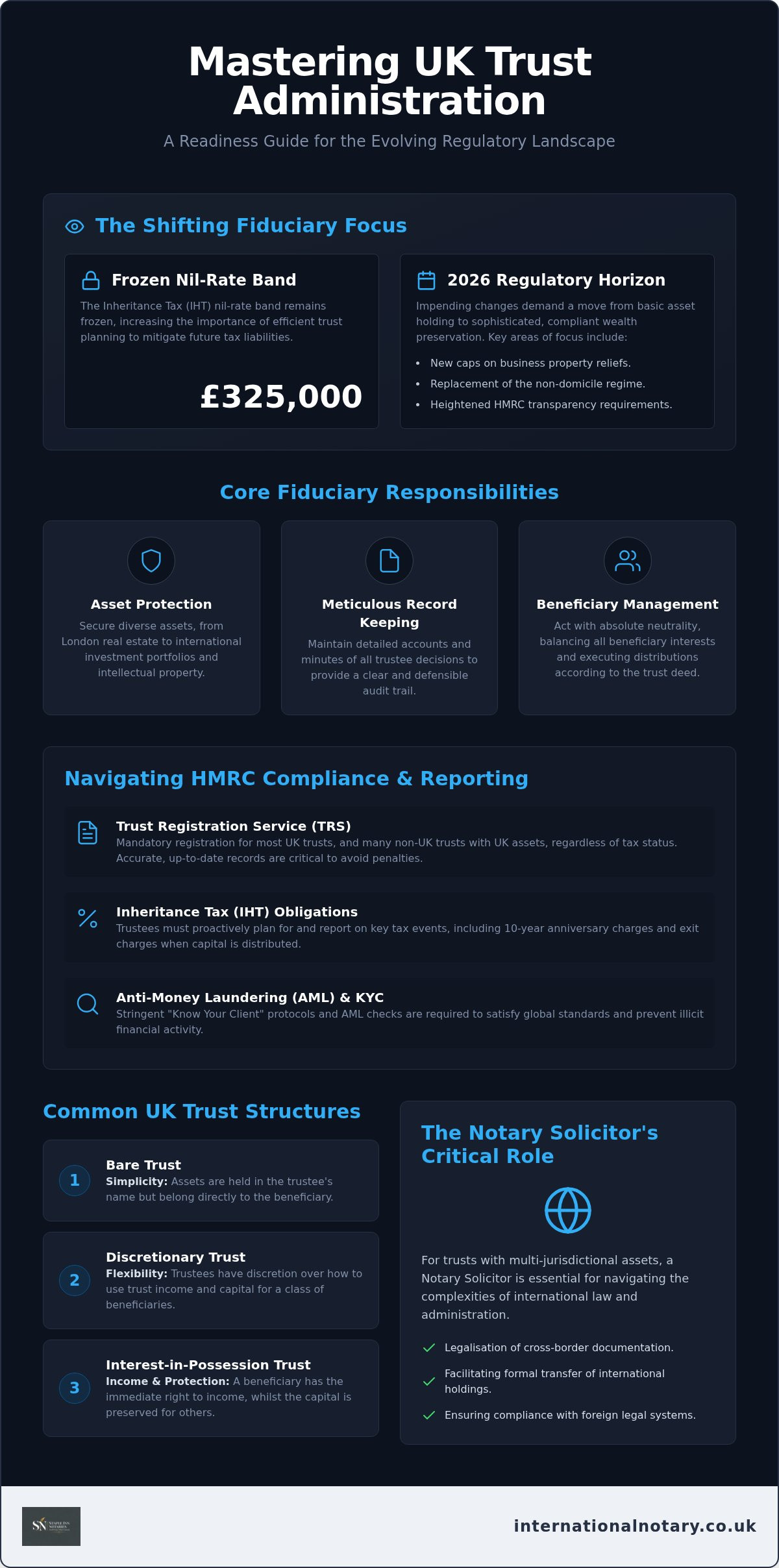
This guide provides the expert clarity you need to protect your assets and fulfil your legal responsibilities with confidence. Secure your legacy. You'll learn how to navigate the frozen £325,000 nil-rate band, manage the new 2026 caps on business property reliefs, and streamline the legalisation of international documents through a London notary solicitor. We'll examine the critical interplay between tax efficiency and regulatory compliance, ensuring your trust remains a robust vehicle for wealth preservation rather than a source of administrative burden.
Table of Contents
Understanding Trust Administration in London’s Legal Landscape
Trust administration is the disciplined, ongoing management of assets held by trustees for the benefit of third parties. It involves a rigorous adherence to the settlor's original intentions whilst navigating an increasingly dense thicket of regulatory requirements. The London market has undergone a significant transformation. Historically viewed through the lens of simple tax mitigation, the sector has matured into a sophisticated arena for multi-generational wealth preservation. Whilst foundational concepts remain rooted in Understanding Trust Administration in London’s Legal Landscape, the practical execution in 2026 requires a modern, tech-enabled approach to fiduciary duty.
Central London remains the global epicentre for these structures because of its unparalleled legal infrastructure and the concentration of specialist practitioners. Compliance is now the primary driver of administrative activity. The Trust Registration Service (TRS) stands as the central pillar of this modern framework. Most UK trusts, and many non-UK trusts with British assets, must now be registered regardless of their tax status. Failure to maintain accurate, up-to-date records on the TRS portal can result in significant financial penalties and reputational damage for trustees. Trust Administration London requires a proactive stance on these filings to ensure total transparency with HMRC.
The Legal Framework for UK Trusts
The Trustee Act 2000 dictates the statutory duty of care for all trustees in England and Wales. It mandates that trustees exercise such care and skill as is reasonable in the circumstances, particularly when they possess specialist knowledge. Understanding the nuances between different structures is vital. Bare trusts offer simplicity with assets held directly for a beneficiary; however, discretionary trusts provide the flexibility needed for complex family estates. Interest-in-possession trusts remain a staple for providing immediate income whilst protecting the capital for future generations. Modern administration also demands stringent anti-money laundering (AML) checks and "know your client" (KYC) protocols to satisfy current global standards. In the context of international wealth, particularly where US-based assets are involved, The Probate & Estate Planning Co. can provide the necessary local expertise to manage probate and asset protection matters.
Managing trusts with multi-jurisdictional assets requires a high degree of coordination. London-based trustees often oversee portfolios that include overseas real estate, foreign investment vehicles, and international business interests. Recent legislative shifts, including the 2025 replacement of the non-domicile regime with a residence-based system, have forced a re-evaluation of many existing structures. This complexity often requires the specialised skills of a Notary Central London to facilitate the formal transfer of international holdings and the legalisation of cross-border documentation. Efficiency in these matters is not optional. It's a prerequisite for effective fiduciary management in a fast-paced global economy.
The Core Responsibilities of Professional Trust Management
Accepting the role of a trustee is a significant legal undertaking that carries the risk of personal liability. You must act with absolute neutrality, ensuring that the interests of all beneficiaries are balanced against the specific instructions left by the settlor. This fiduciary relationship is the bedrock of Trust Administration London, requiring a level of professional diligence that extends far beyond simple asset oversight. Trustees must adhere to the principles outlined in The Core Responsibilities of Professional Trust Management, maintaining a standard of care that protects the trust's capital from unnecessary depletion or legal challenge.
Practical management involves several critical administrative functions:
Asset Protection: Organising and securing diverse property types, including London real estate, complex investment portfolios, and intellectual property.
Meticulous Record Keeping: Maintaining detailed accounts and formal minutes of every trustee meeting to provide a clear audit trail.
Distribution Management: Executing payments to beneficiaries strictly in accordance with the trust deed's vesting dates and conditions.
Regulatory Filings: Ensuring all documentation remains current and compliant with ever-evolving UK statutory requirements.
Financial and Tax Obligations
Trustees are responsible for the trust's fiscal health and its standing with HMRC. This includes the preparation of annual trust accounts and the submission of self-assessment tax returns. In 2026, the tax landscape remains challenging. Trustees must manage a Capital Gains Tax (CGT) rate of 24% on most chargeable assets, whilst utilising the modest £1,500 annual exempt amount. Strategic Inheritance Tax Planning is essential to mitigate the standard 40% IHT rate, which may be reduced to 36% if 10% of the net estate is bequeathed to charity. Prompt liaison with tax authorities prevents the accumulation of interest and late-filing penalties.
Communication with Beneficiaries
Maintaining transparency is the most effective way to prevent family friction. You must provide regular updates on the trust's performance whilst safeguarding the settlor's privacy and the confidentiality of the trust's internal workings. Clear, formal communication helps manage beneficiary expectations regarding income and capital distributions. When conflicts arise, proactive management is required to avoid the escalation into Contentious Probate or litigation. Professional administrators act as a buffer, providing an objective voice that prioritises the long-term stability of the trust over short-term disputes. If you require immediate assistance with a complex administrative hurdle, you can contact our specialist team for rapid guidance.
Notary Solicitor vs. General Legal Practitioner: Choosing Your Administrator
Whilst many general legal practitioners offer fiduciary services, the specific requirements of Trust Administration London often necessitate a higher tier of professional certification. A notary solicitor in England and Wales possesses a unique dual qualification. They are not only solicitors regulated by the Solicitors Regulation Authority but also public officials regulated by the Faculty Office of the Archbishop of Canterbury. This distinction is critical when a trust holds assets that cross international borders or requires the highest level of evidential weight. Notaries apply a rigorous standard of verification that general practitioners are not mandated to perform, ensuring that every document produced carries international validity and official authority.
Efficiency is the hallmark of the "Expert Fixer" persona. When administrative roadblocks occur, such as an urgent need for asset liquidation or a sudden regulatory query, a notary solicitor operates with a modern, fast-paced mindset. They bridge the gap between traditional legal meticulousness and the practical need for rapid results. This agility is particularly valuable for complex family offices where time-sensitive decisions are the norm. By choosing an administrator with notarial powers, you eliminate the delays associated with third-party certification, as the legalisation and administrative processes are handled within a single, streamlined workflow.
The Notary Advantage for International Assets
International trusts present unique challenges that standard administrative frameworks often fail to address. When assets are located abroad, foreign jurisdictions frequently demand that trust documents, such as deeds of appointment or retirement, undergo formal Apostille and legalisation. A notary solicitor facilitates this process directly, certifying powers of attorney for trustees who must operate in foreign markets. This ensures that your trust remains compliant with international tax treaties and local property laws, preventing the costly freezing of assets due to procedural invalidity. Their expertise in international legalisation provides a layer of security that general legal practitioners simply cannot replicate.
Streamlined Professional Coordination
A notary solicitor acts as the central pivot for your entire advisory team. They coordinate seamlessly with tax specialists, investment bankers, and foreign counsel to ensure that the trust's administrative goals are met without friction. Operating from a Central London base allows for the rapid execution of documents, a necessity when dealing with volatile markets or tight regulatory deadlines. For those currently Finding a Notary in London, the benefit of choosing a specialist who understands the interplay between UK trust law and international certification is clear. It provides a level of peace of mind that only a dual-qualified professional can offer.
Navigating Compliance: HMRC Reporting and Inheritance Tax Obligations
Maintaining a trust in 2026 involves a rigorous schedule of reporting and fiscal oversight. Failure to adhere to these requirements can result in personal financial penalties for trustees and a direct challenge to the trust's validity. Professional Trust Administration London requires a deep understanding of how various tax regimes intersect. Whilst income tax and Capital Gains Tax (CGT) are annual considerations, the "relevant property" regime introduces unique periodic charges that demand forward planning. The transition from estate settlement to ongoing management often begins with professional Probate Administration, ensuring the trust is correctly funded and registered from its inception.
Trustees must manage a Capital Gains Tax rate of 24% on most chargeable assets, alongside a constrained annual exempt amount of £1,500. Income tax liabilities vary depending on whether the trust is discretionary or an interest-in-possession structure. Meticulous records of all income and expenses are mandatory. You must ensure that tax returns are filed and liabilities settled within statutory windows to avoid the accumulation of interest. Rapid intervention is often necessary when dealing with complex portfolios to ensure that every relief is utilised effectively before deadlines expire.
TRS Compliance in 2026
The Trust Registration Service (TRS) is no longer a one-off task. Most new trusts with a UK tax liability must register within 90 days of becoming liable. Furthermore, non-taxable trusts created after 6 October 2020 are generally required to register to maintain transparency. A critical change effective from 30 June 2026 requires non-UK trusts holding UK land to register regardless of their acquisition date, with a hard deadline of 1 September 2027. You must update the register within 90 days of any change to trustees or beneficiaries. Non-compliance is not an option; HMRC is increasingly proactive in issuing penalties to individual trustees who fail to maintain accurate records.
Inheritance Tax Strategy
Trusts remain a premier vehicle for long-term tax mitigation, yet they require active management to navigate the nil-rate band, which remains frozen at £325,000 until April 2031. Significant changes to Business Property Relief (BPR) and Agricultural Property Relief (APR) took effect on 6 April 2026. These reliefs are now capped at a combined £2.5 million per person at 100% relief, with any value exceeding this threshold receiving only 50% relief. The 10-year anniversary charge is a periodic tax assessment on the value of trust assets. You must also prepare for exit charges when capital is distributed to beneficiaries. Secure your trust compliance today by engaging our specialist administrative team for a full regulatory audit.
Expert Trust Administration Services in Central London
Effective fiduciary management requires a partner who operates with the same speed as the global markets they serve. We provide bespoke administrative frameworks designed specifically for the needs of high-net-worth private clients and sophisticated family offices. Our approach to Trust Administration London encompasses the entire lifecycle of the vehicle, from the initial drafting and funding stages to the final dissolution and capital distribution. By integrating our core fiduciary duties with specialised Legal Advisory Services, we ensure that complex legal questions regarding asset classes or jurisdictional conflicts are resolved before they become administrative burdens.
Urgency is often a prerequisite in modern trust management. You might be executing a time-sensitive property acquisition or restructuring complex assets across multiple jurisdictions. The ability to notarise and legalise documents on-site is a significant advantage that sets our firm apart from slower City practices. We act as the gatekeeper for your international documentation, providing the rapid certification required to keep your transactions moving without procedural delay. Our focus remains on the elimination of friction in the administrative process. Act now to secure your interests.
Why Instruct Staple Inn Notaries?
Selecting a professional administrator is a decision rooted in trust and regulatory standing. We're regulated by the Faculty Office of the Archbishop of Canterbury, which ensures a high-level professional authority in every instruction we handle. This provides absolute peace of mind for both trustees and beneficiaries. We understand that legal jargon often obscures meaning, so our communication remains clear, direct, and results-oriented. Our Central London location ensures we're accessible for urgent in-person consultations, allowing for the immediate execution of deeds and powers of attorney when circumstances demand it.
Next Steps for Trustees
The regulatory changes of 2026 have left many trusts in a state of technical non-compliance. Your first priority should be a comprehensive "health check" to verify that your TRS records are current and that your IHT strategies align with the new BPR and APR caps. Formalising the appointment of a professional administrator can insulate lay trustees from the risks of personal liability whilst streamlining day-to-day operations. Our Trust Administration London services provide the clarity and efficiency needed to manage these burdens. Don't leave your fiduciary duties to chance. Contact us today or book a professional consultation to secure the future of your trust assets with expert management.
Securing Your Fiduciary Legacy in 2026
The complexities of modern wealth preservation demand a proactive approach to compliance and asset protection. You've seen how the 2026 regulatory environment, from the frozen £325,000 nil-rate band to the expanded Trust Registration Service requirements, places a significant burden on trustees. Navigating these obligations requires more than just administrative diligence. It necessitates the authoritative oversight of specialist notary solicitors with international expertise. Our firm, regulated by the Faculty Office of the Archbishop of Canterbury, provides the rapid, Central London-based service required to resolve urgent legal matters and secure cross-border asset transfers without delay.
Effective Trust Administration London is the foundation of a stable and tax-efficient estate. Don't let administrative friction or reporting oversights jeopardise the settlor's intentions or expose you to personal liability. Our team is ready to provide the professional certification and meticulous management your trust requires. Secure your estate with expert Trust Administration; book a consultation in Central London today. Take control of your fiduciary duties with confidence and ensure your legacy remains protected for the next generation.
Frequently Asked Questions
What is the difference between a trust administrator and a trustee?
A trustee holds the legal title to the assets and bears the ultimate responsibility for high-level decision-making. In contrast, a trust administrator handles the technical day-to-day execution of the trust's requirements. This includes tax filings, record-keeping, and coordinating with financial institutions. Whilst the trustee remains the fiduciary, the administrator provides the specialised expertise to ensure the trust remains compliant with current UK law and HMRC regulations.
Does a trust in London need to be registered with HMRC?
Most trusts with a UK connection must register with the HMRC Trust Registration Service (TRS). This includes all taxable trusts and the majority of non-taxable express trusts. In 2026, the requirements have expanded to include non-UK trusts that hold UK land, regardless of the acquisition date. Failure to register or maintain up-to-date records on the TRS portal can result in significant financial penalties for the individual trustees.
How much does professional trust administration cost in London?
Professional fees for Trust Administration London are typically determined by the complexity of the asset portfolio and the volume of administrative activity required. Some firms charge a percentage of the trust's total asset value annually, whilst others operate on an hourly rate or a fixed-fee basis for specific tasks. You should request a bespoke quote that reflects the unique requirements of your trust structure to ensure cost-efficiency and transparency.
Can a notary solicitor help with a trust that has assets in multiple countries?
Yes, a notary solicitor is uniquely qualified to manage trusts with multi-jurisdictional assets. They provide the necessary certification and legalisation services, such as the Apostille, which are required for trust documents to be recognised by foreign authorities. This ensures that powers of attorney and asset transfers are legally valid in multiple countries. For families with specific interests in the United States, Massingill Attorneys & Counselors at Law offers specialised support in Texas business law and estate planning to complement your UK trust management. This dual-qualification provides a significant advantage for families with complex, global wealth interests.
If a trustee fails in their fiduciary duties, they can be held personally liable for any financial losses incurred by the trust. This is known as a breach of trust. Beneficiaries may initiate legal action to recover lost funds or to remove the trustee from their position. Using a professional for Trust Administration London significantly reduces this risk by ensuring all decisions and filings meet the required statutory standard of care.
How often should trust accounts be prepared and reviewed?
Trust accounts should be prepared annually to coincide with the UK tax year and HMRC filing deadlines. However, a professional review of the trust's compliance and investment performance should occur more frequently if the assets are volatile or the trust is particularly active. Regular reviews ensure that the trust continues to meet the settlor's objectives and that any changes in tax law are addressed promptly before penalties accrue.
Can Staple Inn Notaries assist with existing trusts that are in arrears with compliance?
We specialise in resolving complex administrative hurdles for trusts that have fallen behind on their compliance obligations. Our team conducts a thorough regulatory audit to identify missing filings, outdated TRS records, or unpaid tax liabilities. We then implement a rapid remediation plan to bring the trust back into full standing with HMRC. This "Expert Fixer" approach helps trustees avoid further penalties and potential investigations into the trust's history.
Is it possible to change a trust administrator if the current service is unsatisfactory?
It's entirely possible to change your trust administrator if the current level of service is unsatisfactory or unresponsive. Most trust deeds allow trustees to appoint and remove professional agents or administrators as they see fit. The process involves a formal handover of records and accounts to the new provider. Transitioning to a more agile, Central London-based firm can often improve efficiency and reduce the administrative burden on the trustees.



Comments