
Statutory Declaration: The 2026 Professional Guide to Legal Declarations in the UK

Updated: Sep 10
A single error in the formal wording of a statutory declaration can render a vital international document entirely worthless. It's understandable why many professionals and private individuals feel a sense of controlled urgency when faced with strict deadlines, especially when the distinction between an affidavit and a statutory declaration remains a source of frequent confusion. You likely require a document that's not only legally compliant but also immediately accepted by domestic or foreign authorities without the risk of procedural rejection.
This professional guide ensures you master the precise legal requirements and procedural formalities governed by the Statutory Declarations Act 1835. By following this expert guidance from Central London notaries, you'll gain a clear understanding of the legal penalties for false statements and the exact criteria for authorised witnessing. We'll examine the specific roles of commissioners for oaths and notaries public, whilst outlining the critical steps for achieving international validity through apostille services. From understanding statutory fees to booking an efficient witnessing officer, this 2026 guide provides the technical clarity needed to secure your legal documentation with absolute confidence.
Table of Contents
Defining the Statutory Declaration: Legal Standing and Purpose
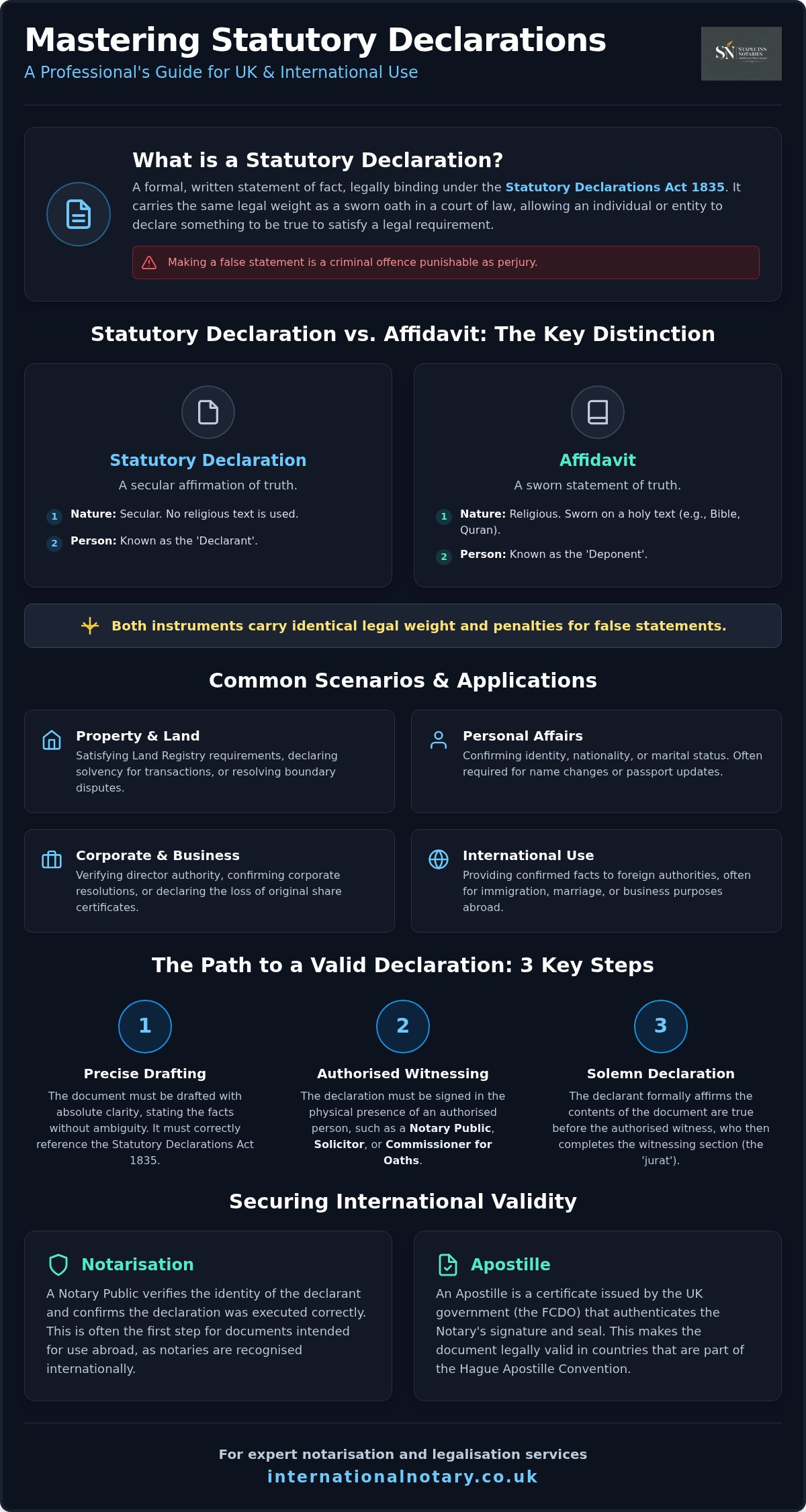
A statutory declaration is a formal statement of fact made under the Statutory Declarations Act 1835. It's not a mere administrative formality. Unlike a simple statement of truth found in standard witness statements, it carries the full weight of a sworn oath in a court of law. This document is a written statement of fact that is signed in the presence of an authorised witness. It allows an individual or corporate entity to declare something to be true for the purpose of satisfying a specific legal requirement or regulation. When you sign this document, you're making a solemn assertion that is legally binding and carries significant consequences if found to be fraudulent.
The Statutory Declarations Act 1835
This legislation remains the primary governing framework for declarations in the UK, even in 2026. Its longevity is a testament to the robust procedural standards it established nearly two centuries ago. Historically, the Act marked a critical evolution in the British legal system by facilitating a transition from mandatory religious oaths to secular declarations. This shift ensured that the legal process was accessible to all individuals, regardless of their religious beliefs, whilst maintaining the solemnity required for official testimony. It's considered the gold standard because it provides a uniform, universally recognised structure that domestic and international authorities trust implicitly. The Act ensures that the gravity of the declaration is understood by the declarant, as any false statement is punishable as perjury.
When is a Statutory Declaration Required?
You'll typically encounter a requirement for this document when primary evidence is absent or where a higher level of personal accountability is demanded by a third party. Regulatory bodies and financial institutions often require them to bridge evidentiary gaps. For instance, they're essential when confirming the loss of original share certificates or declaring solvency during high-stakes property transactions. In Central London's fast-paced commercial environment, they're frequently used to resolve administrative hurdles in the following scenarios:
Satisfying land registry requirements regarding rights of way or boundary disputes.
Confirming identity, nationality, or marital status for individuals moving or marrying abroad.
Verifying corporate resolutions and the authority of directors for international trade.
Correcting discrepancies in official records where standard amendments aren't permitted.
For those managing complex international requirements, our legal advisory services provide the necessary technical oversight to ensure your documentation meets the exact standards of the receiving jurisdiction. Precision is vital; a declaration that fails to reference the 1835 Act correctly or lacks the proper witnessing credentials will be rejected, causing costly delays to your timeline.
Statutory Declarations vs. Affidavits: Key Distinctions
The primary distinction between these two legal instruments lies in the religious or secular nature of the confirmation. An affidavit is a sworn statement, necessitating the use of a religious text such as the Bible, Quran, or Torah. Conversely, a statutory declaration is a secular affirmation, specifically designed for those who prefer not to take a religious oath or where the legal framework mandates a secular statement. Despite this difference in delivery, both instruments carry identical legal weight. Under the Perjury Act 1911, making a false statement in either document results in the same criminal penalties as giving false evidence in court. Identifying which instrument is requested by the receiving authority is critical for ensuring the document's validity and immediate acceptance.
The Deponent vs. The Declarant
Terminology dictates the formal structure of these documents. An individual swearing an affidavit is referred to as a deponent, whereas the person making a statutory declaration is known as a declarant. This linguistic precision is not merely academic; it determines the specific preamble and jurat required for the document to be legally sound. A notary solicitor ensures the correct format is utilised from the outset, preventing administrative rejections that occur when these terms are used interchangeably. Using incorrect terminology can lead a foreign court or a domestic registrar to question the authenticity of the entire certification, causing unnecessary delays.
Choosing the Correct Instrument
Determining whether you need an affidavit or a declaration depends heavily on the requirements of the receiving party. Domestic UK matters, such as formal name changes or tenancy deposit disputes, frequently mandate the use of a declaration under the Statutory Declarations Act 1835. However, international jurisdictions often show a preference for affidavits, especially in litigation or probate matters involving US or Commonwealth courts. You must consult with the receiving authority before drafting to avoid procedural rejection. For instance, whilst a declaration is the standard for name changes in the UK, a foreign bank might insist on a sworn affidavit to update their records. If you're uncertain about the specific requirements for your situation, you can speak with our team to clarify the necessary format for your intended destination. This proactive approach eliminates the risk of documents being returned due to technical non-compliance.
Common Scenarios for Declarations in Central London
In the heart of London's legal and financial districts, the requirement for a statutory declaration often arises with immediate urgency. These documents serve as the primary mechanism for establishing facts when official certifications are unavailable or where a formal, legally binding statement is mandated by a specific authority. Whether you're an individual navigating personal administrative changes or a corporate entity expanding into foreign markets, the procedural precision required by the Statutory Declarations Act 1835 remains the definitive standard for legal validity. Accuracy prevents delays.
Private Client Applications
Private individuals frequently require declarations to facilitate life-altering transitions. A common application involves formal name changes, where the declarant confirms their new identity to satisfy the requirements of HM Passport Office or financial institutions. In immigration matters, declarations of identity or relationship status are often essential for visa applications where primary documentation from a home country is unattainable. For Israeli citizens living in the UK, this process is similarly crucial for הסדרת מעמד בני מהגרים בצה"ל, ensuring legal clarity regarding military service obligations. These instruments are also vital for correcting public records, such as birth or death certificates, where a formal statement of the correct facts must be lodged with the Registrar General. For those dealing with estate matters, a declaration is often required for Probate Administration London to confirm facts when original testamentary documents are missing or damaged. Finally, individuals planning overseas nuptials require a declaration of freedom to marry, satisfying foreign authorities that no legal impediment exists to their intended union.
For businesses operating within Central London, these documents are indispensable for maintaining regulatory compliance and facilitating international trade. Directors often make a statutory declaration regarding corporate powers of attorney to confirm the company's authority to execute deeds or contracts in foreign jurisdictions. Financial institutions may demand a declaration of solvency during corporate restructuring or to confirm the loss of share certificates before issuing replacements. Corporate resolutions must also be certified through these instruments when establishing international branch openings, providing foreign registries with authenticated facts about the company's standing. Export-focused companies also utilise these instruments to declare the origin of goods or to satisfy intellectual property registries when protecting brand assets abroad. Procedural compliance is non-negotiable.
The Procedure: Drafting and Formal Execution
Ensuring your business remains fully compliant across all administrative fronts is vital. For organisations requiring expert guidance on employment law and personnel management, you can learn more about Altum HR to discover how their outsourced support can protect your commercial interests.
The formal execution of a statutory declaration follows a rigid procedural sequence designed to ensure the document's legal integrity. Precision during the drafting phase is non-negotiable; any ambiguity in the factual statements can lead to immediate rejection by the receiving authority. The process moves through four critical stages:
Step 1: Drafting. Construct the declaration using clear, first-person language. Every factual assertion must be verifiable and precise.
Step 2: Selection of Witness. Identify an authorised witness. While solicitors often handle domestic matters, a Notary Public is essential for documents intended for international use.
Step 3: The Signing Ceremony. You must appear in person before the witness. Although remote witnessing gained some traction recently, physical presence remains the definitive requirement for most high-stakes legal and international certifications.
Step 4: Completion of the Jurat. The witness completes the attestation clause, known as the jurat, and affixes their official seal and signature to verify the execution.
The Prescribed Wording
The Statutory Declarations Act 1835 mandates a specific form of words that must be included for the document to be valid. It is a common error to use standard witness statement phrasing, which lacks the necessary legal weight. The declaration must begin with the mandatory preamble: "I, [Full Name], of [Address], do solemnly and sincerely declare that...". This specific wording signals the declarant's awareness of the document's gravity. Furthermore, the instrument must conclude with a precise closing statement referencing the Act: "And I make this solemn declaration conscientiously believing the same to be true, and by virtue of the provisions of the Statutory Declarations Act 1835." Deviating from this prescribed terminology can render the document void, as it fails to trigger the legal protections and penalties associated with the Act.
Authorised Witnesses in London
In London's complex legal landscape, the choice of witness depends entirely on the document's final destination. A Notary Public performs a more rigorous set of checks than a standard commissioner for oaths, verifying not only your identity but also your legal capacity and understanding of the document's contents. For time-sensitive corporate matters where directors cannot leave the office, a Mobile Notary London is essential for providing on-site, urgent certification. The notary’s official seal and signature are recognised globally, providing the necessary authentication for foreign government departments and financial institutions. This high level of scrutiny ensures that the statutory declaration carries the requisite authority for international recognition. For immediate assistance with your documentation, contact our Central London office to arrange a witnessing appointment.
International Validity: Notarisation and Apostille Requirements
A domestic statutory declaration, whilst legally binding within the United Kingdom, is rarely sufficient on its own for use in foreign jurisdictions. International authorities require a higher level of assurance regarding the authenticity of the signature and the legal capacity of the declarant. This is where notarisation serves as the foundational level of authentication. A Notary Public holds a globally recognised commission that allows their seal to be trusted by foreign courts, banks, and government registries. Without this professional certification, your document risks being dismissed as a mere private statement rather than a verified legal instrument. Precision is paramount.
For countries that are signatories to the Hague Apostille Convention, the document must also undergo verification by the Foreign, Commonwealth & Development Office (FCDO). This process confirms the authenticity of the notary's signature and seal. In contrast, non-Hague Convention countries often demand a further stage of consular legalisation, involving submission to the relevant embassy or high commission in London. This multi-layered "chain of trust" ensures that every official who has handled the document is properly authorised, providing the receiving party with absolute certainty regarding its provenance. Deadlines don't wait.
The Legalisation Journey
Navigating the transition from a signed document to a legally valid international instrument requires meticulous planning. You must first determine if your destination country requires an apostille for power of attorney or a specific declaration. Timeframes are a critical consideration; the FCDO offers both standard and urgent legalisation routes. Standard processing can take several working days, whilst urgent requirements may necessitate a more rapid turnaround through specialised channels. Staple Inn Notaries manages the entire process, providing a streamlined solution that encompasses everything from the initial apostille application to final embassy submission. We eliminate procedural friction.
Ensuring Acceptance Abroad
Technical compliance extends beyond the signature and seal. If you are submitting a statutory declaration to a non-English speaking country, professional translation is frequently a mandatory requirement. The notary’s signature is the lynchpin in this international process, bridging the gap between UK law and foreign regulatory expectations. It is vital to confirm these details early in the process to prevent the document from being rejected upon arrival. You should contact us directly to verify the specific requirements for your intended destination. Our expertise ensures that every aspect of the legalisation journey is handled with the precision and speed your international interests demand. Act now.
Securing Your Documentation for International Acceptance
Executing a legally sound statutory declaration requires more than just a signature; it demands meticulous adherence to the Statutory Declarations Act 1835 and a clear strategy for international legalisation. You've learned that the distinction between secular declarations and religious affidavits is critical for procedural validity, whilst notarisation and apostille certification remain the lynchpins of global document acceptance. Precision in drafting prevents costly administrative rejections that can derail urgent personal or corporate timelines. We bridge the gap between complex regulation and your immediate operational needs.
Staple Inn Notaries operates as your trusted gatekeeper in Central London. Regulated by the Faculty Office of the Archbishop of Canterbury, we provide both office-based and mobile notary services to meet your specific needs with professional authority and speed. Our specialised expertise in international legalisation ensures your documents are ready for any jurisdiction. Don't let procedural delays hinder your progress. Book a Notary Appointment for Your Statutory Declaration today to ensure your facts are certified with absolute technical accuracy. Your documentation is in safe hands.
Frequently Asked Questions
Can I write my own statutory declaration?
You are permitted to draft your own statutory declaration, provided it strictly adheres to the prescribed wording mandated by the Statutory Declarations Act 1835. However, technical errors in the preamble or the jurat often result in the document being rejected by receiving authorities. Most clients find it more efficient to use a professional template or have a specialist ensure the factual statements are clear and the legal references are accurate before the witnessing appointment.
Who is authorised to witness a statutory declaration in the UK?
Authorised witnesses include solicitors, notaries public, commissioners for oaths, and justices of the peace. In Central London, most professionals choose a Notary Public for matters involving international jurisdictions to ensure the document is accepted abroad. It is a legal requirement that the witness is independent and not involved in the matter described in the declaration. Our mobile notary service offers a rapid solution for corporate directors who cannot leave their offices for a witnessing appointment.
What is the penalty for making a false statutory declaration?
Making a false declaration is a serious criminal offence under the Perjury Act 1911. Because a statutory declaration carries the same legal weight as a sworn oath in court, providing intentionally misleading information can lead to a fine, a criminal record, or imprisonment. The witness's role is to ensure you understand the gravity of the statement you are signing. You must be certain that every factual assertion is entirely accurate before the execution ceremony begins.
How long does a statutory declaration remain valid?
There is no fixed legal expiry date for a statutory declaration under UK law, but its practical validity is determined by the receiving authority. Most financial institutions, registries, and foreign government departments require the document to have been witnessed within the last three to six months. If your declaration is intended for use in an international transaction, you should verify the specific "freshness" requirements of the destination country to avoid the need for a costly re-execution.
Do I need a solicitor or a notary for a statutory declaration?
The choice depends on where the document will be used. A solicitor or commissioner for oaths is typically sufficient for domestic UK matters, such as tenancy disputes or small estate claims. However, if the document is intended for use overseas, you must use a Notary Public. Notaries hold an internationally recognised commission, and their seal is often a prerequisite for obtaining an apostille from the Foreign, Commonwealth & Development Office for use in foreign jurisdictions.
Can a statutory declaration be signed electronically in 2026?
Physical presence remains the primary legal requirement for the execution of a statutory declaration in 2026. While electronic signatures are widely accepted for standard contracts, the Statutory Declarations Act 1835 requires the declarant to appear in the physical presence of the authorised witness. Some specific domestic processes have moved toward digital alternatives, but for most high-stakes legal and international matters, a "wet ink" signature in the presence of a notary or solicitor is still mandatory for validity.
What is the difference between a statutory declaration and a statement of truth?
A statement of truth is a specific declaration used within the UK court system under the Civil Procedure Rules to verify witness statements or pleadings. In contrast, a statutory declaration is a standalone legal instrument governed by the 1835 Act, used for non-contentious administrative or commercial purposes. While both carry penalties for dishonesty, the statutory declaration is the correct format for satisfying regulatory requirements outside of active litigation, such as confirming identity or solvency for a bank.
Is a statutory declaration the same as a deed poll for changing a name?
They are distinct legal instruments, though both can facilitate a name change. A deed poll is a specialised deed used specifically to renounce a former name and adopt a new one for all purposes. A statutory declaration is a more general statement of fact that can be used to confirm a name change to specific authorities, such as the Passport Office. Many organisations accept both, but a deed poll is the standard requirement for a permanent, comprehensive change of identity in the UK.



Comments