
Resolving Family Disputes Over Inheritance in London: A Practical Guide

What if the fairest first move is not to challenge the will, but to establish what the documents and decisions actually show? If you are resolving family disputes over inheritance London, uncertainty about a will, estate records or an executor’s actions can make even a careful conversation feel risky.
It’s understandable to worry that raising concerns could deepen the disagreement. Early fact-finding and structured dialogue can help prevent positions from becoming entrenched, without requiring you to rush into formal proceedings. Start by identifying the issue clearly, preserving relevant evidence and considering possible routes in proportion to the dispute.
This guide explains how to clarify an inheritance disagreement, which records may help and how discussion, negotiation, mediation and formal legal processes compare. It also covers when to seek specialist advice and what to prepare for an initial discussion, so you can assess your next steps with greater confidence and less risk of escalating family tensions unnecessarily.
Table of Contents
Resolving an inheritance dispute in London starts with identifying the issue
Gather the will, estate records and facts before discussing solutions
Compare discussion, negotiation, mediation and formal probate dispute routes
Follow a measured process to discuss the dispute and protect your position
Choose informed next steps for an inheritance dispute in London
Resolving an inheritance dispute in London starts with identifying the issue
Uncertainty about an estate can put pressure on family relationships and make decisions harder to take calmly. Before approaching relatives or challenging an executor’s decision, identify exactly what is disputed. An inheritance dispute may concern the validity or meaning of a will, how an estate or trust is being administered, or who is entitled to benefit. For families resolving family disputes over inheritance London, making this distinction is a useful first step because different issues call for different evidence and legal assessment.
A challenge to a will’s validity is not the same as a disagreement about its interpretation. A validity challenge questions whether the will should be treated as legally effective; an interpretation dispute asks what a provision means. An administration concern, by contrast, focuses on how the executor is handling the estate. Feeling that an outcome is unfair does not, by itself, establish a legal claim. Whether there are grounds to act depends on the circumstances and the relevant legal tests, so avoid drawing conclusions from dissatisfaction alone.
Some disputes may involve a claim under the Inheritance (Provision for Family and Dependants) Act 1975, which allows certain family members and dependants to seek financial provision from an estate in England and Wales. Whether a person is eligible, and whether a claim may succeed, depends on the facts and legal assessment.
Which inheritance disagreements may need attention?
Concerns can relate to whether a will is valid, how a clause should be understood, an executor’s conduct, what assets belong to the estate, or the administration of a trust. First consider whether the issue might be a factual misunderstanding, such as incomplete information about an asset or a decision already explained in estate correspondence. If the documents do not resolve the concern, specialist advice can help assess whether it raises a legal issue. Eligibility and grounds vary according to the circumstances.
What should London families clarify first?
Set out the essentials before considering a response:
Who died, and which will or later document is relevant?
Who is acting as executor or trustee, and what stage has administration reached?
Which family members are involved, and what specific decision, asset or provision is disputed?
Keep the description factual: “We don’t understand why the property is being sold” is more useful initially than an accusation about motive. Being based in Central London does not, by itself, determine which legal rules apply. This guide concerns England and Wales; succession rules may differ in Scotland and Northern Ireland. Establish the relevant jurisdiction before relying on a legal assumption.
Gather the will, estate records and facts before discussing solutions
Once you have identified the concern, assemble the relevant documents before approaching relatives or proposing a resolution. A clear record can reveal whether the disagreement turns on what the will says, what the executor has done or information that is still missing. It also helps keep discussion focused on evidence rather than assumption, an important first step for families resolving inheritance disputes in London.
Which documents can help clarify an inheritance dispute?
Gather what is available and relevant. This may include:
The current will and any codicils, which amend or supplement it.
Grant of probate or letters of administration details, if issued.
Estate accounts, asset information and correspondence from the executor or administrator.
Relevant communications about the will, the estate or a trust.
Medical or financial records may matter in a dispute about capacity, influence or transactions, but they are not automatically relevant to every disagreement. Nor does every family member necessarily have an automatic right to every record. Get advice before requesting or circulating sensitive material. If you need background on how wills are structured, consult guidance on will writing; if inheritance tax is central, distinguish the tax question from the dispute about entitlement or administration.
How can you organise the facts without escalating matters?
Create a dated chronology of decisions, conversations and estate-administration events. For each entry, identify the source: distinguish what you witnessed or received directly from what another person reported. Mark anything you cannot verify as an open question, not a fact. Keep original documents safe, work from copies and share them securely only with people who need them. Avoid forwarding private records broadly within the family.
Then separate your notes into three categories: confirmed facts, unanswered questions and assumptions. For example, a letter confirming that a property is to be sold is a fact; why the executor chose that course may remain unanswered. Record the practical outcome you seek, such as an explanation, access to specific information or reconsideration of a decision. A precise request is easier to discuss than a general accusation.
If a grant has not yet been issued and you are considering steps to prevent one being made, GOV.UK explains how to stop a probate application by entering a caveat. Understand the implications before acting. Specialist advice can help you assess the documents and proportionate next steps. You can discuss inheritance dispute advice with the team at Staple Inn Notaries in Central London.
Compare discussion, negotiation, mediation and formal probate dispute routes
Seeking legal advice does not automatically mean your family must go to court. Advice can help establish what the documents and circumstances indicate, identify procedural considerations and assess whether a proportionate step may resolve the issue. The right route depends on the dispute, the parties’ ability to communicate and the outcome sought. No process can guarantee settlement or a particular result.
When might discussion or negotiation be a useful first step?
If relatives can communicate safely, a focused conversation may help resolve a factual question, such as why an estate asset is being sold. Keep it respectful and specific. Where positions differ, independent legal advice can clarify a proposed settlement before anyone accepts or rejects it. Do not feel obliged to make contact first if you are concerned about intimidation, a serious power imbalance or a time-sensitive issue. Seek advice on your position and options.
What should families understand about mediation and formal action?
Mediation is a facilitated discussion, not a judicial decision. It may help parties explore agreement, but it is not suitable for every dispute and does not replace advice about legal rights. If discussion or negotiation does not resolve the issue, formal steps may merit consideration. Specialist contentious probate advice can assess that possibility and explain the available options. Staple Inn Notaries provides contentious probate support. For families resolving family disputes over inheritance London, choose a route after assessing the facts, rather than assuming that seeking advice means going to court.
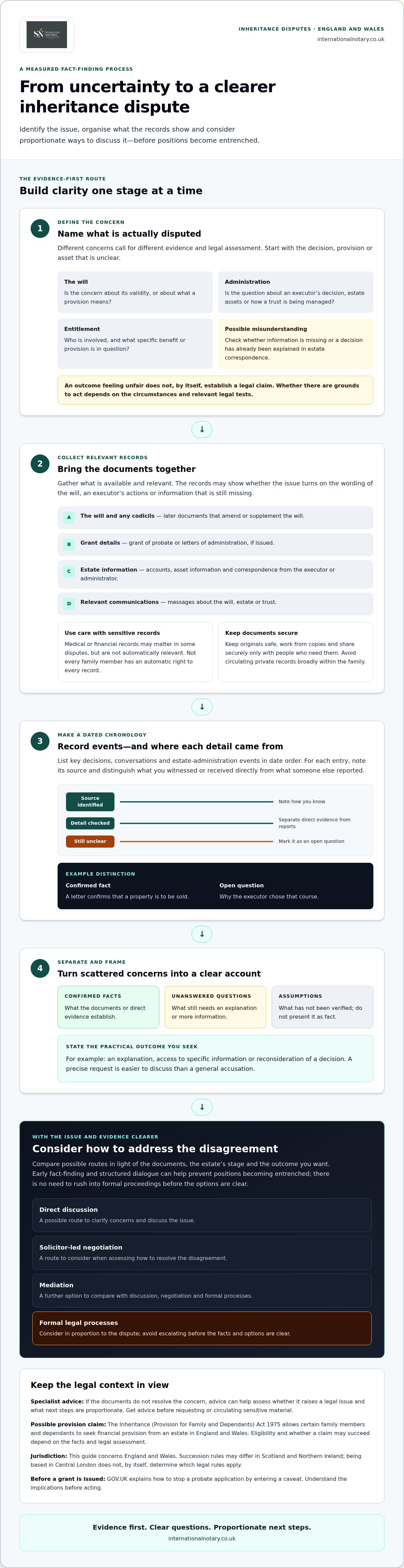
Follow a measured process to discuss the dispute and protect your position
A clear sequence can help keep an inheritance disagreement manageable and prevent important issues from being lost in tense exchanges. For families resolving family disputes over inheritance London, the aim is to establish the concern, communicate accurately and understand the available options before taking a step that may affect the estate or family relationships.
Use this practical sequence:
Record the issue. State what decision, will provision or action is disputed, without assuming another person’s motive.
Organise the relevant evidence. Keep key documents and a dated chronology together, noting what is confirmed and what remains unclear.
Identify the outcome sought. Be specific: you may need an explanation, information, or reconsideration of a decision.
Obtain advice where needed. A specialist can help assess the issue and explain proportionate next steps before you approach relatives or make a proposal.
Keep a record of important communications, including dates, what was requested and any response. Use neutral wording and avoid accusations. If estate assets may be distributed or you think a legal deadline could apply, seek specialist guidance promptly. The urgency and steps available depend on the case; do not assume that starting a discussion will pause estate administration or preserve a deadline.
How can relatives prepare for a constructive conversation?
Agree a clear purpose and share relevant questions in advance, so the discussion stays focused on the disputed issue rather than wider family grievances. A neutral facilitator may help where appropriate, but participation should be voluntary. Afterward, record any proposed actions and who will take them. Treat those notes as a record of discussion, not as proof that a legally binding settlement has been made.
When should you seek specialist advice in London?
Seek advice promptly if the concern involves a will’s validity, executor conduct, entitlement or a possible distribution of estate assets. Prepare a concise chronology, the key documents and a realistic account of the outcome you want. Specialist contentious probate advice can help clarify the issues and assess options without assuming that formal proceedings are inevitable. Explore legal advisory services for guidance tailored to your circumstances.
For advice about your situation, discuss your inheritance dispute with the team.
Choose informed next steps for an inheritance dispute in London
There is no single route that suits every family disagreement. A measured decision path is to understand the issue, organise the relevant evidence, compare ways to address it and obtain specialist advice where needed. The appropriate next step depends on the nature of the dispute, the documents available, the stage of estate administration and what you hope to achieve. For families resolving family disputes over inheritance London, careful assessment can help avoid escalating matters before the options are clear.
What should you prepare before requesting advice?
A concise, organised summary makes it easier to focus an initial discussion. Bring or outline:
A short chronology of key events, decisions and communications.
The will and any codicils, relevant probate documents, estate correspondence or other records you have.
A precise description of the disputed provision, decision, asset or entitlement.
Any known estate-administration activity, such as a proposed sale or distribution, and any deadline you believe may apply.
A practical description of what resolution might look like for you and, if known, the other parties.
Distinguish confirmed information from questions or assumptions. If you are unsure whether a date is legally significant, say so rather than treating it as a deadline. The timing and effect of estate activity depend on the circumstances, so an adviser can assess the relevant facts rather than relying on a general assumption.
How can specialist contentious probate support help?
Specialist advice can help clarify whether the concern relates to a will, estate administration, a trust or a person’s entitlement, then assess the options that fit the circumstances. It can also help you consider whether discussion, negotiation, mediation or a formal step is proportionate. This is advice on your position and available routes, not a promise that the dispute will be resolved or that a particular outcome will follow.
Staple Inn Notaries provides private-client support with contentious probate and will disputes. Its specialist lawyers are regulated by the Faculty Office of the Archbishop of Canterbury. The firm’s contentious probate support helps clients understand the issues and consider appropriate next steps.
Take the next step with a clear summary of the issue and the documents available. Contact the team about your inheritance dispute to discuss your circumstances and relevant next steps.
Take a clear, proportionate next step
Inheritance disagreements can feel difficult to address, particularly when family relationships and decisions about property or other assets are involved. Start by identifying the precise issue, gathering the relevant will and estate records, and separating established facts from unanswered questions. Then compare discussion, negotiation, mediation and formal routes in light of the estate’s circumstances and the outcome you seek.
For families resolving family disputes over inheritance London, specialist advice can help clarify the nature of the disagreement and assess proportionate options. Seeking advice does not automatically mean going to court, and no route can guarantee a particular outcome. The right next step depends on the evidence, the stage of administration and any urgency that may apply.
Staple Inn Notaries provides private-client support with probate administration and contentious probate. Its specialist lawyers are regulated by the Faculty Office of the Archbishop of Canterbury. Prepare a concise chronology and the key documents, then request guidance on your inheritance dispute.
A careful, informed first step can help you address the issue with greater clarity and avoid escalating matters unnecessarily.
Frequently Asked Questions
Do inheritance disputes in England and Wales have to go to court?
No. Families may resolve some disagreements through direct discussion, negotiation or mediation, without asking a court to determine the issue. Specialist advice can help clarify the legal position and assess which route may be proportionate; seeking advice does not commit you to court proceedings. If the parties cannot resolve a dispute, or a formal decision is needed, a court process may be considered. The appropriate route depends on the facts and the issue in dispute.
Can family members use mediation to resolve an inheritance dispute?
Yes. Mediation can provide a structured discussion led by a neutral mediator, giving family members an opportunity to explore possible agreement. It is not a judicial decision, and the mediator does not determine legal rights or guarantee settlement. Participation should be voluntary, and mediation may not suit every dispute, particularly where communication feels unsafe or a formal determination may be needed. Consider obtaining independent legal advice about your rights and options before agreeing to proposals.
What documents should I gather for an inheritance dispute?
Collect the will and any codicils, grant details or other probate documents, relevant estate accounts, and correspondence about the disputed decision or provision. A dated chronology can help show what happened and when. Include medical or financial records only if they relate to the issue, such as a concern about capacity or a transaction, and seek advice before requesting or sharing sensitive material. Not every relative automatically has a right to every estate record.
Can I challenge a will because I believe the inheritance is unfair?
Feeling that a will is unfair does not, by itself, establish grounds to challenge its validity. A validity challenge usually concerns a specific legal issue, while other concerns may relate to interpretation, administration or a possible claim for financial provision. Eligibility and legal tests depend on the circumstances. Identify what you believe is wrong, gather relevant information and seek specialist advice before taking action, as delay may affect the evidence or options available.
Can an executor distribute an estate while family members disagree?
A family disagreement does not automatically stop an executor from administering or distributing an estate. Whether distribution can proceed depends on the nature of the dispute, the estate’s stage and any relevant legal steps already taken. If you are concerned that assets may be distributed before your issue is assessed, seek prompt advice rather than assuming administration is paused. Explain the specific concern and provide relevant documents so the position and possible steps can be considered.
How long does it take to resolve an inheritance dispute in London?
There is no standard timescale. A disagreement resolved through discussion or negotiation may take less time than a complex dispute requiring formal proceedings, but the parties, evidence, estate stage and issues involved all affect progress. For families resolving family disputes over inheritance London, focus first on clarifying the issue and identifying any urgency. A specialist can assess the circumstances, but no reliable timeframe or outcome can be guaranteed in advance.
When should I get legal advice about a family inheritance dispute?
Seek advice promptly if you are challenging a will, questioning an executor’s conduct, disputing entitlement or concerned that estate assets may soon be distributed. A deadline may apply to some claims, so do not rely on assumptions about timing or on informal discussions to protect your position. Prepare a short chronology, relevant documents and a clear description of the outcome you seek. Staple Inn Notaries provides private-client support, including contentious probate advice, from its Central London base.


Comments