
Notary Public London: A Professional Guide to Notarial Services in 2026

Updated: Sep 3
Why does a signature from your long-standing corporate solicitor often carry no legal weight the moment your documents cross an international border? In the high-stakes environment of global commerce, the absence of a recognised seal from a notary public london can terminate a multi-million pound acquisition or a private property sale before it begins. You likely feel the mounting pressure of a tight deadline whilst navigating the technical distinctions between notarisation and legalisation. This friction is a recurring obstacle, particularly when the success of your international matter hinges on a document that a foreign jurisdiction may refuse to recognise.
This professional guide provides the clarity needed to avoid costly procedural delays by explaining the essential framework of modern notarial practice in 2026. We'll examine the latest regulatory updates, including the 2026 Conduct and Discipline Rules and the impact of the Economic Crime and Corporate Transparency Act. By following this structured overview, you'll gain a precise understanding of the appointment process, the current FCDO requirements for e-Apostilles, and the necessary steps to guarantee your documentation is accepted without question in any jurisdiction worldwide.
Table of Contents
What is a Notary Public in London?
A Notary public in England and Wales is a specialist legal professional and a public officer appointed by the Court of Faculties of the Archbishop of Canterbury. Unlike solicitors who focus on domestic advocacy, the primary function of a notary public london is to authenticate and certify documents for use in foreign jurisdictions. This role serves as a vital bridge in international trade. It ensures that a signature or a corporate resolution executed in the UK carries the necessary legal weight when presented to a foreign court, registry, or government body.
London's status as a global financial hub makes it a centre for notarial excellence. The office itself possesses a rich heritage, tracing its origins back to the Roman Empire where "notarius" recorded the proceedings of the Senate. Today, this tradition persists through a rigorous regulatory framework that maintains the integrity of international documentation. The profession remains small and highly regulated. This specialised expertise allows London firms to operate as trusted gatekeepers, facilitating rapid business expansion and high-value property acquisitions across diverse legal systems.
The Legal Authority of a London Notary
The core of notarial practice lies in the "probative value" of the certified document. This means the notary's seal and signature are accepted as evidence of the facts stated within the document without the need for further proof in the receiving country. A notary's duty is to the transaction itself rather than just the client. They must ensure the parties understand the legal implications and that no fraud is committed. This impartial verification is why foreign registries rely on the seal for property titles or corporate registrations. It's the primary mechanism through which a UK document achieves international validity.
Scrivener Notaries vs General Notaries
Within the City of London and its immediate surroundings, a distinction exists between Scrivener notaries and General notaries. Scrivener notaries are a specialised group within the profession who have undergone additional training in foreign languages and the legal systems of other jurisdictions. They often manage complex cross-border transactions involving civil law countries and provide translation services for official deeds. However, for most international legal matters, a General Notary provides the requisite expertise and official certification. Your choice depends on the linguistic requirements of the receiving jurisdiction and the complexity of the legal instrument handled by your notary public london.
The Role and Regulation of a British Notary Public
Engaging a notary public london involves entering a system governed by the Faculty Office of the Archbishop of Canterbury, a regulatory structure that ensures the highest tier of legal integrity. This governance is not merely symbolic; it mandates strict adherence to the Notaries (Conduct and Discipline) Rules 2026, which replaced the 2015 framework to modernise investigative and prosecutorial functions. Every practitioner must maintain substantial professional indemnity insurance and contribute to a compensation fund, providing robust protection for clients engaged in high-value international transactions.
Professional standards are further upheld through membership in organisations such as The Notaries Society, which provides the framework for ongoing professional development. A significant portion of a notary’s modern role involves stringent Anti-Money Laundering (AML) compliance. Under the Money Laundering and Terrorist Financing (Amendment) Regulations 2026 and the phased implementation of the Economic Crime and Corporate Transparency Act, notaries must complete mandatory identity verification for all corporate officers by spring 2026. This rigorous approach prevents fraud and ensures that every certified document is beyond reproach when examined by foreign authorities.
Regulation by the Faculty Office
The Faculty Office serves as the primary regulator to maintain public confidence in the notarial profession. By overseeing the qualification and appointment of notaries in England and Wales, the Office ensures that every notary public london operates with absolute impartiality and doesn't compromise on regulatory standards. This regulatory oversight extends to the maintenance of a formal register of all notarial acts. These records are permanent. They serve as a definitive source for future verification, allowing foreign jurisdictions to confirm the validity of a document years after its initial execution. This system is designed to eliminate procedural doubt.
International Recognition and Treaties
For a document to be legally effective abroad, it must often comply with the Hague Apostille Convention. This treaty simplifies the legalisation process amongst member states. A notary’s signature and seal must be officially on file at the Foreign, Commonwealth & Development Office (FCDO) to facilitate this. The FCDO verifies the notary’s standing before issuing an Apostille, which confirms the authenticity of the notarial act. If you require assistance with these complex procedural steps, you may wish to consult an expert in Apostille and Legalisation Services to ensure your documents meet all international criteria. It's this multi-layered verification system that grants notarial acts their global portability and legal force.
Notary vs Solicitor: Understanding the Key Differences
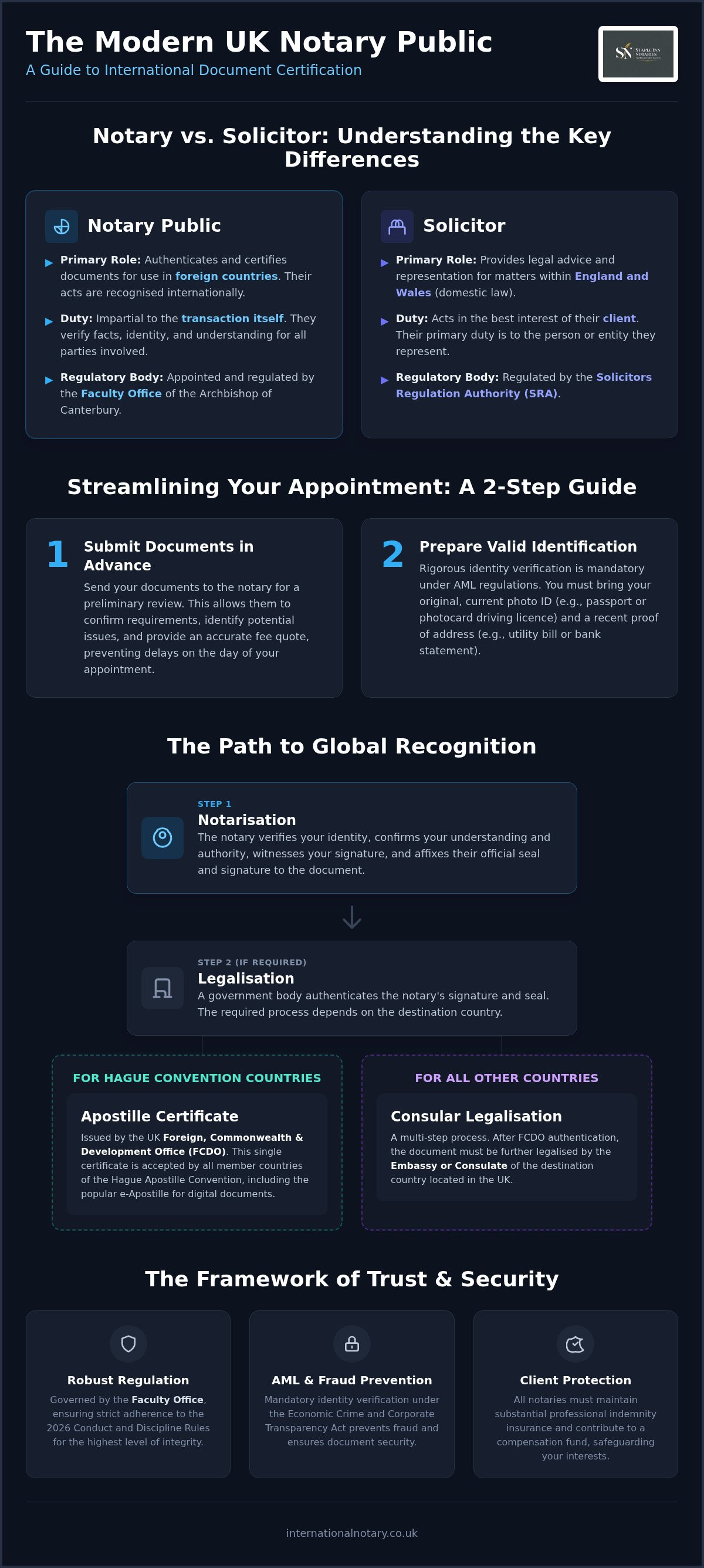
Confusion often arises when you're selecting a legal representative for cross-border matters. Whilst both are qualified lawyers, the fundamental purpose of their work differs significantly. A solicitor represents your specific interests within the domestic legal system of England and Wales. Conversely, a notary public london acts as an impartial officer whose primary duty is to the transaction itself and the receiving foreign jurisdiction. Most solicitors cannot provide the specific certification required abroad because their signatures aren't registered with foreign consulates or the FCDO for the purpose of international authentication.
This distinction in duty fundamentally alters the nature of the legal act. A solicitor is partisan by design. They advocate for your position. A notary is neutral. They verify facts for the benefit of a foreign state or registry. This international liability is immense. If a notary incorrectly certifies a corporate resolution or a deed, the potential for cross-border litigation is substantial. This specialist risk, coupled with the necessity for exact procedural compliance with foreign laws, dictates the fee structure. You aren't merely purchasing a signature; you're securing a guarantee of international acceptance that a standard solicitor can't provide.
When to Instruct a Solicitor
Instruct a solicitor when your legal requirements are contained entirely within the United Kingdom. This includes domestic litigation, UK-based property conveyancing, or drafting a will for assets held only in England. In these scenarios, you require a partisan advisor to protect your interests against another party. A solicitor provides the advocacy and advice necessary to navigate domestic statutes and court procedures. Their work is designed for consumption by UK institutions and doesn't require the international seal of a notary public london.
When a Notary Public is Essential
A notary is indispensable for any matter involving a foreign jurisdiction. This is particularly true when executing a Corporate Power of Attorney Notarisation in London for a subsidiary office abroad. Other essential scenarios include:
Verifying company resolutions for opening overseas bank accounts or branch offices.
Certifying identity documents for individuals purchasing property in Europe, the Middle East, or the Americas.
Authenticating educational certificates or professional qualifications for foreign work permit applications.
In these cases, the document's validity depends on the notary's status as a public officer whose authority is recognised globally. They ensure the document is executed in accordance with both English law and the requirements of the destination country.
How to Prepare for Your Notarial Appointment in London
Efficiency in cross-border legal matters is predicated on meticulous preparation. To ensure your documents are processed without delay and accepted by foreign registries, follow this professional protocol when engaging a notary public london. Procedural errors at the appointment stage often lead to document rejection abroad, causing significant disruption to international property or business deals.
Step 1: Forward your documents via email for a preliminary review. This prevents procedural delays caused by drafting errors, missing information, or incorrect certificate wording.
Step 2: Collate original identity documents. A current passport and a utility bill issued within the last three months are the standard requirements for individuals.
Step 3: Confirm all signatories are physically present and possess the legal capacity to bind themselves or their organisation. The notary must witness the signature in person.
Step 4: Verify if the destination country requires an Apostille or further consular legalisation. The Foreign, Commonwealth & Development Office (FCDO) current turnaround for paper apostilles is approximately 2 to 3 weeks, whilst e-Apostilles take 2 to 3 working days.
Step 5: Attend your appointment at a Notary Central London office or request a mobile visit to your place of business for urgent commercial transactions.
Strict Identification Requirements
A notary public london operates under the stringent Money Laundering and Terrorist Financing (Amendment) Regulations 2026. You must present original documents; photocopies or digital versions are not acceptable for the notary’s permanent register. For corporate entities, the implementation of the Economic Crime and Corporate Transparency Act means you must provide a Certificate of Incorporation and relevant Board Minutes. Identity verification for all Persons with Significant Control (PSCs) is now a mandatory component of the due diligence process as of spring 2026. These measures protect the transaction's integrity and prevent the rejection of documents by foreign authorities.
Reviewing the Document Content
Your document must be in a language the notary understands, or accompanied by a professional translation. Inspect the text for incomplete sections or blank spaces before you arrive. These are often indicators of potential fraud and will lead to a refusal to certify the act. The format of the notarial certificate is determined by the laws of the receiving jurisdiction. Providing the destination country's details early allows the notary to tailor the certification to meet local requirements. This proactive approach ensures the document is legally robust and ready for immediate use abroad.
To secure your time slot and ensure your documents meet all international standards, book your appointment with a specialist notary today.
Navigating International Document Legalisation and Apostilles
Notarisation is only the initial stage in the authentication chain. For a document to be legally recognised by a foreign government, it often requires an Apostille. This certificate, issued by the Foreign, Commonwealth & Development Office (FCDO), confirms that the signature and seal of your notary public london are authentic. In 2026, the landscape of legalisation has shifted significantly towards digital solutions. Whilst traditional paper-based apostilles remain valid, the e-Apostille has become the standard for many commercial documents. This digital alternative reduces turnaround times from weeks to just a few working days, providing a vital tool for time-sensitive transactions.
Speed is often the determining factor in international business. When deadlines are compressed, engaging a Mobile Notary London can significantly expedite the initial certification phase. By having a notary attend your office, you eliminate the logistical delay of transporting original documents. This allows the legalisation process to begin immediately. It ensures that your power of attorney or company resolution reaches its destination without unnecessary friction. Efficiency here is not just a preference; it's a requirement for modern global commerce.
The Role of the Foreign, Commonwealth and Development Office (FCDO)
The FCDO acts as the ultimate verifier of notarial acts within the UK. They maintain a database of all registered notaries to ensure every seal presented is current and authorised. You have two primary routes for legalisation in London. The standard service involves posting physical documents to the FCDO, which currently takes 2 to 3 weeks. For urgent matters, the premium service offers a faster turnaround, though it requires specific appointment slots. The choice between a physical certificate and a digital e-Apostille depends entirely on the requirements of the receiving jurisdiction. Always confirm the format your foreign counterpart requires before proceeding.
Consular and Embassy Legalisation
Not all countries recognise the Hague Apostille Convention. For nations such as the UAE or China, a further layer of verification is required. This process, known as consular legalisation, involves the document being sent to the relevant embassy or consulate in London after it has received an FCDO apostille. Each embassy maintains its own specific procedural requirements and fee structures. Navigating these varied regulations requires a coordinated approach. Your notary public london must ensure the initial certification is formatted correctly to satisfy the specific demands of the destination embassy. Failure to align these steps often results in total document rejection at the final stage, leading to costly delays in your international matters.
Securing Your Global Legal Standing
The successful execution of international documents requires more than just a signature; it demands a precise understanding of the evolving regulatory landscape. By engaging a specialist notary public london, you ensure that your corporate resolutions, property deeds, and powers of attorney meet the rigorous standards required for global portability. We've explored the critical distinctions between domestic and international certification, the shift towards e-Apostilles, and the strict identity verification mandates of 2026. These procedural layers are the only way to prevent document rejection and protect your cross-border interests.
Staple Inn Notaries delivers the expert oversight necessary to navigate these complexities with speed and authority. Regulated by the Faculty Office of the Archbishop of Canterbury, our firm operates from a Central London location with full mobile notary capabilities for urgent commercial matters. We also serve as specialists in Probate Administration London, ensuring that complex estate matters are handled with professional diligence. Contact Staple Inn Notaries for Expert Notarial Services in London and secure the international validity of your documentation today. Your global expansion is within reach when you have the right legal partner by your side.
Frequently Asked Questions
What is the difference between a Notary Public and a Solicitor in London?
A notary public london acts as an impartial officer for international validity, whereas a solicitor provides partisan advocacy for domestic matters. Solicitors focus on UK statutes; notaries focus on the authenticity of documents for foreign jurisdictions. Foreign registries often reject documents signed by solicitors because their signatures aren't registered with the FCDO for international authentication. This distinction is critical for cross-border property transactions or corporate resolutions.
How much does a Notary Public in London cost in 2026?
Fees for a notary public london vary based on the complexity of the document and the volume of signatures required. Industry pricing in 2026 typically accounts for the time spent on verification and the specific risks associated with international liability. Additional costs often include FCDO apostille fees and consular legalisation charges. You should always obtain a specific quotation that reflects the destination country's requirements and any necessary mobile service or courier fees.
Can a London Notary certify documents for any country in the world?
Yes, a London notary can certify documents for any sovereign state, provided the certification adheres to the specific legal requirements of the receiving jurisdiction. While the notary's seal is recognised globally, certain countries require additional layers of verification, such as an apostille or consular legalisation. It's essential to confirm the exact format required by your foreign lawyers to ensure the document is accepted without delay.
How long does the notarisation process typically take?
The act of notarisation itself is usually completed during a single appointment, which typically lasts thirty minutes. However, the total turnaround time depends on whether the document requires further legalisation. In 2026, an e-Apostille can be issued in 2 to 3 working days, whereas a traditional paper apostille from the FCDO often takes 2 to 3 weeks. Urgent business matters can be expedited through mobile notary services.
Do I need to appear in person before the Notary Public?
You must generally appear in person so the notary can verify your identity and witness your signature. This physical presence is a fundamental requirement of the Notaries (Conduct and Discipline) Rules 2026 to prevent fraud. While remote notarisation via secure video link is legally valid under UK law for certain document types, you must first confirm that the receiving jurisdiction will accept a document notarised through a remote platform.
What is an Apostille and do I always need one for my notarised document?
An Apostille is a certificate issued by the FCDO that verifies the authenticity of the notary's seal and signature. You require one if the destination country is a member of the Hague Apostille Convention. For countries that aren't signatories, you may need further consular legalisation. Always check with the foreign recipient, as some institutions accept a notary's seal alone for specific administrative or private matters.
Can a Notary Public in London certify a digital or electronic document?
Yes, notaries in London can certify digital documents using secure electronic signatures and seals. This process often facilitates the issuance of an e-Apostille, which is significantly faster than the paper-based alternative. The notary must still perform rigorous identity checks and verify the document's source. You must ensure the foreign authority has the technical capability and legal framework to accept a digital certificate before proceeding with this method.
What happens if my document is in a foreign language?
If your document is in a foreign language, the notary must be satisfied that they understand its contents and that you understand what you're signing. This often requires a professional translation to be bound with the original document. Some notaries possess specific linguistic skills, but in most cases, an independent translator's certificate is necessary to ensure the document's integrity and to satisfy the requirements of the receiving jurisdiction.


Comments