
Notary Central London: Professional Certification and International Legalisation

Updated: Sep 3
A single administrative oversight in a power of attorney can halt a multi-million pound corporate acquisition or delay a critical cross-border inheritance for months. When your documents must cross borders, the standard certification provided by a solicitor is often insufficient; this leaves you vulnerable to rejection by foreign registries and government departments. Securing a Notary Central London professional ensures that your signatures are not merely witnessed but are authenticated to a standard that commands international recognition. You recognise that in the high-pressure environment of the City, time is a luxury you cannot afford to waste on procedural errors.
We provide a comprehensive roadmap to navigating the complexities of international document legalisation, ensuring your private or corporate matters proceed without friction. You will discover the critical distinctions between notarial acts and standard legal services, alongside a breakdown of the latest FCDO apostille requirements following the 2026 regulatory updates. This guide examines how to achieve rapid turnaround times for urgent matters, providing the clarity required to secure absolute legal validity across any global jurisdiction.
Table of Contents
The Role of a Notary Public in Central London's Global Economy
Navigating International Validity: Notarisation, Apostille, and Legalisation
Choosing the Right Service: Office-Based vs. Mobile Notary Central London
Preparing Your Documents: A Checklist for Seamless Certification
Staple Inn Notaries: Expert Certification for London’s Professionals
The Role of a Notary Public in Central London's Global Economy
A Notary Public is a specialist lawyer, a member of the oldest branch of the legal profession in the United Kingdom. Unlike solicitors who primarily serve their clients' interests, a notary's primary duty is to the transaction itself and the foreign jurisdictions that rely upon the document's authenticity. This unique role is governed by the Faculty Office of the Archbishop of Canterbury, which oversaw the implementation of the Notaries (Conduct and Discipline) Rules 2026 on 28 April 2026. When seeking a Notary Central London, you're engaging a public official whose seal and signature are recognised by the Foreign, Commonwealth & Development Office (FCDO) and overseas government departments. To understand the broader historical and legal context of this office, one might ask: What is a Notary Public?
Why Central London Demands Specialised Notarial Expertise
Central London operates as a global nexus for multi-jurisdictional corporate deals and private wealth management. Securing a professional Notary Central London ensures that your signatures are not merely witnessed but are authenticated to a standard that commands international recognition. In the City and West End, legal documents frequently require execution for use in countries with civil law systems that do not recognise standard solicitor certifications. We act as an expert fixer. We ensure that a Power of Attorney or Company Resolution is drafted and executed with the meticulous detail required to prevent rejection abroad. This foundation of international trust allows commerce to flow without the friction of administrative delays or the risk of document invalidity.
Notary vs. Solicitor: Understanding the Key Differences
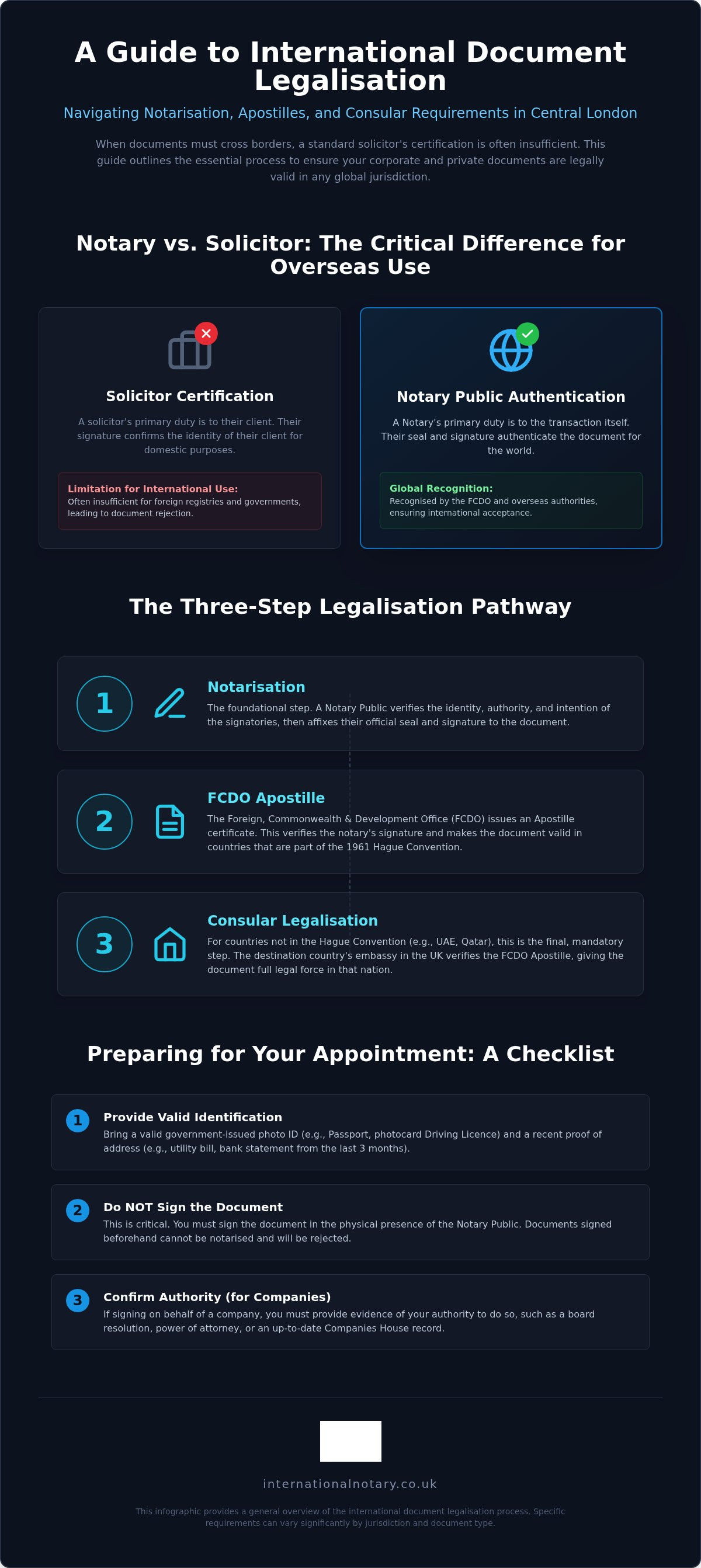
Whilst many notaries are also solicitors, the two functions remain legally distinct and are regulated by different bodies. A solicitor's signature confirms the identity of their client; however, a notary's seal authenticates the document for the world at large. International courts and registries mandate this specific level of verification because notaries are trained to verify capacity, authority, and intention to a globally accepted standard. The Foreign, Commonwealth & Development Office (FCDO) maintains a register of authorised notaries; they'll only issue an apostille if the notary's signature and seal match the records on their database. For those managing complex cross-border estates or inheritance tax planning, it's advisable to engage Staple Inn Notaries to bridge the gap between UK private client law and foreign probate requirements. Our role is to provide the legal certainty that overseas authorities demand through procedural rigour and professional accountability.
Navigating International Validity: Notarisation, Apostille, and Legalisation
International document acceptance follows a rigorous three-step ladder: notarisation, apostille certification, and consular legalisation. A professional Notary Central London provides the foundational act of authentication by verifying the identity and authority of the signatories. Once notarised, the document typically requires an apostille from the Foreign, Commonwealth & Development Office (FCDO). This certificate verifies the notary's signature and seal, ensuring the document's validity under the 1961 Hague Convention. For countries that haven't signed this convention, such as the UAE or Qatar, a third step of consular legalisation is mandatory. You must follow this sequence precisely to ensure your documents are not rejected by foreign registries.
The Apostille Process in Central London
An Apostille is the internationally recognised certificate of authenticity issued by the UK government. The FCDO Legalisation Office manages this process, and as of August 2026, standard paper-based apostilles take approximately two to three weeks to process. For urgent corporate matters, next-day or urgent services are available to meet strict jurisdiction deadlines. This process applies to academic transcripts, General Registry Office documents, and Companies House filings. You can find detailed guidance on the official UK document legalisation portal. It's essential to remember that UK notarisation must occur before the apostille is applied, which typically adds two to three days to the overall timeline.
Embassy and Consulate Legalisation
Non-Hague Convention countries require an additional layer of scrutiny. After the FCDO has issued an apostille, the document must be presented to the relevant diplomatic mission in London for a final stamp. This is common for transactions in China, Qatar, and the United Arab Emirates. Pitfalls include incorrect fee payments, outdated document versions, or failure to meet specific embassy formatting rules. These errors cause significant procedural delays. Choosing an integrated service that handles both notarisation and the subsequent legalisation steps reduces risk. If you require assistance with these multi-stage requirements, you may wish to consult our legalisation specialists to ensure compliance.
Electronic Apostilles (e-Apostilles) in 2026
Digital transformation has reached the FCDO Legalisation Office. As of August 2026, the fee for an e-Apostille is £35, with processing usually taking two to three working days. This digital version provides a faster alternative to paper-based legalisation for jurisdictions that accept electronic signatures. It involves a PDF document with a digital certificate, significantly reducing the logistics of courier services and physical stamps. Whilst not universally accepted, it represents a modern efficiency tool for London businesses operating in a fast-paced global market. Ensure your recipient accepts digital formats before opting for this route.
Choosing the Right Service: Office-Based vs. Mobile Notary Central London
Selecting a professional Notary Central London requires a strategic choice between traditional office-based rigour and the rapid response of mobile services. The decision often rests on the logistical complexity of the transaction and the availability of the signatories. Professional standards maintained by members of The Notaries Society ensure that regardless of the location, the legal rigour remains absolute. This flexibility is vital in a global financial hub where timing often dictates the success of a deal. We balance the gravity of legal certification with the practical necessity for efficiency, ensuring that every document meets the stringent requirements of foreign jurisdictions.
The Strategic Advantage of a Mobile Notary
High-net-worth individuals and senior executives frequently operate under extreme time pressure. A mobile service eliminates the need for travel, bringing the notarial seal directly to boardrooms in Mayfair or private residences in Marylebone. This is particularly critical for the on-site certification of Mobile Notary London services when executing urgent board minutes or property sales. By facilitating signatures in the client's own environment, we ensure that all signatories are correctly identified without disrupting their operational schedule. This approach embodies a sense of controlled urgency, allowing multi-million pound international deals to close with procedural precision. Our geographic reach extends across the Square Mile and Canary Wharf, ensuring that professional certification is accessible wherever the business need arises.
When an Office Visit is Preferred
Whilst mobile services offer unparalleled convenience, visiting a professional legal centre in Holborn or the City remains the preferred choice for certain matters. Complex estate planning or trust administration often involves multiple family members and legal advisors, requiring a neutral, secure space for deliberation. Our office provides access to the full suite of Notary Central London resources, including secure document storage and immediate administrative support for large-scale legalisations. These environments are designed to mirror the meticulous nature of legal work, providing a structured setting for the 'Expert Fixer' to resolve intricate cross-border probate issues. An office appointment provides the ideal backdrop for the detailed drafting and verification phases of international documentation.
Preparing Your Documents: A Checklist for Seamless Certification
Achieving international legal validity requires more than a simple signature. It demands a meticulous adherence to regulatory protocols. As an expert fixer, a Notary Central London ensures that every document meets the stringent standards of the Faculty Office and global anti-money laundering (AML) regulations. One critical rule involves the drafting phase: you must never sign your document before meeting the notary. The act of notarisation requires the official to witness the execution in person or via approved digital means to certify that the signature was made freely and by the correct individual. This procedural rigour is what prevents your documents from being rejected by foreign jurisdictions.
Proof of Identity and Address in 2026
The regulatory landscape in 2026 has intensified the focus on identity verification. To proceed, you must provide original documents rather than photocopies. The following items are typically required to satisfy both legal and insurance mandates:
Photographic ID: A current, valid passport or a UK driving licence.
Proof of Residence: A utility bill, council tax demand, or bank statement issued within the last three months to meet the currency rule.
Biometric Verification: Modern practices now utilise biometric security software to cross-reference your physical ID against live facial recognition data.
This level of scrutiny reduces client anxiety by eliminating the risk of identity disputes in overseas courts. If you're ready to proceed with these identity checks, you can book your appointment online to secure a priority slot in our schedule.
Corporate Notarisation Requirements
When acting on behalf of a London-limited company, you must prove your corporate capacity and authority. The notary will verify the company's 'Good Standing' at Companies House to ensure it's currently active and hasn't been struck off. You'll need to provide supporting evidence such as the Certificate of Incorporation, the Articles of Association, and a specific Board Resolution authorising the transaction. This is particularly vital for Corporate Power of Attorney Notarisation in London when establishing overseas branches or executing high-value property acquisitions. Ensuring your board minutes are correctly formatted is essential for international recognition; foreign registries often require explicit statements of authority that differ from standard UK corporate filings. We provide the professional oversight needed to navigate these multi-clause requirements with speed and precision, ensuring your corporate actions remain robust amongst global regulators.
Staple Inn Notaries: Expert Certification for London’s Professionals
Staple Inn Notaries operates as a trusted gatekeeper for international documentation, providing a sophisticated blend of traditional legal rigour and modern efficiency. We recognise that the gravity of legal certification must be balanced against the practical need for rapid service in a global financial hub. Our practice provides comprehensive support, ranging from simple passport and ID certification to the complex administration of international probate. By acting as your Notary Central London, we ensure that every document adheres to the highest regulatory standards whilst meeting the specific requirements of foreign government departments. We're here to ensure your documents are never rejected abroad.
Private Client Services for High-Net-Worth Individuals
Protecting your London assets whilst managing global liabilities requires a deep understanding of multi-jurisdictional law. We specialise in drafting Wills and Lasting Powers of Attorney (LPA) specifically tailored for international residents and high-net-worth individuals. Our expertise includes trust administration and inheritance tax planning within the post-2025 regulatory environment, providing the clarity needed to protect cross-border estates. Should conflicts emerge, we handle contentious probate and will disputes with professional composure, utilising our regulated standing to resolve matters efficiently. We aim to reduce client anxiety through a display of specialised expertise and accessibility. It's our priority to secure your legacy across borders.
Streamlined Corporate Notary Solutions
City law firms and financial institutions require a partner who understands the time-sensitive nature of international commerce. We provide streamlined corporate solutions, facilitating the legalisation of company resolutions, statutory declarations, and complex share transfer documents. Our role as a Notary Central London involves verifying corporate capacity with meticulous detail to ensure your documents are robust amongst global regulators. We offer a commitment to rapid response, ensuring that procedural delays don't hinder your corporate strategy. Our persona as an expert fixer means we move swiftly from identifying a legal need to offering a results-driven solution. Contact Staple Inn Notaries to organise an urgent mobile appointment or to discuss your specific legalisation requirements today.
Secure Your International Legal Validity Today
Navigating the complexities of cross-border documentation requires more than a simple signature; it demands a regulated authority that understands the nuances of global legalisation. You've seen how meticulous preparation and the strategic use of mobile services can eliminate administrative friction in high-stakes environments. Whether you're managing a complex international estate or executing urgent corporate resolutions, the expertise of a Notary Central London provides the necessary foundation for global trust. This professional oversight ensures your documents remain robust amongst overseas regulators and foreign registries.
Staple Inn Notaries, situated in our professional legal centre in Holborn, combines deep expertise in corporate and private client law with the rigorous oversight of the Faculty Office of the Archbishop of Canterbury. We're committed to providing the rapid, legally robust solutions that London’s professionals demand in an increasingly digital landscape. Book Your Central London Notary Appointment Today to ensure your documents meet the highest standards of international validity. We look forward to facilitating your requirements with precision and efficiency.
Frequently Asked Questions
What is the difference between a Notary Public and a Solicitor in London?
A solicitor typically handles domestic legal matters such as conveyancing or litigation within the UK. In contrast, a Notary Public is a specialist lawyer whose primary function is to authenticate and certify documents for use in foreign jurisdictions. Whilst many notaries are also solicitors, their notarial role is distinct; they owe a primary duty to the transaction and the 'world at large' to ensure the document's international validity and legal robustness.
How long does it take to get a document notarised and apostilled in Central London?
Notarisation can often be completed during a single thirty-minute appointment. However, obtaining an apostille from the Foreign, Commonwealth & Development Office (FCDO) takes longer. As of August 2026, standard paper-based legalisation takes approximately two to three weeks, whilst urgent services can reduce this to one or two working days. Electronic apostilles are generally processed within two to three working days, providing a faster alternative for eligible digital documents.
Do I need to be present in person for a notarisation, or can it be done virtually?
Most foreign jurisdictions and registries still mandate that you appear in person before the notary to execute your documents. This allows for the physical verification of your identity and capacity. Whilst remote video notarisation is available for certain matters, its acceptance varies significantly between countries. You must verify with the receiving authority abroad whether they'll accept a document executed via video link before booking a virtual appointment.
What are the common fees associated with a Notary Public in Central London?
Professional fees for a Notary Central London generally start from £90 per document, though complex corporate matters often attract higher rates. Industry data from August 2026 indicates that personal document notarisation typically begins at £136, whilst business-related certifications start from £156. These figures exclude disbursements such as FCDO apostille fees, which are £45 for standard service or £100 for urgent processing. Always request a specific fee estimate before your appointment.
Can a London Notary certify documents in a foreign language?
A notary can certify documents in a foreign language; however, they must be satisfied that they understand the document's nature and effect. If the notary isn't fluent in the specific language, they may require a formal translation from a qualified translator. You should provide any available translations in advance to ensure the notary can verify the content and confirm that you fully comprehend the legal obligations you are undertaking.
What identification do I need to bring to my notary appointment?
You are required to bring two distinct forms of identification to satisfy stringent anti-money laundering regulations. The first must be a valid photographic ID, such as a current passport or a UK driving licence. The second must be a proof of address, typically a utility bill or bank statement issued within the last three months. Failure to provide original, current documentation will prevent the notary from proceeding with your certification.
Is an Apostille always required for documents being sent abroad?
An apostille isn't universally required, but it's highly recommended for documents destined for countries that are members of the Hague Convention. Some jurisdictions or specific organisations, such as certain banks or registries, may accept a notary's seal alone without government legalisation. You should always obtain written confirmation from the receiving party abroad to determine whether they require an FCDO apostille or additional consular legalisation to recognise the document.
Does a mobile notary charge more than an office-based notary?
Engaging a mobile Notary Central London typically incurs an additional fee to account for the professional's travel time and the convenience of on-site service. Whilst office-based appointments are generally more cost-effective, the mobile option is often essential for senior executives or high-net-worth individuals who can't leave their boardroom or residence. This premium reflects the high level of efficiency and the reduction of logistical disruption for time-sensitive international transactions.



Comments