
Notarising Statutory Declarations: UK Corporate Guide

Updated: Sep 8
A single procedural error in a statutory declaration can halt a multi-million pound international tender or property acquisition indefinitely. For directors and legal counsel, the process of notarising statutory declarations for UK companies often presents a frustrating bottleneck, especially when deadlines are tight and foreign requirements are opaque. While a local solicitor might suffice for domestic matters, international authorities demand a higher level of certification that only a Notary Public can provide. It's a common frustration to find that a document witnessed by a Commissioner for Oaths has been rejected abroad for lacking the necessary international validity.
You need a document that's legally robust and ready for immediate use in your target jurisdiction. This guide serves as a professional roadmap through the complexities of notarisation, legalisation, and FCDO requirements for UK businesses. We'll examine the specific distinctions between standard witnessing and full notarisation, the necessity of the apostille, and how to expedite the process within Central London's fast-paced corporate environment. By understanding these procedural nuances, you'll ensure your company's declarations are beyond reproach and ready for global scrutiny.
Table of Contents
What is a Statutory Declaration for a UK Company?
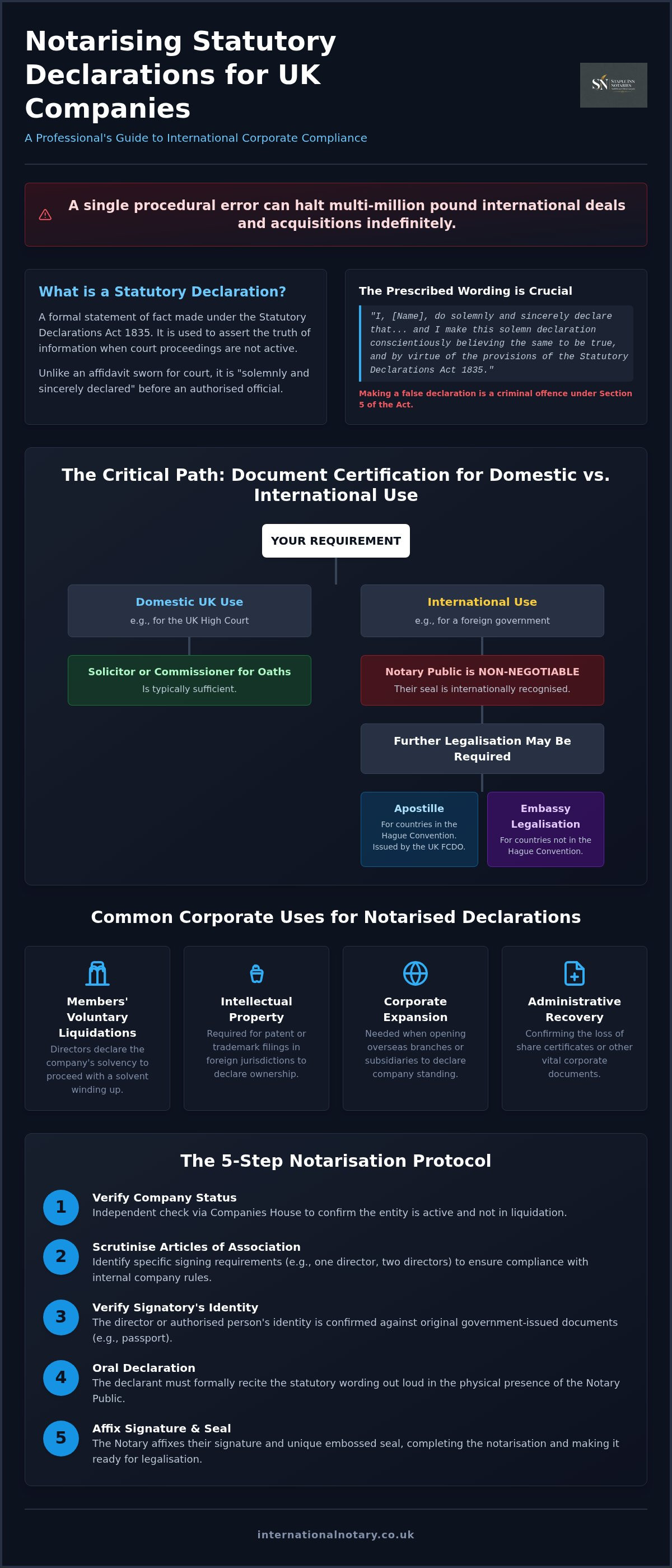
A Statutory declaration is a formal statement of fact made under the Statutory Declarations Act 1835. It serves as a legal instrument used to assert the truth of certain information when court proceedings aren't active. For businesses, notarising statutory declarations for UK companies is a standard procedure for validating corporate actions to third parties, regulatory bodies, or foreign governments. Whilst an affidavit is sworn under oath specifically for use in court, a statutory declaration is "solemnly and sincerely declared" before an authorised official.
UK companies frequently require these documents for diverse administrative and legal functions. Common triggers include:
Members' Voluntary Liquidations (MVLs): Where directors must declare the company's solvency to proceed with a solvent winding up.
Intellectual Property: Patent or trademark filings in foreign jurisdictions often require a declaration of ownership.
Corporate Expansion: Opening overseas branches or subsidiaries frequently necessitates a formal declaration of the company's standing.
Administrative Recovery: Confirming the loss of share certificates or other vital corporate instruments.
A solicitor can witness a declaration for domestic use, but their authority often stops at the UK border. Foreign governments and registries typically require the seal of a Notary Public. Notaries are internationally recognised public officials whose signatures carry the weight of global legal standardisation, making them the preferred choice for cross-border transactions.
The Legal Framework for Corporate Declarations
The "declarant" must be an individual with the requisite authority to bind the company, typically a director or the company secretary. The document must contain specific, prescribed wording: "I, [Name], do solemnly and sincerely declare that... and I make this solemn declaration conscientiously believing the same to be true, and by virtue of the provisions of the Statutory Declarations Act 1835." Accuracy is paramount. Under Section 5 of the Act, making a false declaration is a criminal offence, punishable by imprisonment or fines, ensuring the high integrity of the document for corporate legal advisory purposes.
International vs. Domestic Requirements
If a declaration is destined for the UK High Court, a Commissioner for Oaths is sufficient. However, for an overseas registry, notarisation is non-negotiable. Foreign jurisdictions view the British Notary Public as a high-ranking legal officer who has verified both the identity of the declarant and the standing of the company. This verification is essential for documents crossing international borders. It provides the necessary assurance of authenticity that foreign officials require to process applications without delay. When notarising statutory declarations for UK companies, the notary's seal acts as a bridge between the UK legal system and the requirements of the receiving nation.
The Process of Notarising Statutory Declarations for UK Companies
Notarising statutory declarations for UK companies follows a rigorous five-step protocol designed to withstand international scrutiny. The process begins with an independent verification of the company’s current status via Companies House. We confirm the entity is active and not in liquidation. Next, we scrutinise the Articles of Association to identify specific signing requirements. Some constitutions require two directors to sign, whilst others allow for a sole signatory or an authorised attorney. Failure to adhere to these internal rules can render the declaration void in the eyes of foreign registries.
Once authority is established, the signatory’s identity is verified against original government-issued documents. The formal act of declaring follows. The declarant must orally recite the statutory wording in the presence of the Notary. Finally, the Notary affixes their signature and unique embossed seal. This physical mark is essential if you later need to Get your document legalised for use in a foreign jurisdiction. If you are unsure about your company's current signing powers, you can consult with our Central London team for a preliminary review of your documentation.
Verifying Corporate Capacity and Authority
Corporate capacity is the legal power of an entity to enter into binding obligations. To establish this, a Notary may require a copy of the Board Minutes authorising the specific transaction or the execution of the declaration. This is particularly vital when the signatory is not a registered director but an authorised representative acting under a Power of Attorney. We also verify the "Good Standing" of the UK company to ensure it hasn't been struck off or dissolved, providing a layer of security that foreign authorities expect from British corporate documents.
Identity Requirements for Corporate Signatories
Directors must provide a valid passport or photocard driving licence alongside a recent utility bill or bank statement as proof of residential address. These checks are not mere formalities. They are statutory duties that allow the Notary to mitigate risks of identity fraud and money laundering within corporate structures. By maintaining these high standards, we ensure that the process of notarising statutory declarations for UK companies results in a document that is robust enough to be accepted by overseas registries and legal authorities without question. Our role is to act as a gatekeeper, ensuring every signature is both authentic and authorised.
Apostille and Legalisation: Moving Beyond Notarisation
Notarising statutory declarations for UK companies is often merely the foundational step in a multi-stage certification process. Whilst the Notary’s seal confirms the document's authenticity within the UK, foreign governments require independent verification of the Notary’s own authority. This verification is known as legalisation. In the United Kingdom, the Foreign, Commonwealth & Development Office (FCDO) serves as the competent authority for this task. They compare the Notary’s signature and seal against their registered database to issue an Apostille certificate.
The requirement for an Apostille depends entirely on the destination country. Over 120 nations are signatories to the Hague Apostille Convention, which simplifies the process by accepting the FCDO’s certificate as sufficient proof of validity. However, for jurisdictions outside this convention, such as the UAE, Qatar, or China, a further step of embassy attestation is mandatory. For firms expanding into the Emirates, مكتب جاسم البلوشي للمحاماة والاستشارات القانونية provides expert local guidance to ensure documents are compliant with UAE commercial laws. This creates a procedural chain: notarisation, followed by FCDO legalisation, and finally, attestation by the relevant consulate or embassy. Precision at each stage is vital to avoid rejection at the final hurdle.
If your corporate declaration is destined for a Hague Convention country, an Apostille is non-negotiable. For many corporate documents, the FCDO now offers an e-Apostille, which is a digital alternative to the traditional paper certificate. Whilst faster, it is not yet universally accepted, particularly in jurisdictions that still demand physical embossed seals. For a comprehensive breakdown of these technical requirements, consult our Apostille Services London guide. This resource provides deeper insights into the evolving landscape of digital versus physical legalisation.
Consular and Embassy Legalisation for Global Trade
Global trade often requires expansion into non-Hague jurisdictions. Here, the process becomes significantly more complex. Common pitfalls include failing to meet specific embassy requirements regarding document formatting or the age of the notarised statement. Some embassies require the document to be notarised within the last three months; others demand specific translations before they will grant attestation.
Managing this multi-stage workflow requires precision and a modern, fast-paced mindset. Our "Expert Fixer" approach involves handling the entire chain of custody, from the initial act of notarising statutory declarations for UK companies through to the final embassy stamp. This end-to-end management eliminates procedural delays and ensures that business deals proceed without administrative friction. We act as the trusted gatekeeper, navigating the idiosyncratic demands of different consulates to provide a document that is fully compliant with local laws. Explore our full Apostille and Legalisation Services to secure your international compliance.
Buying Guide: Choosing the Right Notary for Your Company
Selecting a partner for notarising statutory declarations for UK companies requires a discerning assessment of both technical expertise and logistical capability. A notary shouldn't merely witness a signature; they must act as a trusted gatekeeper who ensures the entire documentation chain is resilient against foreign legal challenges. This entails a deep familiarity with Companies House filings, the nuances of the Statutory Declarations Act 1835, and the specific evidentiary standards of overseas registries. Choosing an inexperienced practitioner can lead to document rejection, causing significant delays in international tenders or property acquisitions. To ensure your wider business interests are protected during these complex transactions, you might check out MAR Legal for expert commercial legal guidance.
The logistical advantage of a Central London location cannot be overstated for City-based firms. Proximity to the Foreign, Commonwealth & Development Office and the various diplomatic missions in Mayfair and Belgravia allows for a significantly accelerated legalisation timeline. Whilst standard postal applications to the FCDO can take weeks, a notary with a physical presence in the capital can often facilitate expedited processing. You can Book Same-Day Notary Appointments to ensure your urgent corporate declarations are handled with the necessary priority.
Mobile Notary Services: Certification in Your Boardroom
C-suite executives and directors often find it impossible to leave the office for administrative formalities. Mobile notary services solve this friction by bringing the notary’s seal directly to your boardroom or registered office. This is particularly effective when notarising statutory declarations for UK companies that involve multiple signatories or complex, high-value transactions. Bringing the professional to the site ensures that the execution of documents doesn't disrupt the company’s operational flow. Refer to our guide on Mobile Notary London to understand the specific requirements for on-site certifications and boardroom signings.
Why Staple Inn Notaries is the Preferred Choice for London Businesses
Staple Inn Notaries operates at the intersection of legal tradition and modern corporate urgency. Situated in the heart of London’s legal and financial district, we provide a strategic base for firms requiring rapid, authoritative certification. Our practice is built on a persona of calm competence, designed to facilitate complex transactions without administrative friction. We understand that notarising statutory declarations for UK companies is often a time-critical component of a larger deal. Our responsiveness ensures that your documentation never becomes a bottleneck. We act as the "Expert Fixer" for City-based firms, combining high-level regulatory standing with a results-driven mindset.
Specialist Corporate Expertise
Our firm maintains an in-depth understanding of Companies House requirements and the nuances of corporate governance. We don't simply witness signatures; we verify corporate capacity by scrutinising Articles of Association and Board Minutes. This meticulous approach protects your company’s international standing by ensuring every document is beyond reproach. We possess extensive experience with diverse jurisdictions, from the common law systems of the Commonwealth to the specific civil law requirements of Europe and Asia. This specialised focus allows us to navigate the varied declaration formats required by overseas registries with absolute precision. We ensure that the process of notarising statutory declarations for UK companies adheres to both domestic law and international expectations.
Seamless End-to-End Service
Managing international documentation shouldn't require multiple vendors or fragmented communication. We offer a single point of contact for the entire legalisation chain, from initial drafting advice to final embassy attestation. This streamlined workflow is particularly beneficial for complex matters involving trusts, probate, or intricate corporate structures. You can access our Legal Advisory Services for detailed guidance on these specific areas. We eliminate the need for you to coordinate between different offices, handling the FCDO and consular stages on your behalf.
For executives who cannot leave the office, our mobile service brings our expertise directly to your boardroom. This on-site capability is essential for multi-party signings where coordination is paramount. We combine a formal register with a brisk, efficient rhythm that respects your schedule. By acting as a trusted gatekeeper, we ensure your documents are not only notarised but are also fully compliant with global standards. Contact our team today to secure an efficient solution for your corporate certification needs.
Securing Your Company's Global Compliance
Navigating the procedural requirements for international corporate documentation demands precision and a comprehensive understanding of the legalisation chain. From the initial verification of corporate capacity to the final embassy attestation, every step must be executed with meticulous attention to detail. Establishing a robust workflow for notarising statutory declarations for UK companies ensures that your business avoids the administrative delays that often plague cross-border transactions. By prioritising expert verification, you protect your firm's reputation and operational momentum in foreign jurisdictions.
Staple Inn Notaries offers the specialised expertise required to manage these high-pressure requirements. Regulated by the Faculty Office of the Archbishop of Canterbury, our practice combines a strategic Central London location with the flexibility of mobile notary services for corporate offices. We act as your trusted gatekeeper, ensuring every document is fully compliant with both domestic regulations and international standards. Don't let procedural complexity hinder your global expansion.
Contact Staple Inn Notaries to arrange your corporate notarisation today and experience a streamlined, professional certification process. We are ready to facilitate your next international deal with efficiency and authority.
Frequently Asked Questions
What is the difference between a statutory declaration and an affidavit for a UK company?
A statutory declaration is a formal statement made under the Statutory Declarations Act 1835, whilst an affidavit is a written statement sworn on oath or by affirmation for use in court proceedings. For UK companies, statutory declarations are the standard instrument for administrative matters such as solvency statements or patent filings. The primary distinction lies in the wording and the specific legal framework governing the document's execution and its domestic or international admissibility.
Can any solicitor notarise a statutory declaration for use abroad?
No, a solicitor's signature is generally not recognised by foreign registries or government bodies for documents crossing international borders. Whilst a solicitor can witness a declaration for domestic use, only a Notary Public has the internationally recognised authority to certify documents for global use. Notarising statutory declarations for UK companies through a Notary Public ensures the document meets the stringent verification standards required by overseas authorities and the FCDO.
Who is authorised to sign a statutory declaration on behalf of a UK-limited company?
Authorisation is typically held by a registered director or the company secretary, but the specific requirements are dictated by the company's Articles of Association. We verify the signatory's power by reviewing Companies House records and the firm's constitutional documents. In some instances, an authorised representative may sign under a Power of Attorney, provided the Notary can verify the chain of authority and the company's current good standing.
How long does the notarisation and apostille process take for corporate documents?
The timeline varies depending on the level of legalisation required. Notarisation in Central London can often be completed on a same-day basis, particularly for urgent corporate matters. The apostille process adds time; the FCDO standard service currently takes approximately 15 to 20 working days, whilst expedited professional services can achieve next-day turnaround. Embassy attestation for non-Hague countries may extend the process by several additional days or weeks depending on the specific consulate.
Do I need to provide the original Articles of Association for the notarisation?
You don't always need to provide physical originals, as we can often verify the Articles of Association and certificate of incorporation directly via Companies House. However, we must review these documents to confirm the company’s internal signing rules. If the company has bespoke Articles that aren't public, providing the original or a certified copy is essential to establish the signatory's authority and ensure the declaration is legally robust for international use.
Can a statutory declaration be signed electronically for international use?
Whilst the UK offers e-Apostilles for certain corporate documents, many foreign jurisdictions still demand traditional wet-ink signatures and physical embossed seals. Digital signatures are becoming more common, but their acceptance is inconsistent across international borders. We recommend checking the specific requirements of the receiving authority before opting for electronic execution. Most high-value corporate transactions still rely on physical notarisation to guarantee acceptance and avoid procedural rejections in the target country.
What happens if a statutory declaration is not notarised correctly?
Incorrect notarisation typically results in the document being rejected by the receiving authority, leading to costly delays in business deals or legal filings. Beyond administrative failure, making a false statement in a statutory declaration is a criminal offence under the Statutory Declarations Act 1835. Ensuring the process of notarising statutory declarations for UK companies is handled by a specialist Notary protects the firm from both procedural errors and potential legal liability in the United Kingdom.
Does a statutory declaration for a company expire?
The Statutory Declarations Act 1835 does not specify an expiration date, but the receiving jurisdiction or organisation often imposes its own validity period. Many foreign registries or banks require that the document was notarised within the last three to six months. It's vital to confirm the specific timeframe required by the end-user to ensure the declaration remains valid for the duration of the intended transaction, as older documents are frequently rejected by compliance departments.


Comments