
Notarising Documents for International Expansion: 2026 Guide

A commercial expansion overseas rarely falters on corporate ambition; it stalls when a foreign registrar abruptly rejects an improperly certified document. Successfully notarising documents for international expansion requires far more than a routine signature stamp. It demands precise alignment with the statutory verification standards enforced by overseas registries.
If you're currently balancing director availability, statutory Companies House records, and stringent closing deadlines, untangling the distinction between notarial certification, an FCDO apostille, and consular attestation often feels like an administrative maze. You need to know exactly which corporate instruments require formal authentication before an overseas official halts your transaction.
Master the corporate legalisation process to ensure your UK commercial documentation is accepted by foreign registries without delay. In this guide, we map out the specific corporate records requiring notarial authentication, explain the operational route through the Faculty Office, the FCDO, and London-based embassies across 130 Hague member countries and non-member states, and establish a clear roadmap for prompt cross-border compliance.
Table of Contents
The Role of Document Notarisation in Cross-Border Corporate Expansion
Essential Corporate Documents Requiring Certification for Overseas Registries
Authentication Pathways: Hague Apostille Convention vs Consular Legalisation
Navigating Corporate Due Diligence and Preventing Registry Rejections
Securing Central London Notarial Services for Seamless International Expansion
The Role of Document Notarisation in Cross-Border Corporate Expansion
Establishing an overseas subsidiary or registering a commercial branch requires rigorous validation under foreign administrative law. International notarial certification officially authenticates corporate identity, constitutional documents, and legal signing authority. Without this verification, overseas registries will refuse cross-border filings, leaving commercial initiatives stalled at the border. A notary public acts as an internationally recognised legal official confirming corporate capacity. By scrutinising company structures and validating signatory powers, notaries provide the evidentiary foundation that foreign jurisdictions demand when companies venture into new markets.
Properly notarising documents for international expansion bridges the gap between English common law and foreign civil codes. While a domestic transaction might rely on simple company seals or standard director attestations, international authorities require an independent public officer to verify the facts asserted in the documentation before granting regulatory approval.
Why Foreign Commercial Registries Demand Notarial Authentication
Overseas registrars require statutory verification that a UK company is lawfully incorporated, actively trading, and operating in compliance with domestic legislation. When evaluating incoming filings, foreign officers possess neither the remit nor the mechanism to search Companies House directly. Instead, they rely upon the notary's verification.
Notaries verify that corporate signatories possess legitimate constitutional authority to bind the enterprise, preventing unapproved commitments. This authentication process protects international administrative bodies against corporate fraud, identity theft, and ultra vires acts:
Capacity Verification: Confirming the company exists legally and possesses the corporate power to execute the overseas transaction.
Signatory Authority: Checking board minutes and articles of association to establish that executing directors hold verified authority.
Document Integrity: Affixing an official seal and signature, which international authorities can cross-reference against diplomatic records maintained under the Hague Apostille Convention.
Notarisation vs Solicitor Certification: Key Legal Differences
UK corporate counsel frequently assume that a standard solicitor's stamp suffices for international filings. In practice, solicitor signatures are rarely recognised by civil law commercial courts and overseas registries. A solicitor's certification merely confirms that a copy matches an original or that a signature was witnessed domestically; it carries no sovereign evidential weight outside the United Kingdom.
In contrast, public notaries hold designated public office under the Faculty Office of the Archbishop of Canterbury. Their acts are recognised worldwide under private international law. Civil law jurisdictions mandate formal notarial instruments to execute cross-border corporate registrations, requiring an enrolled public official whose signature and seal are formally registered with foreign consulates and government legalisation departments.
Essential Corporate Documents Requiring Certification for Overseas Registries
Foreign corporate registries require proof across constitutional, representative, and financial categories before granting market access. Successfully notarising documents for international expansion demands assembling a structured dossier mapped directly to concrete registration milestones, such as registering an overseas establishment, opening in-country bank accounts, or executing local commercial leases.
Constitutional Documents: Incorporation and Articles of Association
To achieve initial branch or subsidiary registration, foreign commercial registers demand proof that the parent business is legally constituted. Notarising the Certificate of Incorporation confirms valid company formation under UK company law. Alongside this, the Memorandum and Articles of Association establish the internal governance parameters of the foreign entity, proving its legal capacity to operate abroad. Foreign registrars also routinely demand an official Certificate of Good Standing from Companies House to verify active corporate existence without pending winding-up proceedings.
Board Resolutions and Corporate Powers of Attorney
Executing commercial transactions abroad requires verified legal representation. Certified board resolutions prove collective executive authorisation to establish foreign branches, commit capital, or appoint local resident directors. Without this proof, overseas officials will reject corporate filings as unauthorised.
Equally critical are cross-border powers of attorney. These instruments delegate formal legal authority to overseas legal counsel, allowing them to file registration papers and negotiate leases on your behalf:
Special Powers: Granting explicit, limited authority to complete registry filings and tax enrolments.
General Powers: Conferring broader operational discretion to manage foreign branch operations.
Execution Verification: Ensuring UK directors sign before a notary public to satisfy civil law evidentiary standards.
Officer Identification and Commercial Proofs of Standing
To pass strict anti-money laundering thresholds and open in-country trading accounts, foreign banks and registries require identity verification. Notarised passport copies and residential proofs verify the identities of appointed company officers and Ultimate Beneficial Owners (UBOs).
Tax authorities abroad also scrutinise cross-border operations. An HMRC Certificate of Residence ensures corporate groups prevent double taxation on cross-border revenue, whilst audited accounts substantiate solvency. Submitting these records abroad typically requires routing them through the official UK document legalisation service to ensure administrative recognition. If you need to verify which records your destination registry requires, contact our specialist team to review your document portfolio before execution.
Authentication Pathways: Hague Apostille Convention vs Consular Legalisation
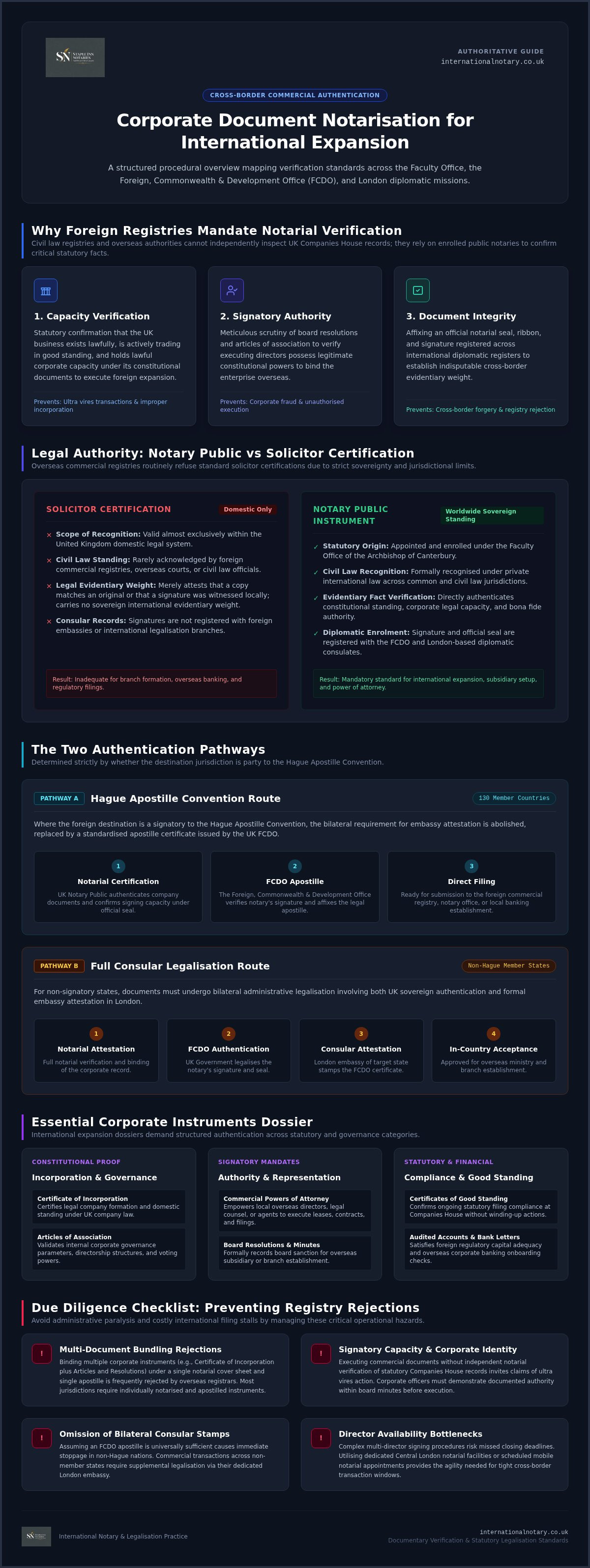
The receiving jurisdiction dictates whether an FCDO apostille or full consular legalisation is mandatory. The 1961 Hague Convention abolishes diplomatic legalisation requirements amongst signatory states. For corporate counsel, identifying the target country's treaty status is the decisive first step when notarising documents for international expansion. Submitting an apostille to a non-signatory state guarantees rejection at the border, whilst seeking unnecessary consular stamps wastes critical closing time. To accelerate statutory submissions, engage dedicated apostille and legalisation services before lodging filings abroad.
The Hague Apostille Procedure: Streamlined Global Acceptance
With 130 contracting parties to the Convention, including recent accessions such as China, Canada, and Viet Nam, this pathway offers rapid procedural legalisation. The Foreign, Commonwealth and Development Office (FCDO) verifies the notary public's registered signature and seal against national records maintained under Faculty Office regulation for notaries public. Once the physical apostille certificate is permanently affixed, member state registries must accept the instrument without diplomatic or consular intervention.
Consular Legalisation: The Multi-Tier Verification Process
Over 60 non-Hague jurisdictions, including major commercial destinations such as the United Arab Emirates, Qatar, Kuwait, and Egypt, enforce a multi-tiered verification chain. Documents must first undergo notarial certification, advance to the FCDO for official validation, and then proceed to the sovereign London embassy for consular attestation. Certain foreign missions mandate prior translation by accredited legal linguists before granting consular seals, followed by final counter-attestation by the destination country's Ministry of Foreign Affairs upon arrival.
Key Differences: Hague Member States vs Non-Hague Jurisdictions
Expanding across disparate legal systems requires navigating distinct authentication pipelines:
Navigating Corporate Due Diligence and Preventing Registry Rejections
Registry rejections waste valuable corporate deal momentum. When foreign authorities reject incoming paperwork, commercial launch dates slip, trade licences stall, and administrative costs escalate. Eliminating these risks requires a structured verification sequence before any legalisation commences:
Step 1: Obtain statutory records: Extract official certified copies of your certificate of incorporation, articles of association, and current confirmation statements directly from Companies House.
Step 2: Secure local counsel clearance: Instruct in-country corporate lawyers to review draft powers of attorney and board resolutions to confirm local statutory wording.
Step 3: Complete corporate notarial authentication: Execute documentation before an enrolled notary public who validates signatory identity, constitutional powers, and board authorisation.
Step 4: Execute sovereign legalisation: Obtain an FCDO apostille or London embassy consular stamp according to the target jurisdiction's treaty obligations.
Step 5: Despatch the completed dossier: Deliver the bound instruments directly to your local corporate secretarial team abroad.
Systematically following this protocol ensures that notarising documents for international expansion remains a controlled, predictable exercise rather than a trial-and-error administrative bottleneck.
Establishing Proper Signatory Authority and Board Capacity
A notary public does not merely witness signatures. The notary conducts independent Companies House register checks to confirm active directorships, corporate solvency, and Persons with Significant Control (PSC) compliance. Reviewing the company's articles of association ensures execution compliance, identifying whether your business operates under sole director authority or requires dual-signatory execution. Board minutes must contain specific, unexpired corporate authorities explicitly empowering named officers to represent the business overseas.
Sworn Translations and Bilingual Execution Protocols
Civil law registries frequently decline English-only submissions. They mandate certified translations prepared by accredited or sworn translators. Dual-column bilingual instruments solve this friction efficiently, presenting parallel text that permits simultaneous English notarisation alongside the local language equivalent. Notaries must verify that foreign legal concepts accurately mirror English corporate governance terms, ensuring that authorities like "managing director" translate accurately into foreign legal registers.
Common Procedural Pitfalls That Derail Overseas Filings
Small administrative oversights regularly invalidate foreign legalisation dossiers. Common compliance traps include:
Stale Certificates of Good Standing: Most international commercial registries refuse statutory certificates issued more than 30, 60, or 90 days prior to submission.
Improper Document Bundling: Attaching several statutory records under a single notarial cover sheet frequently triggers immediate registry rejection; most overseas registrars mandate standalone apostilles per instrument.
Unbound Corporate Schedules: Failing to bind multi-page filings with professional eyelets and ribbons violates document integrity rules enforced across civil law jurisdictions.
Avoid expensive administrative filing delays. Book an appointment with Staple Inn Notaries to review your cross-border document portfolio before dispatching it abroad.
Securing Central London Notarial Services for Seamless International Expansion
Selecting a specialised Central London notary ensures immediate physical proximity to government departments and diplomatic missions. When completing cross-border transactions under tight completion timetables, geographic location directly dictates filing speed. Staple Inn Notaries coordinates complex corporate certifications, expedited FCDO apostilles, and foreign consular legalisation from the heart of legal London. Our practice dispatches documents via hand courier directly to sovereign embassies across Mayfair, Belgravia, and the City. Discover how our dedicated legal advisory services safeguard your cross-border commercial strategy from procedural delays.
Rapid Turnaround via Chancery Lane and Embassy Networks
Positioning our practice near Chancery Lane enables prompt hand-delivery to key diplomatic missions across Central London. While standard postal submissions to the government legalisation office in Milton Keynes can take weeks, registered corporate channels secure expedited turnarounds. Direct diplomatic contacts reduce document handling friction during multi-jurisdictional subsidiary registrations, giving enterprise clients a reliable conduit through consulates that refuse unvetted postal lodgements.
Corporate Boardroom and Mobile Notary Solutions
Coordinating executive signatories across busy calendars often jeopardises overseas transaction deadlines. Mobile notaries attend London corporate headquarters directly, witnessing simultaneous board signatures in your boardroom without executive disruption. This on-site attendance facilitates comprehensive notarial oversight for high-volume corporate certification packages, ensuring seamless execution during multi-territory restructuring and overseas acquisition programmes.
Instructing Your London Notary Public
Meticulous preparation guarantees rapid turnaround times. When notarising documents for international expansion, assembling your documentation early prevents avoidable delays:
Statutory Records: Collate current company registers, constitutional articles, and up-to-date board minutes approving the foreign undertaking.
Signatory Proofs: Supply original photo identification and verified residential proofs for all executing directors and authorised attorneys.
Registry Requirements: Confirm in advance whether your destination commercial registry requires physical wet-ink seals, bound ribboning, or electronic verification.
Engage our specialist team to schedule your corporate document consultation today.
Streamline Your International Commercial Filings
Expanding into new global markets demands absolute procedural precision. Successfully notarising documents for international expansion requires aligning your statutory records with local civil registers, establishing unassailable director authority, and selecting the correct authentication pathway between the Hague Apostille and bilateral consular legalisation. Overlooking these mechanics risks severe administrative delays that can quickly derail foreign subsidiary formation.
Staple Inn Notaries delivers complete certainty for enterprise transactions. Regulated by the Faculty Office of the Archbishop of Canterbury, our Central London office provides direct physical access to both the FCDO and foreign embassies. We provide comprehensive corporate legalisation handling, managing everything from initial drafting reviews and Companies House verifications through to final consular attestation.
Protect your closing timetable and ensure immediate foreign registry acceptance. Instruct our London notaries to legalise your corporate documents and launch your overseas operations without delay.
Frequently Asked Questions
Why do foreign company registries reject standard UK solicitor certified documents?
Foreign registries reject UK solicitor certifications because solicitors hold domestic authority that carries no formal evidentiary weight under private international law. Civil law jurisdictions require authentication by a public notary regulated by the Faculty Office of the Archbishop of Canterbury. Unlike solicitor stamps, notarial acts constitute sovereign public instruments recognised globally, verifying corporate capacity, identity, and statutory compliance beyond British borders.
Which corporate documents must be notarised when opening a foreign subsidiary?
Opening a foreign subsidiary typically requires notarising your Certificate of Incorporation, Articles of Association, Certificate of Good Standing, and board minutes approving the venture. Commercial powers of attorney delegating execution authority to in-country counsel must also be certified. Foreign commercial authorities scrutinise these corporate instruments alongside certified director passports to confirm lawful corporate existence and prevent unauthorized administrative filings.
What is the practical difference between a Hague apostille and embassy legalisation?
A Hague apostille is a single certificate issued by the UK Foreign, Commonwealth & Development Office (FCDO) that validates documents across all 130 member nations. Consular legalisation applies to non-signatory jurisdictions like the UAE, Qatar, and Egypt. It requires a multi-stage procedure where records move from the notary to the FCDO, and finally to the destination country's London embassy for diplomatic attestation.
Can a UK notary certify corporate documents on behalf of an overseas branch?
Yes, a London notary can certify documents for UK companies establishing or operating an overseas branch. The notary verifies parent entity records at Companies House, confirms the constitutional authority of directors to expand abroad, and executes formal certificates confirming lawful capacity. This authentication ensures foreign branch applications satisfy both English corporate governance rules and the administrative demands of target commercial registrars.
How long does corporate document notarisation and apostille legalisation typically take in London?
Turnaround times depend on whether you use public postal routes or Central London corporate channels. Standard postal processing through the FCDO Legalisation Office averages 15 to 20 working days. Registered London notaries access expedited business lodgement services that compress FCDO handling to next-day delivery. Consular attestation timelines vary by embassy, often adding several extra working days to multi-jurisdictional filings.
Do company directors need to appear in person before a London notary public?
Yes, directors executing deeds, affidavits, or commercial powers of attorney must appear in person before an enrolled notary public with verified photo identification. For corporate transactions, mobile notaries attend company offices across Central London to witness simultaneous board signatures on-site. This eliminates travel friction when notarising documents for international expansion under compressed commercial timetables.
Is an electronic apostille (e-Apostille) valid for international corporate expansion filings?
Acceptance of digital e-Apostilles depends entirely on the receiving registry's domestic regulations. While the UK FCDO issues e-Apostilles for digitally certified instruments, many civil law commercial registries across the Middle East, Southern Europe, and Latin America still reject them. When notarising documents for international expansion, registrars frequently mandate traditional physical legalisation bound with wet-ink signatures, embossed notarial wafers, and eyelets.


Comments