
ID1 Forms Explained: Secure Your London Property Deal

Updated: Sep 8
A single administrative error on a Land Registry application can halt a multi-million pound London property deal in its tracks. This is the reality of modern identity verification, where the ID1 form serves as a critical frontline defence against sophisticated property fraud. In this guide to ID1 forms explained: If you’re involved in certain property transactions in England and Wales, you'll discover that the Land Registry demands absolute precision when you aren't using a legal representative. It isn't merely a procedural hurdle; it's a mandatory security protocol designed to protect your most valuable assets.
We recognise that the pressure to secure professional verification quickly can be overwhelming, especially when deadlines are tight and the requirements seem opaque. You likely feel that the risk of application rejection is a burden you shouldn't have to carry alone. This expert breakdown provides the clarity you need to master the complexities of the process with confidence. We'll examine the specific documentation required, the strict three month validity period, and the essential role of a qualified professional in certifying your identity to ensure a successful registration.
Table of Contents
What is an ID1 Form and Why is it Mandatory?
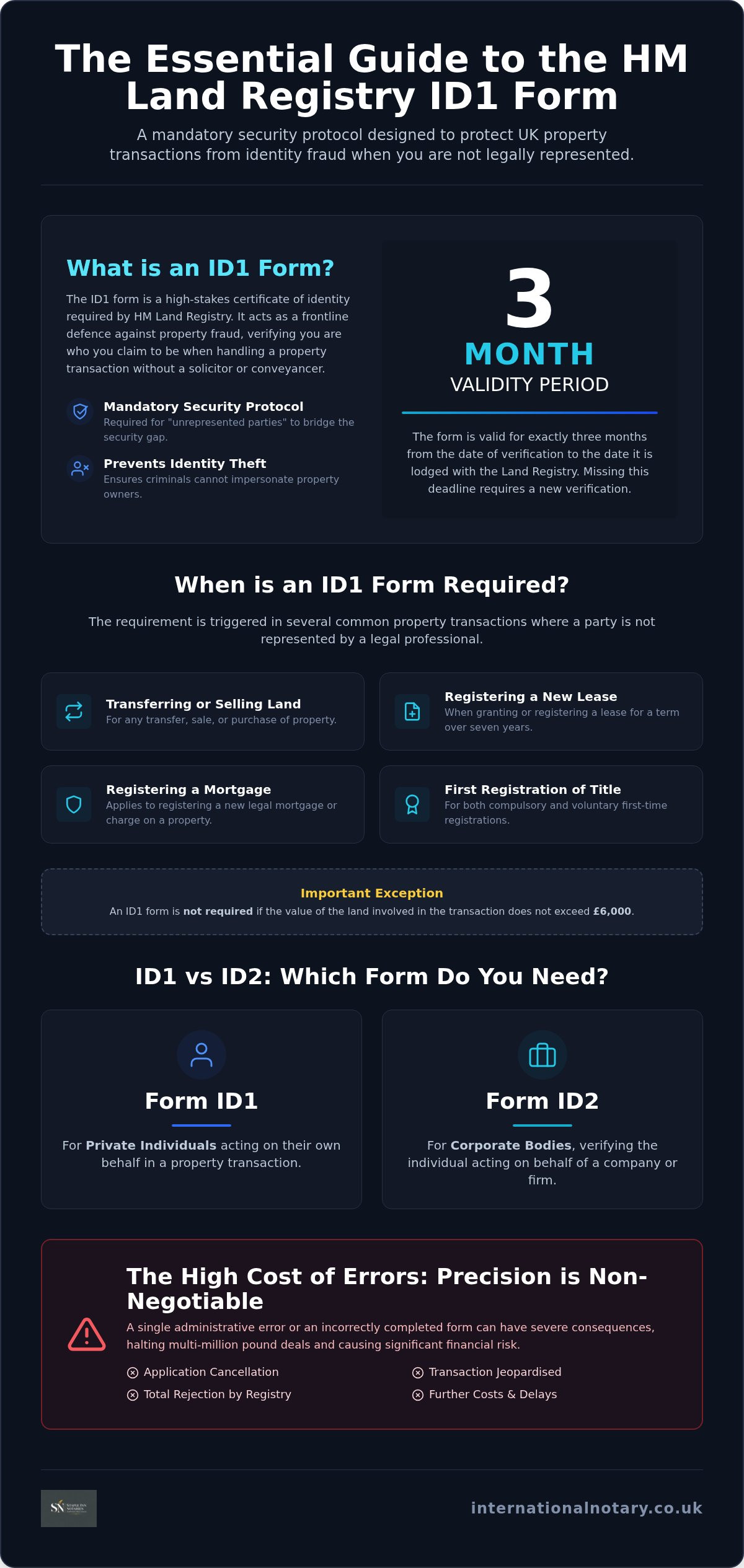
The ID1 form is a formal certificate of identity mandated by the government for individuals who aren't represented by a legal professional during a property deal. It's a high-stakes security protocol. When you choose to handle your own registration, you're classified as an "unrepresented party" by the state. This designation triggers a mandatory requirement for independent identity verification. To understand ID1 forms explained: If you’re involved in certain property transactions in England and Wales, you must recognise that the form acts as a bridge between your private identity and the public register. Precision is non-negotiable. The document remains valid for exactly three months from the date of professional verification until the date of lodgement. Should you miss this deadline, the verification expires, necessitating a fresh appointment and further costs.
The Role of HM Land Registry in Fraud Prevention
Property fraud remains a persistent threat to the UK's economic stability. Criminals frequently attempt to sell or mortgage properties they don't own by impersonating the legitimate registered proprietor. To counter these threats, HM Land Registry maintains a rigorous system of identity checks. The registry's role is to ensure that every entry on the register is authentic and legally sound. As the industry moves toward digital identity standards, the registry has intensified its scrutiny of manual forms. If your ID1 form is incorrectly completed, or if the professional certifier doesn't meet the registry's strict criteria, your application will be cancelled. This isn't just a minor administrative delay. It's a total rejection that can jeopardise your entire property transaction.
Private Individuals vs. Corporate Bodies (ID1 vs. ID2)
It's vital to select the correct documentation for your specific legal status. The ID1 form is designed for private individuals, whereas the ID2 form is the equivalent requirement for corporate bodies. If you're a company director or a partner in a firm involved in a land transfer, the ID2 form is your required route. It involves verifying the identity of the individual acting on behalf of the corporation. Staple Inn Notaries operates as an expert gatekeeper for these documents, providing professional certification for both ID1 and ID2 forms. We ensure your paperwork adheres to the meticulous standards required by the registry. Our Central London office is equipped to handle these urgent certifications, providing the rapid response and technical accuracy that both corporate entities and private individuals require for complex property dealings.
When is an ID1 Form Required in Property Transactions?
The requirement for an official ID1 form arises primarily when a party to a land transaction acts without a solicitor or licensed conveyancer. This unrepresented status creates a security gap that the Land Registry must bridge through formal identity attestation. In the context of ID1 forms explained: If you’re involved in certain property transactions in England and Wales, you'll find that the mandate applies to both the applicant and any other unrepresented party involved in the dealing.
These scenarios include:
Transferring, selling, or purchasing land.
Granting or registering a lease for a term exceeding seven years.
Registering a legal mortgage or charge.
Compulsory or voluntary first registration of title.
Beyond standard sales, the registry demands verification for unrepresented lenders during the discharge or release of a charge. This ensures that the individual authorised to remove a financial interest from a title is indeed who they claim to be. However, an ID1 form isn't required if the value of the land involved in the transaction doesn't exceed £6,000. Whether the application for first registration is voluntary or compulsory, the identity of the applicant must be verified if they aren't using a professional firm.
Unrepresented Parties and the DIY Property Market
The rise of DIY conveyancing has increased the frequency of these requirements significantly. If you choose to manage your own property registration, you must provide a certified ID1. Proceeding without professional identity attestation is impossible. The registry will simply refuse to process the application. The form validates your identity for the public record, ensuring the integrity of the UK's property market whilst protecting you from potential identity theft.
Executors and Probate-Related Property Transfers
Handling the estate of a deceased relative often involves property transfers that catch beneficiaries off-guard. Executors transferring property from a deceased estate are frequently unrepresented by a conveyancer, necessitating a verified ID1. This is where Probate Administration and identity requirements intersect. Beneficiaries must navigate these technical hurdles to ensure the legal title passes correctly. If you find yourself managing an estate and require rapid verification, you can contact our Central London office for an efficient identity certification appointment.
Who Can Verify an ID1 Form? Notaries vs Solicitors
Authorised professionals include Notaries Public, Solicitors, Barristers, and Licensed Conveyancers. Crucially, the verifier must be independent. They cannot be the same individual or firm acting for you in the transaction itself. This separation of duties is a cornerstone of the Land Registry identity requirements, designed to prevent collusion and ensure the integrity of the attestation. Choose your verifier carefully to avoid application rejection. An independent professional provides the objective assurance the registry demands.
Whilst solicitors are commonly used, a Notary Public is frequently the preferred choice for complex or high-value matters. Notaries are international legal officers whose seals are recognised globally. For ID1 forms explained: If you’re involved in certain property transactions in England and Wales, you'll find that the meticulous nature of a notary’s verification process provides an additional layer of security that the Land Registry respects. We operate with a modern, fast-paced mindset to eliminate procedural delays. Our role is to act as a trusted gatekeeper, ensuring your identity is beyond reproach before the document is submitted.
The Notary Advantage for International Residents
Securing verification is difficult if you're resident overseas whilst dealing with a UK property. Staple Inn Notaries specialises in assisting international clients, providing a bridge between foreign jurisdictions and the UK property market. A Notary’s seal carries significant weight in global property dealings. It ensures your identity is verified to a standard that satisfies both domestic and international regulatory bodies. Our expertise ensures your documentation is processed without the delays typical of less specialised firms. We understand the time-sensitive nature of international deals and respond with the necessary urgency.
Verification by UK Armed Forces and Other Exceptions
Specific provisions exist for serving officers of the UK armed forces operating overseas. These officers can verify identity in certain circumstances, provided they hold a rank of at least Lieutenant, Flight Lieutenant, or Captain. Additionally, "Facility Letter" arrangements may apply for bulk transactions involving large institutions. These are rare for private individuals. For the vast majority of transactions, professional verification remains the mandatory norm. If you require a rapid appointment, you can book a session via our online calendar. Don't leave your identity verification to chance.
How to Complete an ID1 Form: A Step-by-Step Guidance
Completing the ID1 form requires methodical attention to detail to prevent application rejection. First, ensure you download the most recent version of the form from the official GOV.UK portal, as outdated versions are summarily dismissed by the Land Registry. You must accurately complete Section A, detailing your personal information and the specific nature of the property transaction. When considering ID1 forms explained: If you’re involved in certain property transactions in England and Wales, you'll find that any discrepancy between Section A and your supporting evidence will cause immediate delays. Remember that as of the February 2026 update, electronic signatures are strictly prohibited on this document.
Collate your original evidence of identity before scheduling your appointment. You cannot use photocopies for the verification process. Once prepared, you must arrange a face-to-face meeting or an approved video appointment with a qualified professional. During this session, the verifier will complete Section B, certifying that the details provided are accurate and that the individual before them matches the documentary evidence. They will also sign the back of a recent passport-sized photograph, which must be attached to the form. This professional attestation is the final safeguard before your application is lodged.
Documentary Evidence: What You Must Bring
The Land Registry categorises acceptable evidence into two distinct groups. List A contains primary identification such as a valid UK passport, a driving licence, or a Biometric Residence Permit. If you possess a List A document, you typically only need one additional document from List B. However, if a List A document is unavailable, you must provide two separate items from List B. These secondary documents, such as utility bills, bank statements, or council tax statements, must be dated within the last three months to be considered valid. Ensure your name and address are consistent across all provided documents.
The Verification Meeting: What to Expect
Expect a rigorous physical inspection of your original documents. The verifier is legally obligated to confirm the authenticity of your papers and ensure your physical appearance matches your photographic ID. You must provide a recent passport-sized photograph which the verifier will sign and date. To streamline this process for busy professionals, Mobile Notary London services can facilitate this verification at your office or residence, eliminating the need for travel. If you are ready to proceed with your verification, contact our Central London office to schedule an urgent appointment.
Staple Inn Notaries: Efficient ID1 Verification in Central London
Staple Inn Notaries acts as the definitive Expert Fixer for those navigating the time-sensitive demands of the London property market. Our office, strategically positioned near the capital's major transport hubs, provides a hub of professional authority for clients requiring immediate identity attestation. When dealing with ID1 forms explained: If you’re involved in certain property transactions in England and Wales, the margin for error is non-existent. We provide the technical rigour necessary to ensure your application is accepted on the first attempt, preventing the costly cancellations that often result from amateur oversight.
Our practitioners possess deep expertise in Passport and ID Certification, a service that is fundamental to the security of domestic and international property dealings. Should your transaction involve overseas assets or foreign jurisdictions, we facilitate a rapid transition to Apostille Services London. This integrated approach ensures that your documentation meets the stringent requirements of both HM Land Registry and international regulatory bodies without the need for multiple service providers.
Mobile Notary Services for Busy Professionals
For corporate board members and high-net-worth individuals, the logistics of attending a central office can be prohibitive. Our mobile notary services resolve this by bringing the verification process directly to your Central London residence or place of business. This high-efficiency model is designed to support the rapid pace of modern commerce, ensuring that your property transaction proceeds without a single day of unnecessary delay. We manage the complexities of the ID1 process with a calm competence that reduces client anxiety and reinforces the validity of the legal record.
Book Your Appointment Today
Don't permit administrative hurdles to jeopardise your property deal. You can Contact Staple Inn Notaries to secure a priority appointment. We also offer the efficiency of Online Booking via Calendly for those who require immediate confirmation. Our commitment to meticulous legal standards and professional authority makes us the trusted gatekeeper for your most significant property documentation. We operate with the controlled urgency required to keep your transaction on track.
Secure Your Property Registration with Expert Attestation
Mastering the identity verification process is the final step in ensuring your property dealings remain secure and legally sound. We've established that the ID1 form is a critical safeguard against fraud, requiring meticulous documentation and independent professional certification. Navigating these requirements effectively prevents the administrative delays or application rejections that can disrupt time-sensitive transactions. This guide to ID1 forms explained: If you’re involved in certain property transactions in England and Wales provides the framework you need for a successful lodgement with HM Land Registry.
Staple Inn Notaries operates as your trusted gatekeeper in the heart of the City. Regulated by the Faculty Office of the Archbishop of Canterbury, we provide the high-level professional authority required for complex legal certifications. Whether you visit our office or utilise our rapid mobile notary service, our Central London expertise ensures your identity is verified with absolute precision. Don't leave your property deal to chance. Book your urgent ID1 verification with Staple Inn Notaries today to guarantee a seamless and efficient registration process. We look forward to facilitating your next successful property transaction.
Frequently Asked Questions
How long does an ID1 form remain valid for the Land Registry?
When considering ID1 forms explained: If you’re involved in certain property transactions in England and Wales, you'll find that the document remains valid for exactly three months. This period runs from the date of professional verification until the date the application is lodged with the Land Registry. If this window closes before your submission is processed, the verification expires. You'll then need to arrange a fresh appointment to avoid repeat certifications and unnecessary procedural delays.
Can I verify my own ID1 form if I am a qualified solicitor?
You cannot verify your own identity, even if you're a qualified solicitor, barrister, or notary public. The Land Registry requires independent verification to maintain the integrity of their anti-fraud systems. The professional certifier must be a third party who isn't personally involved in the transaction or related to the applicant. This separation ensures that the identity attestation remains objective. Attempting to self-verify will result in the immediate rejection of your property application.
What happens if the Land Registry rejects my ID1 form?
If the Land Registry rejects your ID1 form, they'll typically cancel your entire application rather than holding it in abeyance. Common reasons for rejection include using an outdated form version, missing signatures, or verification by an unauthorised person. You'll need to correct the errors immediately, which often involves a new verification meeting and further professional fees. This highlights the importance of using an expert fixer to ensure your paperwork is flawless from the outset.
Is a video call verification acceptable for an ID1 form?
Video call verification is acceptable provided the professional follows the HM Land Registry digital identity standard. Whilst Section B is for traditional face-to-face meetings, Section C was added in June 2025 specifically for digital verification by conveyancers. However, the physical form cannot be signed with an electronic signature. It must still be a wet-ink signature on the paper document after the identity has been confirmed via the approved digital or remote channels.
Do I need an ID1 form if I am selling my house through a solicitor?
You don't usually need an ID1 form if you're represented by a solicitor or licensed conveyancer during your sale. Your legal representative carries out their own identity checks as part of their professional obligations; for instance, Eagle Haus Conveyancing Consultants provide full representation for residential transactions, which bypasses the need for an ID1. The ID1 requirement is specifically for unrepresented parties who are handling their own registration. If you're involved in certain property transactions in England and Wales without a lawyer, this form becomes a mandatory component of your official submission.
The primary difference lies in the legal status of the applicant. An ID1 form is the certificate of identity for private individuals, whereas an ID2 form is required for corporate bodies or other organisations. If a company director is signing property documents on behalf of a business, they must use the ID2 route. Both forms serve the same anti-fraud purpose but require different details regarding the entity's registration and the individual's specific authority to act.
Can a Notary Public verify an ID1 form for an overseas resident?
A Notary Public is specifically authorised to verify ID1 forms for individuals resident overseas who are dealing with UK property. This is a core part of our international service. Because notaries hold a globally recognised office, their seal provides the high level of assurance required by the Land Registry for cross-border transactions. It's an efficient solution for expatriates or foreign investors who cannot attend a meeting within the borders of England or Wales.
How much does a Notary charge for ID1 form verification in London?
Professional fees for ID1 verification in London vary depending on the complexity of the matter and whether you require a mobile service. The total cost reflects the specialist expertise and regulatory responsibility involved in the certification. You should always confirm the fee structure with the firm before your appointment. Our Central London office provides transparent, competitive rates that reflect the rapid, high-quality service we deliver to both corporate and private clients.



Comments