
ID1 Form Identity Verification Guide for London Residents

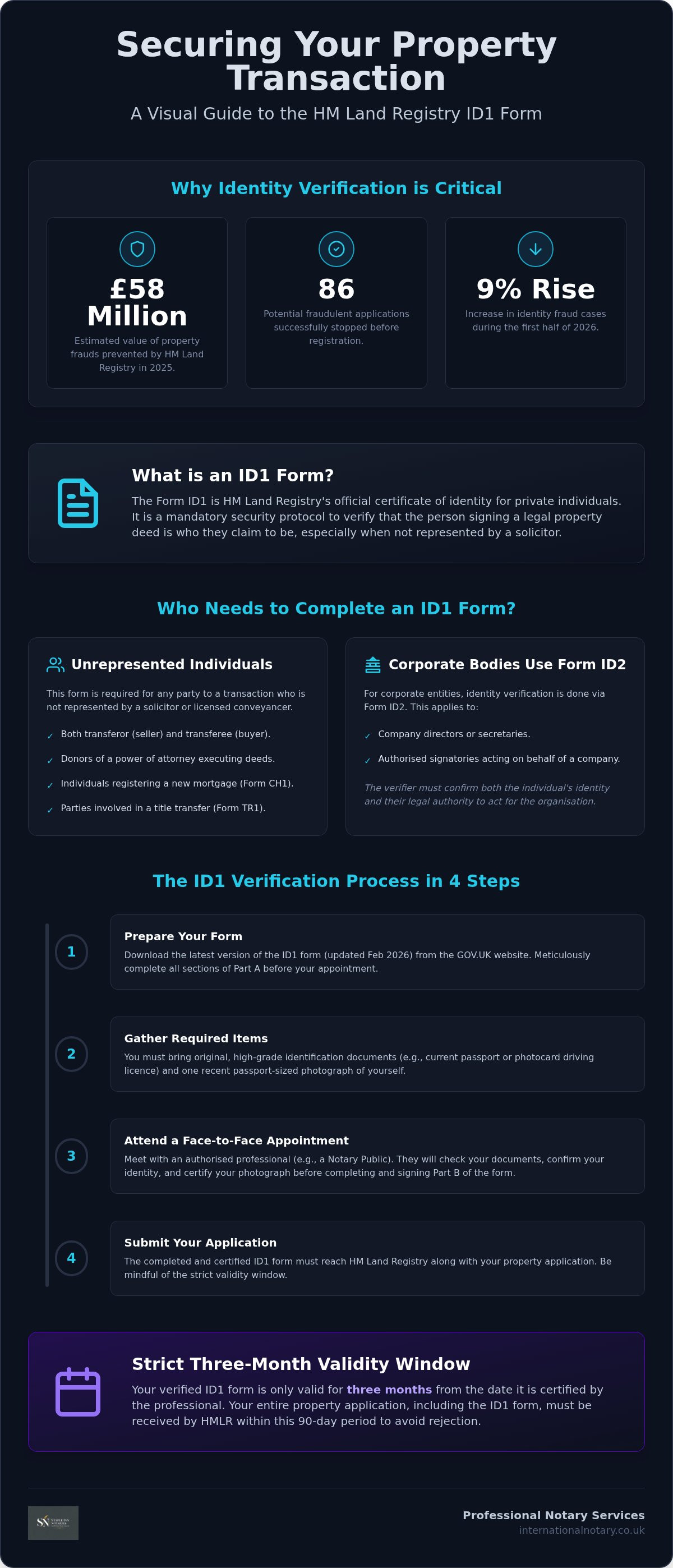
Did you know that HM Land Registry prevented 86 potential property frauds valued at an estimated £58 million in 2025? This staggering figure explains why the registry maintains such rigorous standards for identity certification. If you're managing a property sale or transfer independently, you may be asked to complete an ID1 form to verify your identity. This requirement acts as a vital gatekeeper in a landscape where identity fraud cases rose by 9% in the first half of 2026.
We understand that the prospect of HMLR rejecting your application due to a minor administrative oversight is a significant source of anxiety, especially when a London property completion is imminent. It's frustrating to face confusion over which professionals are authorised to sign your documentation or how to meet the strict three month validity window. You need a process that's both legally watertight and exceptionally efficient to avoid costly procedural delays.
This guide provides a definitive roadmap for navigating the ID1 verification process with professional oversight from an expert Central London notary. We'll detail the necessary identification documents, explain the latest February 2026 form updates, and demonstrate how a meticulous notarisation ensures your transaction remains on track. By the end of this article, you'll have the clarity required to satisfy HMLR's standards and secure your property deal with total peace of mind.
Table of Contents
Understanding the ID1 Requirement: Why You Must Verify Your Identity
The ID1 form serves as the official HM Land Registry certificate of identity for private individuals engaged in property transactions across England and Wales. It's a fundamental instrument of procedural compliance designed to verify that the person signing a legal deed is exactly who they claim to be. If you're proceeding without a solicitor, you may be asked to complete an ID1 form to verify your identity. This requirement is not a mere administrative hurdle; it's a rigorous security protocol essential for maintaining the integrity of the national property register.
The Role of HM Land Registry in Property Transfers
HM Land Registry (HMLR) operates as the authoritative custodian of land ownership, ensuring that every transfer, charge, or discharge is recorded with absolute precision. Whilst solicitors usually provide identity assurances for their clients, unrepresented parties don't benefit from this institutional oversight. To compensate for this, HMLR demands independent verification from a Notary Public, solicitor, or a Licensed Conveyancer. This scrutiny is intensive. Failure to provide a correctly completed and stamped ID1 form results in the immediate rejection of your application. In a competitive London market where timing is everything, such a setback can be catastrophic. If you're facing an urgent deadline, you can contact us to arrange a priority appointment.
Preventing Identity Fraud in the London Property Market
Identity theft and "property hijacking" represent significant threats to the UK's economic stability. HM Land Registry recorded 55 cases of property fraud between April 2025 and March 2026, highlighting the persistent nature of this criminal activity. When managing high-value London assets, you may be asked to complete an ID1 form to verify your identity. This requirement stops criminals by requiring a face-to-face meeting with an authorised professional. During this appointment, the verifier must examine original, high-grade identification documents and certify a passport-sized photograph of the applicant. This isn't just a signature. It's a formal declaration to the Registry, carrying substantial legal weight and professional liability. Our role as your Central London notary is to act as the trusted gatekeeper, providing the rapid, high-precision verification needed to secure your assets.
Who Needs an ID1 Form? Assessing HMLR Compliance
Identity verification is a mandatory component of the HM Land Registry application process for any unrepresented party. If you are conducting a property transfer (Form TR1), registering a new mortgage (Form CH1), or granting a lease without a solicitor, you may be asked to complete an ID1 form to verify your identity. This requirement applies to both the transferor (seller) and the transferee (buyer) to ensure the registry's records remain secure. It also encompasses "donors" of powers of attorney who are executing deeds that impact title. Even in cases where a solicitor is involved in a limited capacity, the registry may still insist on an independent ID1 if the solicitor isn't providing a comprehensive identity guarantee for that specific individual. This often occurs in family transfers or when parties decide to handle the administrative submission themselves to save on legal fees.
Private Individuals vs. Corporate Bodies (Form ID2)
Private individuals use the ID1, but corporate entities must submit Form ID2. This is a common point of confusion for business owners. Company directors, secretaries, or authorised signatories must provide clear evidence of their authority to act, often through a company resolution or official minutes. The verifier's role here is twofold: confirming the individual's identity and validating their legal standing within the organisation. We frequently assist City-based firms with professional certification of these corporate documents to ensure HMLR compliance is met without delay. This meticulous approach prevents the registry from questioning the validity of the corporate execution, which is a frequent cause of rejection for unrepresented business applications.
Exceptions to the Identity Verification Rule
Unless a specific exemption applies, you may be asked to complete an ID1 form to verify your identity. This requirement remains the standard for the vast majority of unrepresented property dealings in London. However, exceptions do exist. Transactions involving property values under £6,000 generally don't trigger the need for formal verification. Additionally, if a solicitor is already providing a certificate of identity for you, a separate ID1 is unnecessary. Trustees and personal representatives in probate cases also face specific requirements. Their identity must often be confirmed unless a legal professional is already providing the necessary assurances to the registry. Understanding these nuances is vital to avoid "stale" applications. Our team ensures these distinctions are handled with the precision required for a successful application, providing the fast turnaround necessary for time-sensitive London property deals.
Professional Verification: Choosing Between a Notary and a Solicitor
HM Land Registry maintains a restrictive list of professionals authorised to certify an ID1 form. Only a Notary Public, a solicitor, a licensed conveyancer, or a barrister currently holding a practising certificate can perform this function. A common misconception amongst unrepresented parties is that any established professional, such as a doctor or teacher, can sign the certificate. This is incorrect. If your documentation is certified by an unauthorised individual, the registry will reject the application immediately. When managing high-value transactions, you may be asked to complete an ID1 form to verify your identity. This requirement demands a verifier with high regulatory standing and technical precision.
Choosing a Notary Public offers a distinct advantage for complex or international property matters. While many high-street solicitors focus on domestic litigation or general practice, a notary's primary function is the authentication of facts and documents for use in official registries. The "Expert Fixer" approach ensures that every detail, from the ink colour to the positioning of the professional seal, aligns with HMLR standards. This meticulousness reduces the risk of rejection and provides the peace of mind that your identity fraud checks are satisfied before submission.
The Notary Advantage in Central London
Speed and accessibility are critical when a property completion is imminent. Large law firms often require lengthy onboarding processes or lack the flexibility to accommodate urgent walk-in appointments. As a specialised practice based in a historic legal centre, we prioritise rapid turnaround. We understand the time-sensitive nature of London property deals and provide a streamlined service that bypasses the bureaucratic delays typical of larger institutions. Learn more about our Notary Public Central London services to see how we facilitate efficient legal certification.
Verification for Overseas Residents and Armed Forces
The verification process becomes significantly more complex if you're resident abroad during the transaction. HM Land Registry has strict rules regarding who can certify identity outside the UK. In such cases, you may be asked to complete an ID1 form to verify your identity. This requirement can be satisfied by a local notary public or, for personnel serving abroad, by a UK armed forces officer. We frequently assist clients with international elements in their property deals, coordinating with overseas counterparts to ensure that all documentation meets the registry's exacting digital and physical standards. Whether you're a London resident or an expatriate, our mobile notary service can also bridge the gap for urgent property matters that require immediate attention.
Step-by-Step: Preparing for Your ID1 Verification Appointment
Success at the certification stage depends entirely on the precision of your preparation. To prevent the immediate rejection of your application, you must arrive at your appointment with documentation that satisfies the current HM Land Registry standards. If you are managing a property transfer independently, you may be asked to complete an ID1 form to verify your identity. This requirement necessitates that you download the most recent version of the form, which was last updated on 16 February 2026, directly from the official GOV.UK website. Outdated versions are no longer accepted by the registry. Complete Part A in full using black ink, ensuring every detail, particularly your full name and current residential address, matches your identification documents exactly.
Essential Documentation Checklist (Lists A and B)
The registry operates a strict tiered evidence system to combat the sophisticated fraud mentioned previously. You must provide either one document from List A or two distinct documents from List B. List A includes high-grade, government-issued photo identification such as a current valid passport, a UK photocard driving licence, or a Biometric Residence Permit. If you cannot produce a List A document, you must provide two items from List B. These typically include:
A utility bill dated within the last three months (excluding mobile phone bills).
A recent council tax bill for the current year.
A bank or building society statement issued within the last three months.
We recommend bringing original physical documents rather than digital printouts to ensure the verification process remains beyond reproach. If you are unsure whether your specific documents meet the criteria, please contact us for professional guidance before your visit.
The Role of the Passport-Sized Photograph
The photograph serves as the definitive physical link between the individual and the legal certificate. It must be a high-quality, passport-sized colour photograph taken within the last month that reflects your current appearance. During the appointment, the Notary Public will examine the photograph and sign a formal declaration on the reverse, certifying it as a true likeness of the applicant. Common errors that lead to rejection include using low-resolution home printouts or photographs that are several years old. We operate with an "Expert Fixer" mindset, meticulously checking these details to ensure your submission is watertight. Once your documentation is gathered, you can book an appointment at our Central London office or arrange for our mobile notary service to visit your location for urgent property matters.
Finalising Your Application: Submission and Validity Periods
The temporal aspect of identity verification is often overlooked, yet it remains a frequent point of failure for unrepresented applicants. HM Land Registry enforces a strict three month validity period for all ID1 certificates. This means the form must reach the registry and be lodged as part of your application within 90 days of the date it was signed by the Notary Public. If you are coordinating a complex chain or awaiting documentation from other parties, you may be asked to complete an ID1 form to verify your identity. This requirement is time-sensitive. A "stale" form that exceeds the 90 day limit will be rejected immediately, necessitating a entirely new verification appointment and potentially jeopardising your completion date.
We adopt an "Expert Fixer" approach to these time-critical submissions. By ensuring that every detail of the form is meticulously completed and stamped at the point of verification, we eliminate the risk of administrative queries that could cause your form to expire whilst in transit. The completed ID1 should be sent to HM Land Registry alongside your main application documents, such as the transfer deed or mortgage charge. Our practitioners provide a clear professional reference and direct contact details on the form, allowing the registry to perform its secondary security checks with absolute efficiency.
Mobile Notary Services for Urgent London Property Deals
For many City professionals and residents, finding the time to visit a legal office during business hours is a significant challenge. Our mobile service addresses this by providing rapid, on-site identity verification across the Square Mile and Central London. This is particularly valuable for urgent property completions where every hour counts. We bring the necessary legal authority to your home or office, ensuring your documentation is certified without you having to leave your desk. Explore our Mobile Notary London options for urgent business to secure a priority appointment that fits your schedule.
What Happens After Submission to HMLR?
Once your application reaches the registry, the caseworkers may contact the certifying Notary to confirm the verification was performed in person. This is a standard anti-fraud measure. Because we are regulated by the Faculty Office of the Archbishop of Canterbury, our certification carries the highest level of regulatory trust. When you may be asked to complete an ID1 form to verify your identity. This requirement is only satisfied when the registry is confident in the verifier's standing. Our prompt response to registry enquiries ensures your application progresses through the system without unnecessary friction. This professional oversight provides the definitive peace of mind that your London property transaction is secure, compliant, and protected against the growing threat of identity fraud.
Secure Your Property Transaction with Expert Certification
Precision is the only defence against procedural rejection. It's vital to ensure your documentation adheres to the latest February 2026 standards, especially when you are acting without legal representation. If you are managing a sale or transfer independently, you may be asked to complete an ID1 form to verify your identity. This requirement demands a verifier who understands the gravity of the declaration and the strict three month validity window enforced by HM Land Registry. A minor error at this stage can stall a time-sensitive London property deal for weeks.
Our practice provides the rapid, high-precision certification needed to keep your transaction on track. As expert notaries regulated by the Faculty Office of the Archbishop of Canterbury, we offer the authority and efficiency your legal documentation requires. Whether you visit our historic Central London office or utilise our mobile notary service for same-day verification, we ensure your identity fraud checks are satisfied without delay. Book your ID1 verification appointment with Staple Inn Notaries today to secure your submission and proceed with total confidence. We look forward to facilitating your successful completion.
Frequently Asked Questions
Who is authorised to verify an ID1 form in the UK?
Authorised professionals include a Notary Public, a solicitor, a licensed conveyancer, or a barrister currently holding a practising certificate. It is a common error to assume any established professional, such as a teacher or doctor, can perform this function. HMLR will only accept certificates from these specific regulated legal professionals. Choosing a notary ensures the meticulous precision and high-level authority required for high-value London property transactions.
Can I get an ID1 form verified online or via a video call?
While HMLR has introduced digital identity standards, the standard ID1 form process typically necessitates a face-to-face meeting. This is because the verifier must physically certify the reverse of a passport-sized photograph to confirm it is a true likeness of the applicant. We offer both office-based and mobile notary services in Central London to ensure this physical requirement is met rapidly and securely for your time-sensitive property deal.
How long is a verified ID1 form valid for HM Land Registry?
A verified ID1 form remains valid for exactly three months from the date of certification. This 90 day window is absolute. If the form reaches the registry after this period, it is considered "stale" and will be rejected immediately. To avoid procedural delays, we recommend scheduling your appointment close to your submission date, ensuring your documentation remains valid throughout the entire registration process for your London asset.
What is the difference between an ID1 and an ID2 form?
Form ID1 is designed for private individuals, whereas Form ID2 is the equivalent certificate for corporate bodies and companies. If you are acting as a director or secretary for a company, you must use the ID2. This requires additional evidence of your authority to represent the entity. Our Central London practice specialises in both forms, providing the expert certification and regulatory standing needed for complex corporate property transfers and registrations.
Do I need an ID1 form if I am using a solicitor for my property sale?
If you are fully represented by a solicitor who provides an identity guarantee to the registry, an ID1 is usually not required. However, you may be asked to complete an ID1 form to verify your identity. This requirement often surfaces if you are unrepresented or if your legal representative is only handling specific elements of the transaction rather than the full registration. We provide rapid verification to bridge this gap.
What documents do I need to bring to my ID1 verification appointment?
You must bring one document from List A, such as a valid passport or driving licence, or two documents from List B if photo ID is unavailable. List B items include utility bills or bank statements dated within the last three months. You also need a recent, passport-sized photograph. We insist on original physical documents to satisfy the registry's rigorous anti-fraud protocols and ensure your application remains beyond reproach.
Can a Notary Public verify an ID1 form for a property in England whilst I am abroad?
Yes, verification can be performed whilst you are resident abroad, but it must be conducted by a local notary public or a UK armed forces officer. The registry has specific criteria for overseas certifications to prevent international property fraud. We often coordinate with clients globally to ensure their documentation meets these exacting standards, providing the professional oversight and controlled urgency necessary for secure cross-border property dealings in the London market.
What happens if HM Land Registry rejects my ID1 form?
Rejection by HM Land Registry results in the immediate cancellation of your application, which can be catastrophic for time-sensitive London completions. You would be forced to restart the entire verification process, obtain new documentation, and incur further delays. Our "Expert Fixer" approach minimises this risk by ensuring every detail of your ID1 form is compliant and watertight before you submit it, providing the peace of mind you require.



Comments