
How to Get a Certified True Copy of a Passport in London (2026 Guide)

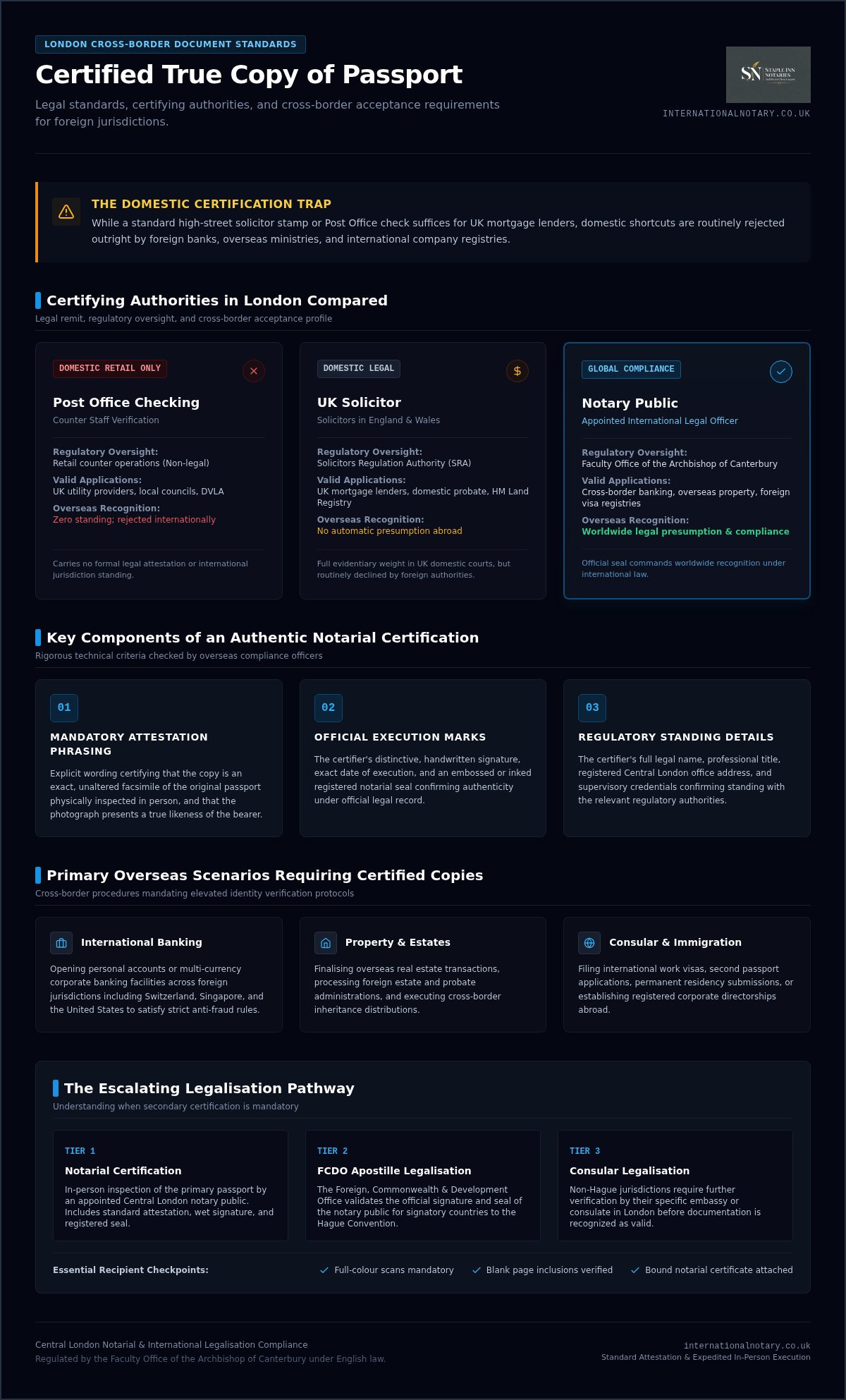
A routine stamp from your local Post Office or a standard high-street solicitor might satisfy a UK mortgage lender, but foreign banks and overseas government registries routinely reject them outright. If you need a certified true copy of passport London authorities and foreign jurisdictions will unconditionally accept, domestic certification shortcuts simply won't suffice. It is intensely frustrating to watch critical international transactions, cross-border corporate filings, or visa applications grind to an abrupt halt due to an unrecognised domestic verification stamp.
This 2026 guide sets out the exact legal standards, certifying authorities, and procedural requirements to ensure your identity documentation clears foreign scrutiny without delay. We examine the vital distinction between solicitor and notarial verifications, clarify precisely when an FCDO apostille must accompany your notarial certificate, and explain how to coordinate an expedited in-person or mobile appointment across Central London.
Table of Contents
What Is a Certified True Copy of a Passport in London?
A certified copy is an official duplicate of a primary identification document, verified and endorsed by an authorised legal professional to confirm that it represents an exact, unaltered facsimile of the original record. In formal legal terms, establishing What is a Certified True Copy requires the certifier to physically inspect the genuine passport, review the security features, and attest that the photographic reproduction reflects the true likeness of the bearer. When securing a certified true copy of passport London professionals can present internationally, simple unverified photocopies or digital printouts won't satisfy statutory compliance.
Cross-border financial institutions, overseas government ministries, and international judicial bodies enforce stringent verification protocols. They mandate notarised copies specifically to mitigate the growing risks of international identity fraud, document tampering, and corporate impersonation. Without a formal physical inspection and contemporaneous attestation by an officially appointed certifier, foreign compliance officers will reject your paperwork out of hand.
When Overseas Authorities Demand a Certified Passport Copy
Foreign jurisdictions require elevated document verification across several standard legal and commercial procedures:
International Corporate and Retail Banking: Opening overseas personal bank accounts or multi-currency corporate facilities across jurisdictions such as Switzerland, Singapore, or the United States.
Cross-Border Property and Estate Matters: Finalising real estate acquisitions abroad, managing foreign probate files, or distributing cross-border inheritance assets.
Immigration and Consular Filings: Processing international work visas, second passports, foreign corporate directorships, or permanent residency applications.
Key Components of an Authentic Notarial Certification
Overseas compliance officers check certified documents against rigorous technical criteria. To secure international validity, an authentic notarial certification must incorporate specific elements:
Mandatory Attestation Phrasing: Explicit wording certifying that the document is a true copy of the original passport inspected in person and that the photograph presents a true likeness of the holder.
Official Execution Marks: The distinctive, handwritten signature of the appointed certifier, the precise date of execution, and an embossed or inked registered notarial seal.
Regulatory Standing Details: The certifier's full legal name, professional title, registered central London office address, and supervisory body credentials, confirming their standing with the relevant regulatory authorities.
Who Can Legally Certify Your Passport in London? Comparing Options
Selecting the appropriate certifying official depends entirely on where your documentation will ultimately be presented. The English legal framework authorises several professionals to endorse identity papers for domestic purposes, but overseas recipients adhere to far stricter verification protocols. While a UK solicitor's signature carries full evidentiary weight before domestic courts and financial institutions, it holds no automatic legal presumption abroad, where only a notary public's official seal commands worldwide recognition.
Post Office and Solicitor Certification vs Notary Public
Understanding the statutory limitations of each certifier prevents costly procedural rejections:
Post Office Document Checking: Counter staff verify photocopies exclusively for domestic UK utilities, local councils, or basic DVLA requirements. These retail verifications carry no weight with overseas institutions.
Solicitors in England and Wales: Regulated by the Solicitors Regulation Authority (SRA), solicitors endorse documents for UK mortgage lenders, domestic probate matters, and HM Land Registry filings under domestic common law rules.
Notaries Public: Regulated by the Faculty Office of the Archbishop of Canterbury, notaries serve as internationally recognised legal officers. When executing a certified true copy of passport London professionals require for global compliance, a notary public provides the essential cross-border validity foreign regulators expect. Official guidance on who can legally certify your passport covers domestic referee rules, but international matters demand this formal notarial authority.
Why Foreign Jurisdictions Reject Standard UK Certifications
Civil law jurisdictions across Continental Europe, the Middle East, Asia, and the Americas do not recognise standard UK solicitor endorsements. Their legal codes recognise the office of the notary rather than common-law solicitors, and foreign public registries maintain no mechanism to authenticate individual solicitor credentials.
Notaries public eliminate this friction entirely. Every London notary's signature and unique seal are formally lodged with the Foreign, Commonwealth and Development Office (FCDO) and foreign consulates. This established infrastructure enables foreign registries to confirm the certifier's legal authority immediately. If you need to satisfy exacting foreign requirements under tight deadlines, you can reach out to our London notaries to secure an unassailable international certification.
How to Obtain a Certified True Copy of Your Passport: Step-by-Step
Securing an internationally recognised document requires a precise sequence of verification steps. When arranging a certified true copy of passport London authorities and overseas compliance teams will accept, adhering to an exact protocol prevents costly administrative delays and document rejections.
Preparing Your Physical Documents Before Your Appointment
Inspect your passport before attending any consultation. The booklet must be fully valid, current, and free from structural defects such as water damage, separated binding, or lifting laminate. Check whether your foreign recipient demands a copy of simply the photographic biodata page or the entire booklet, including all blank visa pages.
Standard UK government guidance on certifying a document provides a baseline for domestic procedures, but international registries almost universally require high-resolution colour reproductions. Gather any specific certification phrasing requested by the receiving overseas counsel, alongside secondary proof of your residential address dated within the past three months to satisfy statutory anti-money laundering checks.
The In-Person Identity Verification and Due Diligence Process
Present your original, physical passport in person. A certifying official cannot execute a valid international attestation from a digital upload, mobile photograph, or pre-existing photocopy without direct visual examination of the original booklet.
The notary examines the document to verify physical security features, inspecting holograms, microprinting, and the machine-readable zone (MRZ) against fraud protocols. A face-to-face visual comparison confirms that the photographic biometric data matches your appearance. For corporate matters, such as verifying overseas company directors, the notary checks corporate registry documentation alongside the individual identity verification before completing the record.
Executing the Formal Notarial Certificate and Seal
Once identity and authenticity are confirmed, the notary creates an exact, high-resolution colour copy of your passport leaves. Depending on the formal requirements of the receiving foreign jurisdiction, the attestation is executed in one of two ways:
Direct Endorsement: The notary inscribes the formal attestation text, signature, and official seal directly onto the face of the photocopied passport page.
Separate Notarial Certificate: The notary drafts a standalone formal certificate, securely binding it to the colour passport copy using legal eyelets and ribbon to prevent tampering.
Affixing the registered notarial seal and signature finalises the legal instrument, confirming its validity for immediate cross-border submission.
Beyond Certification: Do You Require an FCDO Apostille or Legalisation?
Securing a notarial stamp is frequently only the initial phase of cross-border compliance. Depending on the destination jurisdiction, receiving institutions often require an additional layer of intergovernmental validation. When preparing a certified true copy of passport London professionals must establish whether the overseas counterparty accepts standalone notarial certification, mandates an apostille from the Foreign, Commonwealth & Development Office (FCDO), or enforces full consular legalisation. Reviewing comprehensive legalisation and apostille support early prevents expensive submission rejections and cross-border project delays.
Hague Apostille Convention Standards for International Document Use
For nations party to the Hague Apostille Convention of 1961, international document circulation relies on a standardised authentication protocol. Over 120 member states recognise a UK notarial act directly, provided it bears an official apostille certificate. This international treaty eliminates the need for foreign consular involvement.
The FCDO Legalisation Office verifies the genuine signature, official capacity, and seal of the London notary public against its central public database. Once confirmed, an official paper apostille certificate is permanently affixed to the reverse of the notarised passport copy. This legal attachment provides worldwide recognition across participating jurisdictions, including the United States, member states of the European Union, Australia, and Japan.
Embassy Attestation Procedures for Non-Hague Member States
Non-signatory nations operate outside the Hague framework and demand an extended, multi-tier legalisation process. Important international commercial destinations such as the United Arab Emirates, Qatar, and Kuwait enforce strict embassy attestation protocols before foreign identity records are admitted into their corporate registries or administrative systems.
In these cases, your passport copy must undergo sequential verification. The document first receives formal notarial certification, proceeds to the FCDO for an apostille, and concludes with consular legalisation directly at the relevant foreign embassy mission in London. Consular staff examine the prior endorsements and affix their mission's official diplomatic stamps to finalise the instrument. To ensure your documentation complies with overseas diplomatic protocols without administrative delay, contact our Central London notaries to oversee the complete verification workflow.
Securing Your Certified Passport Copy with Staple Inn Notaries London
Navigating strict foreign legal requirements demands swift, authoritative intervention. Regulated by the Faculty Office of the Archbishop of Canterbury, Staple Inn Notaries delivers specialist certification solutions tailored to global legal standards. Whether you are managing cross-border corporate restructures, foreign asset purchases, or overseas immigration filings, our central practice acts as an expert fixer for your time-sensitive documentation. To secure a fully recognised certified true copy of passport London institutions and overseas authorities will honour, consult our team through our contact page for immediate guidance.
Expedited Central London Notary Appointments
Time-critical cross-border filings require prompt execution without procedural friction. Situated in Central London's historic legal district, our office provides convenient appointment availability designed to accommodate pressing commercial and private deadlines.
During your consultation, our notaries conduct on-the-spot physical document examinations, completing the required verifications and sealing protocols within a single sitting. When transactions require secondary legalisation, our team coordinates the transition from initial passport verification directly into FCDO apostille and consular workflows, eliminating administrative bottlenecks. Corporate legal teams and private individuals can arrange a consultation swiftly via our direct online booking portal.
Mobile Notary Solutions for Urgent Corporate and Private Demands
High-profile executives, institutional directors, and private individuals cannot always attend a central office in person. To resolve this challenge, our certified practitioners provide dedicated on-site mobile notary attendances across Greater London:
Corporate Boardroom Verifications: We attend corporate headquarters, investment firms, and legal offices to verify director identification concurrently, ensuring seamless cross-border regulatory compliance.
Private Residences and Healthcare Facilities: We provide discreet, professional on-site certification visits to private residences or medical institutions for clients requiring immediate assistance.
Multi-Document Bundles: We execute concurrent verifications for complex matters involving corporate board resolutions, powers of attorney, and identity dossiers simultaneously.
By bringing statutory notarial authority directly to your premises, we ensure your identity documentation clears foreign regulatory hurdles smoothly and efficiently.
Secure Your Internationally Valid Passport Certification Today
Relying on domestic verification shortcuts invites procedural delays, especially when overseas registries and foreign banks won't accept standard high-street certifications. Ensuring your documentation clears foreign scrutiny demands authoritative notarial verification backed by direct physical inspection. Establishing early whether your transaction requires standalone notarial certification, an FCDO apostille, or consular legalisation protects your cross-border interests from the start.
When you need a compliant certified true copy of passport London professionals can present internationally with total assurance, Staple Inn Notaries provides prompt, meticulous legal execution. Regulated by the Faculty Office of the Archbishop of Canterbury, our centrally located practice oversees the entire journey from initial passport examination through to FCDO apostilles and embassy attestation. Contact our expert team today to arrange your appointment and ensure your international documentation proceeds without delay.
Frequently Asked Questions
Can a UK solicitor certify a passport for use overseas?
Generally no. Foreign jurisdictions and overseas banks routinely reject solicitor certifications because solicitors hold authority purely under English domestic law. Civil law nations and international registries don't recognise standard solicitor endorsements without notarial backing. When submitting documentation abroad, appointing a notary public ensures the certification carries the statutory international recognition and registered seal required across global jurisdictions.
Is a Post Office certified passport copy accepted abroad?
No, Post Office document checking is strictly limited to domestic UK administrative bodies, such as local councils, utility providers, or the DVLA. Overseas financial institutions, foreign registries, and immigration departments won't accept a Post Office stamp. Securing a certified true copy of passport London professionals can rely on abroad requires a formal notarial act executed by a qualified notary public.
What is the difference between a certified copy and an apostilled passport?
A certified copy is an exact photographic reproduction verified, signed, and sealed by an authorised notary public. An apostille is an additional legal certificate issued by the Foreign, Commonwealth & Development Office (FCDO). The apostille attaches permanently to the notarial copy, authenticating the notary's signature and seal for official recognition among countries participating in the 1961 Hague Apostille Convention.
Can I get a certified true copy of my passport online or digitally?
While preliminary document reviews can occur electronically, a notary cannot issue a fully compliant certified true copy purely from a scanned file or digital upload. Statutory notarial practice requires physical inspection of the original passport to verify its tactile security features, watermarks, and laminate integrity. Clients unable to attend a central office can instead arrange an on-site mobile notary attendance at their home or workplace.
What documents must I bring to my passport certification appointment in London?
You must present your current, undamaged physical passport booklet alongside secondary proof of residential address dated within the preceding three months, such as a bank statement or utility bill. If your overseas recipient provided specific attestation instructions or template wording, bring those exact guidelines. Corporate representatives certifying identity for foreign filings should also provide relevant company verification documents.
What happens if the receiving foreign authority rejects my certified passport copy?
Rejections typically occur when an overseas recipient expected an FCDO apostille, foreign consular legalisation, or specific attestation wording that was omitted. If your document is rejected, examine the formal refusal notice immediately to determine whether the deficiency relates to the certifier's legal standing or missing diplomatic legalisations. A notary can review the instructions, re-certify the passport to exact specifications, and coordinate any required embassy attestation.
How long does it take to obtain a certified passport copy in Central London?
Obtaining a certified true copy of passport London practitioners provide typically takes under thirty minutes during an in-person consultation. The notary examines the original, executes high-resolution colour reproductions, and applies the official attestation and registered seal on the spot. If your transaction requires an FCDO apostille or foreign embassy attestation, overall timeframes extend depending on the governmental legalisation route chosen.



Comments