
HM Land Registry Requirements: A London Notary Guide

Updated: Sep 10
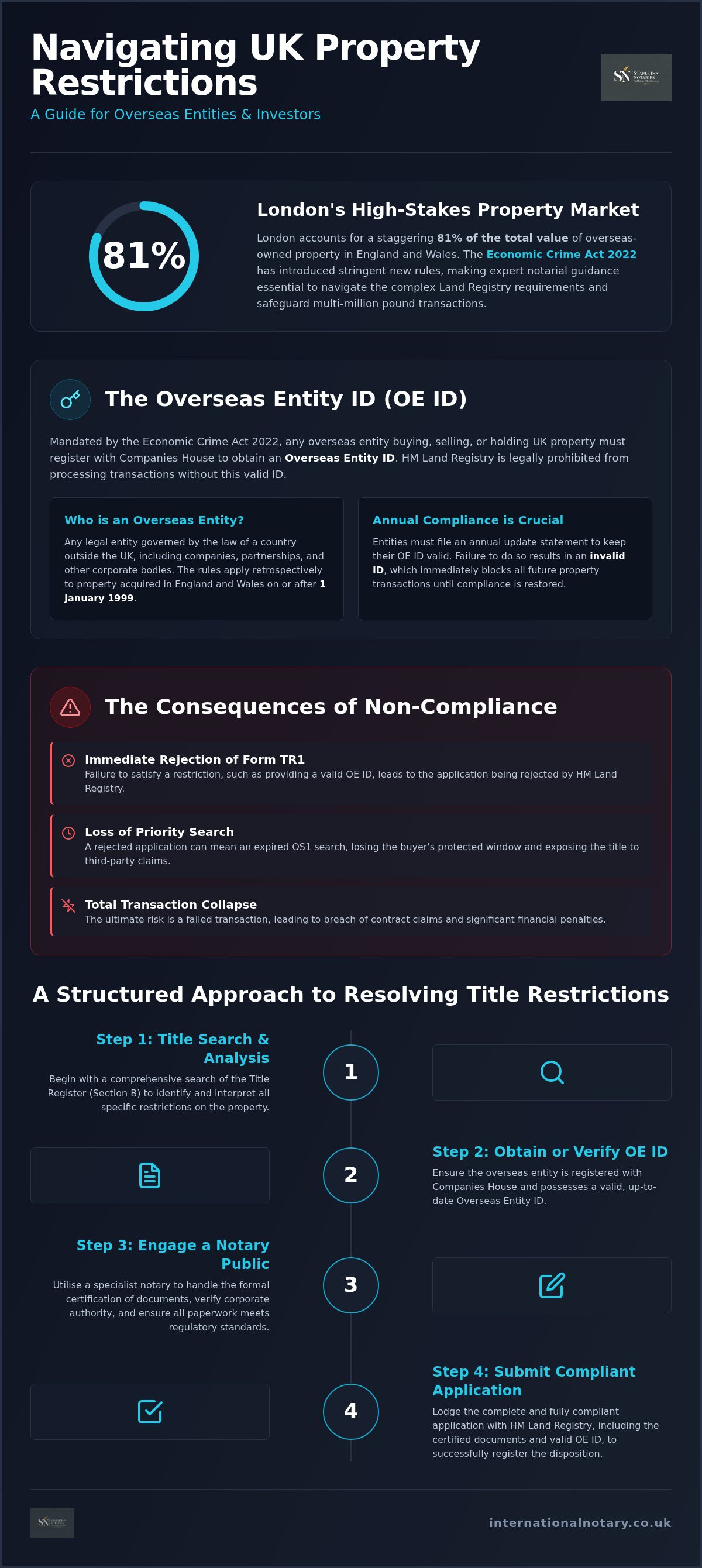
Did you know that London accounts for 81% of the total value of overseas-owned property titles in England and Wales? With such high stakes, the stringent registration requirements enforced by HM Land Registry act as a formidable gatekeeper for any international investor or corporate entity.
You'll likely understand that a single administrative oversight on a Form TR1 or a missing Overseas Entity ID can halt a multi-million pound transaction instantly. The complexity introduced by the Economic Crime Act 2022 has transformed routine filings into high-stakes legal hurdles. We provide the expert notarial guidance necessary to manage these property restrictions and ensure your documentation meets every regulatory standard. This guide explores the essential steps for obtaining a valid OE ID, clearing Land Registry restrictions through professional certification, and securing the urgent notarisation required for successful title registration in Central London, whilst addressing the specific challenges posed by recent legislative updates.
Table of Contents
Understanding the Restrictions Enforced by HM Land Registry
A Land Registry restriction is a formal entry on the Title Register that serves as a robust mechanism to prevent unlawful dealings. These entries limit the powers of a registered proprietor, ensuring that no disposition, such as a sale, lease, or charge, can be registered without fulfilling specific conditions. You'll find these entries located in Section B, the Proprietorship Register, which also specifies the class of title and provides the name and address of the current owner. For international investors, the requirements enforced by HM Land Registry have become significantly more stringent following the enactment of the Economic Crime (Transparency and Enforcement) Act 2022. This legislation provides the statutory framework for the Register of Overseas Entities, positioning HM Land Registry as a critical gatekeeper in the fight against illicit wealth. Our role is to ensure these procedural barriers don't become permanent roadblocks. Act now. Ensure your documentation is beyond reproach. Maintain your regulatory standing through precise certification and expert oversight. Meticulous preparation is the only way to safeguard your investment from administrative rejection.
Common Types of Land Registry Restrictions
Restrictions vary in complexity based on their legal origin. Form P restrictions are common, often requiring a certificate from a solicitor or a notary public to confirm that a specific deed was executed in accordance with the title's requirements. This certification process involves a meticulous review of corporate authority and identity verification. Since 2022, ROE restrictions have become a mandatory feature for property held by non-UK entities, effectively freezing the title until a valid Overseas Entity ID is confirmed. Standard form restrictions also exist to protect trust interests or alert buyers to bankruptcy proceedings, whilst our legal advisory services ensure these entries don't derail your timeline.
The Consequences of Non-Compliance
Failing to satisfy a restriction leads to the immediate rejection of Form TR1. This isn't just a delay; it's a procedural failure that can result in the loss of priority search periods. When an OS1 search, which costs £7 per title as of August 2026, expires without a successful application, the buyer loses their protected window. This allows third-party interests to be registered against the title, potentially jeopardising the entire acquisition. The ultimate risk is a total transaction collapse, followed by breach of contract claims and substantial financial penalties. These outcomes occur when a party can't complete because they failed to meet the standards enforced by HM Land Registry. Verify early. Secure your priority.
The Register of Overseas Entities and Property Transactions
Since the implementation of the Economic Crime (Transparency and Enforcement) Act 2022, any overseas entity wishing to buy, sell, or transfer a qualifying estate in the UK must register with Companies House. This process culminates in the issuance of an Overseas Entity ID (OE ID), a unique identifier that serves as the mandatory credential for all property dealings. The restrictions enforced by HM Land Registry are absolute; the Registrar is legally prohibited from registering any disposition of land unless the entity provides a valid OE ID at the time of application. Compliance is not a one-time event. Entities must file an annual update statement within 14 days of the anniversary of their registration, even if no changes have occurred. Failure to maintain this record results in the OE ID becoming invalid, which immediately triggers a block on any future transactions. Meticulous record-keeping is essential. Act swiftly to avoid transaction delays.
Who is Classified as an Overseas Entity?
An overseas entity is defined as any legal person, such as a company, partnership, or other body corporate, that is governed by the law of a country or territory outside the United Kingdom. This includes entities based in offshore jurisdictions often favoured by high-net-worth individuals for asset protection. The legislation applies retrospectively to any property in England and Wales acquired on or after 1 January 1999. If your entity holds such land, you are already within the scope of the requirements enforced by HM Land Registry and must ensure your registration is current before attempting any transfer. This rule ensures that legacy holdings are brought into the modern transparency regime, leaving no room for anonymity in the London property market.
Identifying Beneficial Owners for HM Land Registry
The verification process requires a deep analysis of ownership structures to identify registrable beneficial owners. Generally, this includes any individual or entity that holds more than 25% of the shares or voting rights in the overseas entity. However, the criteria also extend to those who possess the right to appoint or remove a majority of the board of directors or who exercise significant influence or control over the entity. Tiered corporate structures and complex trust arrangements often obscure these relationships, requiring meticulous investigation. The Law Society's guidance on verification highlights the rigorous standards required for professionals handling these disclosures. If you are managing a complex portfolio, contact us to ensure your beneficial ownership statement meets the exacting standards of the Registrar. We provide the clarity needed to satisfy these complex regulatory demands.
The Critical Role of Notarial Verification in Compliance
For overseas entities, the administrative hurdles enforced by HM Land Registry are often insurmountable without professional intervention. A Notary Public acts as the essential conduit between foreign jurisdictions and the UK land registration system. Unlike standard administrative witnesses, a Notary possesses the international authority to certify the authenticity of foreign corporate documents and the legal validity of signatures executed abroad. For US-based entities, consulting with a business law firm like Matthew Fornaro, P.A. helps ensure that corporate resolutions and governance structures are correctly prepared for such certification. This certification provides the Registrar with the requisite assurance that the entity has the legal capacity to enter into a property transaction. It's a matter of procedural certainty. We eliminate the risk of rejection by ensuring every document meets the high evidentiary threshold required by the Economic Crime (Transparency and Enforcement) Act 2022. Meticulous preparation is your best defence against transaction failure.
Certification of Identity and Authority
Verification starts with the individual. We conduct rigorous identity checks on directors and registrable beneficial owners to satisfy both anti-money laundering regulations and Land Registry standards. Beyond simple ID certification, we verify company resolutions and legal advisory services related to powers of attorney specifically drafted for property sales. These documents must be beyond reproach. A single error in a board minute or a defective execution clause will lead to an immediate halt. We ensure your documentation is valid for use in the UK whilst maintaining compliance with international standards. Precision is our baseline.
The Verification Statement for Companies House
Every application to the Register of Overseas Entities requires a formal verification statement from a regulated agent. Self-certification is not an option for overseas entities. The Notary must submit a detailed report to Companies House confirming that they have taken all reasonable steps to identify the beneficial owners. This report carries significant professional liability; the Notary risks criminal prosecution for providing false or misleading information. This high level of accountability is precisely why the verification statement is trusted by government bodies. It provides the legal certainty needed to obtain the OE ID and subsequently clear the restrictions enforced by HM Land Registry on the property's title. Trust the experts. Secure your deal today.
Steps to Resolve a Land Registry Restriction
Resolving a restriction begins with a surgical analysis of the Title Register. You must first conduct an official search to identify the exact wording of the entry in the Proprietorship Register, as this dictates the specific conditions required for a successful disposition. Once identified, you should immediately engage a Notary Public in London to commence the verification process. This phase involves gathering primary corporate evidence, including certificates of incorporation and registers of members, to satisfy the transparency requirements enforced by HM Land Registry. Precision at this stage is non-negotiable. Any discrepancy between your corporate records and the beneficial ownership statement will lead to a protracted verification cycle. We move swiftly from identification to evidence gathering, ensuring your data is ready for submission to Companies House to secure your Overseas Entity ID. To clear your title restrictions without delay, contact our Central London office today.
Preparing Form TR1 and OE ID Panels
Technical accuracy in your filing is the only way to avoid a Land Registry requisition. Panel 4 of Form TR1 must explicitly state the Overseas Entity ID, and it's imperative that the entity name matches the Title Register exactly, including any punctuation or legal suffixes. Common pitfalls often involve minor naming variations that trigger an immediate rejection under the strict standards enforced by HM Land Registry. We review your draft documents to ensure that every reference to the OE ID is consistent across all registers, providing the procedural certainty required for a seamless transfer of the qualifying estate. For expert support with the broader legal aspects of your property transaction, you can visit Triangle Legal Services Limited for specialised conveyancing services.
Time is the enemy of any property deal. When directors are based in the City or Central London, our mobile notary services provide the rapid response needed to execute deeds without logistical delays. We coordinate directly with your solicitors to ensure that the signing of powers of attorney or company resolutions happens in strict compliance with notarial standards. If your documents originate outside the UK, we also manage the necessary apostille and legalisation requirements to ensure international validity. This integrated approach eliminates the friction between foreign execution and UK registration, allowing your transaction to proceed with pace and professional authority. Efficiency is our priority. We deliver results when the timeline is critical.
Professional Notary Services for London Property Matters
Staple Inn Notaries operates as the "Expert Fixer" for high-value London property acquisitions. When a transaction faces potential collapse due to complex title entries, our intervention provides the necessary procedural resolution. The standards enforced by HM Land Registry require more than mere administrative completion; they demand a level of legal certainty that only a regulated Notary Public can provide. Our deep understanding of the 2026 regulatory landscape allows us to anticipate requisitions before they occur. We specialise in notarising Powers of Attorney for overseas entities, ensuring that every instrument of delegation is robust enough to withstand the scrutiny of the Registrar. By projecting professional authority and efficiency, we reduce the inherent anxiety of cross-border dealings. Your transaction remains on track. Your interests remain protected.
Mobile Notary Services Across Central London
Our Central London location is a strategic asset for clients with time-sensitive requirements. We provide on-site visits to City law firms and private residences, eliminating the need for directors to travel during critical negotiation phases. The Mobile Notary London advantage is specifically geared towards the rapid turnaround of property documentation. Whether you're dealing with an urgent Form TR1 or a complex company resolution, our mobile capability ensures that execution happens within the protected window of your priority search. We offer flexible scheduling to meet the most demanding Land Registry deadlines, providing a level of responsiveness that traditional legal practices often cannot match. Precision meets pace.
Comprehensive Apostille and Legalisation Support
International property owners often find that a simple notarisation is insufficient for UK compliance. We manage the full apostille process to ensure that documents originating outside the UK are legally recognised by domestic authorities. This involves direct liaison with the Foreign, Commonwealth & Development Office and relevant embassies for further legalisation where required. Our goal is to deliver a document package that is "HM Land Registry ready" upon arrival. This comprehensive oversight prevents the common pitfalls of defective execution or invalid certification that frequently lead to rejections under the rules enforced by HM Land Registry. We handle the bureaucracy so you can focus on the deal. Secure your completion with confidence.
Secure Your London Property Interests
Success in the London property market depends on your ability to navigate the stringent transparency standards enforced by HM Land Registry. Whether you're managing a corporate acquisition or a private transfer, the requirement for verified beneficial ownership and valid Overseas Entity IDs is absolute. Administrative rejections aren't just inconvenient; they risk the loss of priority periods and the total collapse of time-sensitive deals. You need a partner who understands the gravity of these legal certifications.
Staple Inn Notaries provides the professional authority required to clear these procedural hurdles. We're regulated by the Faculty Office of the Archbishop of Canterbury and serve as specialists in HM Land Registry compliance for international clients. Our expert mobile notary service operates across Central London to deliver rapid document turnaround exactly when it's required. Don't let administrative complexity stall your acquisition. We're here to ensure your transaction proceeds without delay.
Book an urgent notarisation appointment in Central London to ensure your documentation meets every regulatory standard and proceeds to successful registration.
Frequently Asked Questions
What does "enforced by HM Land Registry" mean for my property sale?
This means the Registrar will block any transfer or charge unless specific legal conditions are met. This primarily concerns compliance with the Economic Crime (Transparency and Enforcement) Act 2022. If you don't provide a valid Overseas Entity ID or satisfy title restrictions, your sale cannot be registered. It's a mandatory procedural gatekeeper that requires precise documentation and professional verification. We ensure your application meets these stringent requirements to avoid transaction failure.
How do I find my Overseas Entity ID (OE ID) for a Land Registry application?
You obtain your OE ID from Companies House after completing the registration and verification process. Once your application is processed, Companies House issues a unique identifier starting with 'OE' followed by six digits. This ID is publicly searchable on the Register of Overseas Entities. You must include this number on Panel 4 of Form TR1. Without it, the application will be rejected under the rules enforced by HM Land Registry.
Why does the Land Registry require a Notary Public for overseas entities?
The Land Registry requires professional verification to ensure that the individuals behind an overseas entity are accurately identified. A Notary Public acts as a UK-regulated agent to provide the high level of assurance needed for international documents. We verify the identity of beneficial owners and the legal capacity of the entity to deal with UK property. This process mitigates the risk of fraud and ensures compliance with the Economic Crime Act. Self-certification is strictly prohibited.
Can I sell my UK property if I haven’t registered as an overseas entity?
No, you cannot register a sale of a qualifying estate if you are an overseas entity that has failed to register. The Land Registry has placed a restriction on all titles held by overseas entities that acquired land after 1 January 1999. This restriction prevents the registration of any disposition unless the entity is registered and compliant. You must secure your OE ID before the transaction can legally complete at the registry level. Precision is essential.
What is a Form P restriction and how do I satisfy it?
A Form P restriction is a title entry that requires a certificate from a solicitor or a notary public. This certificate must confirm that the person executing a deed is the same person as the registered proprietor or has the authority to act for them. We satisfy this by conducting rigorous identity checks and reviewing corporate authority documents. Once we issue the formal certificate, the Land Registry will permit the transaction to proceed without further delay.
How long does it take to notarise documents for a Land Registry application?
Most notarisation appointments in Central London are completed within 30 to 60 minutes. However, the overall timeline depends on the complexity of your corporate structure and the need for further legalisation or apostille services. We offer mobile notary services across the City to expedite this process. Once notarised, the verification statement is submitted to Companies House, which typically processes OE ID applications within a few working days. Efficiency is our baseline for every client.
What information does a Notary need to verify for the Register of Overseas Entities?
We must verify the identity and address of every registrable beneficial owner and officer of the entity. This involves reviewing passports, utility bills, and corporate documents like the register of members or certificates of incumbency. We also investigate the nature of control, such as share ownership thresholds exceeding 25%. This data forms the basis of the formal verification report required by Companies House to clear restrictions enforced by HM Land Registry. Accuracy prevents rejections.
What happens if the Land Registry rejects my application due to a restriction?
A rejection results in the immediate return of your application and the potential loss of your priority search period. If your OS1 search expires, third parties could register interests against the title, jeopardising your ownership. You'll need to rectify the error, which often involves obtaining fresh notarial certification or updating your OE ID status, and then resubmit the entire package. This causes significant delays and potential breach of contract claims. Act swiftly to protect your deal.


Comments