
Guide to ID1 Forms: Why and When You Need One in London

Updated: Aug 26
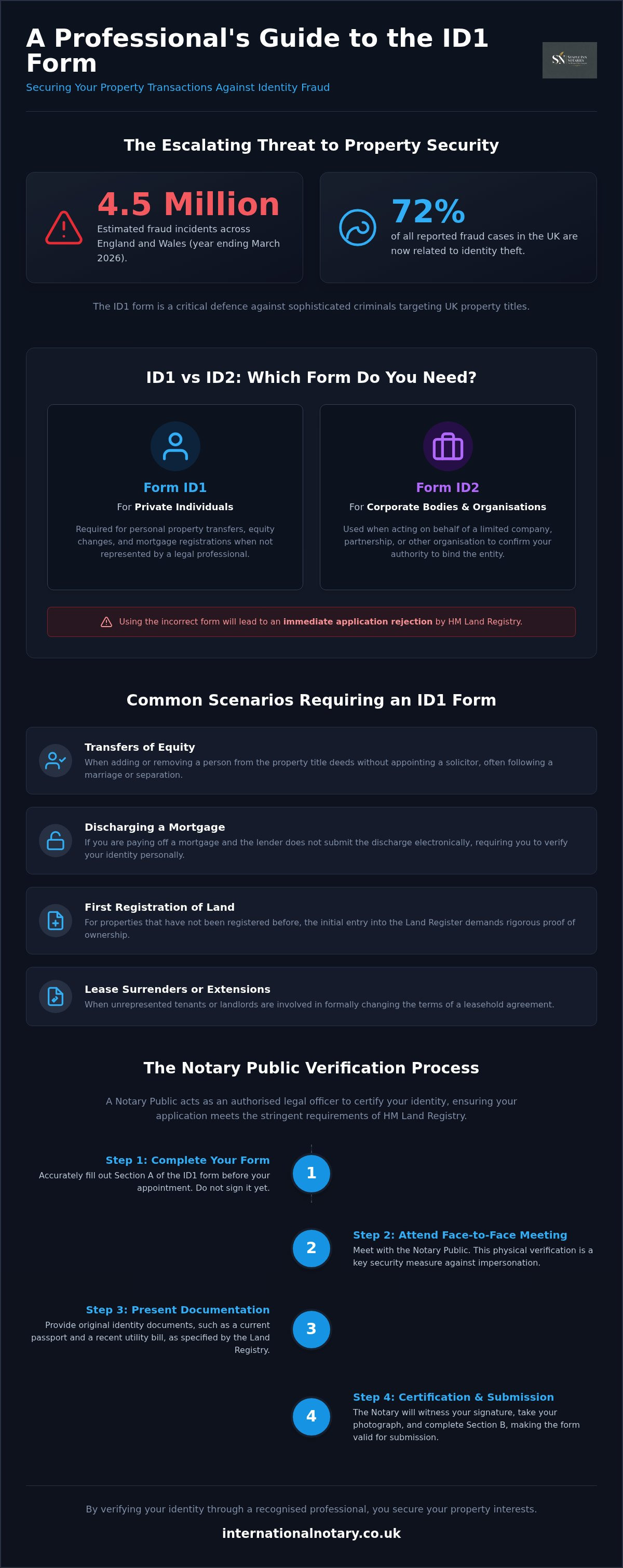
With an estimated 4.5 million fraud incidents recorded across England and Wales in the year ending March 2026, the security of your property assets has never been under greater threat. As identity fraud now accounts for 72% of all reported fraud cases in the UK, understanding when and why ID1 forms are necessary is essential. They serve as a safeguard in an increasingly digital and fraud-sensitive legal environment, acting as a critical barrier against the industrialised sophistication of modern criminals who target property titles and high-value transactions.
We recognise the frustration and urgency that often accompany HM Land Registry requirements, particularly when the fear of application rejection looms over a time-sensitive mortgage discharge or equity transfer. This professional guide provides the technical clarity you require to navigate these identification protocols with absolute certainty. You'll gain a comprehensive overview of the specific transaction trigger points, the 2023 regulatory shifts affecting personal representatives, and the precise methodology a Central London notary employs to ensure your submission is both fully compliant and fraud-proof. By verifying your identity through a recognised professional, you secure your property interests against the rising tide of sophisticated impersonation fraud.
Table of Contents
What is an ID1 Form and Why is it Mandatory?
An ID1 form is a formal certificate of identity required by the HM Land Registry to verify the credentials of any individual involved in a property transaction who isn't represented by a legal professional. In the current climate, understanding when and why ID1 forms are necessary is essential. They serve as a safeguard in an increasingly digital and fraud-sensitive legal environment. Without a solicitor or conveyancer acting on your behalf, the responsibility for proving your identity falls directly to you. This document acts as a verified link between the individual and the legal title they seek to transfer, mortgage, or discharge. It's a mandatory requirement that ensures the integrity of the national property register remains uncompromised.
The Purpose of Identity Verification in 2026
The landscape of property security has shifted dramatically. By March 2026, the UK recorded an estimated 4.5 million fraud incidents, with identity fraud accounting for 72% of all reported cases. Criminal groups have increasingly industrialised their operations, using AI to generate convincing fake documentation at scale. In this context, the ID1 form is not merely an administrative hurdle; it's a vital physical verification step designed to ensure that the person executing a deed is the genuine legal owner. By requiring a face-to-face meeting with an authorised professional, the Registry creates a robust paper trail that digital-only systems cannot yet replicate with the same level of security. It provides a definitive check against the sophisticated impersonation tactics currently targeting the UK housing market.
ID1 vs ID2: Which Form Do You Need?
Selecting the correct documentation is the first step in avoiding procedural delays that can jeopardise property completions. Whilst both forms serve the purpose of identity verification, they cater to different legal entities:
Form ID1: This is the standard requirement for private individuals. It's used for the vast majority of residential property transfers, equity changes, and mortgage registrations.
Form ID2: This is reserved exclusively for corporate bodies and organisations. If you're acting on behalf of a limited company or a partnership, you must utilise this version to confirm your authority to bind the entity.
Utilising the incorrect form will result in an immediate rejection by the Registry. For unrepresented parties, this often leads to significant financial consequences, especially where mortgage offers or purchase deadlines are nearing expiry. Understanding when and why ID1 forms are necessary is essential. They serve as a safeguard in an increasingly digital and fraud-sensitive legal environment, ensuring that every transaction entered into the national register is authenticated with professional scrutiny.
When managing property transactions that involve significant capital or mortgage adjustments, ensuring your finances are in order is just as important as the legal paperwork. For those exploring personal or homeowner loan options, you can learn more about I Need Cash to discover how a credit broker can support your financial goals.
Common Scenarios: When is an ID1 Form Necessary?
Identifying the specific legal triggers that mandate identity verification is the first step in ensuring a seamless application to the Land Registry. Whilst professional representation is the norm, many individuals choose to manage certain property matters independently. In these instances, the Registry requires a completed Official ID1 Form to prevent fraudulent entries. Common scenarios include:
Transfers of equity: This occurs when a property owner adds or removes a person from the title deeds, often following a marriage or separation, without appointing a solicitor.
Discharging a mortgage: If you're paying off a legal charge or mortgage and the lender doesn't submit the discharge electronically, you'll need to verify your identity personally.
First registration of land: For properties that haven't changed hands since registration became compulsory, the initial entry into the register requires rigorous proof of ownership.
Lease surrenders or extensions: Unrepresented tenants or landlords involved in changing leasehold terms must provide verified ID.
Unrepresented Parties in Property Deals
The rise of 'DIY' property transactions has increased the demand for independent verification. In London's high-value market, where property prices often exceed the national average by a significant margin, the risks associated with unrepresented transfers are amplified. Understanding when and why ID1 forms are necessary is essential. They serve as a safeguard in an increasingly digital and fraud-sensitive legal environment, ensuring that the Registry can definitively link the applicant to the property title. This human verification step protects the integrity of the national register by preventing unauthorised parties from executing deeds that could lead to catastrophic financial loss.
Alongside these legal safeguards, property owners in the capital should also ensure they are compliant with boundary regulations; for expert assistance, you can visit Christopher Anthony Surveyors for fixed-fee party wall surveying.
Complex Land Registry Applications
Certain specialised applications carry a higher risk profile and thus trigger mandatory ID checks. Adverse possession claims, where an individual seeks legal title to land based on long-term occupation, require the most stringent verification protocols to prevent land theft. Similarly, registering a property after the death of an owner involves complex probate administration tasks. You must be aware that as of 11 September 2023, personal representatives who are assenting or transferring land are no longer exempt from identity requirements. Because the Registry must mitigate the risks of impersonation during estate distribution, understanding when and why ID1 forms are necessary is essential. They serve as a safeguard in an increasingly digital and fraud-sensitive legal environment, particularly when high-value London assets are involved. For those facing tight deadlines, our Notary Public London service provides the rapid verification needed to keep your application on track.
The Role of the Notary Public in ID1 Verification
While various legal professionals can technically complete an official ID1 form from GOV.UK, the appointment of a Notary Public provides a superior level of certification that is often required for high-value or complex London property deals. Notaries are high-level legal officers whose primary function is to authenticate documents for use both domestically and internationally. In a landscape where more than 444,000 fraud cases were recorded in 2025 alone, understanding when and why ID1 forms are necessary is essential. They serve as a safeguard in an increasingly digital and fraud-sensitive legal environment. A Notary's seal carries a level of global recognition and regulatory weight that a standard solicitor's stamp may lack, making it the preferred choice for international clients, offshore entities, or intricate corporate structures involved in UK land registration.
Safeguarding Against Fraud in a Digital Age
The Land Registry maintains stringent standards for identity verification to combat the rising tide of industrialised property fraud. Physical, face-to-face meetings remain the cornerstone of this security protocol. During these consultations, we perform a rigorous manual inspection of original identity documents to ensure they haven't been tampered with or digitally altered. Criminals now utilise sophisticated AI to generate synthetic identities; therefore, digital-only verification often proves insufficient for the Registry's highest security tiers. By conducting a physical check, a Notary Public ensures that the person signing the deed is the actual individual pictured on the passport. This human intervention is the final, most effective line of defence against impersonation fraud.
Expertise in Passport and ID Certification
Our practitioners adhere to the highest professional standards for passport and ID certification, specifically tailored to the nuances of HM Land Registry requirements. We possess the technical expertise to handle foreign identity documents and complex verification scenarios with professional care. This includes meticulous record-keeping and the retention of certified copies, which serve as vital evidence should the transaction be challenged in the future. Because the consequences of a rejected application can be financially devastating, understanding when and why ID1 forms are necessary is essential. They serve as a safeguard in an increasingly digital and fraud-sensitive legal environment, providing the objective, third-party verification required to secure your property interests. Our Central London office operates with a modern, fast-paced mindset to ensure your identity is certified accurately and without procedural delay.
How to Complete an ID1 Form: A Step-by-Step Guide
To initiate the verification process, you must download the most recent version of Form ID1 from the official HM Land Registry portal. Ensure you complete Part A in its entirety before your appointment, providing accurate personal and property details that match your supporting evidence. You must gather your original identity documents well in advance of your scheduled verification. This preparation is vital because the Registry maintains a zero-tolerance policy regarding incomplete or outdated evidence. Understanding when and why ID1 forms are necessary is essential. They serve as a safeguard in an increasingly digital and fraud-sensitive legal environment, ensuring that every unrepresented party is definitively authenticated before the register is altered.
Preparing Your Documents for Certification
You must present original documents; photocopies or digital scans are strictly prohibited. Acceptable primary identification includes a valid full passport or a current UK photocard driving licence. If you're an international client, a valid foreign passport is acceptable, provided it meets the Registry's current list of approved identification. For secondary evidence, you typically require two separate forms of proof of residency. These usually include utility bills (excluding mobile phone bills), council tax statements, or mortgage statements. These must be original paper documents or certified printed versions dated within the last three months. You must also provide a high-quality, recent passport-sized photograph. This image is a core component of the ID1 form, as the Notary must certify on the reverse that it's a true likeness of the person whose identity is being verified.
The Verification Appointment: What to Expect
The physical appointment is a non-negotiable requirement for notarial certification. During this consultation, the Notary performs a meticulous physical inspection of your original documents to verify their authenticity and security features. This face-to-face interaction is the most effective method for detecting the sophisticated forgeries that currently target the property market. Beyond mere identification, the Notary has a professional duty to confirm that you understand the gravity of the legal transaction you are undertaking. This is particularly relevant in London's fast-paced property market where equity transfers and mortgage discharges often involve significant financial sums. Once the verification is complete, the Notary signs Part B and applies their official seal of office. This seal provides the international and domestic validity required to move your application forward. Understanding when and why ID1 forms are necessary is essential. They serve as a safeguard in an increasingly digital and fraud-sensitive legal environment, preventing the industrialised fraud that targets unrepresented applicants. For those requiring a rapid turnaround to meet strict completion deadlines, we recommend you book a Notary Public London appointment today to ensure your submission is compliant.
Professional ID1 Verification Services in Central London
Staple Inn Notaries provides an accelerated verification pathway for individuals and corporate entities facing stringent HM Land Registry deadlines. Strategically situated in the heart of the capital, our office offers immediate accessibility for clients traversing London's primary transport hubs. We operate with a precise understanding of the procedural rigours required for a successful property submission. Our expertise ensures your documentation is executed correctly the first time, effectively neutralising the risk of application rejection. In a climate where identity fraud has reached record levels, understanding when and why ID1 forms are necessary is essential. They serve as a safeguard in an increasingly digital and fraud-sensitive legal environment, and our practitioners provide the authoritative certification required to protect your high-value assets.
Mobile Notary Services for London Professionals
Time is a critical commodity in property law. For directors and high-net-worth individuals managing complex transactions within the City or West End, travelling to a central office is often impractical. We address this through our Mobile Notary London service. This allows for the physical verification of identity documents at your private residence or corporate headquarters. By bringing notarial authority directly to your location, we eliminate the logistical delays that frequently jeopardise completion dates. Our mobile practitioners maintain the same meticulous standards of scrutiny as our office-based team, ensuring that every signature is witnessed and every document is sealed in full compliance with Registry standards.
Why Choose Staple Inn Notaries for Your ID1?
Our firm is deeply rooted in the traditions of legal certification whilst maintaining a modern, results-driven mindset. We are regulated by the Faculty Office of the Archbishop of Canterbury, providing the high-level professional standing necessary for international and domestic validity. Beyond standard identity checks, we are experienced specialists in corporate power of attorney and complex land registration matters. This specialised knowledge allows us to navigate the intersection of corporate authority and individual identity with absolute precision. We recognise that understanding when and why ID1 forms are necessary is essential. They serve as a safeguard in an increasingly digital and fraud-sensitive legal environment, acting as the definitive barrier against unauthorised property transfers. We provide a calm, efficient, and highly professional environment for all your certification needs. Secure your appointment today to ensure your Land Registry application is processed without unnecessary delay.
Secure Your Property Transaction with Expert Verification
Navigating the complexities of HM Land Registry requirements demands precision and a proactive approach to identity security. You now possess a clear understanding of the specific triggers for ID1 submission, ranging from equity transfers to mortgage discharges. By engaging a professional to witness your documentation, you eliminate the risk of procedural errors that frequently lead to application rejection. As we have explored, understanding when and why ID1 forms are necessary is essential. They serve as a safeguard in an increasingly digital and fraud-sensitive legal environment.
Staple Inn Notaries provides the specialised expertise required to navigate these protocols with absolute confidence. As a firm regulated by the Faculty Office of the Archbishop of Canterbury, we ensure every certification meets the highest standards of Land Registry compliance. Our Central London location is perfectly positioned to facilitate rapid service for both domestic and international clients. Don't let administrative delays compromise your property deadlines. Book your ID1 verification appointment at our Central London office today and secure your transaction with authoritative certification. Your property’s integrity is our priority.
Frequently Asked Questions
How long is an ID1 form valid for after it is signed?
An ID1 form remains valid for exactly three months from the date it is signed and certified by the authorised professional. You must ensure that HM Land Registry receives your application within this specific window. If you miss this deadline, the form becomes void and you'll require a fresh verification appointment. Understanding when and why ID1 forms are necessary is essential. They serve as a safeguard in an increasingly digital and fraud-sensitive legal environment by ensuring identity data is current.
Who is authorised to verify an ID1 form in the UK?
Verification must be performed by a qualified legal professional, including a Notary Public, a solicitor, or a licensed conveyancer. Certain barristers and legal executives are also permitted to certify these documents. It's critical to confirm that your chosen professional is currently regulated and holds a valid practising certificate. Using an unauthorised individual will lead to immediate rejection, potentially jeopardising your property transaction and causing unnecessary financial delays.
Can I complete an ID1 form online without a face-to-face meeting?
While digital identity standards have evolved, unrepresented parties typically require a physical, face-to-face meeting for the completion of Section B. The verifier must personally inspect your original documents to detect sophisticated forgeries. Although Section C allows for certain digital verifications, most traditional ID1 applications still rely on the security of a physical encounter. This human oversight is vital for maintaining the integrity of the national property register against industrialised identity theft.
What happens if my ID1 form is rejected by the Land Registry?
Rejection usually stems from procedural errors, such as using an expired form or providing insufficient proof of address. If rejected, you must restart the verification process, which includes a new appointment and a fresh certification of your documents. This causes significant delays and can lead to the expiry of mortgage offers. Our practitioners ensure your documentation is compliant the first time, preventing the frustration and urgency associated with failed submissions.
Do I need an ID1 form if I am using a solicitor for my property sale?
No, you don't require an ID1 form if a solicitor or licensed conveyancer is acting on your behalf for the entire transaction. In these cases, your legal representative verifies your identity as part of their standard anti-money laundering protocols. The ID1 requirement is specifically triggered when a party is unrepresented. Understanding when and why ID1 forms are necessary is essential. They serve as a safeguard in an increasingly digital and fraud-sensitive legal environment for those managing their own legal affairs.
What documents do I need to bring to my ID1 verification appointment?
You must bring one primary form of photographic identification, such as a valid passport or a UK photocard driving licence. Additionally, you require two separate forms of evidence for your current residential address, such as original utility bills or council tax statements dated within the last three months. All documents must be originals; digital copies or printouts from the internet are generally unacceptable. You must also provide a recent passport-sized photograph for certification.
Is there a difference between a solicitor and a notary for ID1 forms?
Whilst both are authorised, a Notary Public provides a higher level of certification that is often preferred for international or high-value transactions. Notarial acts carry global recognition and are backed by rigorous record-keeping standards. If your property transaction involves offshore entities or foreign jurisdictions, a Notary's seal offers an additional layer of professional authority. This ensures your identity is verified to the highest possible standard, reducing the risk of Registry queries.
Can I use an ID1 form for a company-owned property?
No, the ID1 form is reserved exclusively for private individuals. If the property is owned by a corporate body or organisation, you must utilise Form ID2 instead. This corporate version requires the verification of the individual's authority to act on behalf of the company, alongside standard identity checks. Selecting the incorrect form will result in an immediate rejection, so you must confirm the legal status of the applicant before scheduling your verification appointment.



Comments