
Grounds for Contesting a Will in the UK: A Practical Checklist

Updated: Oct 9
What if a will seems unfair, but its terms alone aren’t enough to challenge it? If you’re searching for the grounds for contesting a will UK law recognises, start by identifying a legal basis and matching it to the available evidence. Suspicious circumstances may justify closer examination, but they don’t automatically invalidate a will.
It’s understandable to worry that important records could be lost or the estate distributed before your concerns are assessed. It’s also easy to confuse a challenge to a will’s validity with a claim for reasonable financial provision. These are separate legal routes. Choosing the wrong one can affect which evidence matters and what action may be needed.
This practical checklist explains the main grounds for challenging a will, the evidence that may support or weaken a concern, and what to organise before seeking advice. It also distinguishes validity challenges from claims under the Inheritance (Provision for Family and Dependants) Act 1975, and explains why timing matters. The law differs across the UK, so the relevant rules depend on where the estate is being dealt with.
Table of Contents
Grounds for contesting a will in the UK: first identify the type of challenge
A will can be challenged only on a recognised legal basis, not simply because its terms appear unfair. The grounds for contesting a will UK law recognises depend on the type of claim, the evidence and the jurisdiction. A concern about how the will was made is different from a claim that the estate should provide more for an eligible person.
Legal rules differ between England and Wales, Scotland and Northern Ireland. The statutory examples in this section relate to England and Wales and shouldn’t be assumed to apply elsewhere. Even within that jurisdiction, the outcome depends on the wording of the document, the circumstances in which it was made and the evidence available.
Does an unfair will automatically give someone grounds to contest it?
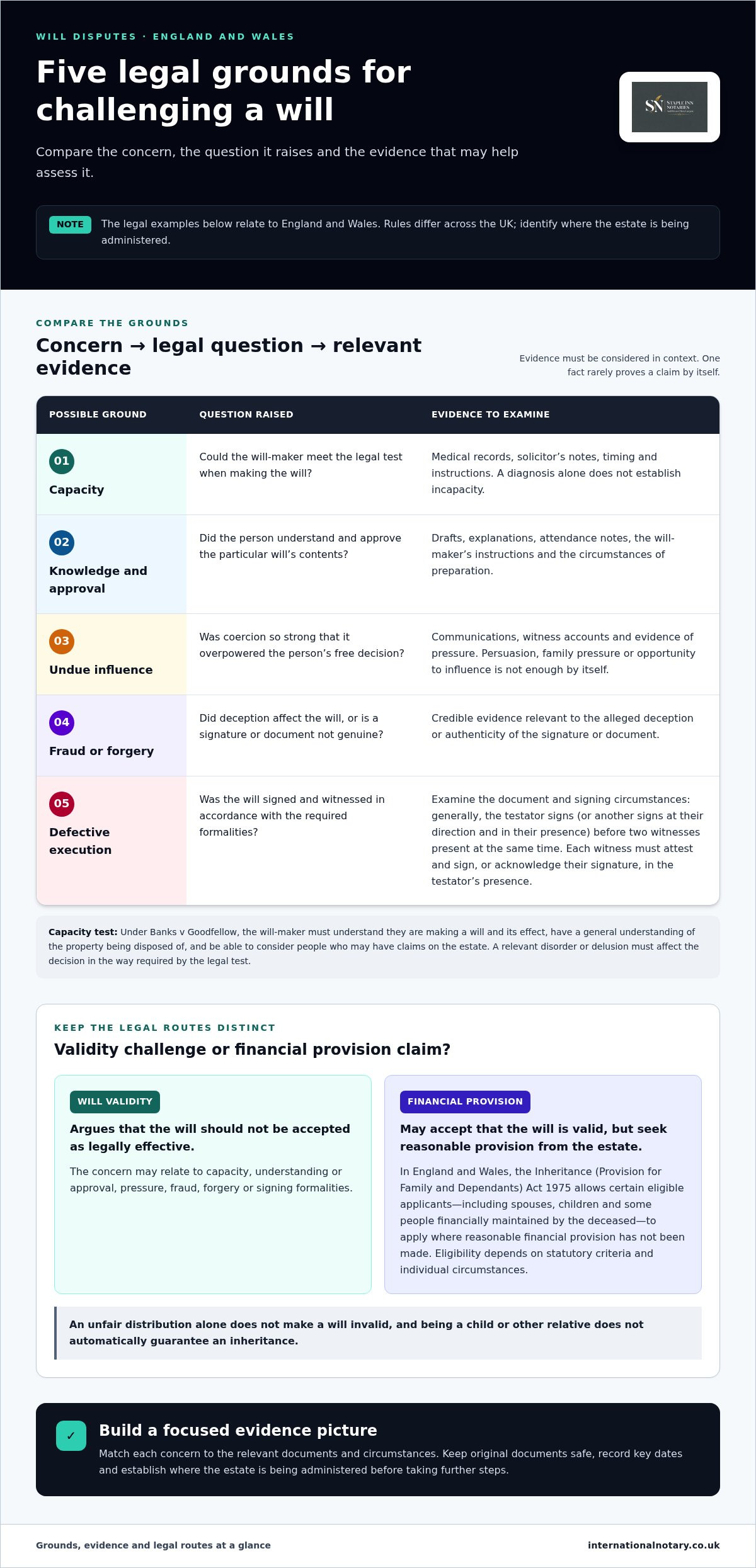
No. Disappointment with a distribution, or a belief that another relative deserved more, doesn’t by itself make a will invalid. Someone may have strong moral expectations based on family relationships, past promises or years of support, but those expectations aren’t necessarily legal rights. Nor does being a child or other relative automatically guarantee an inheritance. Start by asking whether the facts point to a recognised legal route.
Will validity challenge or financial provision claim?
A validity challenge argues that a will shouldn’t be accepted as legally effective. For example, there may be concerns about whether it was properly signed, whether the will-maker had capacity, or whether pressure or fraud affected the document. These are distinct legal issues, and a troubling family history alone doesn’t establish any of them. This overview of legal grounds for contesting a will introduces common types of challenge, but it isn’t a substitute for advice on the law that applies to an estate.
A financial provision claim takes a different approach. It may accept that the will is valid while asking for reasonable provision from the estate. In England and Wales, the Inheritance (Provision for Family and Dependants) Act 1975 allows certain eligible applicants, including spouses, children and some people who were financially maintained by the deceased, to apply where the will or intestacy rules fail to make reasonable financial provision for them. Eligibility and the assessment depend on the statutory criteria and individual circumstances.
Keep the distinction clear. Before acting, identify where the estate is being administered and whether your concern is about the will’s validity, provision from the estate, or potentially both. A focused assessment of the will and supporting evidence can help clarify which route may fit.
The main legal grounds for contesting a will and the tests to understand
In England and Wales, a validity challenge must fit a recognised ground and be supported by evidence. These grounds for contesting a will UK readers commonly ask about are distinct. Concerns about a person’s ability to make a will are not the same as concerns about whether they understood or approved its contents. Suspicious circumstances may justify investigation, but they don’t prove a legal ground on their own.
Capacity, knowledge and approval: what must be examined?
Testamentary capacity is assessed under the test in Banks v Goodfellow. In broad terms, the will-maker must understand that they are making a will and its effect, have a general understanding of the property they are disposing of, and be able to consider the people who may have claims on their estate. A relevant disorder or delusion must affect the decision in the way required by the legal test. A diagnosis alone doesn’t establish incapacity.
Knowledge and approval is a separate question: did the person understand and approve the particular will’s contents? Contemporaneous medical records, the will-maker’s instructions, a solicitor’s attendance notes and the circumstances of drafting may all help. Their significance depends on the full context.
Undue influence, fraud, forgery and signing formalities
Undue influence in probate requires more than persuasion, family pressure or an opportunity to influence the will-maker. The issue is whether coercion overpowered their free decision, and the person alleging it must support the allegation with evidence. Fraud or forgery likewise requires credible evidence that deception affected the will or that a signature or document is not genuine.
Under the Wills Act 1837, a will in England and Wales generally must be in writing, signed by the testator (or by another person in their presence and at their direction), with the signature made or acknowledged in the presence of two witnesses present at the same time. Each witness must then attest and sign, or acknowledge their signature, in the testator’s presence. Any concern about execution requires careful examination of the document and circumstances.
For general guidance on practical steps, see Citizens Advice information about wills. A specialist review can help assess how the evidence fits the relevant test. Contact Staple Inn Notaries about a will dispute for advice tailored to your circumstances.
Which ground may fit? Compare the concern with the evidence available
Start by describing what appears unusual, then consider what evidence could clarify it. The same event may raise different questions: a sharp change in a will could relate to capacity, knowledge and approval, or influence, but the change alone doesn’t establish any of those grounds. Use this comparison to organise your concerns, not to diagnose a claim. For a general overview of the grounds for challenging a will, see The Gazette.
What evidence may support a concern about capacity or execution?
Start with records you can lawfully access: copies of the will and earlier versions, correspondence, relevant attendance notes, and any medical records already available to you. Timing matters. A record made close to the will-making process may help illuminate the person’s condition at that point, while later records may offer context but not settle the issue. Medical or professional records may require consent or a lawful process to obtain. Don’t assume you are entitled to them; take case-specific advice.
What evidence may matter in an influence or fraud allegation?
Record who communicated with the will-maker, who arranged appointments, and what you personally observed. Preserve relevant messages and correspondence in their original form, and note the names of people who may have first-hand knowledge. Avoid editing, annotating or circulating sensitive records unnecessarily. Assess the evidence together: no single message, relationship or unexplained change should be treated as conclusive. A clear factual timeline can help identify gaps while memories and records remain accessible.
Will-contesting checklist: protect information and take proportionate next steps
Act methodically. The right next step depends on the jurisdiction, the type of claim and how far estate administration has progressed. Use this checklist to organise what you know before taking advice on the grounds for contesting a will UK law may recognise.
Identify the jurisdiction. Establish where the deceased lived, where the will is being dealt with and whether a grant has been issued. England and Wales, Scotland and Northern Ireland have distinct rules.
Define the concern. State the specific issue, such as a question about the will-maker’s capacity, the signing process or possible pressure. Separate what you know directly from what you suspect or have been told.
Collect available records. Organise the current will, earlier versions, probate correspondence and relevant messages or letters. Note where each document came from and keep originals secure.
Record dates and people. Prepare a chronology of key events, including when the will was made, when concerns arose and any known steps in estate administration. List people who may have relevant first-hand knowledge.
Obtain tailored advice. Have the potential legal route, supporting evidence and stage of the estate assessed together before deciding what to do next.
What should you organise before taking legal advice?
A short, factual chronology is often more useful than a lengthy account of family disagreements. Include the date of each event, who was present and how you know it happened. Flag assumptions clearly. Preserve original documents without annotating them, and avoid circulating sensitive records unnecessarily. Access to medical or professional records may be restricted and can involve lawful processes; get case-specific advice before seeking them.
Why jurisdiction and timing need early attention
Don’t assume the same deadline applies to every challenge. In England and Wales, a claim under the Inheritance (Provision for Family and Dependants) Act 1975 generally needs to be made within six months of the grant of representation. A court may permit a late claim, but permission isn’t guaranteed. This period is not a universal deadline for challenging a will’s validity. The estate’s stage can also affect urgency, particularly if assets may be distributed. Confirm the applicable rules promptly.
Staple Inn Notaries supports private clients with contentious probate matters. Our experience can help clarify the possible route, relevant evidence and next steps. Read about our legal advisory services, or contact us to discuss a will dispute.
Getting advice on a possible will dispute in Central London
A focused assessment can turn a broad concern into a clear set of questions. Start by establishing which jurisdiction’s rules apply, what may have happened, what evidence is available and how far estate administration has progressed. These details help distinguish a possible challenge to the will’s validity from a claim for financial provision, which involve different legal tests.
Staple Inn Notaries is based in Central London and supports private clients with contentious probate matters. An assessment can help organise the facts, identify relevant documents and highlight uncertainties or time-sensitive issues for further legal consideration. Whether a claim has prospects depends on the evidence and applicable law. No particular outcome can be assumed before those matters are examined.
What can a contentious probate assessment help you establish?
Bring the will and any earlier versions you have, probate correspondence, a chronology of key events and a concise account of your concerns. The discussion can help identify which facts are known first-hand, what remains uncertain and what further information may be relevant. It can also clarify whether the issue appears to concern validity, reasonable financial provision, or both. Any view on prospects must remain conditional on a proper assessment of the evidence and law.
The estate’s stage matters. If a grant has been issued or assets are being dealt with, explain this at the outset and share any dates or correspondence you have. Prompt, informed consideration may help you understand the available options before decisions become harder to revisit.
How to take the next step without escalating family conflict
Keep communications factual and measured. Describe what you have observed, identify the records that support it and avoid making accusations that the evidence does not justify. This can help preserve constructive dialogue while the legal position is assessed. Early advice may also clarify what information is needed and which steps are proportionate, without treating a family disagreement as proof of wrongdoing.
Staple Inn Notaries provides contentious probate and private-client support. Discuss your will dispute with our team.
Take a clear, evidence-led next step
A will dispute should begin with a recognised legal question, not an assumption that an unexpected or unequal outcome is automatically unlawful. The grounds for contesting a will UK law recognises depend on the applicable jurisdiction and the evidence. Keep relevant records safe, note key dates and establish whether your concern relates to the will’s validity or reasonable financial provision.
Staple Inn Notaries provides contentious probate and will-dispute support, alongside private-client experience in wills, estate planning and probate administration. Based in Central London, the firm serves clients across the wider London area. A focused discussion can help clarify the possible route, the evidence available and any issues requiring prompt attention. It won’t predetermine the outcome, which depends on the facts and applicable law.
Discuss your will dispute with our team. With the relevant information organised, you can approach the next step with greater clarity.
Frequently Asked Questions
What are the main grounds for contesting a will in England and Wales?
The main grounds include lack of testamentary capacity, lack of knowledge and approval, undue influence, fraud or forgery, and failure to meet execution formalities. Each raises a different legal question and needs evidence relevant to that test. The grounds for contesting a will UK law recognises aren’t established just because the outcome seems unfair. Rules also differ across the UK, so first identify where the estate is being administered.
Can you contest a will because you were left out?
Being left out doesn’t, by itself, make a will invalid. If you believe the will-maker lacked capacity or was coerced, for example, you’d need evidence supporting that specific ground. Separately, certain eligible people may seek reasonable financial provision under the Inheritance (Provision for Family and Dependants) Act 1975 in England and Wales. Eligibility depends on the statutory criteria and circumstances; being a relative alone doesn’t guarantee an inheritance or a successful claim.
How do you prove undue influence in a will dispute?
You need evidence capable of showing that coercion overpowered the will-maker’s free decision. Persuasion, family pressure, dependency or someone having the opportunity to influence the person isn’t enough on its own. Relevant material may include communications, witness accounts, records of who arranged appointments or gave instructions, and the circumstances surrounding the will. Assess the evidence as a whole. A sudden change to a will may raise questions, but it doesn’t prove undue influence.
Can a will be challenged if the person lacked mental capacity?
Yes, if evidence supports the claim that the person lacked testamentary capacity when they made the will. In England and Wales, the test associated with Banks v Goodfellow considers whether the person understood they were making a will and its effect, had a general understanding of their property, and could consider potential claims on their estate. Medical records, a solicitor’s notes and the timing of events may be relevant. A diagnosis alone doesn’t establish incapacity.
Is there a time limit for contesting a will in the UK?
There isn’t one universal deadline for every type of will challenge, and rules vary by jurisdiction. In England and Wales, a claim under the 1975 Act generally must be made within six months of the grant of probate. A court may allow a late claim, but permission isn’t guaranteed. Other validity challenges don’t have the same strict statutory time limit, but delay can make evidence harder to obtain and assets may be distributed. Seek advice promptly.
Does contesting a will stop probate or the estate being distributed?
No. Raising a dispute doesn’t automatically stop a grant being issued or prevent estate assets from being distributed. In England and Wales, a caveat may temporarily prevent a grant of probate from being issued, but it doesn’t decide whether a will is valid or necessarily address what happens after a grant has been made. The appropriate step depends on the claim and the estate’s stage. Get advice before relying on a caveat or assuming distribution is paused.
Can I contest a will without a solicitor?
It may be possible to take steps or represent yourself, but will disputes can involve complex evidence, legal tests and court procedures. For those navigating court proceedings independently, platforms such as findamckenziefriend.com connect self-representing individuals with vetted McKenzie Friends for practical and procedural assistance. Before acting, establish the jurisdiction, identify the potential claim and consider any applicable deadline. Specialist advice can help clarify the options without committing you to a particular course. Staple Inn Notaries, based in Central London, provides contentious probate and will-dispute support.



Comments