
Director & PSC Identity Verification in London

Updated: Sep 3
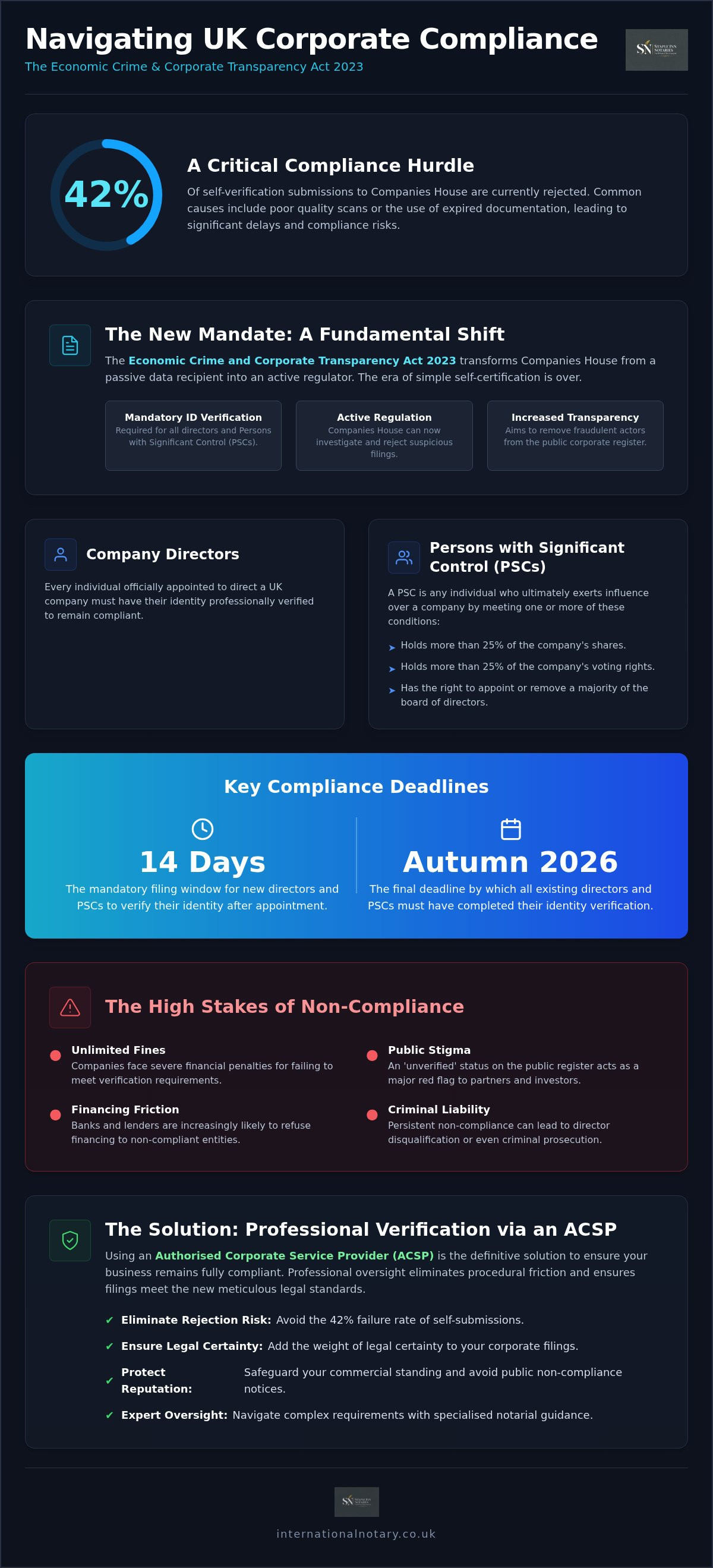
Did you know that 42% of self-verification submissions to Companies House are currently rejected due to scan quality issues or expired documentation? For directors and persons with significant control (PSCs), the transition to the regulatory regime mandated by the Economic Crime and Corporate Transparency Act 2023 is a high-stakes legal requirement. You're likely feeling the mounting pressure of the strict 14-day filing window and the looming autumn 2026 deadline for existing appointments. Navigating the intricacies of the Authorised Corporate Service Provider (ACSP) role is often confusing, especially when the threat of unlimited fines or a public note of non-compliance hangs over your commercial reputation.
Staple Inn Notaries provides a definitive solution through professional identity verification for directors and persons with significant control (PSCs). Master these mandatory requirements now. This article provides a comprehensive guide to ensuring your business remains fully compliant whilst securing your unique personal code. We will examine the precise steps for professional ACSP certification, the mechanics of the 14-day PSC window, and the specific strategies required to avoid severe financial penalties. Act swiftly to protect your standing. Secure your compliance. Eliminate procedural delays through expert oversight.
Table of Contents
Understanding the 2026 Identity Verification Mandate for UK Directors and PSCs
Defining the Person with Significant Control (PSC) Under Current Legislation
The Verification Process: One Login vs. Authorised Corporate Service Providers (ACSPs)
Avoiding Penalties: Managing the 14-Day Deadline and Data Mismatches
Professional Identity Verification Services: How Staple Inn Notaries Facilitates Compliance
Understanding the 2026 Identity Verification Mandate for UK Directors and PSCs
The Economic Crime and Corporate Transparency Act 2023 represents the most significant overhaul of UK company law in a generation. It fundamentally transforms Companies House from a passive recipient of corporate data into an active regulator with the power to investigate and challenge suspicious filings. This legislative shift is designed to purge the public register of fraudulent actors. For legitimate business leaders, it introduces a mandatory requirement for Identity Verification: Conducts official ID checks for directors and persons with significant control (PSCs). Every individual running a UK company must now prove they are exactly who they claim to be. Verify your standing. Protect your company.
The Legal Framework: Economic Crime and Corporate Transparency Act
The Act's primary objective is to improve corporate transparency by ensuring that the person behind a legal entity is identifiable and verified. This legislation empowers the Registrar to reject documents that contain inconsistencies or appear fraudulent. Whilst new directors and any Person with Significant Control (PSC) appointed after 18 November 2025 must verify their identity immediately, existing officers have a transition period. You must ensure all current directors and PSCs are verified by autumn 2026. Failure to meet this deadline will trigger automatic flags on your company's public profile. Don't delay your filing. Secure your personal code.
Why "Self-Certification" is No Longer Sufficient
The era of simple notification is over. Historically, Companies House relied on the honesty of those filing information; however, the new mandate requires rigorous, independent validation. If a director remains "unverified" on the public register, the consequences are immediate and severe. This status isn't just a clerical oversight; it's a public signal of potential non-compliance that can halt business operations.
Public Stigma: An "unverified" status acts as a red flag to potential investors and global partners.
Financing Friction: Banks and lenders are increasingly likely to refuse corporate financing to entities with unverified leadership.
Regulatory Risk: Ongoing non-compliance can lead to disqualification or criminal prosecution.
Professional Identity Verification: Conducts official ID checks for directors and persons with significant control (PSCs) ensures that your corporate filings carry the weight of legal certainty. The move towards a "trustworthy" register means that every officer's digital footprint must be authenticated by a regulated professional or through government biometric systems. This shift eliminates the anonymity that previously masked economic crime. It forces a higher standard of corporate governance. By utilising an Authorised Corporate Service Provider, you ensure that your documentation meets the meticulous standards required by the Faculty Office of the Archbishop of Canterbury and Companies House alike. Achieve compliance. Eliminate risk.
Defining the Person with Significant Control (PSC) Under Current Legislation
Determining exactly who qualifies as a Person with Significant Control (PSC) is no longer a matter of internal preference; it is a statutory obligation. Under current UK legislation, a PSC is an individual who meets one or more conditions, most commonly holding more than 25% of a company's shares or voting rights. The law also targets those who have the right to appoint or remove a majority of the board of directors. The objective is to identify the 'warm body', the natural person, who ultimately exerts influence. This is why Identity Verification: Conducts official ID checks for directors and persons with significant control (PSCs) is now central to corporate transparency.
In many instances, a company is owned by another legal entity. These are known as Relevant Legal Entities (RLEs). If an RLE is the first legal entity in the ownership chain, it must be recorded. The verification requirement often extends through these layers to the individual trustees or shadow directors who exercise significant influence. Companies House has clarified the identity verification requirements for these individuals to prevent control being masked by complex trust arrangements or private equity structures. This process of Identity Verification: Conducts official ID checks for directors and persons with significant control (PSCs) ensures the register remains robust and accurate.
Identifying PSCs in Complex Corporate Structures
Mapping control through parent and subsidiary companies requires meticulous analysis. You must look beyond formal shareholding to identify 'Significant Influence'. This is particularly relevant for family offices where control might be exercised through indirect means or specific veto rights. Identifying these individuals is the first step toward compliance. Our team at Staple Inn Notaries provides Passport and ID Certification to help verify these individuals quickly, ensuring your filings remain accurate and your corporate structure remains transparent.
Common Misconceptions About PSC Status
A common error is assuming that every director is a PSC or that every PSC must be a director. They are distinct roles. A director manages the company, whereas a PSC controls it. Even a 'silent partner' who avoids the boardroom but holds significant voting power must be verified. PSC status is a matter of fact, not just registration. If the reality of control exists, the verification obligation follows. Failure to identify these individuals correctly can lead to the 'unverified' flags discussed previously. Verify every controller. Maintain your register's integrity. Avoid procedural delays by ensuring every person with significant influence is identified and verified before your next filing deadline.
The Verification Process: One Login vs. Authorised Corporate Service Providers (ACSPs)
Compliance requires a definitive choice between two distinct pathways. You can either verify directly via the government's digital portal or utilise a regulated professional. Both methods culminate in the issuance of a unique "Companies House Personal Code". This lifelong identifier is essential for all future filings. However, the process of Identity Verification: Conducts official ID checks for directors and persons with significant control (PSCs) is not always a seamless digital experience. The final step is the submission of a "Verification Statement", which formally links your authenticated identity to the specific corporate records you manage.
The Direct Route: GOV.UK One Login Explained
The GOV.UK One Login system relies on biometric technology and specific photographic identification. You'll typically need a valid passport or a UK driving licence to complete the process via the dedicated smartphone app. Whilst this route is cost-free, it presents significant friction for individuals without UK-issued documentation. Research indicates a 42% rejection rate for self-verification attempts, often caused by poor scan quality or expired credentials. For international directors, the inability to satisfy the system's UK-centric requirements often makes this path unviable. Secure your compliance through a more reliable method if you face these hurdles.
The Professional Route: Why Use an ACSP Notary?
An Authorised Corporate Service Provider (ACSP) acts as a high-level intermediary. When a Notary Public performs Identity Verification: Conducts official ID checks for directors and persons with significant control (PSCs), they provide a layer of legal certainty that automated systems lack. This is particularly advantageous for corporate boards where multiple directors require simultaneous verification. A Notary can verify non-UK passports and international address proofs that the One Login system might reject.
Speed is often the primary concern for City-based executives. If you're managing tight 14-day filing deadlines for new PSC appointments, professional intervention eliminates the risk of technical delays. Our Mobile Notary London service provides on-site certification at your offices, allowing for the rapid processing of documentation without requiring directors to leave their desks. This professional oversight ensures that the verification statement is filed correctly the first time. Avoid the stigma of a rejected filing. Choose the professional route for guaranteed accuracy and efficiency.
Avoiding Penalties: Managing the 14-Day Deadline and Data Mismatches
Precision in timing is the bedrock of corporate compliance. The 14-day countdown for PSCs is a rigid statutory window that demands immediate action. For individuals newly appointed as PSCs, the clock starts on the day of appointment. For existing PSCs who are not directors, the verification window begins on the first day of their birth month; however, if the PSC is also a director, the 14-day window starts from the company's confirmation statement date. Missing these deadlines is not a minor oversight; it is a criminal offence that risks unlimited fines and personal liability. Professional Identity Verification: Conducts official ID checks for directors and persons with significant control (PSCs) ensures these deadlines are met with legal precision.
The financial stakes are high. In 2025, the courts issued fines totalling £5.2 million to 127 directors for various compliance failures. Research indicates that specific non-compliance with these new identity mandates can expose firms to fines of up to £30,000. If you cannot meet the deadline due to unforeseen circumstances, extension requests must be submitted to Companies House, though they're only granted under exceptional conditions. Proactive verification is the only reliable strategy to avoid these penalties. Don't risk your reputation on a technicality. Secure your personal code early.
Reconciling Discrepancies in Official Records
Data mismatches remain the most frequent reason for verification rejection. Your physical ID documents must match the names held on the Companies House register exactly. Discrepancies often arise from middle names, maiden names, or complex transliterations in international passports. When you sign the Identity Verification Statement, you're confirming the accuracy of these details under penalty of perjury. You must match your ID documents exactly to your Companies House filings to ensure a successful submission. Contact us for Passport and ID Certification to resolve naming conflicts before they lead to a formal rejection.
The Consequences of the "Unverified" Public Note
A public note of non-compliance is a significant reputational hazard. Lenders, insurers, and prospective partners monitor the Companies House register as part of their standard risk assessment. An "unverified" status signals a failure in corporate governance, which can halt credit applications or terminate supplier contracts. Persistent non-compliance may eventually lead to the Registrar striking the company off the register entirely. This status can also complicate other essential legal procedures, such as Corporate Power of Attorney Notarisation London, where the validity of the director's standing is paramount. Secure your status today. Protect your commercial future.
Professional Identity Verification Services: How Staple Inn Notaries Facilitates Compliance
Staple Inn Notaries operates as a primary gatekeeper for corporate integrity, serving as your Authorised Corporate Service Provider (ACSP) in Central London. We provide the essential bridge between your internal governance and the rigorous standards of the Economic Crime and Corporate Transparency Act. Through Identity Verification: Conducts official ID checks for directors and persons with significant control (PSCs), we ensure that every filing is beyond reproach. Our service is designed for rapid execution, providing the legal certainty required to meet the strict 14-day Companies House window. Secure your compliance. Protect your board.
Speed is the defining factor in modern corporate regulation. For busy City executives, our Mobile Notary London service provides an efficient solution by conducting on-site verifications at your business premises. This eliminates the need for directors to leave their desks, ensuring that the necessary biometric and document checks are completed without disrupting operational flow. This rapid turnaround is crucial for new appointments where the 14-day countdown is already active. We integrate this seamlessly with our Passport and ID Certification services to provide a complete compliance package.
Tailored Solutions for Corporate Boards and PSCs
Managing the verification of an entire board of directors requires a methodical approach. We organise group verification sessions at your London offices to streamline the process for multiple officers simultaneously. This is particularly effective for large corporate entities or investment firms with numerous persons with significant control. Our expertise extends to handling international identity documents for non-resident directors, navigating the complexities of foreign jurisdictions that automated systems often fail to process. We ensure that all Company Resolution Certifications are supported by verified identities, creating a robust audit trail for your corporate records.
Trust and Regulation: The Notary Advantage
Choosing a Notary Public for your ACSP requirements provides the highest level of assurance available in the UK legal system. We are regulated by the Faculty Office of the Archbishop of Canterbury, a standing that denotes international validity and professional precision. As an "Expert Fixer", we specialise in resolving complex verification challenges, such as data mismatches or non-standard documentation, before they result in a rejected filing. This professional oversight reduces client anxiety whilst ensuring that the "unverified" tag never appears on your public register profile. Our methodical rhythm moves swiftly from identifying your legal need to delivering a certified solution. Contact Staple Inn Notaries for urgent PSC identity verification to secure your standing today.
Securing Your Corporate Standing for 2026
The landscape of UK corporate governance has shifted permanently. The mandatory requirement for Identity Verification: Conducts official ID checks for directors and persons with significant control (PSCs) is now a fundamental pillar of company law. You must act before the autumn 2026 transition deadline or the immediate 14-day filing window expires. Relying on automated systems with high rejection rates risks your public standing and exposes your firm to severe financial penalties. Professional oversight is the only way to guarantee your Companies House personal code is issued without delay.
Staple Inn Notaries provides the specialised expertise needed to navigate these technicalities. We are regulated by the Faculty Office of the Archbishop of Canterbury; this standing ensures your documentation meets the highest regulatory standards. As specialists in corporate compliance and international legalisation, we offer both Central London and Mobile Notary services for your convenience. We act as your authoritative gatekeeper to ensure your board remains fully compliant. Instruct Staple Inn Notaries for Official PSC Identity Verification today to eliminate procedural friction. Maintain your commercial momentum. Secure your compliance with professional certainty.
Frequently Asked Questions
What is a Companies House personal code and how do I get one?
A Companies House personal code is a unique, lifelong identifier linked to your authenticated identity. You obtain this code by successfully completing the mandatory verification process through either the GOV.UK One Login service or an Authorised Corporate Service Provider (ACSP). Once your identity is confirmed, the code is issued to you directly. You must then use this identifier for all future appointments and filings to ensure your actions are legally attributed to your verified profile.
Can a Notary Public verify my identity for Companies House if I live abroad?
Yes, a Notary Public can facilitate your verification regardless of your current residence. This is a vital service for non-UK residents who often struggle with the GOV.UK One Login system due to a lack of UK financial history. As a regulated ACSP, we perform Identity Verification: Conducts official ID checks for directors and persons with significant control (PSCs) by reviewing international documentation and submitting the required verification statement directly to the Registrar.
What happens if I miss the 14-day deadline for identity verification?
Missing the 14-day statutory deadline is a criminal offence that triggers immediate regulatory consequences. The Registrar will place an "unverified" note on your public record, which alerts lenders and partners to your non-compliance. You may face unlimited fines, and persistent failure to verify can result in your disqualification as a director or the company being struck off the register. Act swiftly to ensure your verification statement is filed within the required window.
Does identity verification for PSCs apply to dormant companies?
Identity verification requirements apply to every company on the UK register, including those with dormant status. There are no exemptions for companies that are not currently trading. Every director and person with significant control linked to a dormant entity must complete the verification process by their specific deadline. Neglecting these duties for a dormant company can lead to the same severe financial penalties and criminal liability as an active trading business.
What documents do I need to provide for a professional ID check?
You must provide a valid form of primary photographic identification and secondary evidence of your residential address. Primary documents typically include a current passport or driving licence. Address proof must be a recent utility bill or bank statement issued within the last three months. Our Identity Verification: Conducts official ID checks for directors and persons with significant control (PSCs) ensures that your documentation meets the exact standards required for successful ACSP submission.
Is identity verification a one-off process or does it need renewing?
Verification is intended to be a one-off process that results in a permanent personal code. This code remains valid for all your current and future roles across different companies. You won't need to re-verify for every new appointment. However, you must update your records if your legal name changes. Companies House also retains the power to request re-verification if they have grounds to suspect that your initial identification was fraudulent or is no longer accurate.
How much does it cost to have a Notary act as an ACSP for identity verification?
The total expenditure includes a fixed Companies House ACSP registration fee of £63.00 and professional service fees. Professional costs vary depending on the complexity of your corporate structure and whether you require mobile services for a full board of directors. Whilst we don't quote fixed professional fees here, investing in an ACSP eliminates the risk of technical rejections. This ensures your compliance is handled with the precision required to avoid much larger statutory fines.
Can I verify my identity through a mobile app for Companies House?
You can use the GOV.UK ID Check app as part of the direct One Login route. This app utilises your smartphone's camera to capture biometric data from your passport and perform a face match. It's a functional solution for many; however, technical errors frequently lead to document rejection. If the app cannot process your specific ID or if you hold a non-UK passport, utilising a professional ACSP is the most reliable method to secure your personal code.


Comments