
Completing ID3 Forms: Land Registry Guide for Londoners

Updated: Aug 26
A single administrative oversight on your ID3 form Land Registry submission can stall a high-value London property transaction indefinitely. In an era of heightened security against property fraud, HM Land Registry maintains an uncompromising stance on identity verification, meaning any deviation from their prescribed standards leads to immediate rejection. It's a stressful position for any unrepresented party, particularly when you're caught between the strict one-year acquaintance rule and the restricted list of authorised professional verifiers. You need certainty, not guesswork.
We understand the urgency of your situation and the necessity for absolute procedural compliance. This guide provides the technical precision required to master the complexities of the ID3 form, offering professional insights into eligibility criteria and the meticulous verification standards demanded by the registry as of August 2026. You'll gain a clear understanding of the authorised verifier list, the critical three-month validity window, and the exact steps needed to secure your property interests. By following this structured approach, you can eliminate paperwork errors and ensure the rapid, successful lodgement of your property deeds.
Table of Contents
What is Land Registry Form ID3 and When is it Required?
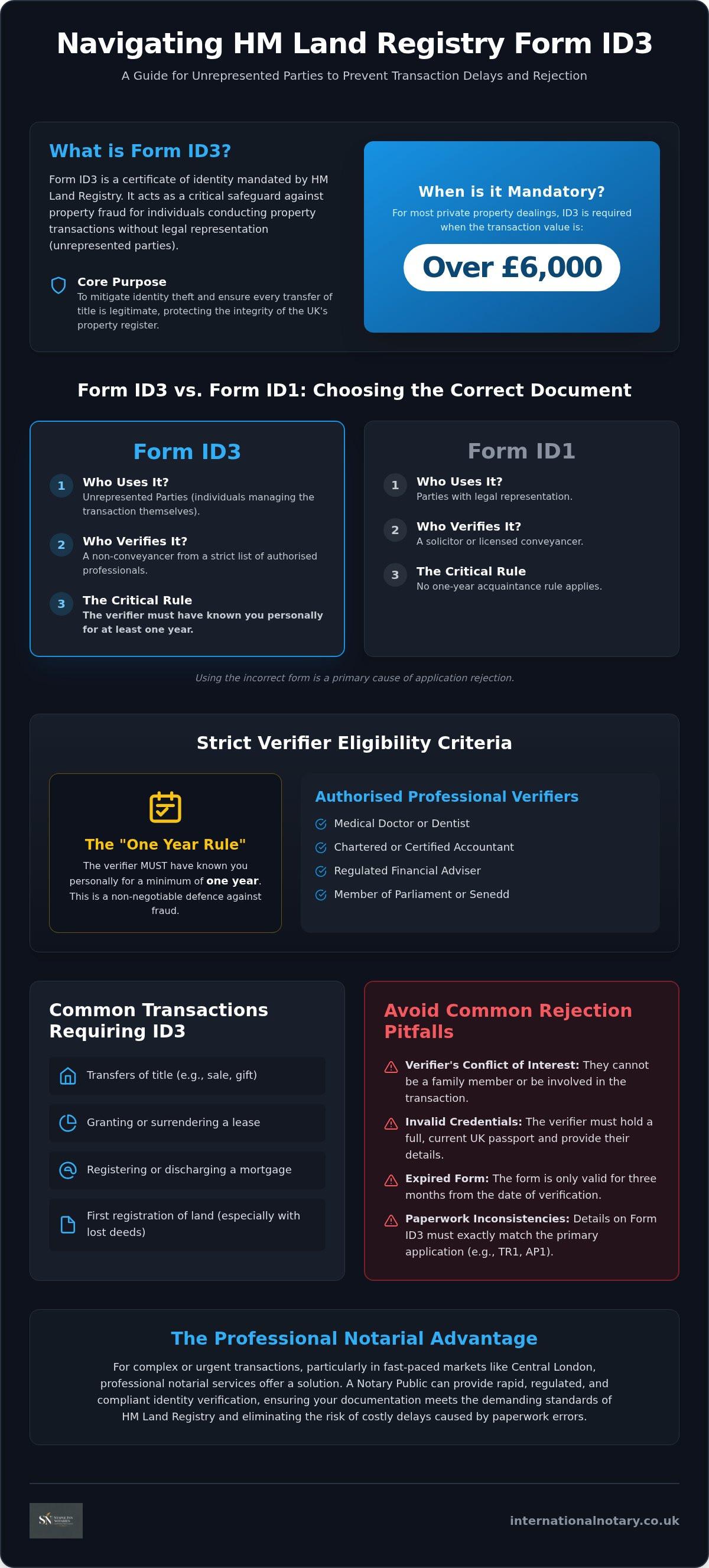
Form ID3 serves as a critical mechanism for verifying the identity of individuals who choose to conduct property transactions without professional legal representation. It's a formal certificate of identity required by HM Land Registry to safeguard the integrity of the national property register, which encompasses over 26 million titles in England and Wales. By mandating this rigorous verification, the registry effectively mitigates the risk of property fraud and identity theft, ensuring that every transfer of title is legitimate and authorised. For many Londoners, the ID3 form Land Registry requirement becomes active whenever a transaction's value exceeds the established £6,000 threshold, making it a staple of private property dealings.
Form ID3 vs Form ID1: Choosing the Correct Document
Distinguishing between these two documents is the first step toward a successful application. While both serve to prove identity, Form ID1 is designed for use when a legal professional, such as a solicitor or licensed conveyancer, verifies your identity. Conversely, unrepresented parties typically default to the ID3 form when they're unable to find a conveyancer willing to act for them or choose to manage the process independently. Using the incorrect document is a primary cause of procedural failure; the registry won't accept an ID1 verified by a non-conveyancer, nor will they accept an ID3 if the verifier doesn't meet the strict professional criteria. Keep in mind that a conveyancer cannot verify your identity on an ID3 form if they're already acting for another party in the same transaction.
Common Transactions Requiring ID3 Certification
You'll need to complete this certification for various dealings involving registered or unregistered land. The most frequent scenarios include:
Transfers of title, such as a sale or a deed of gift between family members.
Registering a new mortgage or charge against a property for the first time.
Discharging an existing mortgage or charge from a title.
First registration of land where the original title deeds have been lost or destroyed, requiring secondary evidence of ownership.
Precision at this stage is vital. If the transaction involves a property valued over £6,000, failing to provide a correctly executed ID3 form results in an immediate rejection of your application. This can lead to missed completion dates and significant financial repercussions, particularly in the fast-paced London market. Our role is to ensure your documentation aligns perfectly with registry expectations, eliminating the risk of costly delays.
Strict Eligibility: Who Can Verify Your Identity on Form ID3?
The eligibility criteria for verifying an ID3 form Land Registry submission are significantly more restrictive than those for standard identity documents or passport applications. Unlike general certifications where a professional might only need to witness a signature, the verifier for an ID3 must have known the applicant personally for at least one year. This "One Year Rule" serves as a primary defence against impersonation fraud. It ensures the verifier can confidently vouch for the individual's identity based on a sustained professional relationship. If your chosen verifier cannot confirm this specific duration of acquaintance, the registry will summarily reject the application. This is non-negotiable.
Registry officials only accept certifications from a limited pool of authorised professionals. This list includes Medical Doctors, Dentists, Chartered or Certified Accountants, Regulated Financial Advisers, Members of Parliament, and Members of the Senedd. Many professionals, such as GPs or teachers, now frequently refuse to sign these forms. This trend stems from the significant professional liability involved and the requirement for the verifier to provide their own personal passport details for registry scrutiny. They often feel they don't have the requisite level of personal knowledge to satisfy the legal standards required under the Fraud Act 2006.
The Professional Verifier Checklist
To be valid, the verifier must hold a full and current UK passport. They're required to provide their professional business address and contact details, allowing HM Land Registry to conduct independent checks. It's imperative that the verifier has no familial relationship with the applicant and is not involved in the property transaction itself. Any conflict of interest or failure to provide a valid UK passport number will invalidate the ID3 form Land Registry process. Such errors often lead to the collapse of transaction deadlines in the competitive London market.
Why a Notary Public is the Preferred Verifier
While various professions are listed in the official Form ID3 guidance, engaging a notary public offers a superior level of security and regulatory compliance. As specialists in Notary Central London services, we provide the high-level professional authority required to navigate these meticulous protocols. Our certifications carry significant weight, established through our regulation by the Faculty Office of the Archbishop of Canterbury. For clients with established professional ties to our firm, seeking professional identity certification ensures that every procedural detail is handled with the precision needed to avoid costly registry rejections.
Step-by-Step Guide to Completing the ID3 Form
The successful execution of the ID3 form Land Registry requires a methodical approach long before you meet your verifier. Precision is your primary safeguard. Start by gathering your current, original UK passport and a recent passport-sized photograph that meets standard biometric requirements. You must ensure all data entered into the form aligns perfectly with the primary application documents, such as the TR1 or AP1. Any discrepancy, however minor, will trigger an immediate requisition from the registry. For the most current technical specifications, refer to the official Completing form ID3 guidance to ensure your version of the form is up to date.
Section A: The Applicant’s Responsibility
Accuracy in Section A is paramount. You must provide the correct title number and a precise property description as they appear on the official register. Don't rely on memory; consult a recent copy of the title register to confirm the exact spelling of names. If you're acting in a specific legal capacity, such as an executor of a will or a beneficiary under a trust, this must be explicitly disclosed. Discrepancies between the name on your passport and the name on the property register often lead to rejections. If your name has changed since the property was last registered, you'll need to provide secondary evidence, such as a marriage certificate or deed poll, alongside your ID3 form Land Registry submission.
Section B is completed by your verifier. They'll need to enter their full professional credentials, including their business address and their own UK passport number. They must also confirm the duration of their personal acquaintance with you, which must be a minimum of one year. Ensure they sign and date the declaration clearly.
The Certification of the Photograph
The endorsement on the back of your photograph is a frequent point of failure for unrepresented applicants. The registry's standards are uncompromising. Your verifier must write the following exact wording on the reverse of the photo: "I certify that this is a true likeness of [your full name]". This endorsement must be followed by their signature and the current date. The date on the photograph must match the date on the ID3 form itself. An incorrectly endorsed photo, or one that lacks the specific mandatory wording, leads to an immediate form rejection. Remember that the completed document is only valid for three months from the date of signature. If your application isn't lodged within this window, the entire process must be repeated.
Avoiding Delays: Why Land Registry Applications are Frequently Rejected
A rejection from HM Land Registry isn't merely an administrative setback; it's a procedural failure that can jeopardise the legal finality of your property transaction. Precision is paramount. Errors are costly. The registry's examiners operate under a mandate of zero tolerance for discrepancies because their primary function is to prevent high-value property fraud. Inconsistencies between the ID3 form Land Registry and primary transaction documents, such as the TR1 transfer or AP1 application, remain the most prevalent cause of rejection. If a middle name appears on your passport and the ID3 form but is omitted from the transfer deed, the registry will issue a requisition, halting the registration process immediately.
Technical omissions by the verifier are equally damaging. We frequently see applications fail because a verifier neglected to provide their current UK passport number or failed to include a valid professional business address. Additionally, using an out-of-date version of the form is a fatal error. As of August 2026, the registry requires the most recent iteration of the document; submitting a version from 2024 or earlier will result in an automatic return. Illegible handwriting or unverified alterations, such as crossing out a mistake without the verifier's initials, will also lead to the summary dismissal of the document.
The Consequences of Identity Fraud and Negligence
The registry maintains sophisticated cross-referencing protocols to validate verifier data against professional databases. Providing false or misleading information on an ID3 form isn't just a paperwork error; it's a criminal offence under the Fraud Act 2006. Beyond legal penalties, the practical impact of a rejected form is often the collapse of a property completion date. In a chain of transactions, one person's identity verification failure can trigger a cascading series of delays, potentially leading to breach of contract claims and significant financial forfeiture.
Procedural Precision for London Property
Managing the compressed timelines typical of Central London property exchanges requires a mindset of controlled urgency. When a rejection occurs, you don't have the luxury of weeks to rectify the mistake. You need immediate, compliant corrections to satisfy registry requirements before transaction deadlines expire. For busy professionals in the City or West End, our Mobile Notary London service provides the rapid, on-site certification necessary to overcome these hurdles. We act as the expert fixers who ensure your identity evidence is beyond reproach. If you're facing a registry deadline, book a priority verification appointment to secure your transaction.
Professional Identity Verification: The Staple Inn Notaries Advantage
When established professional contacts decline to verify identity, the entire property transaction risks immediate collapse. This reluctance is increasingly common among general practitioners and accountants who fear the personal liability and data disclosure associated with registry protocols. At Staple Inn Notaries, we occupy the role of the 'Expert Fixer', providing the high-level professional authority necessary to master the technicalities of the ID3 form Land Registry. We don't merely witness signatures; we provide a robust, regulated certification that registry examiners trust. This credibility is vital for unrepresented individuals navigating the complexities of the London property market without a solicitor.
Our service is designed for speed and precision. We maintain direct channels for clarifying technical queries, ensuring that every document we produce meets the 2026 standards of HM Land Registry. This proactive approach eliminates the back-and-forth communication that often delays property registration for months. For corporate entities and private individuals alike, we offer a streamlined solution that prioritises the finality of your legal documentation. We understand that in the City, delay is often synonymous with financial loss.
Our Notarial and Private Client Expertise
We integrate identity verification with a comprehensive suite of legal services to ensure total procedural harmony. For example, ensuring that a Corporate Power of Attorney aligns with the specific requirements of a property transfer is a frequent requirement for our City-based clients. Executors and trustees often face additional scrutiny when submitting the ID3 form Land Registry; our role is to provide the professional certification that validates their capacity to act. This level of oversight is particularly crucial in probate administration where the stakes involve significant inheritance tax implications and multi-million pound assets.
Contact Us for Urgent ID3 Certification
Time is of the essence in the London property market. You can secure your transaction by booking an appointment at our Central London office, located conveniently for rapid access from the City and West End. For busy professionals or those with mobility constraints, our mobile notary service offers on-site verification at your home or place of business. We operate with a modern, fast-paced mindset, ensuring that your identity evidence is processed and returned with minimal delay. Don't leave your property registration to chance. Secure your property transaction with expert verification.
Securing Your London Property Transaction
Navigating the administrative rigour of HM Land Registry requires absolute procedural precision. Errors are costly. The integrity of your ID3 form Land Registry submission depends on adhering to the strict one-year acquaintance rule and ensuring every technical detail, from the photograph endorsement to the verifier's credentials, is beyond reproach. In a market as fast-paced as London's, even a minor discrepancy can lead to a transaction-halting rejection. You don't have to manage these complexities alone.
Staple Inn Notaries provides the authoritative oversight needed to eliminate the risk of procedural failure. We are Regulated by the Faculty Office and serve as Specialists in London Property Law, offering the calm competence required for high-value transactions. Whether you visit our Central London office or require our Urgent Mobile Notary Services for on-site verification in the City, we ensure your documentation is registry-ready. Take the final step toward a successful completion today.
Book Your ID3 Verification with Staple Inn Notaries and move forward with total confidence in your property registration.
Frequently Asked Questions
Can I use Form ID3 if I do not have a UK passport?
You cannot use Form ID3 without a current UK passport. This specific form is reserved exclusively for individuals who hold valid UK travel documentation. If you don't possess a UK passport, you must submit Form ID1 instead. Form ID1 permits the use of alternative identification, such as a UK driving licence or state benefits letters, but it requires verification by a legal professional rather than a general professional verifier.
How long is a completed Land Registry ID3 form valid for?
A completed ID3 form is valid for exactly three months from the date it was signed and dated by your verifier. You must ensure your full application is submitted to HM Land Registry within this ninety-day window. If this deadline is missed, the verification process must be repeated in its entirety to comply with current anti-fraud protocols. We recommend lodging your deeds immediately after certification to avoid expiration.
Does the verifier need to be a solicitor to sign Form ID3?
No, the verifier for an ID3 form Land Registry submission does not need to be a solicitor. While solicitors are eligible, the registry also accepts signatures from other authorised professionals, including medical doctors, dentists, chartered accountants, and notaries. Crucially, the verifier must have known you personally for at least one year and must hold a current UK passport themselves to satisfy the registry's stringent identity requirements.
What happens if the Land Registry cannot contact my verifier?
If the registry is unable to verify the credentials or the statement of your verifier, they will issue a formal requisition or reject the application outright. HM Land Registry frequently conducts independent checks to confirm a verifier's identity and professional standing. Any failure to respond to these enquiries will stall your property transaction, potentially leading to a breach of contract and the loss of your completion date.
Can a retired professional sign my ID3 form?
No, the verifier must be a current, practising member of their profession with a valid, verifiable business address. Retired professionals are not accepted because the registry needs to confirm their active standing with a relevant regulatory body. Using a verifier who is no longer in active practice is a common cause for the summary rejection of identity evidence, as they cannot be easily held accountable under professional indemnity standards.
Is there a fee for the Land Registry to process Form ID3?
There is no direct fee payable to the Land Registry for processing the ID3 form Land Registry itself. It's a mandatory supporting document for unrepresented applications. However, you should expect to pay a professional fee to your chosen verifier for their time and liability. Furthermore, the primary application, such as a property transfer, will attract its own registration fee based on the transaction value and the method of submission.
Can I use a digital signature on Form ID3 in 2026?
No, you cannot use a digital signature on Form ID3 as of August 2026. The registry demands a traditional "wet ink" signature from both the applicant and the professional verifier. This must be completed during a physical, in-person meeting. The previous allowance for video call verification was rescinded in 2024 to strengthen defences against property fraud, meaning digital or electronic signatures will lead to an immediate form rejection.
What should I do if I cannot find anyone who has known me for a year?
If you cannot find an eligible professional who has known you for at least one year, you're ineligible to use Form ID3. In this situation, you must use Form ID1. This alternative form requires you to have your identity verified by a solicitor or licensed conveyancer, who can verify you based on documentary evidence without the one-year acquaintance rule. This ensures that everyone has a path to secure identity certification.



Comments