
Company Resolution Certification: The Professional Guide to Notarial Services in London

Updated: Sep 6
A single administrative oversight in a corporate resolution can instantly jeopardise a high-value international transaction. You are likely aware that while internal board decisions serve as the foundation of your company's governance, these documents rarely possess the legal standing required by foreign jurisdictions without rigorous, formal verification. When notarising board minutes in London, the pressure of urgent deadlines for cross-border deals often compounds the anxiety of potential rejection by overseas authorities.
Mastering the complexities of certifying corporate resolutions for international use requires a precise understanding of procedural compliance and legalisation. This professional guide provides the expert oversight needed to ensure that your Ordinary or Special resolutions are prepared to withstand the scrutiny of the FCDO apostille process. We will detail the essential steps to secure a certified resolution, providing the procedural certainty necessary to avoid costly delays and ensure your corporate documentation is recognised globally.
Table of Contents
Understanding Company Resolution Certification for International Business
A Corporate resolution serves as the formal, written record of decisions made by a company's board of directors or its shareholders. While these documents are sufficient for domestic compliance within the United Kingdom, they lack the inherent legal standing required for use in foreign jurisdictions. Notarising board minutes in London bridges this gap by providing an independent, high-level verification of the document's authenticity and the authority of those who signed it. A Notary Public doesn't merely witness a signature; they perform a comprehensive review to confirm that the individuals acting on behalf of the company possess the legal capacity to do so. This rigorous process distinguishes a notarised original from a simple photocopy, which carries no legal weight in international trade or cross-border litigation.
The Purpose of Certification in Global Trade
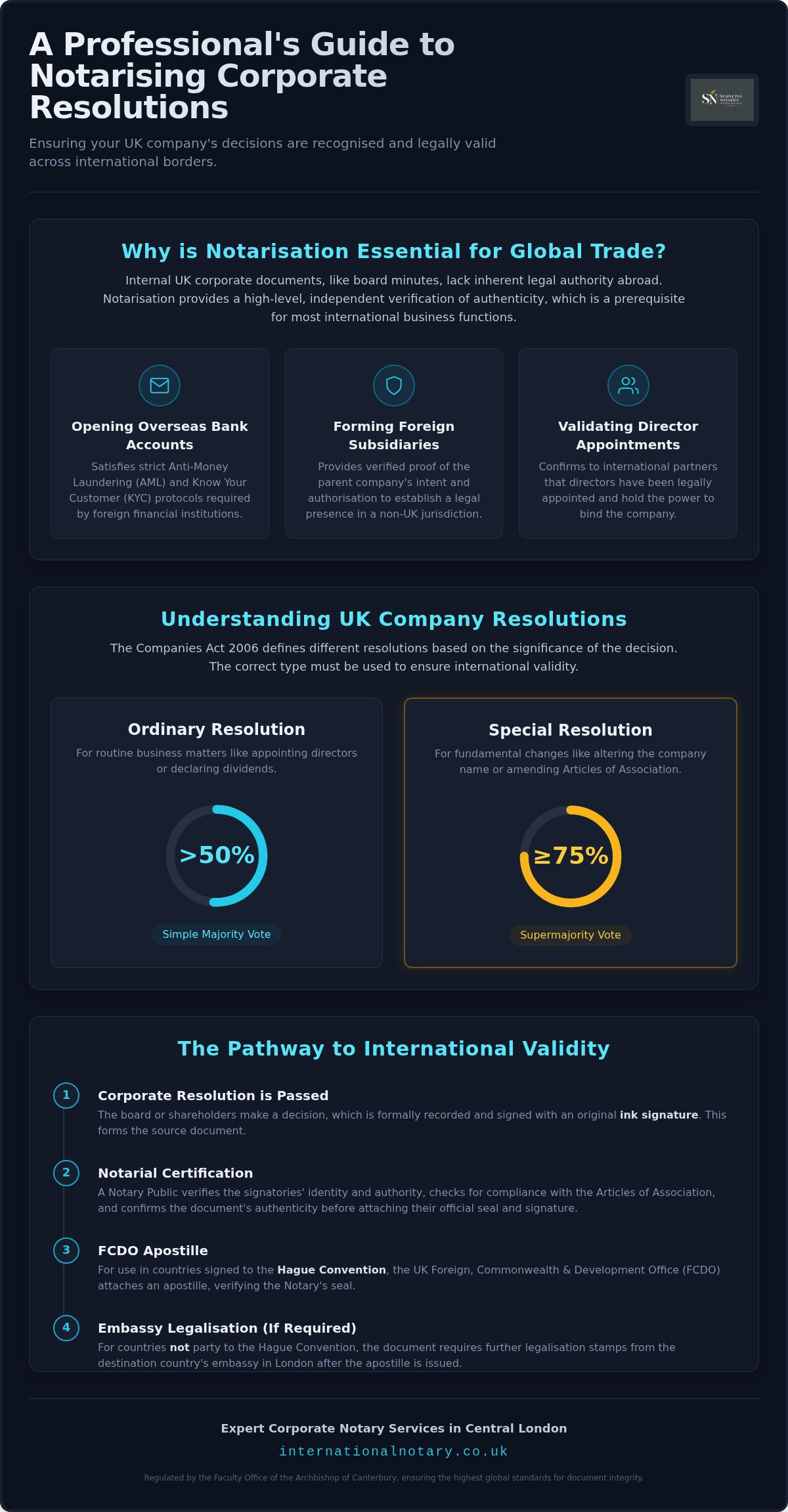
International commerce relies on the certainty of corporate authority. When a UK entity seeks to expand its operations, foreign regulators and financial institutions demand evidence that internal decisions were reached through proper channels. Professional certification is a prerequisite for several critical business functions:
Opening overseas corporate bank accounts: Banks in Europe, Asia, and the Americas require notarised resolutions to satisfy strict Anti-Money Laundering (AML) and Know Your Customer (KYC) protocols.
Forming foreign subsidiaries: Establishing a legal presence in a non-UK jurisdiction requires verified proof of the parent company's intent and authorisation. If you are planning to incorporate in the Netherlands, you can read more about Dutch corporate tax to ensure your new entity remains compliant.
Validating director appointments: Notarisation confirms to international partners that new directors have been legally appointed and hold the power to bind the company to contracts.
Strategic expansion into Brazil: For firms looking to establish a presence in South America, you can learn more about Pactum Global to understand the specific requirements for company formation in Brazil.
Without this expert intervention, transactions often encounter insurmountable delays. We provide the controlled urgency needed to keep your global projects on schedule. It's vital that your documentation is prepared correctly the first time to avoid the rejection of applications by overseas authorities.
Regulatory Standards and the Notary’s Duty
Staple Inn Notaries operates under the strict oversight of the Faculty Office of the Archbishop of Canterbury. This regulation ensures that our verification processes meet the highest global standards for document integrity. When notarising board minutes in London, our primary duty is to act as a trusted gatekeeper, preventing fraud and ensuring international procedural compliance. We meticulously examine the company's Articles of Association to confirm the resolution aligns with internal powers and statutory requirements. This scrutiny ensures the document is fit for purpose, whether it's destined for the FCDO apostille process or further embassy legalisation. Our role is to provide the procedural certainty that protects your firm's reputation and legal standing abroad.
Types of Private Company Resolutions: Ordinary, Special, and Written
The legal framework for corporate decision-making in the United Kingdom is strictly governed by the Companies Act 2006. For any UK entity engaging in international transactions, identifying the specific type of resolution required is a critical prerequisite for successful certification. When notarising board minutes in London, the Notary Public must verify that the decision was reached through the correct procedural channels, as the type of resolution directly dictates the language used in the notarial act. Foreign jurisdictions often demand precise wording to confirm that a resolution was passed with the requisite authority and majority threshold.
Ordinary vs Special Resolutions
Ordinary resolutions are typically utilised for routine business matters, such as the authorisation of director appointments or the declaration of dividends. These require a simple majority of more than 50% of the votes cast by shareholders. In contrast, special resolutions are reserved for fundamental constitutional changes. These include altering the company's name, amending the Articles of Association, or restructuring share capital. Because special resolutions require a 75% majority threshold, the notarial certification must explicitly state that this higher legal standard was met. This level of detail provides the procedural certainty that international banks and regulators require before they will recognise a significant change in a company's structure.
Written Resolutions and Board Minutes
Private companies frequently utilise written resolutions to bypass the logistical challenges of physical shareholder meetings. These documents are highly flexible, allowing shareholders to sign a single document or identical copies in counterpart. Whilst shareholder resolutions focus on ownership-level decisions, board minutes record the executive actions taken by the directors. Certifying these minutes involves a rigorous check of the meeting's quorum and the directors' specific powers. Our "Expert Fixer" approach is designed to handle complex, multi-signatory documents with the controlled urgency required for City-based transactions. If you are uncertain which resolution type is necessary for your specific overseas project, you can discuss your requirements with our specialists to ensure total compliance.
Before notarising board minutes in London, it's essential that the underlying corporate action is validly passed in accordance with the company's internal rules. We often review the company's statutory registers and internal minutes to confirm that proper notice was given and the correct majority was achieved. This meticulous verification process ensures that the certified resolution is beyond reproach when it is presented for embassy legalisation or used to facilitate a cross-border deal. Accuracy at this stage is the only way to eliminate the risk of document rejection by foreign authorities.
The Notarial Certification Process: Ensuring Procedural Compliance
Notarising board minutes in London is a process defined by precision and procedural rigidity. Once you've identified the correct resolution type, the focus shifts to the physical execution of the document. Despite the rise of digital workflows, most foreign jurisdictions and embassies still require an original "ink signature" to grant legal recognition. We facilitate this by witnessing the signing in person, ensuring that the document meets the stringent standards required for subsequent legalisation. This physical presence is non-negotiable for transactions involving countries that aren't yet fully digitalised in their corporate registries.
Our verification extends beyond the signature itself. When notarising board minutes in London, we conduct a thorough review of Companies House records to confirm the current standing of the company and the identity of its officers. This step ensures that the individuals signing the resolution have the actual authority to bind the company. We also scrutinise the Articles of Association to verify that the board's actions align with the company's internal governance rules. This prevents procedural challenges that could derail a deal at the final hour.
Document Verification and Identification
The first stage of the appointment involves a rigorous identification process. We require all signatories to provide valid identification, often involving Passport and ID Certification, to comply with anti-fraud regulations. For busy City executives, our Mobile Notary London service allows this verification to take place at your offices, maintaining the necessary professional authority without disrupting your schedule. We ensure the resolution is correctly dated and formatted to meet the specific requirements of the target jurisdiction, as even minor layout errors can lead to rejection by foreign authorities.
The Notarial Act and Seal
Once the signatures are verified, we prepare a formal Notarial Certificate. This document is securely attached to the resolution, detailing the steps taken to verify the company's capacity and the signatories' identities. The application of the Notary’s official seal and signature is the definitive act that grants the resolution international validity. This certificate is essential when you need to Get your document legalised through the FCDO. We maintain a meticulous record of every notarial act, providing a permanent trail that can be verified by foreign regulators or banks years after the transaction has closed. This systematic approach eliminates uncertainty and provides the procedural certainty your business requires for cross-border success.
Cross-Border Validity: Apostilles and Embassy Legalisation
The completion of a notarial act is merely the first phase in securing international document recognition. To be accepted by foreign government departments or financial institutions, the resolution must undergo legalisation to confirm the Notary's standing. The Foreign, Commonwealth & Development Office (FCDO) serves as the competent authority in the United Kingdom for this purpose, affixing an Apostille to the document. For countries that are signatories to the Hague Convention, this single certificate is sufficient to grant the resolution legal effect. However, notarising board minutes in London often involves transactions with non-member states, which necessitates a more complex, multi-stage legalisation journey. We operate as your expert fixer in these scenarios, managing the interface between the Notary, the FCDO, and various foreign consulates to meet aggressive commercial deadlines.
Paper Apostille vs e-Apostille for Corporate Documents
In 2026, the choice between a traditional paper apostille and the e-Apostille is dictated by the destination country's technological readiness and the nature of the original signature. Whilst the FCDO has expanded its digital offerings, paper apostilles remain the dominant requirement for ink-signed corporate resolutions destined for embassy legalisation. If your resolution contains a physical signature, you must opt for the paper route to ensure compatibility with consular standards. Conversely, e-Apostilles are suitable for documents with verified digital signatures, provided the receiving authority explicitly accepts electronic formats. We ensure you select the correct path to avoid the risk of document rejection at the border.
The Legalisation Journey: From Notary to Embassy
The path to cross-border validity follows a strict, three-step sequence that leaves no room for error. First, the original resolution must undergo notarisation to verify corporate authority and signatory capacity. Second, the document is submitted to the Apostille Services London centre for FCDO certification. For jurisdictions such as the UAE, China, or Qatar, a third step is mandatory: consular legalisation. This involves the relevant embassy adding its own seal to confirm the FCDO’s verification. When notarising board minutes in London for these specific jurisdictions, any deviation from this sequence will result in immediate failure. Our team manages every link in this chain, providing the procedural certainty required for complex international restructures.
Efficiently managing this journey requires a deep understanding of ever-changing embassy protocols and current FCDO turnaround times. We eliminate the procedural friction that often stalls high-stakes international transactions. If your firm requires rapid document legalisation for an upcoming board meeting or corporate restructure, enquire about our expedited apostille services to ensure your deadlines are met without compromise.
Expert Corporate Notary Services in Central London
Staple Inn Notaries operates at the intersection of traditional legal authority and modern corporate speed. For City firms and international banks, the administrative burden of certifying documentation can become a significant bottleneck in complex cross-border deals. Notarising board minutes in London requires more than just a witness signature; it demands a deep understanding of the regulatory landscape and a commitment to rapid execution. We provide the controlled urgency necessary to ensure that your corporate resolutions are not only accurate but also delivered within the tightest transaction windows. Our specialists act as the "Expert Fixer" for your international documentation, ensuring every seal and certificate meets the precise standards required by foreign jurisdictions.
Mobile Notary Services for Central London Offices
The logistical challenge of coordinating directors for a physical signing often delays critical deals. Our Mobile Notary London service addresses this friction by providing on-site certification at your headquarters or law firm. We handle multiple signatures with clinical efficiency during board meetings, verifying the identity and authority of each signatory without requiring them to leave the office. Once the notarisation is complete, we provide immediate dispatch for legalisation, moving your documents directly from the boardroom to the FCDO or relevant embassy. This streamlined workflow is essential for high-stakes transactions where every hour counts.
Secure Your International Transaction Today
Choosing a specialist Notary Central London is a strategic decision that prioritises document acceptance and procedural certainty. We offer comprehensive support beyond basic certification, including specialist guidance on Corporate Power of Attorney Notarisation. This ensures that all facets of your international authority are verified simultaneously, preventing the disjointed filings that often trigger rejection by overseas regulators. Our meticulous attention to detail and adherence to Faculty Office regulations provide the legal weight your business needs to operate globally with confidence.
Direct access to our expert advisers allows for the rapid resolution of complex legalisation issues. We don't just process paperwork; we provide the professional oversight that bridges the gap between internal governance and international law. By notarising board minutes in London through our firm, you secure a partner dedicated to eliminating procedural delays and ensuring your cross-border transactions proceed without interruption. Contact our team to facilitate your next corporate certification.
Secure Global Validity for Your Corporate Resolutions
Navigating the intersection of UK corporate governance and international legal requirements demands absolute precision. Successful certification hinges on identifying the correct resolution type under the Companies Act 2006 and adhering to the strict procedural standards of the FCDO and foreign embassies. Notarising board minutes in London is the essential mechanism that transforms internal decisions into legally recognised instruments for cross-border trade. By ensuring every signature is verified and every seal is correctly applied, you eliminate the risk of document rejection and avoid costly transaction delays.
Staple Inn Notaries provides the professional oversight required for high-stakes business. Regulated by the Faculty Office, we offer a specialist mobile notary for Central London and a comprehensive apostille and legalisation service. Don't let procedural friction impede your international expansion. Book an urgent appointment for Company Resolution Certification to ensure your corporate documentation is ready for immediate global use. We are here to facilitate your cross-border success with efficiency and expert care.
Frequently Asked Questions
What is a certified company resolution?
A certified company resolution is a formal record of a corporate decision that has been verified and sealed by a Notary Public. The Notary confirms the company's legal existence, the resolution's validity under its Articles of Association, and the identity of the signatories. This certification provides the necessary legal weight for the document to be recognised by foreign government departments and international financial institutions during cross-border transactions.
Why does an overseas bank require a notarised resolution?
Foreign banks require independent verification to satisfy strict Anti-Money Laundering (AML) and Know Your Customer (KYC) regulations. A notarised resolution proves that the individuals opening an account or signing a loan agreement possess the legal authority to bind the UK company. Without this professional certification, internal minutes lack the evidentiary standing required for international financial transactions and are likely to be rejected by overseas compliance departments.
Can a company resolution be signed digitally for notarisation?
Digital signatures are increasingly accepted, but their use depends entirely on the requirements of the receiving jurisdiction. Whilst the FCDO offers e-Apostilles for electronically signed documents, many embassies and foreign registries still mandate traditional ink signatures on paper. We recommend verifying the target country's specific requirements before proceeding with a digital workflow to avoid potential rejection by overseas regulators or delays in the legalisation process.
How long does it take to get a company resolution apostilled in London?
Turnaround times for an apostille in London depend on the current processing speeds at the Foreign, Commonwealth & Development Office (FCDO). Standard paper-based applications typically take several working days, whilst the urgent or business-critical service levels can expedite this process significantly. We manage the entire submission and collection process on your behalf, ensuring your notarised company resolutions are legalised as quickly as current regulations allow.
What is the difference between an ordinary and a special resolution for certification?
The primary difference lies in the majority threshold required by the Companies Act 2006. Ordinary resolutions require a simple majority of over 50%, while special resolutions require a 75% threshold for fundamental changes. When notarising board minutes in London, the Notary must explicitly certify that the correct legal standard was met. This ensures the document's validity abroad and provides the procedural certainty required by international banks.
Do I need to visit your Central London office for certification?
No, a physical visit to our office is not mandatory. We provide a specialist Mobile Notary London service, allowing us to attend your headquarters or law firm offices directly. This is particularly advantageous when notarising board minutes in London, as it enables us to witness multiple signatures during a single meeting. This on-site approach ensures professional certification and procedural compliance without disrupting your company's executive schedule.
What documents must I provide to the notary for a corporate resolution?
You must provide the original resolution, the company's Articles of Association, and valid identification for all signatories. We also require evidence of the directors' authority, which we verify through Companies House records and internal minutes. Providing these documents in advance allows us to conduct the necessary due diligence and verification of corporate capacity, ensuring a streamlined and efficient appointment that meets all regulatory standards.
Will a UK notarised resolution be valid in the UAE or China?
A notarised resolution is the first step, but jurisdictions like the UAE or China require further embassy legalisation. Because these countries are not members of the Hague Convention, the document must be apostilled by the FCDO and subsequently stamped by the relevant consulate or embassy. We provide a comprehensive service to manage this multi-stage legalisation journey, ensuring your company documents meet the specific requirements of these jurisdictions.


Comments