
Company Incorporation in London: Notary Filing Guide

Updated: Sep 3
The era of Companies House acting as a passive registry is over; as of 2026, it operates as a rigorous regulator with enhanced powers to query every submission. When your business requires Document Filing: Submits company incorporations, the margin for error has vanished. You likely recognise that the distinction between a Memorandum and Articles of Association is more than just a formality, it is the fundamental legal framework of your corporate governance. It's frustrating to face administrative delays because of identity verification hurdles or incorrect filing structures, particularly whilst an urgent international deal hangs in the balance.
We understand that for foreign directors and City law firms, the requirement for mandatory identity verification adds a layer of complexity that demands expert intervention. This guide will help you master the intricacies of legalisation, notarisation, and the current Companies House protocols to ensure your registration is both swift and successful. We'll examine the updated 2026 fee structures, such as the £100 digital incorporation fee, and provide a clear roadmap for achieving a legally compliant corporate structure. By following these precise steps, you can secure the international validity required for your most critical business ventures.
Table of Contents
Understanding Document Filing: Submits Company Incorporations
Document Filing: Submits company incorporations serves as the formal gateway to the UK market. It involves the meticulous preparation and delivery of a company’s constitutional documents to the Registrar of Companies. This process isn't merely administrative; it's a statutory requirement that transforms a private venture into a registered legal entity. Under the Economic Crime and Corporate Transparency Act 2023, the Registrar now possesses enhanced powers to query and reject inconsistent data. This shift from a passive registry to an active regulator means that precision is non-negotiable for any entity seeking to establish a presence in London. As of early 2026, every application must include a declaration of lawful purpose, reinforcing the registry's commitment to corporate transparency and the integrity of the public record.
The Legal Significance of Incorporation
Successful filing establishes a separate legal personality, a concept central to the process of incorporation of a business in the UK. Once registered, the company exists independently of its directors and shareholders. This distinction allows the business to enter into legally binding contracts, own assets, and assume its own debts. For the individuals involved, this creates the corporate veil of limited liability, protecting personal assets from the company's financial obligations. It's the critical transition from a proposed venture to a registered private limited company, providing the structural security required for long term growth and commercial credibility.
Why Professional Oversight is Required
Filing errors frequently cause unnecessary delays, which can be fatal for urgent business deals. The 2026 regulatory framework requires mandatory identity verification for all directors and Persons with Significant Control (PSCs). If these details don't align perfectly with the submitted Memorandum and Articles of Association, Companies House will reject the application. Current digital filing fees sit at £100, and a rejection often means forfeiting time that your business cannot afford to lose. Professional oversight ensures your bespoke Articles of Association comply with the Companies Act 2006 and subsequent amendments whilst reflecting your specific governance needs. Precise language is vital; ambiguous clauses can lead to future internal disputes or regulatory scrutiny. Using a specialist ensures that your Document Filing: Submits company incorporations is handled with the meticulous care required for international validity and procedural compliance.
Essential Statutory Documents for Incorporation Filing
The legal architecture of a new business is defined by its statutory pack. Every successful instance of Document Filing: Submits company incorporations relies on the precision of Form IN01. This document identifies the initial directors, any company secretaries, and the registered office address, which must be a physical UK location. It also includes the statement of capital, which specifies the number and value of shares issued at the point of formation. This defines the initial ownership structure and sets the threshold for corporate control. Errors in these foundational details often trigger immediate rejections from the Registrar, potentially delaying urgent commercial operations.
Memorandum and Articles of Association
The Memorandum of Association is a concise declaration of intent, signed by all subscribers wishing to form the company. In contrast, the Articles of Association serve as the comprehensive internal rulebook governing corporate behaviour and decision-making processes. Whilst many startups opt for standard Model Articles, complex organisations often require bespoke drafting to manage specific shareholder rights or restrictive covenants. Executing these documents amongst multiple subscribers requires meticulous coordination to ensure every signature is valid and properly witnessed. If your corporate structure involves international stakeholders, aligning these filings with your Notary Central London requirements is vital for cross-border recognition.
Identity and Control Documentation
Under the Economic Crime and Corporate Transparency Act 2023, transparency is the primary objective of the corporate centre. You must identify all People with Significant Control (PSC) during the filing process to prevent the misuse of corporate structures. This involves providing accurate residential addresses and service addresses for every individual holding more than 25% of shares or voting rights. Stricter identity verification for directors is now mandatory to prevent fraudulent incorporations; existing directors must complete this verification by November 2026. For a complete breakdown of these requirements, you should consult the official government guidance on company names and registration. Maintaining accurate statutory registers is not just good practice; it's a legal obligation that ensures your business remains compliant during future audits. Using an expert for Document Filing: Submits company incorporations ensures that your PSC data and director verifications are processed without the risk of rejection. If you require assistance with the certification of these sensitive documents, our notary services provide the high-level professional authority needed to satisfy both UK and international regulators.
The Critical Role of Notarisation in International Incorporations
Whilst the official government guide provides a clear baseline for domestic registration, it often glosses over the hurdles faced by international entities. When a UK enterprise involves overseas stakeholders, the standard registration process requires the specialised intervention of a Notary Public to ensure international validity. For foreign parent companies establishing UK subsidiaries, the Registrar requires definitive proof of the parent entity's legal standing and the formal authorisation of its representatives. In these instances, Document Filing: Submits company incorporations becomes a multi-jurisdictional exercise, necessitating notarised board resolutions that confirm the corporate intent to incorporate. Without this high-level certification, international entities often find their applications stalled by bank compliance departments or the Registrar's enhanced scrutiny under the 2026 transparency regulations.
Certified Copies and ID Verification
Anti-Money Laundering (AML) regulations in the UK have reached a peak of stringency in 2026. For overseas directors, a simple solicitor certification is frequently insufficient for London's high-street banks or the Companies House identity verification mandate. A Notary Public provides a superior level of assurance, certifying that passports and proof of address documents are genuine copies of the originals. This process is vital for global mobility, allowing foreign directors to satisfy UK requirements without being physically present in the City. Ensuring that your identity documentation meets these exacting standards is a prerequisite for opening corporate bank accounts, a step that often proves more time-consuming than the incorporation itself.
Notarising Corporate Resolutions
Establishing a subsidiary requires clear evidence that the parent company's board has sanctioned the new venture. We specialise in notarising board resolutions that authorise specific individuals to act on behalf of the company during the incorporation phase. Utilising a Corporate Power of Attorney Notarisation in London ensures that your local representatives have the legal authority to sign statutory documents and manage the registry interface. This level of professional oversight is essential when Document Filing: Submits company incorporations involves complex cross-border structures. By validating company resolutions through a regulated notary, you establish a chain of authority that is recognised by both UK authorities and international regulators, facilitating seamless cross-border transactions and future corporate expansion.
Step-by-Step Guide to Submitting Incorporation Documents
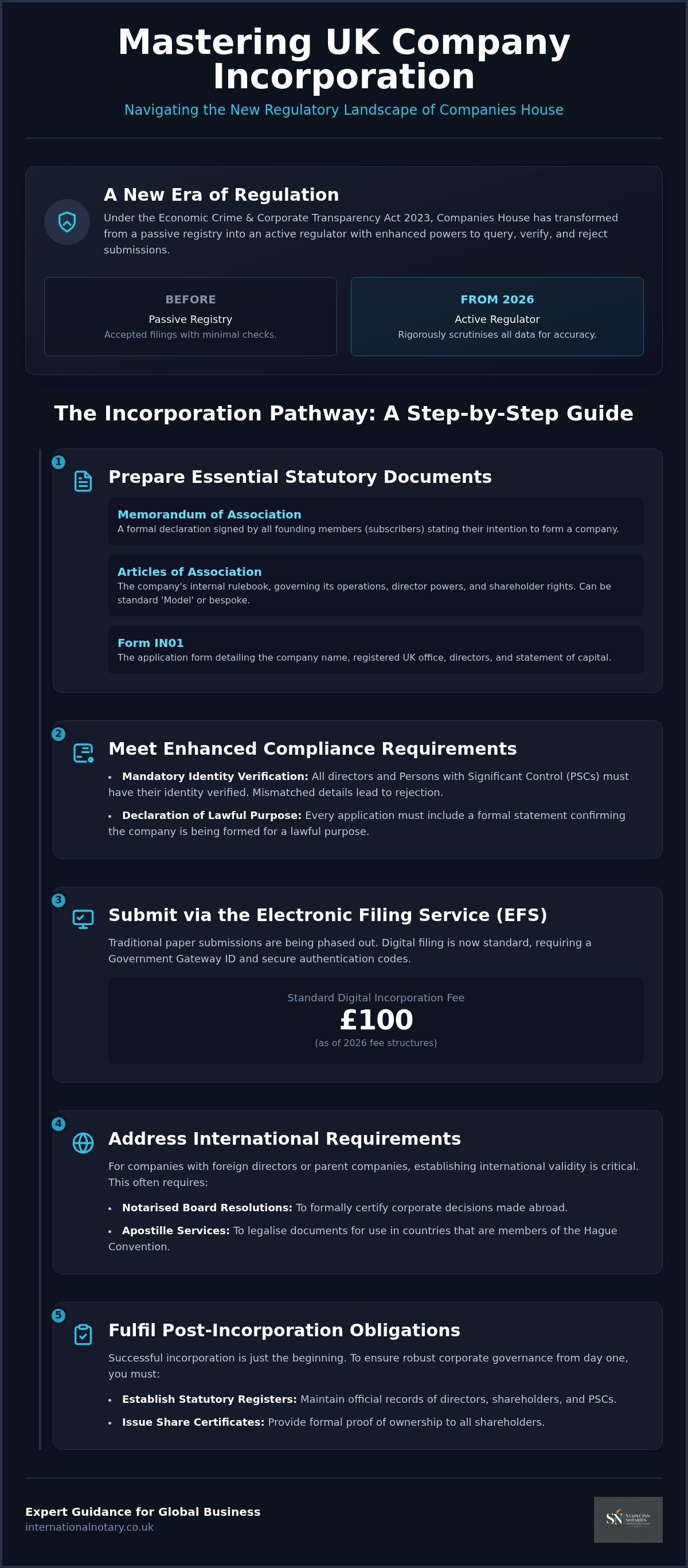
The choice between digital and paper-based submission determines the speed and cost of your London setup. In 2026, Companies House operates on a digital-by-default basis, incentivising electronic submissions with a standard £100 fee. Paper filings are now significantly more expensive at £124 and suffer from longer processing queues. For urgent business deals, the same-day digital incorporation service remains the gold standard, though it carries a premium of £156. Before Document Filing: Submits company incorporations can commence, you must establish a secure digital environment. This involves creating a Government Gateway ID and securing a unique authentication code for the company, which acts as the digital signature for all future filings. Once submitted, the sequence typically concludes with the issuance of a Certificate of Incorporation within 24 hours for digital applications.
Electronic Filing Service (EFS) Protocols
Successful digital uploads require meticulous document organisation. You must ensure all PDFs are clear, legible, and formatted to the Registrar's specific technical requirements. The Companies House upload service is the primary portal for specialised corporate filings, including bespoke Articles of Association that deviate from the standard model. If you encounter technical errors during the submission process, they often stem from inconsistent data between the Form IN01 and the supporting constitutional documents. Resolve these discrepancies immediately to avoid the system flagging your application for manual review, which can add unnecessary days to your timeline. Ensure your payment protocol is established through a Companies House account or a valid credit/debit card to prevent transaction failures at the point of submission.
Apostille and Legalisation Requirements
UK incorporation documents often require an Apostille from the Foreign, Commonwealth & Development Office (FCDO) if they are destined for use overseas. This is particularly relevant for companies opening branches in Hague Convention countries or entering into international contracts. The Legalisation Office validates the notary's seal or the Registrar's signature, confirming the document's authenticity for foreign jurisdictions. For City law firms and corporate entities facing tight deadlines, utilising a Mobile Notary London provides a streamlined solution for on-site certification and urgent legalisation. This service ensures that Document Filing: Submits company incorporations is supported by the necessary international credentials without requiring your directors to leave the corporate centre. If you require rapid certification to meet an international filing deadline, book our notary services to secure the necessary legalisation for your corporate documents.
Post-Filing Obligations and Corporate Governance
The receipt of the Certificate of Incorporation marks the commencement of your statutory duties. You must convene the first board meeting immediately to formalise the business's operational structure. During this session, the board must issue share certificates to the initial subscribers, providing definitive evidence of ownership. Accurate Document Filing: Submits company incorporations ensures the foundation is solid; however, maintaining the statutory registers, including the register of members, directors, and charges, is an ongoing legal requirement. Failure to keep these records at your registered office can result in significant penalties and corporate governance failures.
Immediate Post-Incorporation Tasks
Registration with HMRC is a non-negotiable next step. You must register for Corporation Tax within three months of starting to trade. If your taxable turnover exceeds the £90,000 threshold in a rolling 12-month period, VAT registration becomes mandatory. Formalising the appointment of company secretaries or auditors should also occur at this stage to ensure professional oversight of your accounts. Draft and notarise the initial board minutes immediately. This creates a robust, official record that carries international validity. Such certification is particularly useful if you intend to open overseas bank accounts or participate in global tenders shortly after formation.
Maintaining International Compliance
Annual compliance requires rigorous attention to deadlines. Your confirmation statement must be filed within 14 days of the review period's end. In 2026, the digital filing fee for this statement is £50. Missing the annual accounts filing deadline, which is nine months after your Accounting Reference Date for private companies, triggers automatic late filing penalties. These start at £150 and escalate to £1,500 for delays exceeding six months. If your business expands, ongoing legalisation of corporate documents for foreign branch offices is essential. Any subsequent changes to your company constitution or control structure require updated Document Filing: Submits company incorporations to reflect the current status. Staple Inn Notaries provides specialised support for these transitions, including long-term trust and estate planning for directors. We ensure your corporate and personal legal interests remain protected as the business matures.
Securing Your Corporate Foundation in London
Precision in statutory documentation is the bedrock of a successful UK venture. As Companies House transitions into a more active regulator in 2026, the complexity of Document Filing: Submits company incorporations has increased, making expert oversight essential for avoiding procedural delays. You've seen how meticulous identity verification and the correct drafting of Articles of Association protect your interests and ensure long-term compliance. For international entities, the role of notarisation remains critical for bridging the gap between UK requirements and global standards.
Staple Inn Notaries acts as your authoritative partner in this process. Regulated by the Faculty Office of the Archbishop of Canterbury, we are specialists in international corporate legalisation. Whether you require on-site assistance through our mobile notary service or prefer to visit our Central London office, we provide the rapid, expert certification your business demands. Contact Staple Inn Notaries for expert assistance with your corporate document filings and notarisation. Take the next step with confidence, knowing your corporate structure is legally sound and ready for global trade.
Frequently Asked Questions
Do I need a Notary Public to file company incorporation documents in the UK?
Notarisation is not a strict requirement for domestic UK registrations, however, it becomes indispensable when Document Filing: Submits company incorporations involves international stakeholders. Foreign parent companies or overseas directors must often have their resolutions and identity documents certified by a Notary Public to satisfy UK anti-money laundering regulations. This high-level certification provides the necessary international validity for cross-border corporate structures and facilitates smoother interactions with London's banking institutions.
What is the difference between a Memorandum of Association and Articles of Association?
The Memorandum of Association is a concise legal statement signed by all subscribers confirming their intention to form the company and become members. Conversely, the Articles of Association serve as the comprehensive internal rulebook that governs corporate behaviour, director powers, and shareholder rights. Whilst the Memorandum is a historical snapshot of the formation, the Articles are a living document that can be amended as the business matures and its governance requirements evolve.
How long does it take for Companies House to process an incorporation filing in 2026?
Standard online applications are typically approved within 24 hours, provided the submission is free from technical errors or data inconsistencies. For businesses facing time-sensitive deadlines, a same-day digital incorporation service is available if the filing is completed before 11:00 am. Paper-based submissions take significantly longer and are subject to postal delays; therefore, we strongly recommend the digital route to ensure your business becomes a legal entity without unnecessary procedural friction.
What documents do I receive once the company is successfully incorporated?
Upon successful registration, you will receive a digital or physical Certificate of Incorporation, which acts as conclusive proof that the company exists. This document displays your unique company number and the date of formation. You will also retain the Memorandum of Association and the Articles of Association. These foundational documents are essential for opening corporate bank accounts, registering for taxes, and entering into formal commercial contracts with third-party suppliers.
Can a foreign national be a director of a UK company during incorporation?
Foreign nationals can certainly serve as directors of a UK company, provided they satisfy the mandatory identity verification requirements introduced in 2026. Under the Economic Crime and Corporate Transparency Act 2023, every director must verify their identity with the Registrar. For those based abroad, a Notary Public is often required to certify passports and proof of address to ensure these documents meet the stringent standards of the UK's corporate registry.
When is an Apostille required for my company incorporation documents?
An Apostille is required whenever you need to prove the authenticity of your UK incorporation documents to authorities in another country. This process involves the Foreign, Commonwealth & Development Office (FCDO) legalising the signature and seal of the Notary Public or the Registrar of Companies. It is a prerequisite for opening overseas branches, registering for foreign taxes, or executing international powers of attorney in countries that are signatories to the Hague Convention.
What is the cost of filing company incorporation documents at Companies House?
As of February 2026, the standard fee for a digital incorporation filing is £100, whilst paper-based submissions attract a higher fee of £124. If your business requires an accelerated turnaround, the same-day digital service is priced at £156. These fees were recently adjusted to fund the Registrar's enhanced regulatory powers. It is vital to ensure your Document Filing: Submits company incorporations is accurate, as rejections can lead to additional costs and administrative delays.
Can I use a mobile notary for urgent corporate document certification in London?
Yes, you can utilise a mobile notary for urgent corporate document certification to ensure your filing meets strict deadlines without leaving your office. We provide on-site services across Central London, specifically tailored for City law firms and corporate entities involved in fast-paced transactions. This service is designed to reduce client anxiety by offering rapid, professional certification of board resolutions and identity documents at a location that suits your immediate business requirements.



Comments