
Apostille Central London: The Professional Guide to Document Legalisation (2026)

Updated: Sep 7
A single administrative oversight in your document legalisation process can derail a multi-million pound international merger or halt a critical overseas relocation before it even begins. You likely recognise that the thin margin between a successful cross-border transaction and a costly bureaucratic delay often rests on the absolute precision of a single official stamp. Securing a reliable Apostille Central London is a prerequisite for international validity, yet the complexities of satisfying the Foreign, Commonwealth & Development Office (FCDO) requirements whilst managing the nuances of notarisation can be overwhelming.
Mastering the intricacies of document authentication is essential for any professional requiring guaranteed global validity for their papers. This expert guide provides the clarity you need to move from confusion to certainty, ensuring your sensitive legal documents are handled with the meticulous care they require. We will examine the vital distinction between notarisation and legalisation, provide updated 2026 processing timelines, and detail the streamlined pathways available to secure rapid turnaround times for your international business deals. By understanding these regulatory frameworks, you can eliminate the fear of document rejection and ensure your papers are ready for immediate global use.
Table of Contents
Understanding the Apostille Process in Central London
The 1961 Hague Apostille Convention fundamentally transformed international document exchange by replacing the cumbersome chain of legalisation with a single, standardised certificate. This treaty ensures that a document issued in the United Kingdom is recognised in other member states without additional embassy intervention. In the UK, the Foreign, Commonwealth & Development Office (FCDO) serves as the sole competent authority for this certification. Securing an Apostille Central London allows professionals to bypass the logistical delays associated with remote processing; the capital remains the primary hub for legalisation due to the concentration of government offices and foreign missions. This geographical advantage is critical for business entities operating on tight schedules where postal delays are unacceptable.
What Does an Apostille Actually Certify?
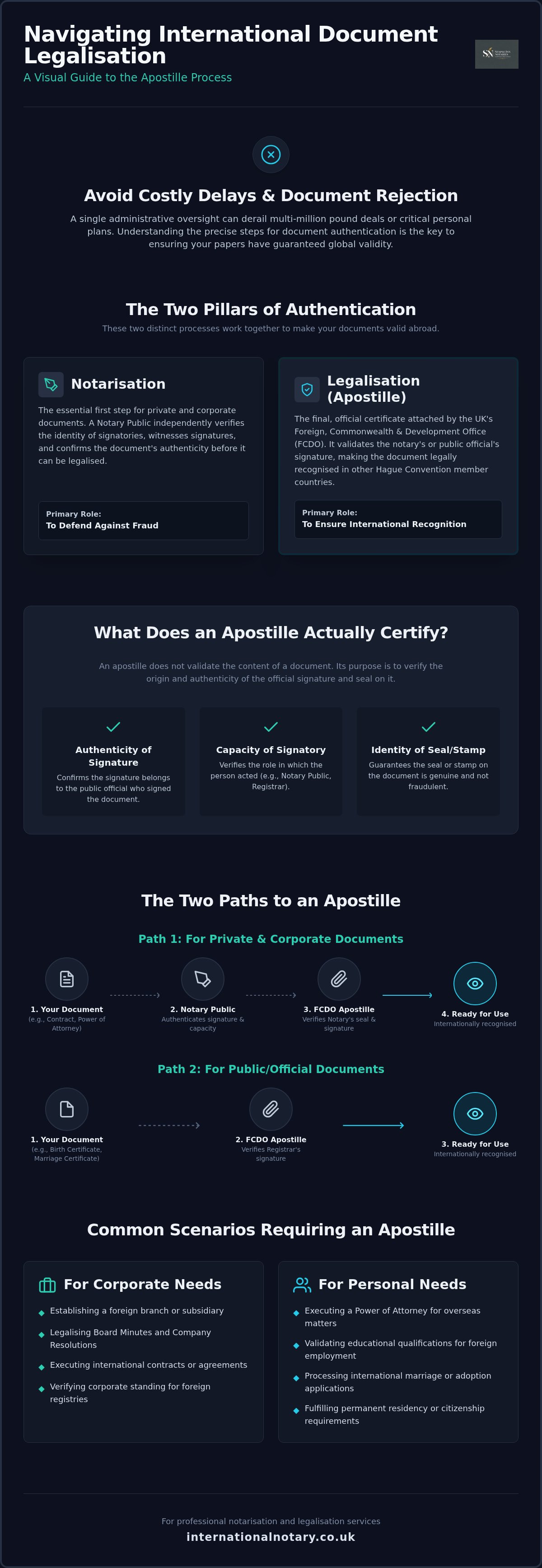
An apostille does not validate the truth of a document's contents. Instead, it serves as a rigorous verification of the procedural origin. It confirms the following elements to foreign authorities:
The authenticity of the signature belonging to the public official who signed the document.
The capacity in which that person acted, such as a Notary Public or a Registrar.
The identity of the seal or stamp affixed to the document to prevent fraudulent replication.
This verification provides the necessary security for foreign jurisdictions to accept British papers as legitimate. Without this certificate, your documents lack the legal standing required for cross-border recognition. It's the final layer of official trust that bridges the gap between different legal systems. For those managing complex portfolios, this certification is the definitive proof of authenticity required by foreign courts and registries.
When is a Central London Apostille Required?
The requirement for an apostille typically arises during significant life events or high-value commercial expansions. For corporate entities, establishing a foreign branch requires the legalisation of Board Minutes and Company Resolutions to prove corporate standing. Private individuals often require an Apostille Central London for the following scenarios:
Executing a Power of Attorney for overseas property transactions or inheritance matters.
Validating educational qualifications for international employment or professional registration.
Processing international marriage, adoption, or permanent residency applications.
Speed is often the defining factor in these situations. Missing a deadline for a property completion or a company registration due to a rejected document can have severe financial consequences. We provide the technical precision needed to ensure your documents are accepted the first time, every time. This proactive approach eliminates the anxiety associated with international bureaucracy and facilitates seamless global mobility. For more details on how we manage these requirements, visit our Apostille and Legalisation Services page.
The Critical Role of a Notary Public in Legalisation
While public documents such as birth or marriage certificates are issued by state registrars and may be submitted directly for authentication, private documents require a preliminary step. For business papers, contracts, or personal declarations, the FCDO will only issue an Apostille Central London once the document has been authenticated by a Notary Public. This requirement exists because the FCDO doesn't verify the content of your private agreements; instead, they verify the signature and seal of the notary who has already performed the rigorous task of identity and authority verification. Staple Inn Notaries provides this essential layer of professional scrutiny, ensuring that every signature is genuine and every signatory has the legal capacity to bind their organisation.
This process serves as a primary defence against international fraud. By meticulously checking identification and witnessing signatures, a notary provides the foreign authority with the assurance that the document is legitimate. This professional intervention reduces the risk of document rejection at later stages of the legalisation chain. If you require urgent assistance with these requirements, our team can guide you through the notarisation process to ensure your papers are ready for the FCDO.
Preparing Private Documents for the Apostille
The preparation of private documents, such as a Power of Attorney for use in Spain or Dubai, requires more than a simple signature. Similarly, if your documents are destined for use in Israel, you can learn more about Salior Ben Hamou Law Office for expert legal assistance in that jurisdiction. We ensure that the document's format complies with both UK law and the specific requirements of the destination jurisdiction. For individuals needing passport or ID certification, we offer a service to certify your identification whilst you wait at our Central London office. This efficiency is underpinned by our standing on the FCDO’s official register of authorised signatories, which is a mandatory requirement for any document intended for an Apostille Central London.
A frequent cause of procedural delay is the submission of incorrectly certified copies. If a document isn't certified in the exact manner prescribed by the FCDO, it will be rejected, resulting in lost time and additional fees. Another common error involves using solicitors for international papers; whilst solicitors have certain domestic powers, many foreign jurisdictions specifically demand the seal of a Notary Public. A Notary Public regulated by the Faculty Office of the Archbishop of Canterbury represents the gold standard for London legalisation, providing the highest level of international assurance and regulatory compliance.
Navigating Express vs Standard Apostille Services
Choosing the correct legalisation route is a strategic decision based on your specific deadline and document type. The FCDO provides a standard postal service, but for those requiring an Apostille Central London, professional intermediaries offer premium business routes that circumvent the standard queue. Our location in Staple Inn, situated at the heart of the legal district, provides an unparalleled logistical advantage. We facilitate hand-delivery to the Legalisation Office, ensuring your documents aren't lost in the postal system. This proximity allows us to monitor processing times in real-time, providing a level of responsiveness that remote services cannot match.
Standard Processing via the Legalisation Office
The standard FCDO postal service is typically suited for non-urgent personal documents where time is not a critical factor. Current 2026 processing times for this route can vary significantly, often taking between 10 to 15 working days depending on seasonal demand and government volume. Whilst this is cost-effective, it lacks the oversight required for high-stakes transactions. For a deeper dive into these procedures, consult our Apostille Services London: The Professional Guide. We always recommend using secure, tracked couriers for the transit of original certificates to mitigate the risk of loss; replacing government-issued documents can take months.
Urgent and Same-Day Requirements for Business
Corporate clients often operate under intense pressure, where a delay of 24 hours can jeopardise a cross-border acquisition. As an "Expert Fixer", we prioritise these time-critical corporate deadlines by utilising the FCDO's premium business service. This route allows for significantly accelerated turnaround times, often reducing the process to a single working day. Our mobile notary services further accelerate this by visiting your boardroom to notarise Company Resolutions or Powers of Attorney on-site. This eliminates the transit time between your office and our chambers, allowing the legalisation process to begin immediately. For jurisdictions not party to the Hague Convention, we also manage the additional layer of embassy attestation, ensuring your documents remain valid in countries like China or the UAE.
By 2026, the e-Apostille has become a standard tool for digital legalisation. While efficient, it's only appropriate for documents that can be digitally verified by the FCDO. We assess your specific paperwork to determine if a digital or physical Apostille Central London is the most secure and accepted option for your destination country. If you're unsure which path fits your needs, contact us for a direct assessment of your document's eligibility for express processing.
Essential Requirements for Corporate and Private Documents
Precision in document preparation is the single most important factor in avoiding FCDO rejection. While digital signatures have gained traction in domestic law, many foreign jurisdictions and the FCDO itself often still require "wet-ink" signatures for certain high-stakes legal papers. This physical signature provides a verifiable chain of authenticity that digital counterparts sometimes struggle to replicate in a cross-border context. Ensuring your documents meet these exacting standards is the first step toward securing a successful Apostille Central London. Our team meticulously reviews every page to ensure compliance with current 2026 regulations before the legalisation process begins.
Corporate Document Legalisation Standards
Corporate entities frequently require the legalisation of a Certificate of Incorporation to facilitate foreign banking or the establishment of overseas subsidiaries. For international mergers, the notarisation of board minutes and company resolutions is mandatory to prove the authority of the individuals signing the contracts. These documents must be current; foreign authorities often reject papers that are more than three months old. If you are managing complex corporate structures, you may also require a Corporate Power of Attorney Notarisation in London to empower local directors to act on the company's behalf. For businesses expanding specifically from Italy to the United States, consulting an E-2 visa lawyer for Italian investors ensures that your legalised corporate documents align perfectly with US immigration and investment regulations.
Global mobility often hinges on the rapid certification of passports and identification documents for visa applications or professional registrations. Educational records, including degree certificates and transcripts, also require specific verification from the issuing institution before an Apostille Central London can be affixed. For those involved in foreign court proceedings, statutory declarations and affidavits must be drafted and witnessed with absolute procedural accuracy. To secure an apostille on a duplicate document, the notary must certify it as a true copy by confirming they have inspected the original and verified that the reproduction is complete, accurate, and unaltered. This level of detail ensures that your personal papers carry the full weight of legal authority when presented to foreign officials.
Failure to adhere to these specific formatting and certification rules is the primary cause of administrative delays. We act as your technical gatekeepers, identifying potential issues before they lead to a formal rejection by the Legalisation Office. Don't leave your international timelines to chance. To ensure your documents are prepared to the highest professional standard, submit your papers for an expert review today.
Securing Your Apostille with Staple Inn Notaries
Staple Inn Notaries operates as a specialised gatekeeper for international documentation, providing a seamless transition from initial certification to final legalisation. Our location within the historic Staple Inn puts us at the epicentre of London's legal district, allowing for rapid physical transit of papers to the FCDO and foreign missions. By managing both the notarial act and the procurement of an Apostille Central London under one roof, we eliminate the procedural gaps that often lead to delays. This integrated approach is particularly vital for high-net-worth individuals and family offices who demand absolute discretion alongside a rapid, reliable service for complex global portfolios. We don't merely process papers; we act as strategic partners to ensure your international standing remains unimpeachable.
Our comprehensive service extends beyond the Hague Convention requirements. For jurisdictions requiring embassy attestation, we manage the entire chain of authentication, from the Chamber of Commerce to the relevant consulate. This end-to-end management ensures that sensitive legal papers never leave professional hands, maintaining a secure chain of custody throughout the process. Our persona as the "Expert Fixer" is built on this ability to navigate the most demanding administrative landscapes with calm competence and technical precision. We understand the gravity of your deadlines and operate with the controlled urgency required to meet them.
The Seamless Client Experience
Efficiency is the cornerstone of our practice. You won't be passed between administrative departments; instead, you maintain direct communication with the specialist lawyers handling your case. We provide transparent tracking for every document, ensuring you're informed of its status as it moves through the legalisation stages. For those with immediate requirements, you can book your notary appointment online to secure a priority slot. Our mobile notary services also remain available for clients in Central London who require on-site verification at their private residence or corporate headquarters. This flexibility is essential for maintaining momentum in fast-paced international business environments.
Contact Staple Inn Notaries Today
Our chambers are situated at the heart of the capital’s legal infrastructure, providing the professional authority required for sensitive international matters. To begin the process, we require an initial review of your documents to ensure they meet the specific standards of the destination country. Whether you're finalising a foreign property purchase or certifying a company resolution, we provide the technical expertise to guarantee international validity. Take the first step toward securing your documentation today. Contact Staple Inn Notaries for Apostille Services in Central London to receive a bespoke assessment of your legalisation needs. Don't let administrative friction delay your global objectives.
Advancing Your Global Interests with Certified Precision
Successfully navigating the complexities of international document legalisation requires more than just administrative compliance; it demands a strategic approach to authentication. You've seen how the distinction between notarisation and the final FCDO certificate is critical for private papers, and how the proximity of our Staple Inn chambers allows for the rapid processing of an Apostille Central London. By prioritising technical accuracy and leveraging premium business routes, you can bypass standard postal delays and ensure your corporate or personal documents are accepted by foreign authorities without hesitation.
Staple Inn Notaries provides the high-level professional authority required for these sensitive matters. Regulated by the Faculty Office of the Archbishop of Canterbury, we offer a specialist mobile notary service across the capital to accommodate your schedule. Our deep expertise in international legalisation ensures that every seal and signature meets the most rigorous global standards. Don't let bureaucratic friction stall your international progress. Secure your Apostille in Central London today and move forward with absolute confidence in your documentation's validity.
Frequently Asked Questions
What is the difference between notarisation and an apostille?
Notarisation is the act of a Notary Public verifying the identity and capacity of a signatory, while an apostille is a government-issued certificate from the FCDO confirming the notary's own signature and seal. Notarisation validates the document's origin at a professional level; the apostille provides the final layer of state-level legalisation required for international recognition. Most private documents require notarisation before the FCDO will issue an Apostille Central London.
How long does it take to get an apostille in Central London?
Standard postal processing via the FCDO typically takes between 10 to 15 working days during peak 2026 periods. However, by utilising our premium business-to-business routes, we can often secure legalisation within 24 to 48 hours. Our proximity to the Legalisation Office allows for hand-delivery, which significantly reduces the transit times associated with standard mail. We monitor current government throughput daily to provide accurate estimates for your specific deadlines.
Can I get an apostille on a copy of my passport?
Yes, you can obtain an apostille on a passport copy, provided it has been certified as a true copy by a registered Notary Public. The FCDO won't apostille a photocopy without this professional certification. We inspect your original document and affix our notarial seal to a high-quality reproduction, which then becomes eligible for an Apostille Central London. This is a standard requirement for international visa applications and foreign bank account openings.
Do I need to attend the notary office in person for an apostille?
Physical attendance is generally required if we're notarising your signature on a document, such as a Power of Attorney. However, if you only require the legalisation of a pre-existing public document or a certified copy of your ID, you can often send the original to us via secure courier. For corporate clients requiring signature witnessing, our mobile notary services can attend your offices across Central London to facilitate the process without disruption.
Is an e-Apostille accepted in all countries?
No, the e-Apostille isn't universally accepted, although its adoption amongst Hague Convention members has increased significantly through 2026. Acceptance depends entirely on the receiving authority in the destination country. Some jurisdictions still demand a physical "wet-ink" signature and an embossed seal. We assess your specific destination and document type to advise whether a digital or paper-based legalisation route is the most secure and appropriate option for your needs.
What happens if my document is for a country not in the Hague Convention?
Documents intended for non-Hague countries require a multi-stage process known as embassy attestation. After the initial notarisation and FCDO legalisation, the document must be presented to the consulate or embassy of the destination country for final verification. This process is common for nations such as the UAE or China. We manage this entire chain of authentication, navigating the specific procedural requirements and varying timelines of different foreign missions on your behalf.
Can Staple Inn Notaries handle the entire legalisation process for me?
Yes, we provide a comprehensive end-to-end service that manages every stage of the legalisation chain. This includes the initial notarisation, submission to the FCDO for the apostille, and any subsequent embassy attestation if required. By centralising these tasks with a single professional firm, you eliminate the risk of administrative errors and ensure a faster turnaround. We act as your primary point of contact, providing regular updates throughout the entire process.
How much does a same-day apostille service in London cost?
The cost of an Apostille Central London varies based on the level of urgency and whether additional embassy attestation is required. Fees generally include the FCDO’s own disbursements and our professional handling charges for premium submission. We provide transparent, fixed-fee quotes once we've reviewed your specific document requirements. It's important to note that government fees are subject to periodic adjustment; we always confirm the current rates before proceeding with your instruction.



Comments